 Add to Chrome
 Add to Firefox
 Add to Edge
TopoTuner: Topological Finetuning of Large Language Models
Jul 18, 2026
Full fine-tuning remains a strong way to adapt pretrained LLMs, but it updates all weights and can be expensive. LoRA reduces the number of trainable parameters, but it does not directly answer which pretrained components should be trained and which can be frozen during adaptation. We introduce TopoTuner, a topology-guided fine-tuning framework for selective freezing of attention projection matrices. \method treats each projection matrix as a row cloud and uses Wasserstein distances between persistence diagrams to measure how its topology changes during fine-tuning. TopoTuner learns a reusable freezing profile from a source dataset and transfers it to efficiently fine-tune models on out-of-domain datasets, evaluating whether task-specific topological drift generalizes across question answering and sentiment analysis tasks. Across LLaMA-3.1-8B, Mistral-7B-v0.3, and Qwen3-8B-Base, TopoTuner is competitive with full fine-tuning while training only 1-2\% of the model parameters, and outperforms LoRA in 7 out of 9 model-dataset settings, which can change up to 39.57\% of the projection parameters. Along with minimized updates, TopoTuner reduces training time by 20.4\% relative to full fine-tuning and 5.5\% relative to LoRA on average. TopoTuner opens a new direction for reusable freezing profiles, where fine-tuning behavior learned on one dataset can be shared across multiple tasks.

Exploring LLMs for South Asian Music Understanding and Generation
Jun 03, 2026Recent advancements in Large Language Models (LLMs) have shown promising results in music understanding and generation tasks. However, existing works remain confined to Western tonal traditions, offering little insight into whether current LLMs can handle structurally distinct low-resource musical traditions. We present the first systematic evaluation of LLM competence in South Asian classical music, a tradition governed by raga, tala-based melodic constraints that impose fundamentally different structural principles from Western harmony-driven music. We ground our evaluation in Hindustani classical theory and Bengali classical forms, including Rabindra and Nazrul Sangeet -- representative low-resource traditions within South Asian classical music. For music understanding evaluation, we introduce a 504-question-answer benchmark spanning raga grammar, cultural knowledge, and symbolic notation reasoning, evaluating 33 LLMs where frontier models such as Gemini 2.5 Pro achieve 85-90% accuracy, while most open-source models remain in the 23-40% range. For music generation, we design a five-level controlled prompting framework and find that even the strongest model produces stylistically faithful outputs only 40% of the time. These results reveal that structural validity and stylistic faithfulness in music generation are distinct objectives and highlight an open challenge for culturally grounded music modeling.
OmniToM: Benchmarking Theory of Mind in LLMs via Explicit Belief Modeling
May 25, 2026Theory of Mind (ToM), the ability to infer others' knowledge, intentions, and emotions, is commonly evaluated in large language models (LLMs) using end-point question answering, where performance is judged solely by the final answer to a social reasoning query. This paradigm obscures whether the model actually constructs the underlying mental-state representations required for robust reasoning, particularly in scenarios involving divergent, evolving, or mistaken beliefs. In order to address this research gap, we introduce OmniToM, a benchmark that directly evaluates these representations by requiring explicit modeling of belief structures for all relevant actors within a narrative. These structures are composed of belief propositions: minimal statements of what an actor takes to be true about the world or another actor's mental state, allowing knowledge, intentions, emotions, and false beliefs to be analyzed in a common format. Models are evaluated in two stages: Stage 1: Belief Extraction, which extracts from the story the beliefs relevant to its social dynamics, and Stage 2: Belief Labeling, which assigns each belief a seven-dimensional schema label covering recursive order, truth status, knowledge access, explicitness, content type, mental source, and context. Built from 895 stories from the existing ToMBench story corpus and augmented with 22,343 labeled belief propositions, OmniToM uses a human-calibrated LLM-assisted annotation pipeline. Across diverse models in zero-shot evaluation, OmniToM reveals an actor-specific belief-tracking bottleneck: current LLMs struggle with the knowledge-access and representational decisions required to transform narrative facts into actors' beliefs and shared mental states.
The Path Not Taken: Duality in Reasoning about Program Execution
Apr 22, 2026Large language models (LLMs) have shown remarkable capabilities across diverse coding tasks. However, their adoption requires a true understanding of program execution rather than relying on surface-level patterns. Existing benchmarks primarily focus on predicting program properties tied to specific inputs (e.g., code coverage, program outputs). As a result, they provide a narrow view of dynamic code reasoning and are prone to data contamination. We argue that understanding program execution requires evaluating its inherent duality through two complementary reasoning tasks: (i) predicting a program's observed behavior for a given input, and (ii) inferring how the input must be mutated toward a specific behavioral objective. Both tasks jointly probe a model's causal understanding of execution flow. We instantiate this duality in DexBench, a benchmark comprising 445 paired instances, and evaluate 13 LLMs. Our results demonstrate that dual-path reasoning provides a robust and discriminative proxy for dynamic code understanding.
FinTradeBench: A Financial Reasoning Benchmark for LLMs
Mar 19, 2026Real-world financial decision-making is a challenging problem that requires reasoning over heterogeneous signals, including company fundamentals derived from regulatory filings and trading signals computed from price dynamics. Recently, with the advancement of Large Language Models (LLMs), financial analysts have begun to use them for financial decision-making tasks. However, existing financial question answering benchmarks for testing these models primarily focus on company balance sheet data and rarely evaluate reasoning over how company stocks trade in the market or their interactions with fundamentals. To take advantage of the strengths of both approaches, we introduce FinTradeBench, a benchmark for evaluating financial reasoning that integrates company fundamentals and trading signals. FinTradeBench contains 1,400 questions grounded in NASDAQ-100 companies over a ten-year historical window. The benchmark is organized into three reasoning categories: fundamentals-focused, trading-signal-focused, and hybrid questions requiring cross-signal reasoning. To ensure reliability at scale, we adopt a calibration-then-scaling framework that combines expert seed questions, multi-model response generation, intra-model self-filtering, numerical auditing, and human-LLM judge alignment. We evaluate 14 LLMs under zero-shot prompting and retrieval-augmented settings and witness a clear performance gap. Retrieval substantially improves reasoning over textual fundamentals, but provides limited benefit for trading-signal reasoning. These findings highlight fundamental challenges in the numerical and time-series reasoning for current LLMs and motivate future research in financial intelligence.
The Critical Role of Aspects in Measuring Document Similarity
Jan 06, 2026We introduce ASPECTSIM, a simple and interpretable framework that requires conditioning document similarity on an explicitly specified aspect, which is different from the traditional holistic approach in measuring document similarity. Experimenting with a newly constructed benchmark of 26K aspect-document pairs, we found that ASPECTSIM, when implemented with direct GPT-4o prompting, achieves substantially higher human-machine agreement ($\approx$80% higher) than the same for holistic similarity without explicit aspects. These findings underscore the importance of explicitly accounting for aspects when measuring document similarity and highlight the need to revise standard practice. Next, we conducted a large-scale meta-evaluation using 16 smaller open-source LLMs and 9 embedding models with a focus on making ASPECTSIM accessible and reproducible. While directly prompting LLMs to produce ASPECTSIM scores turned out be ineffective (20-30% human-machine agreement), a simple two-stage refinement improved their agreement by $\approx$140%. Nevertheless, agreement remains well below that of GPT-4o-based models, indicating that smaller open-source LLMs still lag behind large proprietary models in capturing aspect-conditioned similarity.
Large Language Models for IT Automation Tasks: Are We There Yet?
May 26, 2025LLMs show promise in code generation, yet their effectiveness for IT automation tasks, particularly for tools like Ansible, remains understudied. Existing benchmarks rely primarily on synthetic tasks that fail to capture the needs of practitioners who use IT automation tools, such as Ansible. We present ITAB (IT Automation Task Benchmark), a benchmark of 126 diverse tasks (e.g., configuring servers, managing files) where each task accounts for state reconciliation: a property unique to IT automation tools. ITAB evaluates LLMs' ability to generate functional Ansible automation scripts via dynamic execution in controlled environments. We evaluate 14 open-source LLMs, none of which accomplish pass@10 at a rate beyond 12%. To explain these low scores, we analyze 1,411 execution failures across the evaluated LLMs and identify two main categories of prevalent semantic errors: failures in state reconciliation related reasoning (44.87% combined from variable (11.43%), host (11.84%), path(11.63%), and template (9.97%) issues) and deficiencies in module-specific execution knowledge (24.37% combined from Attribute and parameter (14.44%) and module (9.93%) errors). Our findings reveal key limitations in open-source LLMs' ability to track state changes and apply specialized module knowledge, indicating that reliable IT automation will require major advances in state reasoning and domain-specific execution understanding.
Multi-Party Conversational Agents: A Survey
May 24, 2025Multi-party Conversational Agents (MPCAs) are systems designed to engage in dialogue with more than two participants simultaneously. Unlike traditional two-party agents, designing MPCAs faces additional challenges due to the need to interpret both utterance semantics and social dynamics. This survey explores recent progress in MPCAs by addressing three key questions: 1) Can agents model each participants' mental states? (State of Mind Modeling); 2) Can they properly understand the dialogue content? (Semantic Understanding); and 3) Can they reason about and predict future conversation flow? (Agent Action Modeling). We review methods ranging from classical machine learning to Large Language Models (LLMs) and multi-modal systems. Our analysis underscores Theory of Mind (ToM) as essential for building intelligent MPCAs and highlights multi-modal understanding as a promising yet underexplored direction. Finally, this survey offers guidance to future researchers on developing more capable MPCAs.
LLM for Comparative Narrative Analysis
Apr 11, 2025In this paper, we conducted a Multi-Perspective Comparative Narrative Analysis (CNA) on three prominent LLMs: GPT-3.5, PaLM2, and Llama2. We applied identical prompts and evaluated their outputs on specific tasks, ensuring an equitable and unbiased comparison between various LLMs. Our study revealed that the three LLMs generated divergent responses to the same prompt, indicating notable discrepancies in their ability to comprehend and analyze the given task. Human evaluation was used as the gold standard, evaluating four perspectives to analyze differences in LLM performance.
Zero-Shot Multi-Label Classification of Bangla Documents: Large Decoders Vs. Classic Encoders
Mar 04, 2025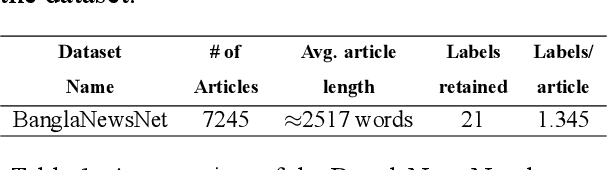
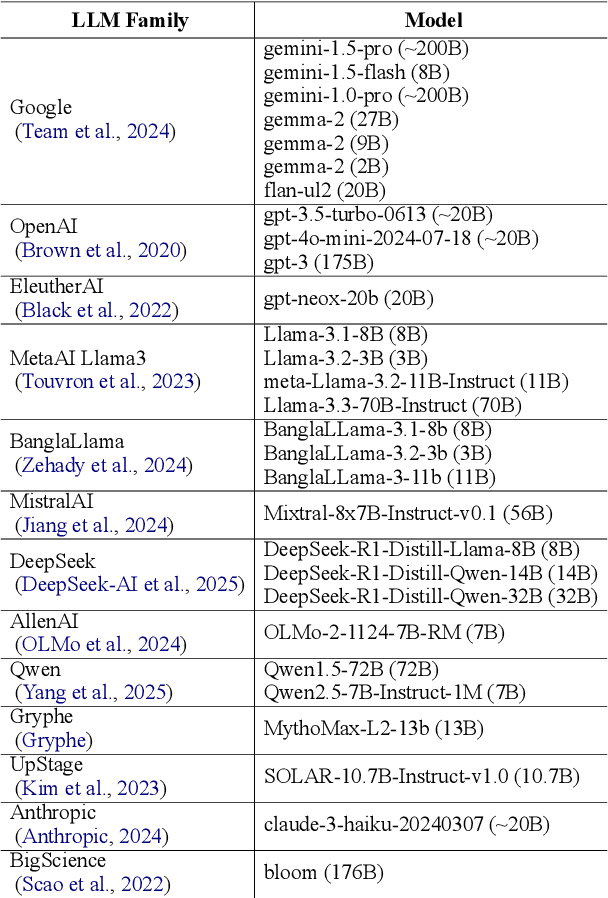

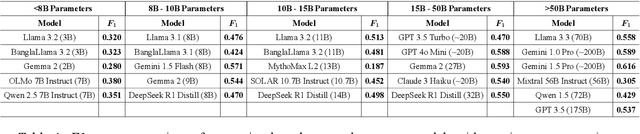
Bangla, a language spoken by over 300 million native speakers and ranked as the sixth most spoken language worldwide, presents unique challenges in natural language processing (NLP) due to its complex morphological characteristics and limited resources. While recent Large Decoder Based models (LLMs), such as GPT, LLaMA, and DeepSeek, have demonstrated excellent performance across many NLP tasks, their effectiveness in Bangla remains largely unexplored. In this paper, we establish the first benchmark comparing decoder-based LLMs with classic encoder-based models for Zero-Shot Multi-Label Classification (Zero-Shot-MLC) task in Bangla. Our evaluation of 32 state-of-the-art models reveals that, existing so-called powerful encoders and decoders still struggle to achieve high accuracy on the Bangla Zero-Shot-MLC task, suggesting a need for more research and resources for Bangla NLP.