 Add to Chrome
 Add to Firefox
 Add to Edge
Are LLMs Ready to Replace Bangla Annotators?
Feb 19, 2026
Large Language Models (LLMs) are increasingly used as automated annotators to scale dataset creation, yet their reliability as unbiased annotators--especially for low-resource and identity-sensitive settings--remains poorly understood. In this work, we study the behavior of LLMs as zero-shot annotators for Bangla hate speech, a task where even human agreement is challenging, and annotator bias can have serious downstream consequences. We conduct a systematic benchmark of 17 LLMs using a unified evaluation framework. Our analysis uncovers annotator bias and substantial instability in model judgments. Surprisingly, increased model scale does not guarantee improved annotation quality--smaller, more task-aligned models frequently exhibit more consistent behavior than their larger counterparts. These results highlight important limitations of current LLMs for sensitive annotation tasks in low-resource languages and underscore the need for careful evaluation before deployment.

BETA-Labeling for Multilingual Dataset Construction in Low-Resource IR
Feb 16, 2026IR in low-resource languages remains limited by the scarcity of high-quality, task-specific annotated datasets. Manual annotation is expensive and difficult to scale, while using large language models (LLMs) as automated annotators introduces concerns about label reliability, bias, and evaluation validity. This work presents a Bangla IR dataset constructed using a BETA-labeling framework involving multiple LLM annotators from diverse model families. The framework incorporates contextual alignment, consistency checks, and majority agreement, followed by human evaluation to verify label quality. Beyond dataset creation, we examine whether IR datasets from other low-resource languages can be effectively reused through one-hop machine translation. Using LLM-based translation across multiple language pairs, we experimented on meaning preservation and task validity between source and translated datasets. Our experiment reveal substantial variation across languages, reflecting language-dependent biases and inconsistent semantic preservation that directly affect the reliability of cross-lingual dataset reuse. Overall, this study highlights both the potential and limitations of LLM-assisted dataset creation for low-resource IR. It provides empirical evidence of the risks associated with cross-lingual dataset reuse and offers practical guidance for constructing more reliable benchmarks and evaluation pipelines in low-resource language settings.
DL$^3$M: A Vision-to-Language Framework for Expert-Level Medical Reasoning through Deep Learning and Large Language Models
Dec 14, 2025Medical image classifiers detect gastrointestinal diseases well, but they do not explain their decisions. Large language models can generate clinical text, yet they struggle with visual reasoning and often produce unstable or incorrect explanations. This leaves a gap between what a model sees and the type of reasoning a clinician expects. We introduce a framework that links image classification with structured clinical reasoning. A new hybrid model, MobileCoAtNet, is designed for endoscopic images and achieves high accuracy across eight stomach-related classes. Its outputs are then used to drive reasoning by several LLMs. To judge this reasoning, we build two expert-verified benchmarks covering causes, symptoms, treatment, lifestyle, and follow-up care. Thirty-two LLMs are evaluated against these gold standards. Strong classification improves the quality of their explanations, but none of the models reach human-level stability. Even the best LLMs change their reasoning when prompts vary. Our study shows that combining DL with LLMs can produce useful clinical narratives, but current LLMs remain unreliable for high-stakes medical decisions. The framework provides a clearer view of their limits and a path for building safer reasoning systems. The complete source code and datasets used in this study are available at https://github.com/souravbasakshuvo/DL3M.
Investigating Hallucination in Conversations for Low Resource Languages
Jul 30, 2025Large Language Models (LLMs) have demonstrated remarkable proficiency in generating text that closely resemble human writing. However, they often generate factually incorrect statements, a problem typically referred to as 'hallucination'. Addressing hallucination is crucial for enhancing the reliability and effectiveness of LLMs. While much research has focused on hallucinations in English, our study extends this investigation to conversational data in three languages: Hindi, Farsi, and Mandarin. We offer a comprehensive analysis of a dataset to examine both factual and linguistic errors in these languages for GPT-3.5, GPT-4o, Llama-3.1, Gemma-2.0, DeepSeek-R1 and Qwen-3. We found that LLMs produce very few hallucinated responses in Mandarin but generate a significantly higher number of hallucinations in Hindi and Farsi.
Zero-Shot Multi-Label Classification of Bangla Documents: Large Decoders Vs. Classic Encoders
Mar 04, 2025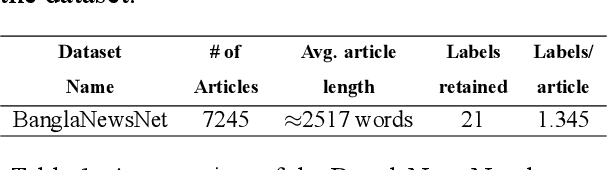
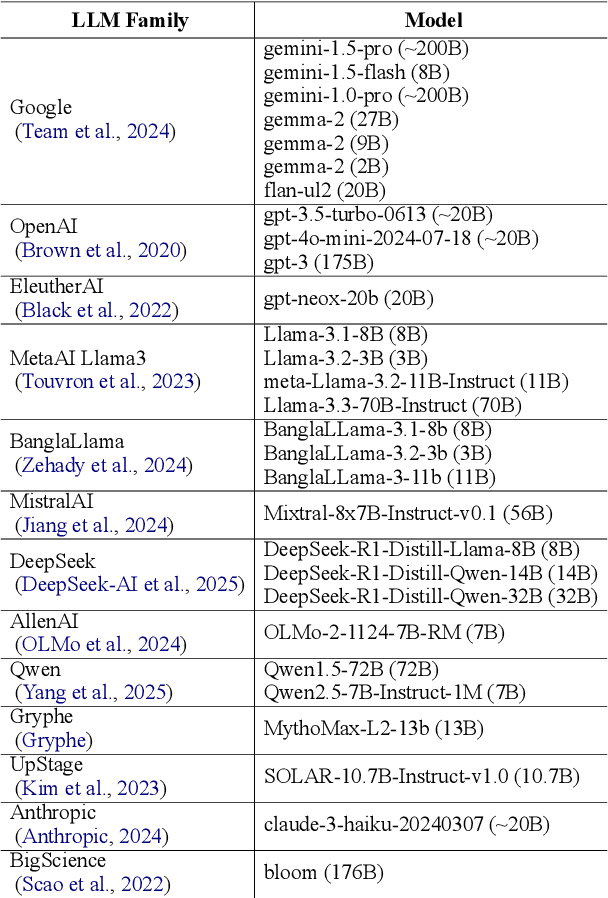

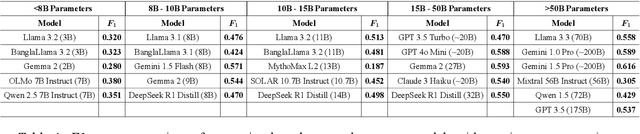
Bangla, a language spoken by over 300 million native speakers and ranked as the sixth most spoken language worldwide, presents unique challenges in natural language processing (NLP) due to its complex morphological characteristics and limited resources. While recent Large Decoder Based models (LLMs), such as GPT, LLaMA, and DeepSeek, have demonstrated excellent performance across many NLP tasks, their effectiveness in Bangla remains largely unexplored. In this paper, we establish the first benchmark comparing decoder-based LLMs with classic encoder-based models for Zero-Shot Multi-Label Classification (Zero-Shot-MLC) task in Bangla. Our evaluation of 32 state-of-the-art models reveals that, existing so-called powerful encoders and decoders still struggle to achieve high accuracy on the Bangla Zero-Shot-MLC task, suggesting a need for more research and resources for Bangla NLP.