 Add to Chrome
 Add to Firefox
 Add to Edge
TopoTuner: Topological Finetuning of Large Language Models
Jul 18, 2026
Full fine-tuning remains a strong way to adapt pretrained LLMs, but it updates all weights and can be expensive. LoRA reduces the number of trainable parameters, but it does not directly answer which pretrained components should be trained and which can be frozen during adaptation. We introduce TopoTuner, a topology-guided fine-tuning framework for selective freezing of attention projection matrices. \method treats each projection matrix as a row cloud and uses Wasserstein distances between persistence diagrams to measure how its topology changes during fine-tuning. TopoTuner learns a reusable freezing profile from a source dataset and transfers it to efficiently fine-tune models on out-of-domain datasets, evaluating whether task-specific topological drift generalizes across question answering and sentiment analysis tasks. Across LLaMA-3.1-8B, Mistral-7B-v0.3, and Qwen3-8B-Base, TopoTuner is competitive with full fine-tuning while training only 1-2\% of the model parameters, and outperforms LoRA in 7 out of 9 model-dataset settings, which can change up to 39.57\% of the projection parameters. Along with minimized updates, TopoTuner reduces training time by 20.4\% relative to full fine-tuning and 5.5\% relative to LoRA on average. TopoTuner opens a new direction for reusable freezing profiles, where fine-tuning behavior learned on one dataset can be shared across multiple tasks.

The Illusion of Equivalency: Statistical Characterization of Quantization Effects in LLMs
Jul 09, 2026Post-training quantization is widely used to deploy large language models in resource-constrained settings, yet its evaluation relies almost exclusively on accuracy and perplexity. We show that these metrics fail to capture behavioral changes induced by quantization. We introduce correctness agreement, a decision-level metric that measures overlap in correct predictions between a base model and its quantized variants, independent of absolute accuracy. Across multiple models and quantization schemes from 8-bit to 2-bit, we find that behavioral divergence emerges under moderate quantization even when task performance appears preserved. To explain this effect, we analyze quantization as a structural operator on attention weights and quantify layer-wise distortions using statistical and distributional measures. Our results reveal non-linear breakpoints at low bit-widths and show that query and key projections are consistently more sensitive than value and output projections. These findings expose an illusion of equivalence between base and quantized models and motivate behavioral evaluation beyond conventional performance metrics.
SoK: Prompt Hacking of Large Language Models
Oct 16, 2024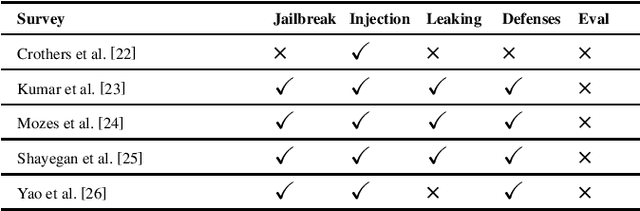



The safety and robustness of large language models (LLMs) based applications remain critical challenges in artificial intelligence. Among the key threats to these applications are prompt hacking attacks, which can significantly undermine the security and reliability of LLM-based systems. In this work, we offer a comprehensive and systematic overview of three distinct types of prompt hacking: jailbreaking, leaking, and injection, addressing the nuances that differentiate them despite their overlapping characteristics. To enhance the evaluation of LLM-based applications, we propose a novel framework that categorizes LLM responses into five distinct classes, moving beyond the traditional binary classification. This approach provides more granular insights into the AI's behavior, improving diagnostic precision and enabling more targeted enhancements to the system's safety and robustness.
Hybrid Model For Intrusion Detection Systems
Mar 19, 2020


With the increasing number of new attacks on ever growing network traffic, it is becoming challenging to alert immediately any malicious activities to avoid loss of sensitive data and money. This is making intrusion detection as one of the major areas of concern in network security. Anomaly based network intrusion detection technique is one of the most commonly used technique. Depending upon the dataset used to test those techniques, the accuracy varies. Most of the times this dataset does not represent the real network traffic. Considering this, this project involves analysis of different machine learning algorithms used in intrusion detection systems, when tested upon two datasets which are similar to current real world network traffic(CICIDS2017) and an improvement of KDD 99 (NSL-KDD). After the analysis of different intrusion detection systems on both the datasets, this project aimed to develop a new hybrid model for intrusion detection systems. This new hybrid approach combines decision tree and random forest algorithms using stacking scheme to achieve an accuracy of 85.2% and precision of 86.2% for NSL-KDD dataset, and achieve an accuracy of 98% and precision of 98% for CICIDS2017 dataset.