 Add to Chrome
 Add to Firefox
 Add to Edge
The Path Not Taken: Duality in Reasoning about Program Execution
Apr 22, 2026
Large language models (LLMs) have shown remarkable capabilities across diverse coding tasks. However, their adoption requires a true understanding of program execution rather than relying on surface-level patterns. Existing benchmarks primarily focus on predicting program properties tied to specific inputs (e.g., code coverage, program outputs). As a result, they provide a narrow view of dynamic code reasoning and are prone to data contamination. We argue that understanding program execution requires evaluating its inherent duality through two complementary reasoning tasks: (i) predicting a program's observed behavior for a given input, and (ii) inferring how the input must be mutated toward a specific behavioral objective. Both tasks jointly probe a model's causal understanding of execution flow. We instantiate this duality in DexBench, a benchmark comprising 445 paired instances, and evaluate 13 LLMs. Our results demonstrate that dual-path reasoning provides a robust and discriminative proxy for dynamic code understanding.

Fuzzwise: Intelligent Initial Corpus Generation for Fuzzing
Dec 24, 2025In mutation-based greybox fuzzing, generating high-quality input seeds for the initial corpus is essential for effective fuzzing. Rather than conducting separate phases for generating a large corpus and subsequently minimizing it, we propose FuzzWise which integrates them into one process to generate the optimal initial corpus of seeds (ICS). FuzzWise leverages a multi-agent framework based on Large Language Models (LLMs). The first LLM agent generates test cases for the target program. The second LLM agent, which functions as a predictive code coverage module, assesses whether each generated test case will enhance the overall coverage of the current corpus. The streamlined process allows each newly generated test seed to be immediately evaluated for its contribution to the overall coverage. FuzzWise employs a predictive approach using an LLM and eliminates the need for actual execution, saving computational resources and time, particularly in scenarios where the execution is not desirable or even impossible. Our empirical evaluation demonstrates that FuzzWise generates significantly fewer test cases than baseline methods. Despite the lower number of test cases, FuzzWise achieves high code coverage and triggers more runtime errors compared to the baselines. Moreover, it is more time-efficient and coverage-efficient in producing an initial corpus catching more errors.
Large Language Model Critics for Execution-Free Evaluation of Code Changes
Jan 28, 2025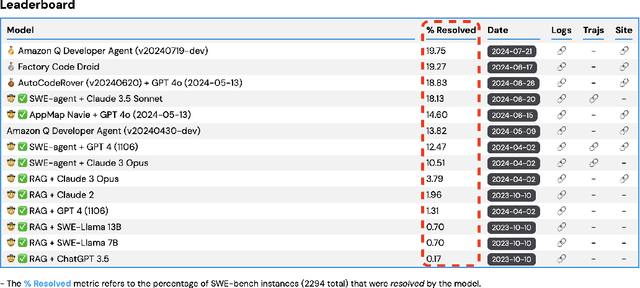
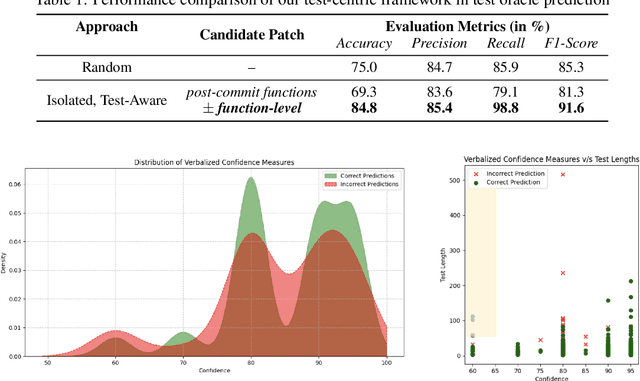
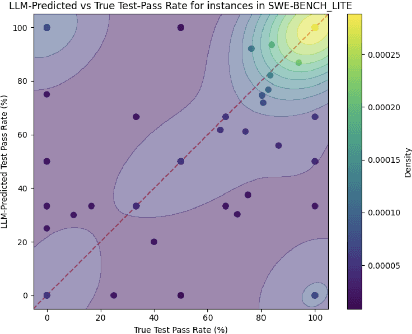
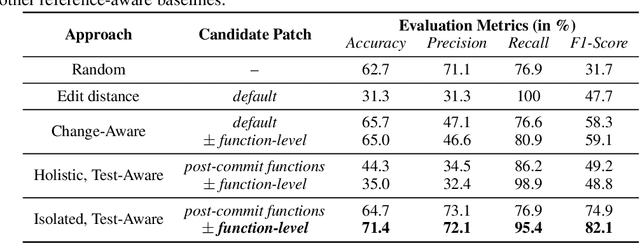
Large language models (LLMs) offer a promising way forward for automating software engineering tasks, such as bug fixes, feature additions, etc., via multi-step LLM-based agentic workflows. However, existing metrics for evaluating such workflows, mainly build status and occasionally log analysis, are too sparse and limited in providing the information needed to assess the quality of changes made. In this work, we designed LLM-based critics to derive well-structured and rigorous intermediate/step-level, execution-free evaluation proxies for repo-level code changes. Importantly, we assume access to the gold test patch for the problem (i.e., reference-aware) to assess both semantics and executability of generated patches. With the gold test patch as a reference, we predict executability of all editing locations with an F1 score of 91.6%, aggregating which, we can predict the build status in 84.8% of the instances in SWE-bench. In particular, such an execution-focused LLM critic outperforms other reference-free and reference-aware LLM critics by 38.9% to 72.5%. Moreover, we demonstrate the usefulness of such a reference-aware framework in comparing patches generated by different agentic workflows. Finally, we open-source the library developed for this project, which allows further usage for either other agentic workflows or other benchmarks. The source code is available at https://github.com/amazon-science/code-agent-eval.