 Add to Chrome
 Add to Firefox
 Add to Edge
MCRB and MSE Analysis for Parameter Estimation in AFDM-ISAC Systems
Jun 24, 2026
Affine frequency division multiplexing (AFDM) is a promising waveform for integrated sensing and communication (ISAC). In AFDM systems, the complex gains, delays, and Doppler shifts are commonly estimated from the AFDM symbols carrying pilots and data simultaneously. In practice, however, the unknown data symbols and data-pilot coupling interference may render the estimator mismatched to the true signal model. In this paper, we systematically characterize the parameter-estimation performance of AFDM-ISAC systems under practical model misspecification. The main contributions are threefold. First, we extend the Cramér-Rao bound (CRB) for a general observation model that treats the data symbols as unknown, which generalizes existing AFDM CRB analyses and serves as the matched benchmark for the subsequent analysis. Second, we identify two practical sources of misspecification, namely a covariance mismatch caused by insufficient pilot-data isolation and a combined covariance-and-mean mismatch caused by sequential single-target estimation, and derive the corresponding misspecified CRB (MCRB). Third, we characterize the pseudotrue parameters under different levels of prior knowledge, analyze the resulting estimation bias, and establish a lower bound (LB) on the mean square error (MSE). Simulation results validate the derived bounds and show that, under model misspecification, the CRB is overly optimistic while the MCRB and LB faithfully characterize the achievable accuracy. The comparison further reveals how these bounds vary with the pilot length and pilot power, providing useful guidance for pilot configuration.

Low-Complexity Hybrid Precoding for Cell-Free Massive MU-MIMO ISAC Systems
Jun 15, 2026Integrated sensing and communication (ISAC) in cell-free (CF) massive multi-user multiple-input multiple-output (MU-MIMO) system is a promising architecture for high-rate communications and high-accuracy multi-target sensing. However, centralized coordination among distributed access points (APs) incurs substantial fronthaul overhead and computation complexity. This paper proposes a low-complexity hybrid precoding framework for CF massive MU-MIMO ISAC systems with partially-connected architectures at the APs. By applying hybrid architecture at the APs, the proposed framework converts the original high-dimensional channel information into a low-dimensional effective channel, enabling digital precoding over the compressed channel domain and thereby substantially reducing both fronthaul overhead and baseband computational complexity. We formulate the joint hybrid precoding design as an ergodic sum-rate (ESR) maximization problem with position error bound (PEB) constraints to ensure multi-target sensing accuracy. An efficient alternating optimization (AO)-based solver is then developed, where the PEB constraint is reformulated into tractable convex constraints, while the digital-domain optimization is carried out over the reduced-dimensional effective channel and the analog precoding is refined on the constant-modulus manifold. For dynamic user topology, we further propose multi-branch (MB) rate-splitting (RS) minimum mean-square-error Tomlinson-Harashima precoding (MMSE-THP) update algorithm that combines multi-branch ordering with recursive MMSE-THP matrix updates, enabling common and private digital precodings to be refreshed without repeated full matrix recomputation. Simulation results demonstrate that the proposed scheme achieves high ESR and accurate multi-target sensing while reducing computational complexity by 87.02\% compared with conventional baselines.
Scalable GNN-Based Power Allocation for Rate-Splitting Cell-Free Massive MIMO Systems
Jun 01, 2026Cell-free massive multiple-input multiple-output (CF-mMIMO) systems provide enhanced coverage and capacity for next-generation wireless networks. However, CF-mMIMO systems face significant challenges in downlink power allocation (PA) due to imperfect channel state information (CSI), severe multi-user interference (MUI), and high computational complexity. To address these issues, rate-splitting multiple access (RSMA) is adopted as a robust interference management strategy. Accordingly, this paper proposes an unsupervised and scalable graph neural network (GNN) framework for PA in rate-splitting CF-mMIMO (RS-CF-mMIMO) systems, relying exclusively on large-scale fading (LSF) coefficients without instantaneous CSI. To resolve the dimensionality mismatch in dynamic networks, we introduce a slice-based adaptive layer that projects variable-dimension features into a fixed latent space. This mechanism enables a unified model to generalize across diverse topologies without retraining. Within this architecture, the sum spectral efficiency (SE) is maximized under per-AP power constraints, assuming maximum-ratio precoding for common streams and regularized zero-forcing precoding for private streams. We also derive a weighted minimum mean-square error-alternating direction method of multipliers (WMMSE-ADMM) algorithm as a performance upper bound. Extensive simulations verify that the proposed GNN framework achieves near-optimal SE and outperforms unsupervised deep neural networks (DNNs) across diverse system sizes and pilot assignment schemes. Furthermore, the scalable variant maintains robust performance while reducing the trainable parameter count by over 57% relative to DNNs and decreasing inference latency by up to three orders of magnitude compared with WMMSE-ADMM.
Enabling Indoor Multi-Person Tracking With 6G mmWave ISAC Systems
May 05, 2026Integrated sensing and communication (ISAC) has emerged as a key technology for 6G wireless networks. In this paper, wireless sensing for the indoor multi-person tracking is explored with 6G mmWave ISAC systems. To limit the sensing overhead, a sparse deployment of sensing reference signals (RS) is applied in the orthogonal frequency-division multiplexing (OFDM) frame, where the channel state information (CSI) at the sensing RS is extracted for the multi-person tracking. To enable a robust tracking of multiple persons in a complex indoor environment, three key mechanisms are proposed: 1) a modified moving target indicator (MTI) scheme is proposed to remove the static environmental clutter under a sparse RS time spacing; 2) an effective target identification mechanism is developed to exclude false target points; 3) the Kalman filter with a penalty association algorithm is designed to associate the detected points with the right tracks, especially handling the crossover case of two tracks. With the above mechanisms, multiple persons can be effectively tracked with an extremely low sensing overhead. An mmWave bistatic ISAC prototype system at 26 GHz with 500 MHz bandwidth has been developed to validate our design, where the overhead of the sensing RS is less than 0.005\%. Experimental results demonstrate that our proposed design achieves a median position error of 12 cm for multi-person tracking with path-crossing in the indoor environment with a single receiver.
Waveform Design for 6G ISAC Systems Under Full-Duplex Residual Self-Interference
May 04, 2026In this paper, the waveform design for 6G integrated sensing and communication (ISAC) systems is investigated, with a particular focus on the practical limitations imposed by imperfect full-duplex radios. Under such imperfections, continuous communication waveforms, such as OFDM, suffer from severe full-duplex residual self-interference (RSI) for radar sensing, which significantly restricts the long-range sensing capabilities required by emerging low-altitude wireless networks (LAWN). To address this challenge, we propose a novel time-division ISAC waveform that integrates a specially developed dual-power phase-coded pulse for sensing into the communication frame under full-duplex RSI. Specifically, the dual-power sensing pulse consists of a high-power sequence followed by a low-power sequence, effectively exploiting imperfect full-duplex operations to achieve reliable long-range sensing while eliminating the detection blind range inherent to conventional half-duplex pulse radars. Furthermore, a complementary and inverse-phase sequence group is designed to ensure perfect autocorrelation and robust cross-correlation sidelobe suppression, so as to enhance multi-target detection capability. As for sensing signal processing, a parameterized mismatched filter is developed and optimized to maximize the detection performance, tailored to the proposed pulse structure. In addition, we design a hierarchical one-dimensional CFAR-CA detector that can exploit the perfect range-domain autocorrelation characteristics of the proposed waveform to further improve the detection performance. Extensive simulations demonstrate that the proposed design significantly improves the maximum detection range and multi-target detection capability compared to existing OFDM and LFM pulse baselines, while effectively covering the blind range for targets with small RCS.
SSB-Based Sensing-Assisted Robust Beamforming for High-Mobility UAV Communications in LAWN
Apr 21, 2026High-mobility uncrewed aerial vehicle (UAV) communications in low-altitude wireless networks (LAWN) demand reliable beamforming, while conventional feedback-based schemes suffer from excessive overhead and severe misalignment under rapid trajectory variations. To address this challenge, this paper proposes an SSB-based sensing-assisted predictive robust beamforming framework that replaces explicit channel state information (CSI) feedback with sensing-driven state estimation and uncertainty-aware optimization. Leveraging the periodic 'always-on' synchronization signal block (SSB), a hierarchical sensing algorithm tailored for hybrid digital-analog uniform planar arrays is developed, combining 2D range-velocity profiling and augmented beamspace multiple signal classification (MUSIC). By integrating a locally-focused analog receive beamformer, the proposed sensing design can ensure energy accumulates across different radio-frequency (RF) chains while resolving angular ambiguity. An extended Kalman filter (EKF) is further employed to track UAV states between sparse synchronization-signal (SS) bursts, and a covariance correction is introduced to characterize maneuver-induced prediction uncertainties. Based on the derived statistical distributions of range and angular parameters, the communication channel is modeled through predictive correlation matrices rather than instantaneous CSI, leading to a multi-user robust beamforming formulation that maximizes average network sum-rate under uncertainty. The resulting nonconvex problem is efficiently solved via successive convex approximation and alternating minimization. Simulation results demonstrate that the proposed framework significantly enhances spectral efficiency and link stability compared with feedback-based beamforming and non-robust beamforming design, particularly in high-mobility and large-SSB-interval scenarios.
Low-Complexity Soft-Feedback Detector for AFDM Systems
Apr 16, 2026Affine frequency division multiplexing (AFDM), an emerging multi-carrier modulation scheme, has garnered significant attention due to its resilience to Doppler shifts and capability to achieve full diversity in doubly dispersive channels. However, existing data detection algorithms for AFDM systems face a significant trade-off between computational complexity and accuracy. In this paper, a novel low-complexity data detection scheme, termed the soft-feedback detector (SFD), is proposed. Particularly, building upon a maximum ratio combining (MRC) estimator framework, the SFD leverages the a priori symbol distribution to mitigate error propagation during iterative detection. Specifically, soft-decision feedback is incorporated as extrinsic information derived from the log-likelihood ratios of the transmitted symbols. As a result, the proposed detector significantly enhances detection accuracy while maintaining low computational complexity. Simulation results demonstrate that the SFD consistently outperforms benchmark decision-feedback detectors. In particular, compared with the conventional MRC detector, the proposed scheme achieves approximately a 3 dB signal-to-noise ratio (SNR) gain at the bit error rate (BER) of $10^{-3}$.
Experiment Study on Reference-Path-Aided System Calibration for mmWave Bistatic ISAC Systems
May 08, 2025Integrated sensing and communications (ISAC) has been regarded as a key enabling technology for next-generation wireless networks. Compared to monostatic ISAC, bistatic ISAC can eliminate the critical challenge of self-interference cancellation and is well compatible with the existing network infrastructures. However, the synchronization between the transmitter and the sensing receiver becomes a crucial problem. The extracted channel state information (CSI) for sensing under communication synchronization contains different types of system errors, such as the sampling time offset (STO), carrier frequency offset (CFO), and random phase shift, which can severely degrade sensing performance or even render sensing infeasible. To address this problem, a reference-path-aided system calibration scheme is designed for mmWave bistatic ISAC systems, where the line-of-sight (LoS) path can be blocked. By exploiting the delay-angle sparsity feature in mmWave ISAC systems, the reference path, which can be either a LoS or a non-LoS (NLoS) path, is first identified. By leveraging the fact that all the paths suffer the same system errors, the channel parameter extracted from the reference path is utilized to compensate for the system errors in all other paths. A mmWave ISAC system is developed to validate our design. Experimental results demonstrate that the proposed scheme can support precise estimation of Doppler shift and delay, maintaining time-synchronization errors within 1 nanosecond.
Sensing-Assisted Channel Estimation for OFDM ISAC Systems: Framework, Algorithm, and Analysis
Feb 23, 2025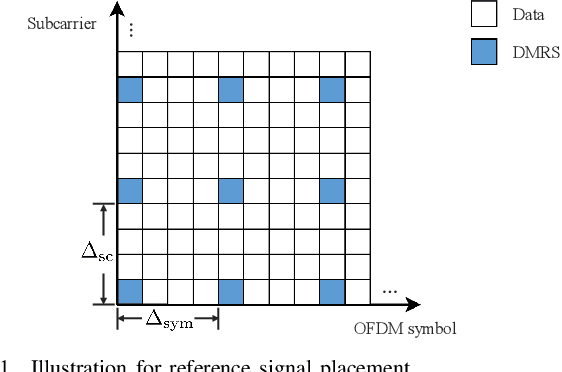
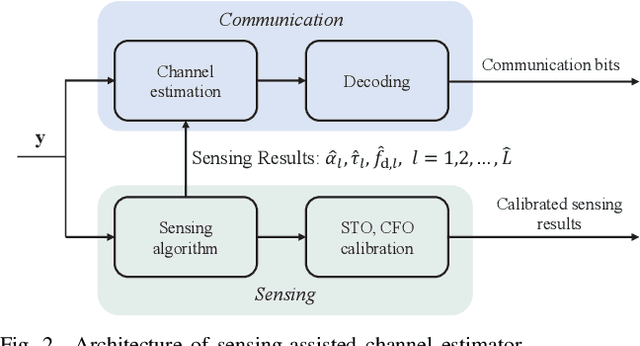
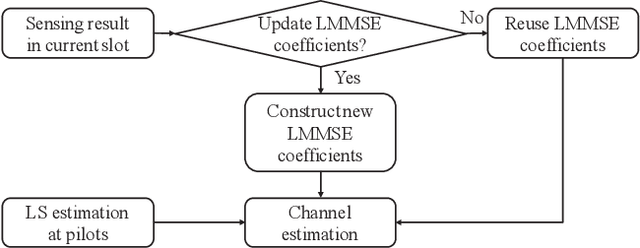
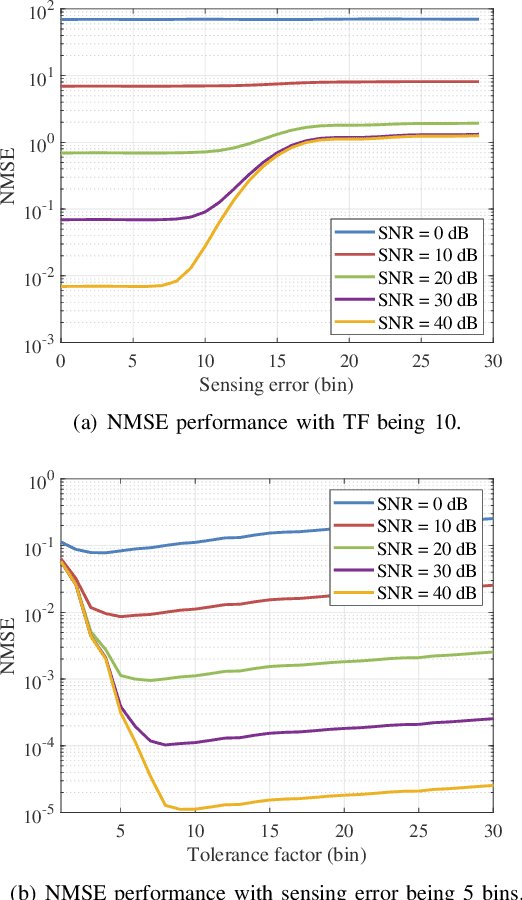
Integrated sensing and communication (ISAC) has garnered significant attention in recent years. In this paper, we delve into the topic of sensing-assisted communication within ISAC systems. More specifically, a novel sensing-assisted channel estimation scheme is proposed for bistatic orthogonal-frequency-division-multiplexing (OFDM) ISAC systems. A framework of sensing-assisted channel estimator is first developed, integrating a tailored low-complexity sensing algorithm to facilitate real-time channel estimation and decoding. To address the potential sensing errors caused by low-complexity sensing algorithms, a sensing-assisted linear minimum mean square error (LMMSE) estimation algorithm is then developed. This algorithm incorporates tolerance factors designed to account for deviations between estimated and true channel parameters, enabling the construction of robust correlation matrices for LMMSE estimation. Additionally, we establish a systematic mechanism for determining these tolerance factors. A comprehensive analysis of the normalized mean square error (NMSE) performance and computational complexity is finally conducted, providing valuable insights into the selection of the estimator's parameters. The effectiveness of our proposed scheme is validated by extensive simulations. Compared to existing methods, our proposed scheme demonstrates superior performance, particularly in high signal-to-noise ratio (SNR) regions or with large bandwidths, while maintaining low computational complexity.
Channel Modeling Framework for Both Communications and Bistatic Sensing Under 3GPP Standard
Aug 21, 2024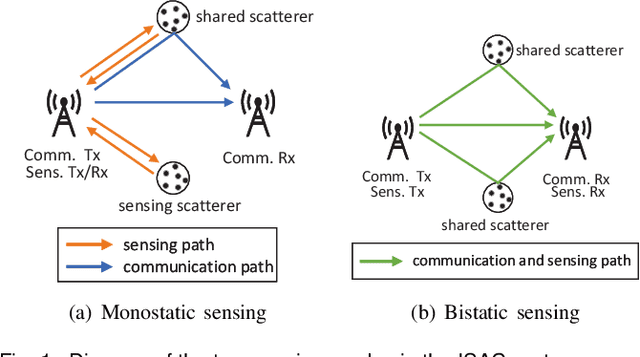
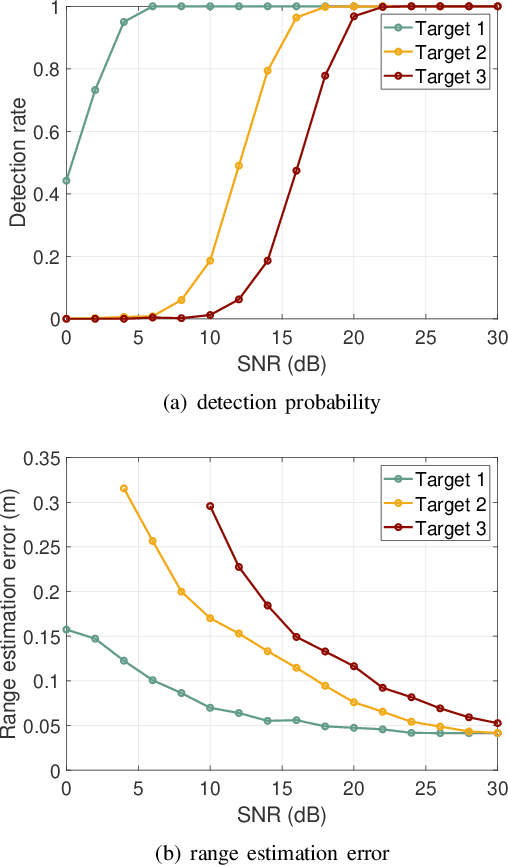
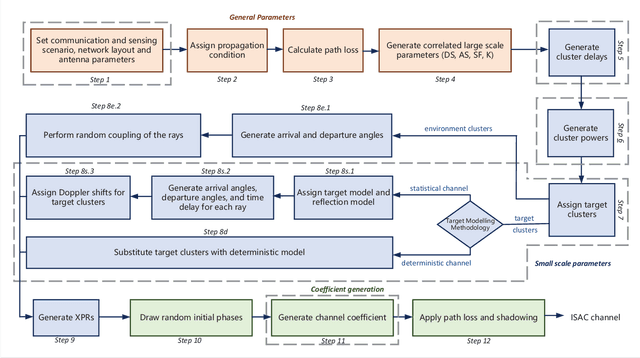
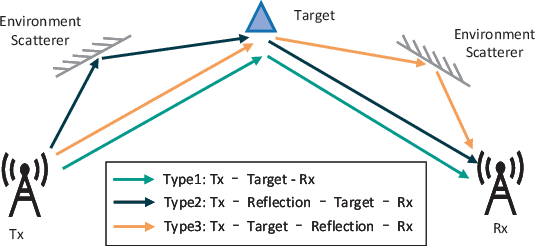
Integrated sensing and communications (ISAC) is considered a promising technology in the B5G/6G networks. The channel model is essential for an ISAC system to evaluate the communication and sensing performance. Most existing channel modeling studies focus on the monostatic ISAC channel. In this paper, the channel modeling framework for bistatic ISAC is considered. The proposed channel modeling framework extends the current 3GPP channel modeling framework and ensures the compatibility with the communication channel model. To support the bistatic sensing function, several key features for sensing are added. First, more clusters with weaker power are generated and retained to characterize the potential sensing targets. Second, the target model can be either deterministic or statistical, based on different sensing scenarios. Furthermore, for the statistical case, different reflection models are employed in the generation of rays, taking into account spatial coherence. The effectiveness of the proposed bistatic ISAC channel model framework is validated by both ray tracing simulations and experiment studies. The compatibility with the 3GPP communication channel model and how to use this framework for sensing evaluation are also demonstrated.