 Add to Chrome
 Add to Firefox
 Add to Edge
Staypoint Detection from Noisy Trajectory Data [Experiment Paper]
Jul 21, 2026
Detecting staypoints from raw trajectory data is fundamental to numerous spatial computing applications. This process transforms raw numeric sequences of geolocations into semantically meaningful locations, such as homes, workplaces, or restaurants. Despite its importance for semantic trajectory analysis, staypoint detection lacks standard benchmarks, and existing algorithms have never been systematically evaluated. This gap persists because no publicly available datasets provide both raw individual trajectories and ground-truth staypoint annotations. This benchmark paper addresses this limitation with two key contributions: (1) we introduce 16 large-scale simulated datasets capturing thousands of agents with annotated staypoints across varying trajectory noise levels, and (2) we evaluate nine staypoint detection algorithms-including both state-of-the-art and novel methods-to analyze their robustness to noise. Our evaluation reveals that existing state-of-the-art algorithms perform poorly under realistic noise conditions. Conversely, our proposed unsupervised methods yield substantial improvements, while supervised approaches drastically outperform existing baselines. While these results are very promising, these datasets and methods are only meant as starting points for future research in staypoint detection.

An Infectious Disease Spread Simulation Based on Large Language Model Decision Making
Jun 04, 2026Modelling individual decision-making during infectious disease outbreaks is crucial for understanding behavioural dynamics and informing effective public health interventions. Prior work has shown that large language models can simulate realistic human behaviour by generating agent decisions based on demographic prompts and situational context. We build on this foundation with a spatially grounded, agent-based simulation framework that integrates LLM-generated decisions about self-reported influenza-like illness into a census-based synthetic population of agents. Location is treated as a central feature: agents are assigned to spatial units within cities, capturing the spatial distributions of different demographic groups using real-world census data and enabling geographically diverse behavioural modelling. We implement and compare three decision scenarios, independent reasoning, household influence, and message framing, and simulate self-reporting outcomes in San Francisco and Atlanta. Results reveal that income and education are the dominant drivers of reporting rate variation, with smaller but consistent effects from geography, LLM model choice, and message framing. Our framework generates synthetic data that captures both social and geographic heterogeneity, supporting spatial epidemiological modelling and bias-aware behavioural analysis.
Dynamic Network Embedding Survey
Mar 29, 2021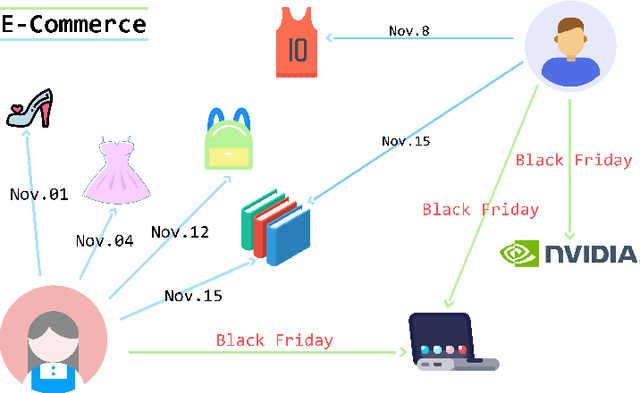
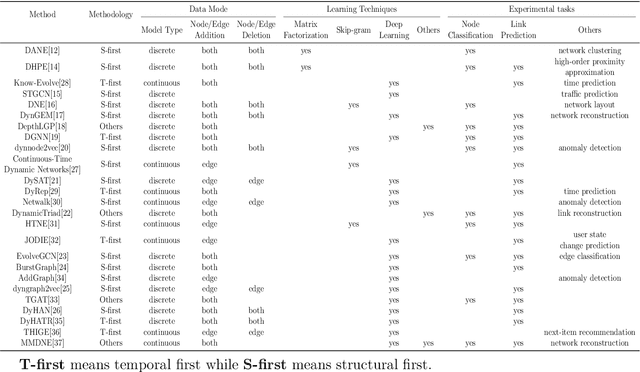
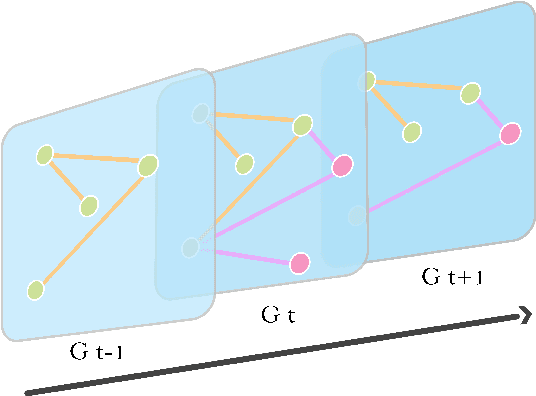
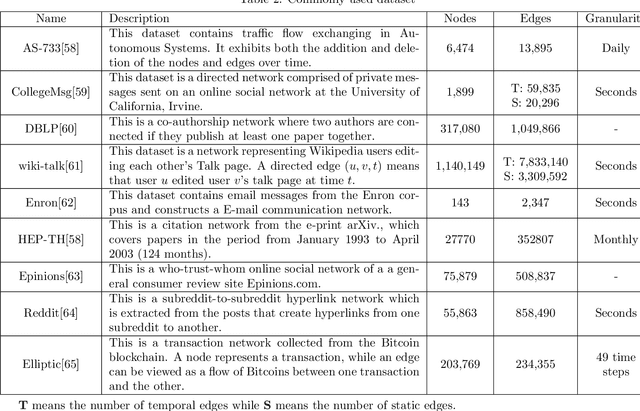
Since many real world networks are evolving over time, such as social networks and user-item networks, there are increasing research efforts on dynamic network embedding in recent years. They learn node representations from a sequence of evolving graphs but not only the latest network, for preserving both structural and temporal information from the dynamic networks. Due to the lack of comprehensive investigation of them, we give a survey of dynamic network embedding in this paper. Our survey inspects the data model, representation learning technique, evaluation and application of current related works and derives common patterns from them. Specifically, we present two basic data models, namely, discrete model and continuous model for dynamic networks. Correspondingly, we summarize two major categories of dynamic network embedding techniques, namely, structural-first and temporal-first that are adopted by most related works. Then we build a taxonomy that refines the category hierarchy by typical learning models. The popular experimental data sets and applications are also summarized. Lastly, we have a discussion of several distinct research topics in dynamic network embedding.