 Add to Chrome
 Add to Firefox
 Add to Edge
Mobility Anomaly Generation using LLM-Driven Behavior with Kinematic Constraints
Jun 09, 2026
Although the study of human trajectory anomalies is critical for advancing spatial data mining, empirical research remains severely hindered by a pervasive lack of ground-truth datasets. Despite the availability of several real-world and simulated human trajectory collections, these datasets exclusively capture normal mobility patterns and lack annotated anomalies. This specific scarcity is fundamentally driven by the inherent statistical rarity of anomalous events, precluding the feasibility of conventional observational methods. Compounding this challenge, the systematic acquisition of large-scale mobility data is strictly bottlenecked by prohibitive costs and stringent privacy regulations. To overcome these fundamental limitations and establish a reliable human trajectory anomalies dataset with annotated ground truth, we introduce a novel, end-to-end generative framework designed to synthesize realistic trajectory anomalies at scale. Our architecture bridges the gap between purely synthetic mobility data and complex real-world physical constraints by operating directly on baseline simulated trajectories. We employ Large Language Model (LLM) agents to systematically inject semantically meaningful behavioral anomalies such as irregular out-of-distribution check-ins and skipped routine visits. To ensure rigorous spatial validity, the system leverages map-constrained routing reconstruction to recalculate the physical transitions between these LLM agent-modified staypoints. Moreover, to narrow the simulation-to-reality gap, we augment the resulting trajectories with a context-aware spatial noise model, parameterized by environmental and location-specific variables, to accurately emulate heterogeneous GPS sensor degradation.

Change of human mobility during COVID-19: A United States case study
Sep 18, 2021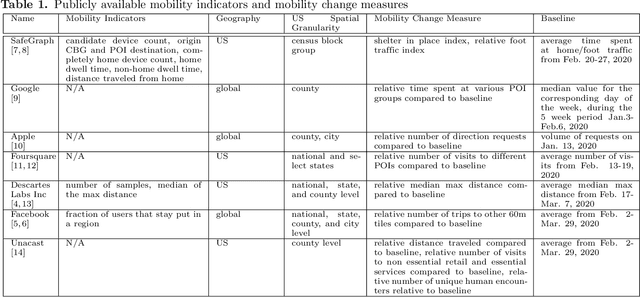
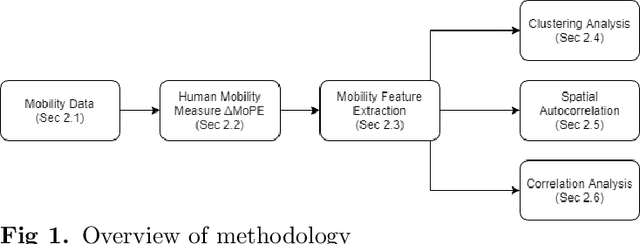
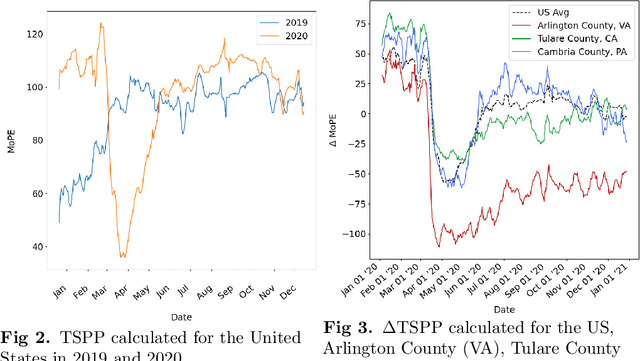

With the onset of COVID-19 and the resulting shelter in place guidelines combined with remote working practices, human mobility in 2020 has been dramatically impacted. Existing studies typically examine whether mobility in specific localities increases or decreases at specific points in time and relate these changes to certain pandemic and policy events. In this paper, we study mobility change in the US through a five-step process using mobility footprint data. (Step 1) Propose the delta Time Spent in Public Places (Delta-TSPP) as a measure to quantify daily changes in mobility for each US county from 2019-2020. (Step 2) Conduct Principal Component Analysis (PCA) to reduce the Delta-TSPP time series of each county to lower-dimensional latent components of change in mobility. (Step 3) Conduct clustering analysis to find counties that exhibit similar latent components. (Step 4) Investigate local and global spatial autocorrelation for each component. (Step 5) Conduct correlation analysis to investigate how various population characteristics and behavior correlate with mobility patterns. Results show that by describing each county as a linear combination of the three latent components, we can explain 59% of the variation in mobility trends across all US counties. Specifically, change in mobility in 2020 for US counties can be explained as a combination of three latent components: 1) long-term reduction in mobility, 2) no change in mobility, and 3) short-term reduction in mobility. We observe significant correlations between the three latent components of mobility change and various population characteristics, including political leaning, population, COVID-19 cases and deaths, and unemployment. We find that our analysis provides a comprehensive understanding of mobility change in response to the COVID-19 pandemic.