 Add to Chrome
 Add to Firefox
 Add to Edge
Staypoint Detection from Noisy Trajectory Data [Experiment Paper]
Jul 21, 2026
Detecting staypoints from raw trajectory data is fundamental to numerous spatial computing applications. This process transforms raw numeric sequences of geolocations into semantically meaningful locations, such as homes, workplaces, or restaurants. Despite its importance for semantic trajectory analysis, staypoint detection lacks standard benchmarks, and existing algorithms have never been systematically evaluated. This gap persists because no publicly available datasets provide both raw individual trajectories and ground-truth staypoint annotations. This benchmark paper addresses this limitation with two key contributions: (1) we introduce 16 large-scale simulated datasets capturing thousands of agents with annotated staypoints across varying trajectory noise levels, and (2) we evaluate nine staypoint detection algorithms-including both state-of-the-art and novel methods-to analyze their robustness to noise. Our evaluation reveals that existing state-of-the-art algorithms perform poorly under realistic noise conditions. Conversely, our proposed unsupervised methods yield substantial improvements, while supervised approaches drastically outperform existing baselines. While these results are very promising, these datasets and methods are only meant as starting points for future research in staypoint detection.

Social Networks of LLM Agents
Jul 04, 2026Large language model (LLM) agents are increasingly deployed in interacting populations, raising the question of what such populations come to believe collectively. Whether a population aggregates genuine knowledge or collapses into a false consensus directly affects how much such systems can be trusted. Classical social-network models assume that the network itself determines how beliefs combine. This assumption breaks down for LLM agents, whose limited attention takes in only part of what they are exposed to, so these models overstate how much information a population actually pools and cannot tell genuine consensus from herding. We introduce SNLA, a framework that models how much each agent actually influences others, rather than merely how the network connects them. This influence depends on each agent's position in the network and on how sharply attention focuses. Theoretically, we show on a tractable proxy that narrow attention causes herding, where the effective sample size stays bounded regardless of population size, while wide attention recovers wisdom-of-crowds behavior only when the exposure graph is undirected and degree-regular. Empirically, a controlled testbed validates these predictions directly, and the herding-wisdom transition reproduces on operator-controlled variants of three multi-agent LLM benchmarks.
GlucoFM-Bench: Benchmarking Time-Series Foundation Models for Blood Glucose Forecasting
Jun 05, 2026Blood glucose forecasting models are foundational for modern diabetes management systems, as reliable short-term predictions can enable proactive interventions, support automated insulin delivery, and reduce the risk of hypo- and hyperglycemic events. From a modeling perspective, glucose forecasting poses unique challenges due to heterogeneous physiological dynamics across diabetes populations. Traditional machine learning and deep learning models have been extensively evaluated for glucose prediction, yet recent time-series foundation models (TSFMs) remain much less studied in this setting. To bridge this gap, we present GlucoFM-Bench, a comprehensive benchmark evaluating state-of-the-art TSFMs alongside supervised deep learning models for blood glucose forecasting. We assess eight representative architectures, including pre-trained TSFMs, time-series large language models, and task-specific deep learning models, across 15 publicly available diabetes-relevant datasets comprising 1,117 individuals with type 1 diabetes, type 2 diabetes, prediabetes, and no diabetes. Models are evaluated under zero-shot, few-shot, and full-shot protocols, with systematic variation in context length and prediction horizon. Across datasets, pre-trained TSFMs, especially Chronos-2 and TimesFM, show strong zero-shot and few-shot transfer, with the best zero-shot model performing within 5% of the best full-shot supervised model. Yet, when task-specific data are abundant, a lightweight LSTM remains strongest, outperforming TSFMs by 4--21% under full-shot training. Stratified analyses reveal persistent challenges in T1D cohorts and hypo-/hyperglycemic ranges, highlighting the need for evaluation beyond aggregate error metrics. Together, GlucoFM-Bench provides a standardized and reproducible foundation for evaluating, comparing, and improving foundation models for blood glucose forecasting.
Autoregressive Diffusion World Models for Off-Policy Evaluation of LLM Agents
Jun 04, 2026Evaluating large language model (LLM) agents in multi-turn interactive environments is expensive and risky, as it requires online environment interaction. We propose ADWM (Autoregressive Diffusion World Model), an evaluation framework that estimates the performance of a new LLM agent policy purely from pre-collected trajectories. The core idea is to learn a latent diffusion world model that simulates how the environment responds to the evaluation policy, without ever executing it in the real environment. Existing diffusion-based OPE methods guide full trajectories in a single pass by jointly diffusing states and actions, an assumption that breaks down for LLM agents whose actions are discrete text that must be sampled from the policy after observing the environment. Unlike autoregressive world models that suffer from compounding errors, ADWM models each transition as an independent denoising process, enabling reliable step-by-step rollouts where the world model and agent alternate in causal order. Crucially, the LLM agent under evaluation directly guides the diffusion generation at each step via a policy-conditioned score function, ensuring that simulated trajectories accurately reflect its decision-making patterns. Empirically, ADWM achieves accurate value estimates and evaluation reliability across diverse multi-turn agent tasks, demonstrating its promise as a practical framework for offline LLM agent evaluation.
An Adaptive Machine Learning Triage Framework for Predicting Alzheimer's Disease Progression
Nov 10, 2025Accurate predictions of conversion from mild cognitive impairment (MCI) to Alzheimer's disease (AD) can enable effective personalized therapy. While cognitive tests and clinical data are routinely collected, they lack the predictive power of PET scans and CSF biomarker analysis, which are prohibitively expensive to obtain for every patient. To address this cost-accuracy dilemma, we design a two-stage machine learning framework that selectively obtains advanced, costly features based on their predicted "value of information". We apply our framework to predict AD progression for MCI patients using data from the Alzheimer's Disease Neuroimaging Initiative (ADNI). Our framework reduces the need for advanced testing by 20% while achieving a test AUROC of 0.929, comparable to the model that uses both basic and advanced features (AUROC=0.915, p=0.1010). We also provide an example interpretability analysis showing how one may explain the triage decision. Our work presents an interpretable, data-driven framework that optimizes AD diagnostic pathways and balances accuracy with cost, representing a step towards making early, reliable AD prediction more accessible in real-world practice. Future work should consider multiple categories of advanced features and larger-scale validation.
CANDOR: Counterfactual ANnotated DOubly Robust Off-Policy Evaluation
Dec 11, 2024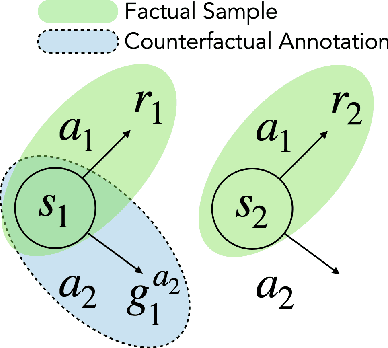
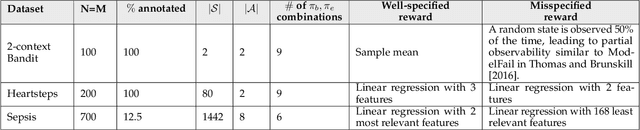


Off-policy evaluation (OPE) provides safety guarantees by estimating the performance of a policy before deployment. Recent work introduced IS+, an importance sampling (IS) estimator that uses expert-annotated counterfactual samples to improve behavior dataset coverage. However, IS estimators are known to have high variance; furthermore, the performance of IS+ deteriorates when annotations are imperfect. In this work, we propose a family of OPE estimators inspired by the doubly robust (DR) principle. A DR estimator combines IS with a reward model estimate, known as the direct method (DM), and offers favorable statistical guarantees. We propose three strategies for incorporating counterfactual annotations into a DR-inspired estimator and analyze their properties under various realistic settings. We prove that using imperfect annotations in the DM part of the estimator best leverages the annotations, as opposed to using them in the IS part. To support our theoretical findings, we evaluate the proposed estimators in three contextual bandit environments. Our empirical results show that when the reward model is misspecified and the annotations are imperfect, it is most beneficial to use the annotations only in the DM portion of a DR estimator. Based on these theoretical and empirical insights, we provide a practical guide for using counterfactual annotations in different realistic settings.
Machine Learning for Health symposium 2023 -- Findings track
Dec 01, 2023A collection of the accepted Findings papers that were presented at the 3rd Machine Learning for Health symposium (ML4H 2023), which was held on December 10, 2023, in New Orleans, Louisiana, USA. ML4H 2023 invited high-quality submissions on relevant problems in a variety of health-related disciplines including healthcare, biomedicine, and public health. Two submission tracks were offered: the archival Proceedings track, and the non-archival Findings track. Proceedings were targeted at mature work with strong technical sophistication and a high impact to health. The Findings track looked for new ideas that could spark insightful discussion, serve as valuable resources for the community, or could enable new collaborations. Submissions to the Proceedings track, if not accepted, were automatically considered for the Findings track. All the manuscripts submitted to ML4H Symposium underwent a double-blind peer-review process.
Counterfactual-Augmented Importance Sampling for Semi-Offline Policy Evaluation
Oct 26, 2023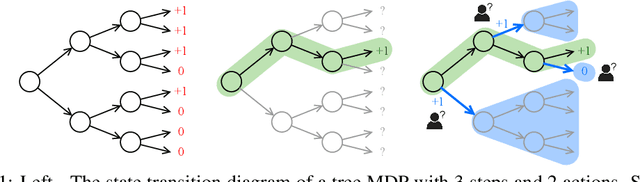
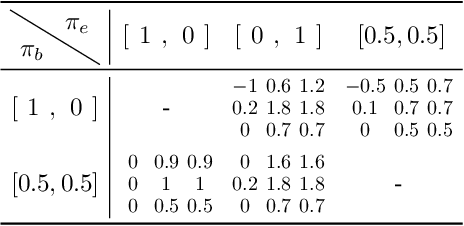
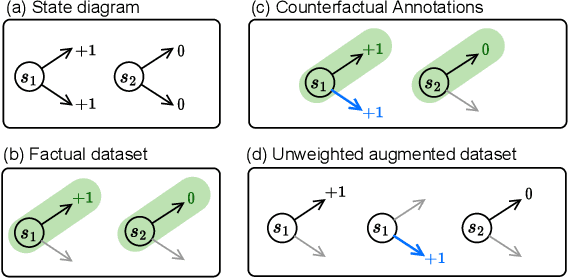
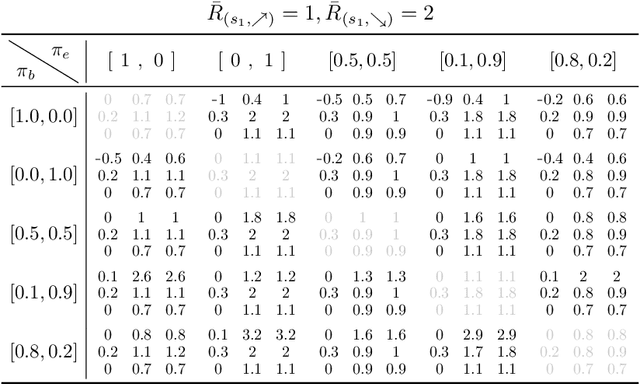
In applying reinforcement learning (RL) to high-stakes domains, quantitative and qualitative evaluation using observational data can help practitioners understand the generalization performance of new policies. However, this type of off-policy evaluation (OPE) is inherently limited since offline data may not reflect the distribution shifts resulting from the application of new policies. On the other hand, online evaluation by collecting rollouts according to the new policy is often infeasible, as deploying new policies in these domains can be unsafe. In this work, we propose a semi-offline evaluation framework as an intermediate step between offline and online evaluation, where human users provide annotations of unobserved counterfactual trajectories. While tempting to simply augment existing data with such annotations, we show that this naive approach can lead to biased results. Instead, we design a new family of OPE estimators based on importance sampling (IS) and a novel weighting scheme that incorporate counterfactual annotations without introducing additional bias. We analyze the theoretical properties of our approach, showing its potential to reduce both bias and variance compared to standard IS estimators. Our analyses reveal important practical considerations for handling biased, noisy, or missing annotations. In a series of proof-of-concept experiments involving bandits and a healthcare-inspired simulator, we demonstrate that our approach outperforms purely offline IS estimators and is robust to imperfect annotations. Our framework, combined with principled human-centered design of annotation solicitation, can enable the application of RL in high-stakes domains.
Leveraging Factored Action Spaces for Off-Policy Evaluation
Jul 13, 2023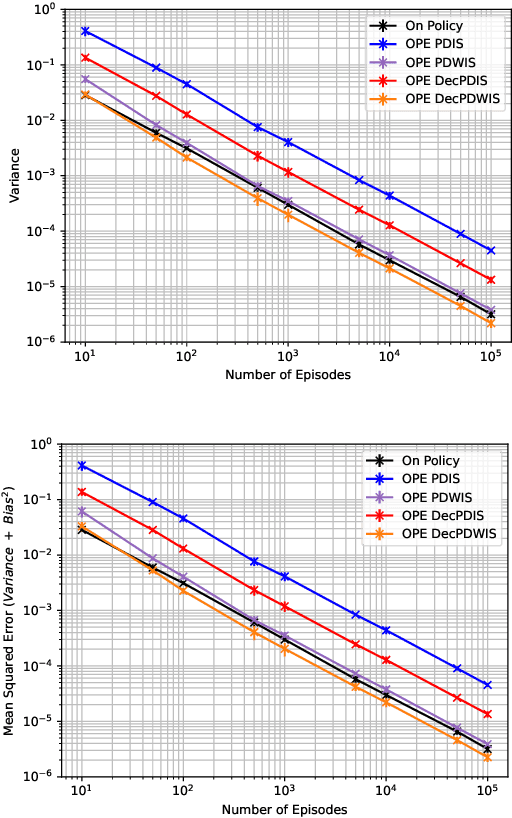

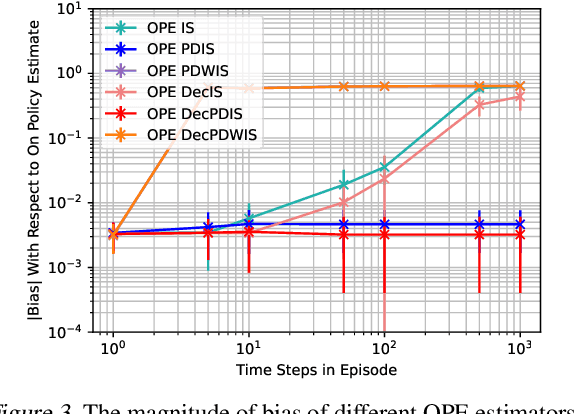
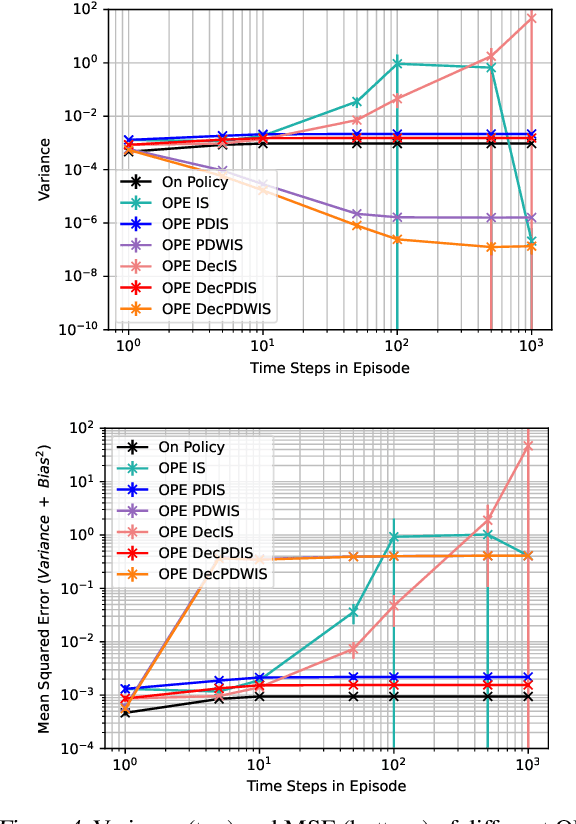
Off-policy evaluation (OPE) aims to estimate the benefit of following a counterfactual sequence of actions, given data collected from executed sequences. However, existing OPE estimators often exhibit high bias and high variance in problems involving large, combinatorial action spaces. We investigate how to mitigate this issue using factored action spaces i.e. expressing each action as a combination of independent sub-actions from smaller action spaces. This approach facilitates a finer-grained analysis of how actions differ in their effects. In this work, we propose a new family of "decomposed" importance sampling (IS) estimators based on factored action spaces. Given certain assumptions on the underlying problem structure, we prove that the decomposed IS estimators have less variance than their original non-decomposed versions, while preserving the property of zero bias. Through simulations, we empirically verify our theoretical results, probing the validity of various assumptions. Provided with a technique that can derive the action space factorisation for a given problem, our work shows that OPE can be improved "for free" by utilising this inherent problem structure.
Leveraging Factored Action Spaces for Efficient Offline Reinforcement Learning in Healthcare
May 02, 2023Many reinforcement learning (RL) applications have combinatorial action spaces, where each action is a composition of sub-actions. A standard RL approach ignores this inherent factorization structure, resulting in a potential failure to make meaningful inferences about rarely observed sub-action combinations; this is particularly problematic for offline settings, where data may be limited. In this work, we propose a form of linear Q-function decomposition induced by factored action spaces. We study the theoretical properties of our approach, identifying scenarios where it is guaranteed to lead to zero bias when used to approximate the Q-function. Outside the regimes with theoretical guarantees, we show that our approach can still be useful because it leads to better sample efficiency without necessarily sacrificing policy optimality, allowing us to achieve a better bias-variance trade-off. Across several offline RL problems using simulators and real-world datasets motivated by healthcare, we demonstrate that incorporating factored action spaces into value-based RL can result in better-performing policies. Our approach can help an agent make more accurate inferences within underexplored regions of the state-action space when applying RL to observational datasets.