 Add to Chrome
 Add to Firefox
 Add to Edge
BLUFF: Benchmarking the Detection of False and Synthetic Content across 58 Low-Resource Languages
Feb 28, 2026
Multilingual falsehoods threaten information integrity worldwide, yet detection benchmarks remain confined to English or a few high-resource languages, leaving low-resource linguistic communities without robust defense tools. We introduce BLUFF, a comprehensive benchmark for detecting false and synthetic content, spanning 79 languages with over 202K samples, combining human-written fact-checked content (122K+ samples across 57 languages) and LLM-generated content (79K+ samples across 71 languages). BLUFF uniquely covers both high-resource "big-head" (20) and low-resource "long-tail" (59) languages, addressing critical gaps in multilingual research on detecting false and synthetic content. Our dataset features four content types (human-written, LLM-generated, LLM-translated, and hybrid human-LLM text), bidirectional translation (English$\leftrightarrow$X), 39 textual modification techniques (36 manipulation tactics for fake news, 3 AI-editing strategies for real news), and varying edit intensities generated using 19 diverse LLMs. We present AXL-CoI (Adversarial Cross-Lingual Agentic Chainof-Interactions), a novel multi-agentic framework for controlled fake/real news generation, paired with mPURIFY, a quality filtering pipeline ensuring dataset integrity. Experiments reveal state-of-theart detectors suffer up to 25.3% F1 degradation on low-resource versus high-resource languages. BLUFF provides the research community with a multilingual benchmark, extensive linguistic-oriented benchmark evaluation, comprehensive documentation, and opensource tools to advance equitable falsehood detection. Dataset and code are available at: https://jsl5710.github.io/BLUFF/

From Latent to Observable Position-Based Click Models in Carousel Interfaces
Feb 18, 2026Click models are a central component of learning and evaluation in recommender systems, yet most existing models are designed for single ranked-list interfaces. In contrast, modern recommender platforms increasingly use complex interfaces such as carousels, which consist of multiple swipeable lists that enable complex user browsing behaviors. In this paper, we study position-based click models in carousel interfaces and examine optimization methods, model structure, and alignment with user behavior. We propose three novel position-based models tailored to carousels, including the first position-based model without latent variables that incorporates observed examination signals derived from eye tracking data, called the Observed Examination Position-Based Model (OEPBM). We develop a general implementation of these carousel click models, supporting multiple optimization techniques and conduct experiments comparing gradient-based methods with classical approaches, namely expectation-maximization and maximum likelihood estimation. Our results show that gradient-based optimization consistently achieve better click likelihoods. Among the evaluated models, the OEPBM achieves the strongest performance in click prediction and produces examination patterns that most closely align to user behavior. However, we also demonstrate that strong click fit does not imply realistic modeling of user examination and browsing patterns. This reveals a fundamental limitation of click-only models in complex interfaces and the need for incorporating additional behavioral signals when designing click models for carousel-based recommender systems.
MultiCW: A Large-Scale Balanced Benchmark Dataset for Training Robust Check-Worthiness Detection Models
Feb 18, 2026Large Language Models (LLMs) are beginning to reshape how media professionals verify information, yet automated support for detecting check-worthy claims a key step in the fact-checking process remains limited. We introduce the Multi-Check-Worthy (MultiCW) dataset, a balanced multilingual benchmark for check-worthy claim detection spanning 16 languages, 7 topical domains, and 2 writing styles. It consists of 123,722 samples, evenly distributed between noisy (informal) and structured (formal) texts, with balanced representation of check-worthy and non-check-worthy classes across all languages. To probe robustness, we also introduce an equally balanced out-of-distribution evaluation set of 27,761 samples in 4 additional languages. To provide baselines, we benchmark 3 common fine-tuned multilingual transformers against a diverse set of 15 commercial and open LLMs under zero-shot settings. Our findings show that fine-tuned models consistently outperform zero-shot LLMs on claim classification and show strong out-of-distribution generalization across languages, domains, and styles. MultiCW provides a rigorous multilingual resource for advancing automated fact-checking and enables systematic comparisons between fine-tuned models and cutting-edge LLMs on the check-worthy claim detection task.
Multilingual vs Crosslingual Retrieval of Fact-Checked Claims: A Tale of Two Approaches
May 28, 2025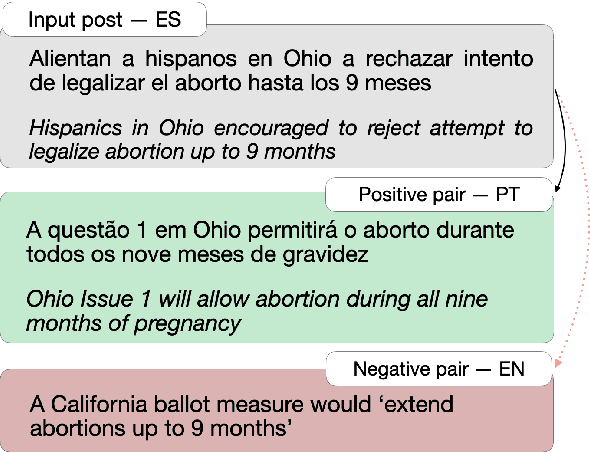
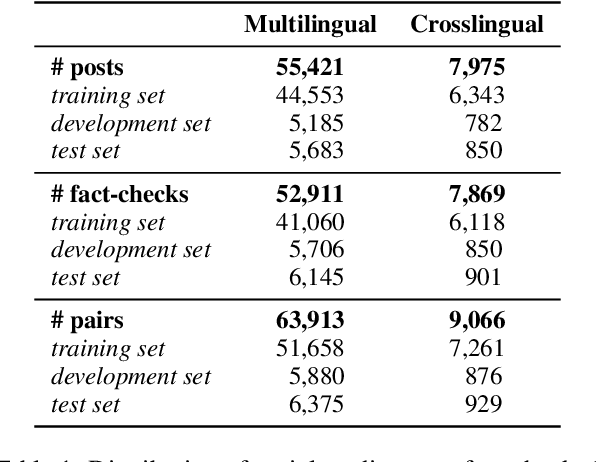
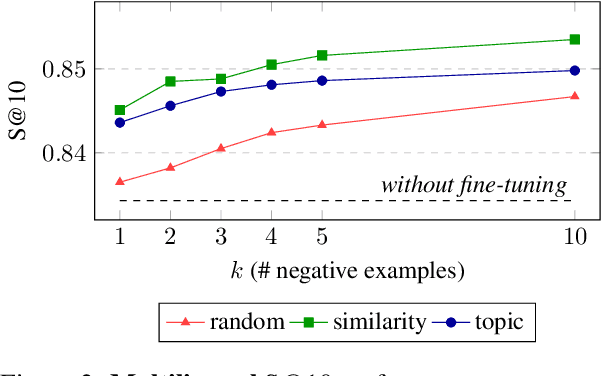
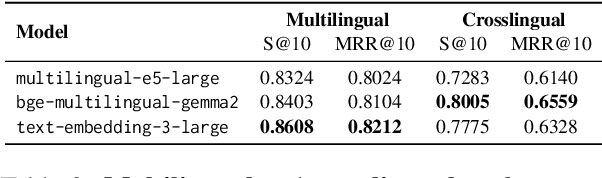
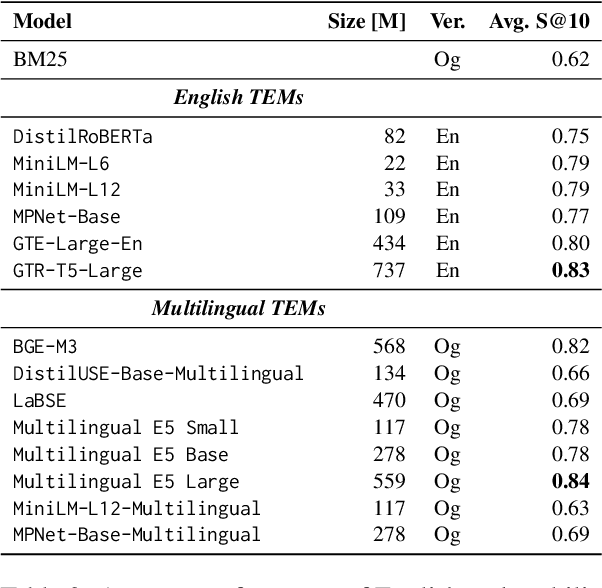
Retrieval of previously fact-checked claims is a well-established task, whose automation can assist professional fact-checkers in the initial steps of information verification. Previous works have mostly tackled the task monolingually, i.e., having both the input and the retrieved claims in the same language. However, especially for languages with a limited availability of fact-checks and in case of global narratives, such as pandemics, wars, or international politics, it is crucial to be able to retrieve claims across languages. In this work, we examine strategies to improve the multilingual and crosslingual performance, namely selection of negative examples (in the supervised) and re-ranking (in the unsupervised setting). We evaluate all approaches on a dataset containing posts and claims in 47 languages (283 language combinations). We observe that the best results are obtained by using LLM-based re-ranking, followed by fine-tuning with negative examples sampled using a sentence similarity-based strategy. Most importantly, we show that crosslinguality is a setup with its own unique characteristics compared to the multilingual setup.
SemEval-2025 Task 7: Multilingual and Crosslingual Fact-Checked Claim Retrieval
May 15, 2025The rapid spread of online disinformation presents a global challenge, and machine learning has been widely explored as a potential solution. However, multilingual settings and low-resource languages are often neglected in this field. To address this gap, we conducted a shared task on multilingual claim retrieval at SemEval 2025, aimed at identifying fact-checked claims that match newly encountered claims expressed in social media posts across different languages. The task includes two subtracks: (1) a monolingual track, where social posts and claims are in the same language, and (2) a crosslingual track, where social posts and claims might be in different languages. A total of 179 participants registered for the task contributing to 52 test submissions. 23 out of 31 teams have submitted their system papers. In this paper, we report the best-performing systems as well as the most common and the most effective approaches across both subtracks. This shared task, along with its dataset and participating systems, provides valuable insights into multilingual claim retrieval and automated fact-checking, supporting future research in this field.
Eye Movements as Indicators of Deception: A Machine Learning Approach
May 05, 2025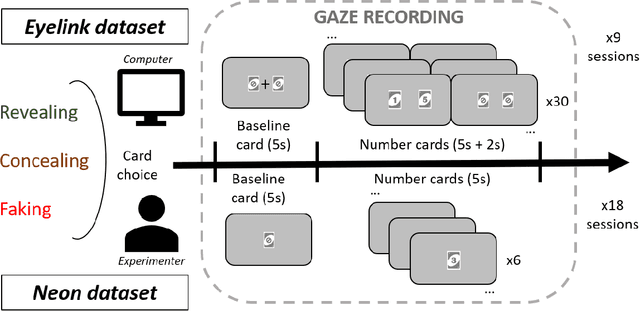
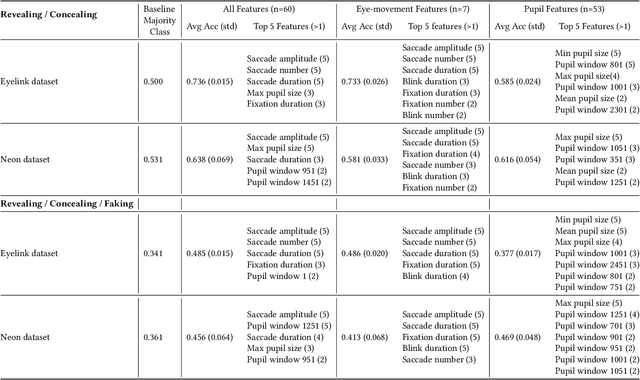
Gaze may enhance the robustness of lie detectors but remains under-studied. This study evaluated the efficacy of AI models (using fixations, saccades, blinks, and pupil size) for detecting deception in Concealed Information Tests across two datasets. The first, collected with Eyelink 1000, contains gaze data from a computerized experiment where 87 participants revealed, concealed, or faked the value of a previously selected card. The second, collected with Pupil Neon, involved 36 participants performing a similar task but facing an experimenter. XGBoost achieved accuracies up to 74% in a binary classification task (Revealing vs. Concealing) and 49% in a more challenging three-classification task (Revealing vs. Concealing vs. Faking). Feature analysis identified saccade number, duration, amplitude, and maximum pupil size as the most important for deception prediction. These results demonstrate the feasibility of using gaze and AI to enhance lie detectors and encourage future research that may improve on this.
A Generative-AI-Driven Claim Retrieval System Capable of Detecting and Retrieving Claims from Social Media Platforms in Multiple Languages
Apr 29, 2025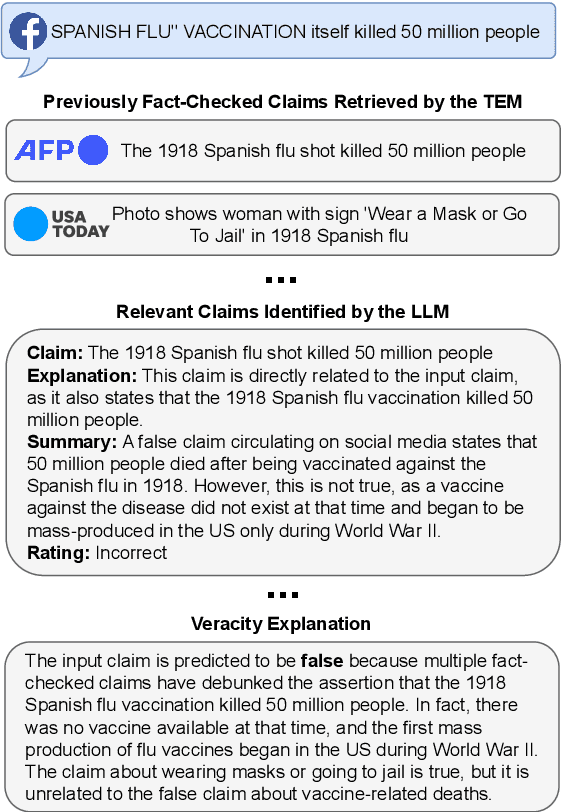
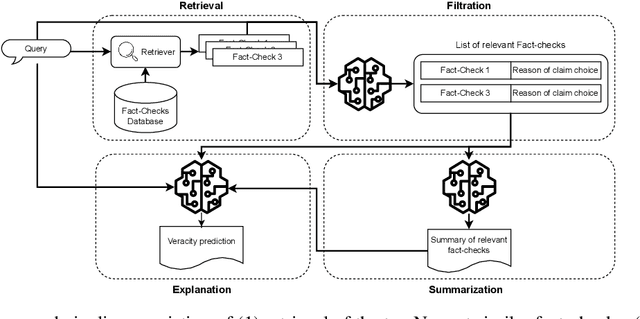
Online disinformation poses a global challenge, placing significant demands on fact-checkers who must verify claims efficiently to prevent the spread of false information. A major issue in this process is the redundant verification of already fact-checked claims, which increases workload and delays responses to newly emerging claims. This research introduces an approach that retrieves previously fact-checked claims, evaluates their relevance to a given input, and provides supplementary information to support fact-checkers. Our method employs large language models (LLMs) to filter irrelevant fact-checks and generate concise summaries and explanations, enabling fact-checkers to faster assess whether a claim has been verified before. In addition, we evaluate our approach through both automatic and human assessments, where humans interact with the developed tool to review its effectiveness. Our results demonstrate that LLMs are able to filter out many irrelevant fact-checks and, therefore, reduce effort and streamline the fact-checking process.
RecGaze: The First Eye Tracking and User Interaction Dataset for Carousel Interfaces
Apr 29, 2025Carousel interfaces are widely used in e-commerce and streaming services, but little research has been devoted to them. Previous studies of interfaces for presenting search and recommendation results have focused on single ranked lists, but it appears their results cannot be extrapolated to carousels due to the added complexity. Eye tracking is a highly informative approach to understanding how users click, yet there are no eye tracking studies concerning carousels. There are very few interaction datasets on recommenders with carousel interfaces and none that contain gaze data. We introduce the RecGaze dataset: the first comprehensive feedback dataset on carousels that includes eye tracking results, clicks, cursor movements, and selection explanations. The dataset comprises of interactions from 3 movie selection tasks with 40 different carousel interfaces per user. In total, 87 users and 3,477 interactions are logged. In addition to the dataset, its description and possible use cases, we provide results of a survey on carousel design and the first analysis of gaze data on carousels, which reveals a golden triangle or F-pattern browsing behavior. Our work seeks to advance the field of carousel interfaces by providing the first dataset with eye tracking results on carousels. In this manner, we provide and encourage an empirical understanding of interactions with carousel interfaces, for building better recommender systems through gaze information, and also encourage the development of gaze-based recommenders.
Beyond speculation: Measuring the growing presence of LLM-generated texts in multilingual disinformation
Mar 29, 2025Increased sophistication of large language models (LLMs) and the consequent quality of generated multilingual text raises concerns about potential disinformation misuse. While humans struggle to distinguish LLM-generated content from human-written texts, the scholarly debate about their impact remains divided. Some argue that heightened fears are overblown due to natural ecosystem limitations, while others contend that specific "longtail" contexts face overlooked risks. Our study bridges this debate by providing the first empirical evidence of LLM presence in the latest real-world disinformation datasets, documenting the increase of machine-generated content following ChatGPT's release, and revealing crucial patterns across languages, platforms, and time periods.
Increasing the Robustness of the Fine-tuned Multilingual Machine-Generated Text Detectors
Mar 19, 2025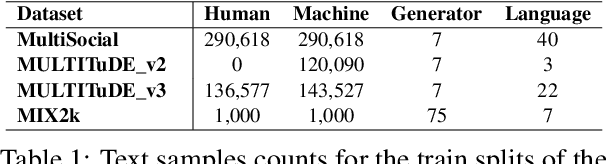
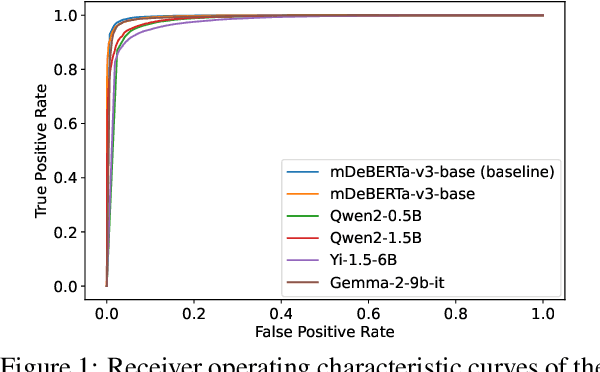
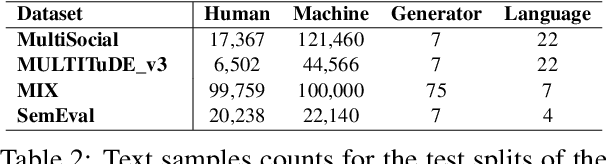
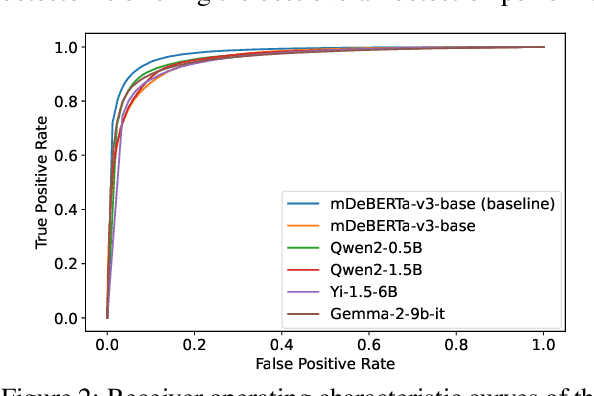
Since the proliferation of LLMs, there have been concerns about their misuse for harmful content creation and spreading. Recent studies justify such fears, providing evidence of LLM vulnerabilities and high potential of their misuse. Humans are no longer able to distinguish between high-quality machine-generated and authentic human-written texts. Therefore, it is crucial to develop automated means to accurately detect machine-generated content. It would enable to identify such content in online information space, thus providing an additional information about its credibility. This work addresses the problem by proposing a robust fine-tuning process of LLMs for the detection task, making the detectors more robust against obfuscation and more generalizable to out-of-distribution data.