 Add to Chrome
 Add to Firefox
 Add to Edge
Multi-Agentic System Leveraging Open-Source LLMs to Mitigate Disinformation Threats
Jun 29, 2026
In contemporary societies, the threat of disinformation has reached alarming levels, exacerbated by the proliferation of electronic communication, social media, and advancements in artificial intelligence. As a result, there is an urgent need to develop effective countermeasures to mitigate this menace. However, the sheer scale of the problem renders manual fact-checking and human-based verification inadequate, underscoring the necessity for automated methods to detect and debunk disinformation. This article proposes a novel approach based on a multi-agent system that emulates the decision-making processes of human annotators engaged in disinformation detection tasks. By incorporating a consensus mechanism, diversity in cognition and diversity in knowledge, and also hierarchical structure, inspired by human annotators' behavior, the proposed method achieves superior results compared to individual Large Language Models (LLMs), including GPT 4 and GPT 3.5. The system leverages open models (e.g., LLaMA, Kimi, Qwen, Deepseek and LLaMA-Nemotron) to ensure greater transparency. The evaluation of the proposed method encompasses datasets in languages with varying resource availability, including English (high-resource), Polish (medium-resource), Slovak (low-resource) and Bulgarian (low-resource). Experiments were conducted on tasks such as direct disinformation detection, identification of texts worthy of verification, and detection of texts containing verifiable factual claims.

MultiCW: A Large-Scale Balanced Benchmark Dataset for Training Robust Check-Worthiness Detection Models
Feb 18, 2026Large Language Models (LLMs) are beginning to reshape how media professionals verify information, yet automated support for detecting check-worthy claims a key step in the fact-checking process remains limited. We introduce the Multi-Check-Worthy (MultiCW) dataset, a balanced multilingual benchmark for check-worthy claim detection spanning 16 languages, 7 topical domains, and 2 writing styles. It consists of 123,722 samples, evenly distributed between noisy (informal) and structured (formal) texts, with balanced representation of check-worthy and non-check-worthy classes across all languages. To probe robustness, we also introduce an equally balanced out-of-distribution evaluation set of 27,761 samples in 4 additional languages. To provide baselines, we benchmark 3 common fine-tuned multilingual transformers against a diverse set of 15 commercial and open LLMs under zero-shot settings. Our findings show that fine-tuned models consistently outperform zero-shot LLMs on claim classification and show strong out-of-distribution generalization across languages, domains, and styles. MultiCW provides a rigorous multilingual resource for advancing automated fact-checking and enables systematic comparisons between fine-tuned models and cutting-edge LLMs on the check-worthy claim detection task.
Multilingual Models for Check-Worthy Social Media Posts Detection
Aug 13, 2024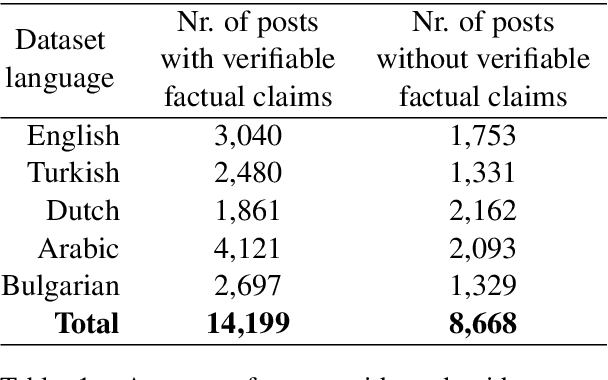
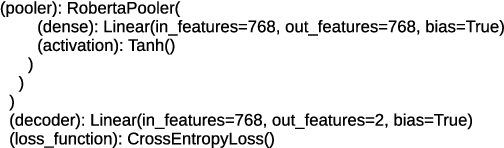
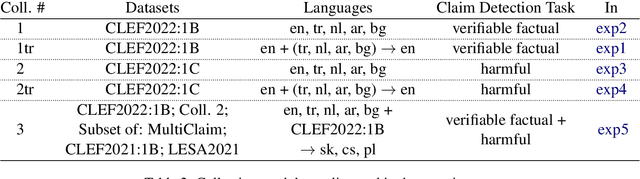
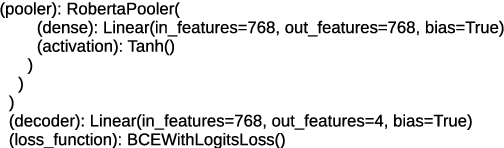
This work presents an extensive study of transformer-based NLP models for detection of social media posts that contain verifiable factual claims and harmful claims. The study covers various activities, including dataset collection, dataset pre-processing, architecture selection, setup of settings, model training (fine-tuning), model testing, and implementation. The study includes a comprehensive analysis of different models, with a special focus on multilingual models where the same model is capable of processing social media posts in both English and in low-resource languages such as Arabic, Bulgarian, Dutch, Polish, Czech, Slovak. The results obtained from the study were validated against state-of-the-art models, and the comparison demonstrated the robustness of the proposed models. The novelty of this work lies in the development of multi-label multilingual classification models that can simultaneously detect harmful posts and posts that contain verifiable factual claims in an efficient way.
Is it indeed bigger better? The comprehensive study of claim detection LMs applied for disinformation tackling
Nov 10, 2023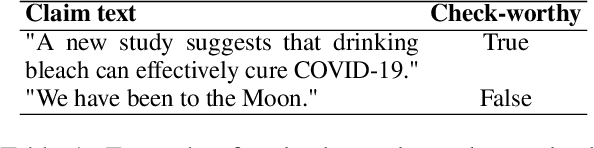
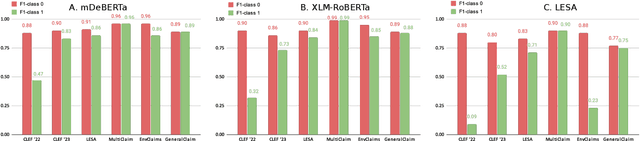
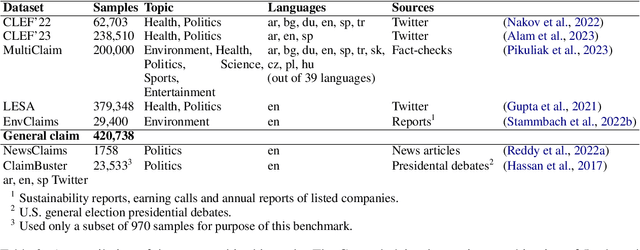
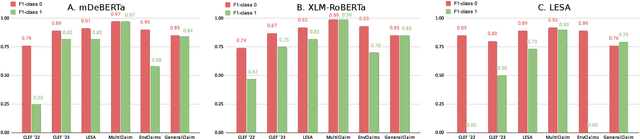
This study compares the performance of (1) fine-tuned models and (2) extremely large language models on the task of check-worthy claim detection. For the purpose of the comparison we composed a multilingual and multi-topical dataset comprising texts of various sources and styles. Building on this, we performed a benchmark analysis to determine the most general multilingual and multi-topical claim detector. We chose three state-of-the-art models in the check-worthy claim detection task and fine-tuned them. Furthermore, we selected three state-of-the-art extremely large language models without any fine-tuning. We made modifications to the models to adapt them for multilingual settings and through extensive experimentation and evaluation. We assessed the performance of all the models in terms of accuracy, recall, and F1-score in in-domain and cross-domain scenarios. Our results demonstrate that despite the technological progress in the area of natural language processing, the models fine-tuned for the task of check-worthy claim detection still outperform the zero-shot approaches in a cross-domain settings.