 Add to Chrome
 Add to Firefox
 Add to Edge
mdok-style at SemEval-2026 Task 9: Finetuning LLMs for Multilingual Polarization Detection
May 04, 2026
SemEval-2026 Task 9 is focused on multilingual polarization detection. Specifically, it covers the identification of multilingual, multicultural and multievent polarization along three axes (in subtasks), namely detection, type, and manifestation. Online polarization presents a concern, because it is often followed by hate speech, offensive discourse, and social fragmentation. Therefore, its detection before it escalates is crucial for a safer and more inclusive online space. We have coped with this SemEval task by finetuning mid-size LLMs for the sequence-classification task using the QLoRA parameter-efficient finetuning technique. The training data augmented the multilingual (22 languages) training sets by anonymized, lower-cased, upper-cased, and homoglyphied counterparts, making the detection more robust.

mcdok at SemEval-2026 Task 13: Finetuning LLMs for Detection of Machine-Generated Code
Apr 23, 2026Multi-domain detection of the machine-generated code snippets in various programming languages is a challenging task. SemEval-2026 Task~13 copes with this challenge in various angles, as a binary detection problem as well as attribution of the source. Specifically, its subtasks also cover generator LLM family detection, as well as a hybrid code co-generated by humans and machines, or adversarially modified codes hiding its origin. Our submitted systems adjusted the existing mdok approach (focused on machine-generated text detection) to these specific kinds of problems by exploring various base models, more suitable for code understanding. The results indicate that the submitted systems are competitive in all three subtasks. However, the margins from the top-performing systems are significant, and thus further improvements are possible.
Interpretable Predictability-Based AI Text Detection: A Replication Study
Mar 16, 2026This paper replicates and extends the system used in the AuTexTification 2023 shared task for authorship attribution of machine-generated texts. First, we tried to reproduce the original results. Exact replication was not possible because of differences in data splits, model availability, and implementation details. Next, we tested newer multilingual language models and added 26 document-level stylometric features. We also applied SHAP analysis to examine which features influence the model's decisions. We replaced the original GPT-2 models with newer generative models such as Qwen and mGPT for computing probabilistic features. For contextual representations, we used mDeBERTa-v3-base and applied the same configuration to both English and Spanish. This allowed us to use one shared configuration for Subtask 1 and Subtask 2. Our experiments show that the additional stylometric features improve performance in both tasks and both languages. The multilingual configuration achieves the results that are comparable to or better than language-specific models. The study also shows that clear documentation is important for reliable replication and fair comparison of systems.
MultiCW: A Large-Scale Balanced Benchmark Dataset for Training Robust Check-Worthiness Detection Models
Feb 18, 2026Large Language Models (LLMs) are beginning to reshape how media professionals verify information, yet automated support for detecting check-worthy claims a key step in the fact-checking process remains limited. We introduce the Multi-Check-Worthy (MultiCW) dataset, a balanced multilingual benchmark for check-worthy claim detection spanning 16 languages, 7 topical domains, and 2 writing styles. It consists of 123,722 samples, evenly distributed between noisy (informal) and structured (formal) texts, with balanced representation of check-worthy and non-check-worthy classes across all languages. To probe robustness, we also introduce an equally balanced out-of-distribution evaluation set of 27,761 samples in 4 additional languages. To provide baselines, we benchmark 3 common fine-tuned multilingual transformers against a diverse set of 15 commercial and open LLMs under zero-shot settings. Our findings show that fine-tuned models consistently outperform zero-shot LLMs on claim classification and show strong out-of-distribution generalization across languages, domains, and styles. MultiCW provides a rigorous multilingual resource for advancing automated fact-checking and enables systematic comparisons between fine-tuned models and cutting-edge LLMs on the check-worthy claim detection task.
Better as Generators Than Classifiers: Leveraging LLMs and Synthetic Data for Low-Resource Multilingual Classification
Jan 22, 2026Large Language Models (LLMs) have demonstrated remarkable multilingual capabilities, making them promising tools in both high- and low-resource languages. One particularly valuable use case is generating synthetic samples that can be used to train smaller models in low-resource scenarios where human-labelled data is scarce. In this work, we investigate whether these synthetic data generation capabilities can serve as a form of distillation, producing smaller models that perform on par with or even better than massive LLMs across languages and tasks. To this end, we use a state-of-the-art multilingual LLM to generate synthetic datasets covering 11 languages and 4 classification tasks. These datasets are then used to train smaller models via fine-tuning or instruction tuning, or as synthetic in-context examples for compact LLMs. Our experiments show that even small amounts of synthetic data enable smaller models to outperform the large generator itself, particularly in low-resource languages. Overall, the results suggest that LLMs are best utilised as generators (teachers) rather than classifiers, producing data that empowers smaller and more efficient multilingual models.
A Rigorous Evaluation of LLM Data Generation Strategies for Low-Resource Languages
Jun 13, 2025Large Language Models (LLMs) are increasingly used to generate synthetic textual data for training smaller specialized models. However, a comparison of various generation strategies for low-resource language settings is lacking. While various prompting strategies have been proposed, such as demonstrations, label-based summaries, and self-revision, their comparative effectiveness remains unclear, especially for low-resource languages. In this paper, we systematically evaluate the performance of these generation strategies and their combinations across 11 typologically diverse languages, including several extremely low-resource ones. Using three NLP tasks and four open-source LLMs, we assess downstream model performance on generated versus gold-standard data. Our results show that strategic combinations of generation methods, particularly target-language demonstrations with LLM-based revisions, yield strong performance, narrowing the gap with real data to as little as 5% in some settings. We also find that smart prompting techniques can reduce the advantage of larger LLMs, highlighting efficient generation strategies for synthetic data generation in low-resource scenarios with smaller models.
A Generative-AI-Driven Claim Retrieval System Capable of Detecting and Retrieving Claims from Social Media Platforms in Multiple Languages
Apr 29, 2025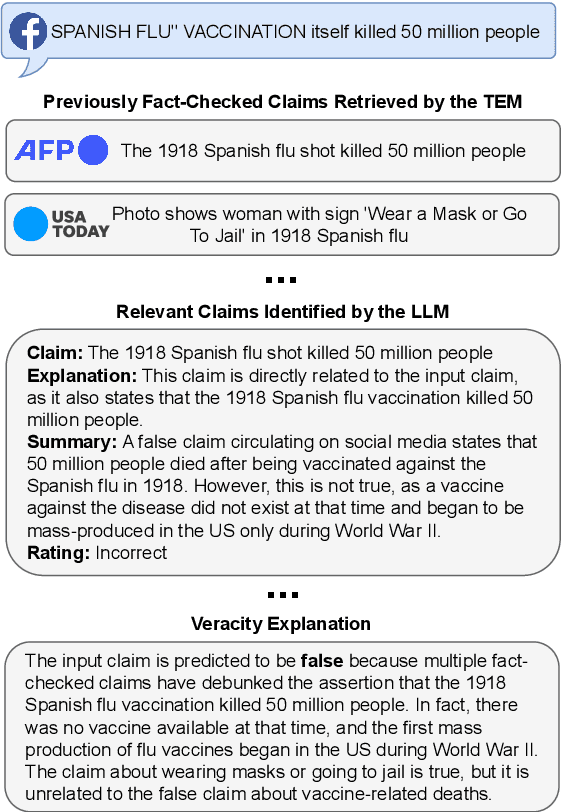
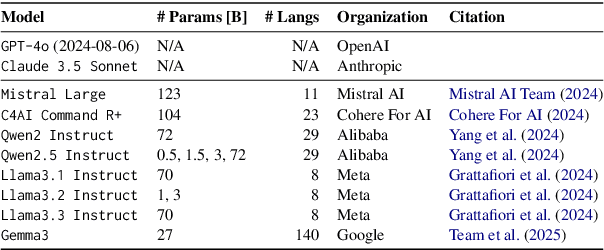
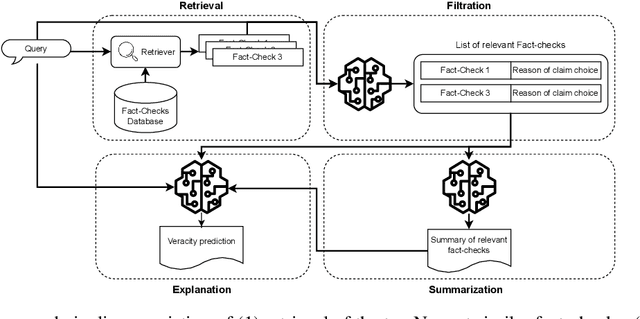
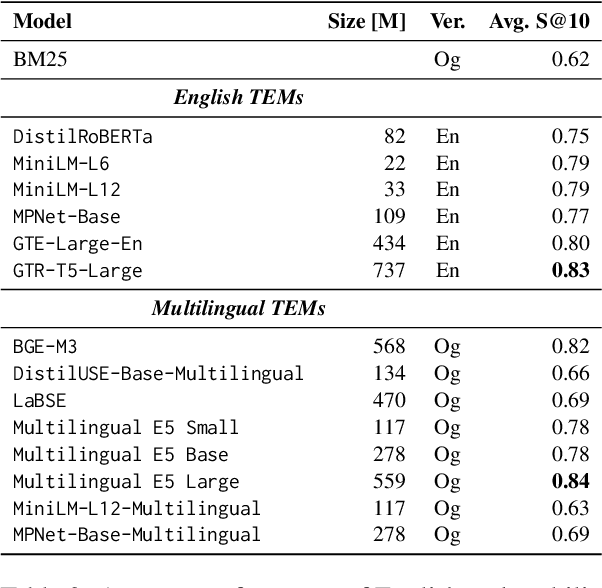
Online disinformation poses a global challenge, placing significant demands on fact-checkers who must verify claims efficiently to prevent the spread of false information. A major issue in this process is the redundant verification of already fact-checked claims, which increases workload and delays responses to newly emerging claims. This research introduces an approach that retrieves previously fact-checked claims, evaluates their relevance to a given input, and provides supplementary information to support fact-checkers. Our method employs large language models (LLMs) to filter irrelevant fact-checks and generate concise summaries and explanations, enabling fact-checkers to faster assess whether a claim has been verified before. In addition, we evaluate our approach through both automatic and human assessments, where humans interact with the developed tool to review its effectiveness. Our results demonstrate that LLMs are able to filter out many irrelevant fact-checks and, therefore, reduce effort and streamline the fact-checking process.
Overshoot: Taking advantage of future gradients in momentum-based stochastic optimization
Jan 16, 2025Overshoot is a novel, momentum-based stochastic gradient descent optimization method designed to enhance performance beyond standard and Nesterov's momentum. In conventional momentum methods, gradients from previous steps are aggregated with the gradient at current model weights before taking a step and updating the model. Rather than calculating gradient at the current model weights, Overshoot calculates the gradient at model weights shifted in the direction of the current momentum. This sacrifices the immediate benefit of using the gradient w.r.t. the exact model weights now, in favor of evaluating at a point, which will likely be more relevant for future updates. We show that incorporating this principle into momentum-based optimizers (SGD with momentum and Adam) results in faster convergence (saving on average at least 15% of steps). Overshoot consistently outperforms both standard and Nesterov's momentum across a wide range of tasks and integrates into popular momentum-based optimizers with zero memory and small computational overhead.
Use Random Selection for Now: Investigation of Few-Shot Selection Strategies in LLM-based Text Augmentation for Classification
Oct 14, 2024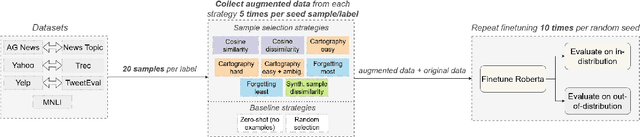


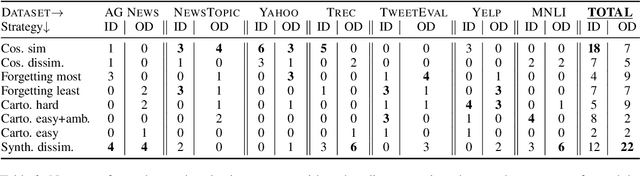
The generative large language models (LLMs) are increasingly used for data augmentation tasks, where text samples are paraphrased (or generated anew) and then used for classifier fine-tuning. Existing works on augmentation leverage the few-shot scenarios, where samples are given to LLMs as part of prompts, leading to better augmentations. Yet, the samples are mostly selected randomly and a comprehensive overview of the effects of other (more ``informed'') sample selection strategies is lacking. In this work, we compare sample selection strategies existing in few-shot learning literature and investigate their effects in LLM-based textual augmentation. We evaluate this on in-distribution and out-of-distribution classifier performance. Results indicate, that while some ``informed'' selection strategies increase the performance of models, especially for out-of-distribution data, it happens only seldom and with marginal performance increases. Unless further advances are made, a default of random sample selection remains a good option for augmentation practitioners.
LLMs vs Established Text Augmentation Techniques for Classification: When do the Benefits Outweight the Costs?
Aug 29, 2024The generative large language models (LLMs) are increasingly being used for data augmentation tasks, where text samples are LLM-paraphrased and then used for classifier fine-tuning. However, a research that would confirm a clear cost-benefit advantage of LLMs over more established augmentation methods is largely missing. To study if (and when) is the LLM-based augmentation advantageous, we compared the effects of recent LLM augmentation methods with established ones on 6 datasets, 3 classifiers and 2 fine-tuning methods. We also varied the number of seeds and collected samples to better explore the downstream model accuracy space. Finally, we performed a cost-benefit analysis and show that LLM-based methods are worthy of deployment only when very small number of seeds is used. Moreover, in many cases, established methods lead to similar or better model accuracies.