 Add to Chrome
 Add to Firefox
 Add to Edge
Smaller, Weaker, Yet Better: Training LLM Reasoners via Compute-Optimal Sampling
Aug 29, 2024
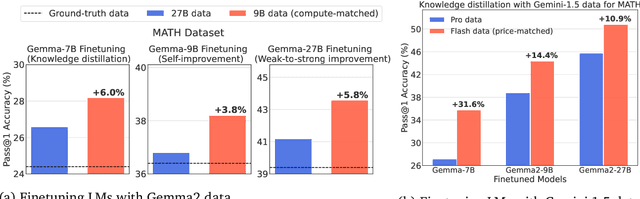


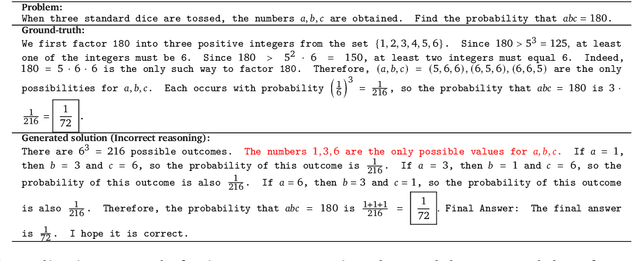
Training on high-quality synthetic data from strong language models (LMs) is a common strategy to improve the reasoning performance of LMs. In this work, we revisit whether this strategy is compute-optimal under a fixed inference budget (e.g., FLOPs). To do so, we investigate the trade-offs between generating synthetic data using a stronger but more expensive (SE) model versus a weaker but cheaper (WC) model. We evaluate the generated data across three key metrics: coverage, diversity, and false positive rate, and show that the data from WC models may have higher coverage and diversity, but also exhibit higher false positive rates. We then finetune LMs on data from SE and WC models in different settings: knowledge distillation, self-improvement, and a novel weak-to-strong improvement setup where a weaker LM teaches reasoning to a stronger LM. Our findings reveal that models finetuned on WC-generated data consistently outperform those trained on SE-generated data across multiple benchmarks and multiple choices of WC and SE models. These results challenge the prevailing practice of relying on SE models for synthetic data generation, suggesting that WC may be the compute-optimal approach for training advanced LM reasoners.

Generative Verifiers: Reward Modeling as Next-Token Prediction
Aug 27, 2024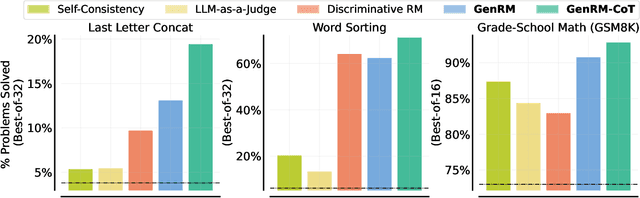
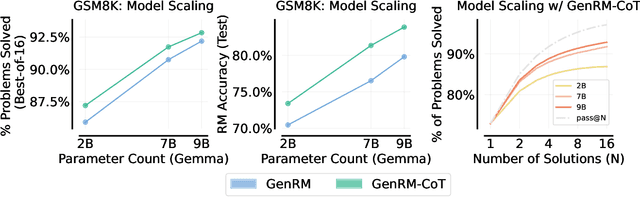
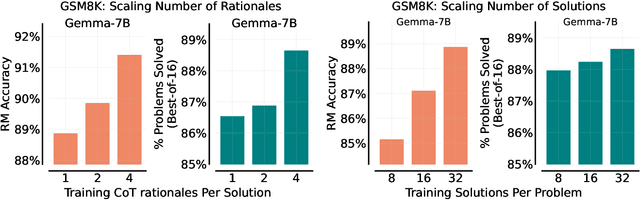
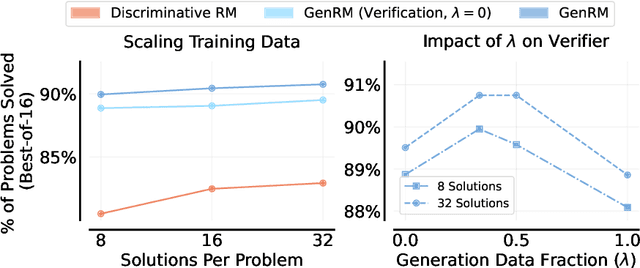
Verifiers or reward models are often used to enhance the reasoning performance of large language models (LLMs). A common approach is the Best-of-N method, where N candidate solutions generated by the LLM are ranked by a verifier, and the best one is selected. While LLM-based verifiers are typically trained as discriminative classifiers to score solutions, they do not utilize the text generation capabilities of pretrained LLMs. To overcome this limitation, we instead propose training verifiers using the ubiquitous next-token prediction objective, jointly on verification and solution generation. Compared to standard verifiers, such generative verifiers (GenRM) can benefit from several advantages of LLMs: they integrate seamlessly with instruction tuning, enable chain-of-thought reasoning, and can utilize additional inference-time compute via majority voting for better verification. We demonstrate that when using Gemma-based verifiers on algorithmic and grade-school math reasoning tasks, GenRM outperforms discriminative verifiers and LLM-as-a-Judge, showing a 16-64% improvement in the percentage of problems solved with Best-of-N. Furthermore, we show that GenRM scales favorably across dataset size, model capacity, and inference-time compute.
Gemma 2: Improving Open Language Models at a Practical Size
Aug 02, 2024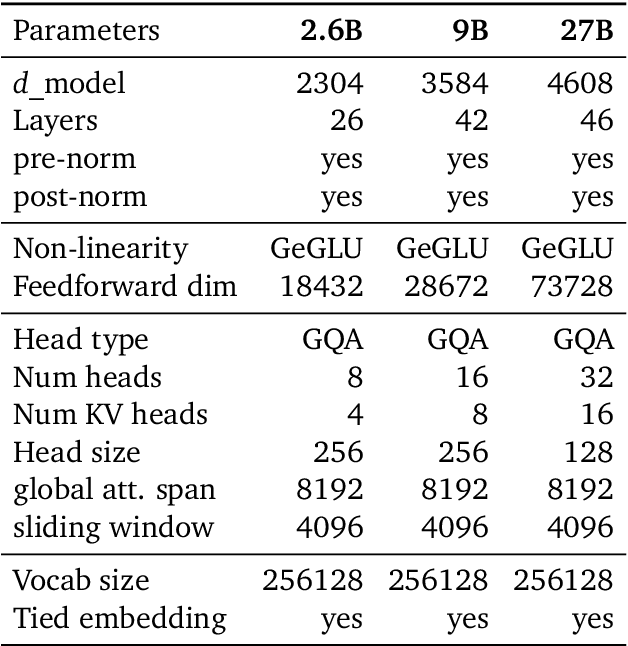
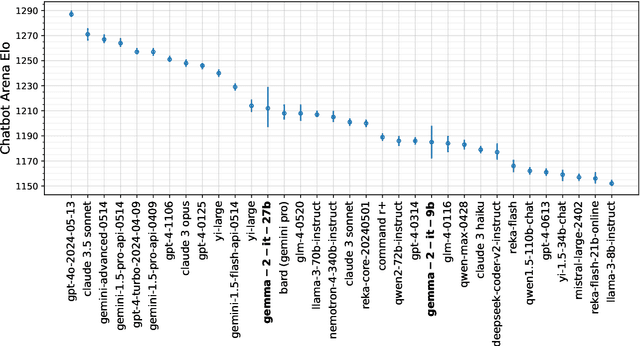
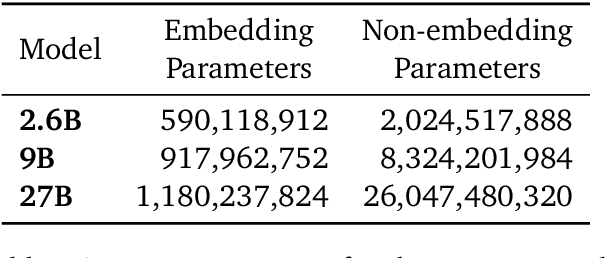
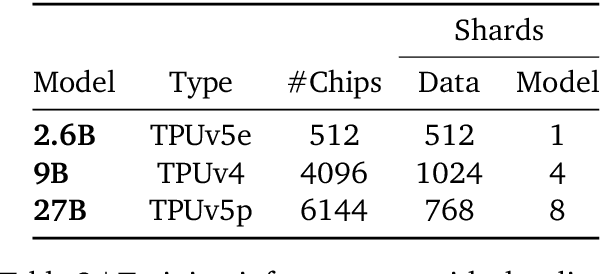
In this work, we introduce Gemma 2, a new addition to the Gemma family of lightweight, state-of-the-art open models, ranging in scale from 2 billion to 27 billion parameters. In this new version, we apply several known technical modifications to the Transformer architecture, such as interleaving local-global attentions (Beltagy et al., 2020a) and group-query attention (Ainslie et al., 2023). We also train the 2B and 9B models with knowledge distillation (Hinton et al., 2015) instead of next token prediction. The resulting models deliver the best performance for their size, and even offer competitive alternatives to models that are 2-3 times bigger. We release all our models to the community.
Don't Throw Away Data: Better Sequence Knowledge Distillation
Jul 15, 2024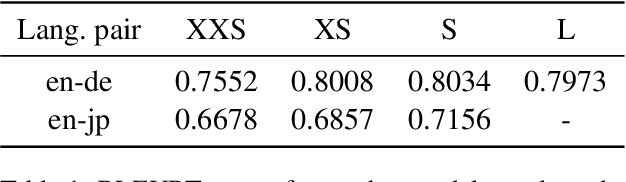
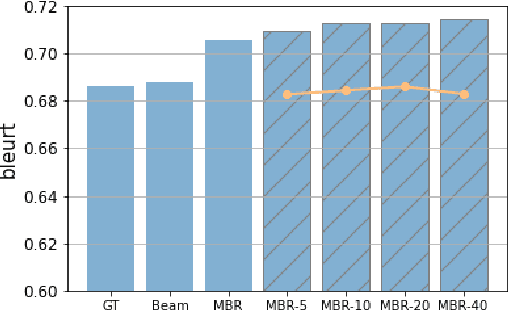

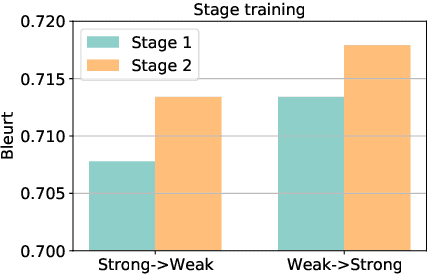
A critical component in knowledge distillation is the means of coupling the teacher and student. The predominant sequence knowledge distillation method involves supervised learning of the student against teacher-decoded outputs, and is exemplified by the current state of the art, which incorporates minimum Bayes risk (MBR) decoding. In this paper we seek to integrate MBR more tightly in distillation training, specifically by using several high scoring MBR translations, rather than a single selected sequence, thus capturing a rich diversity of teacher outputs. Our experiments on English to German and English to Japanese translation show consistent improvements over strong baseline methods for both tasks and with varying model sizes. Additionally, we conduct a detailed analysis focusing on data efficiency and capacity curse aspects to elucidate MBR-n and explore its further potential.
On scalable oversight with weak LLMs judging strong LLMs
Jul 05, 2024


Scalable oversight protocols aim to enable humans to accurately supervise superhuman AI. In this paper we study debate, where two AI's compete to convince a judge; consultancy, where a single AI tries to convince a judge that asks questions; and compare to a baseline of direct question-answering, where the judge just answers outright without the AI. We use large language models (LLMs) as both AI agents and as stand-ins for human judges, taking the judge models to be weaker than agent models. We benchmark on a diverse range of asymmetries between judges and agents, extending previous work on a single extractive QA task with information asymmetry, to also include mathematics, coding, logic and multimodal reasoning asymmetries. We find that debate outperforms consultancy across all tasks when the consultant is randomly assigned to argue for the correct/incorrect answer. Comparing debate to direct question answering, the results depend on the type of task: in extractive QA tasks with information asymmetry debate outperforms direct question answering, but in other tasks without information asymmetry the results are mixed. Previous work assigned debaters/consultants an answer to argue for. When we allow them to instead choose which answer to argue for, we find judges are less frequently convinced by the wrong answer in debate than in consultancy. Further, we find that stronger debater models increase judge accuracy, though more modestly than in previous studies.
SiT: Symmetry-Invariant Transformers for Generalisation in Reinforcement Learning
Jun 21, 2024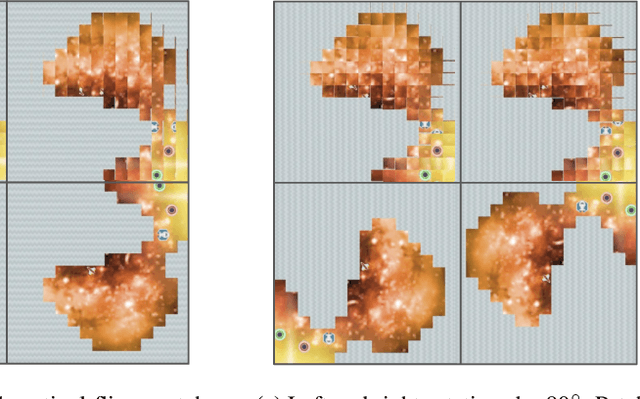
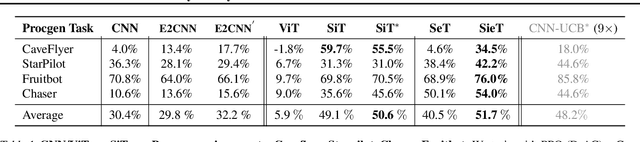

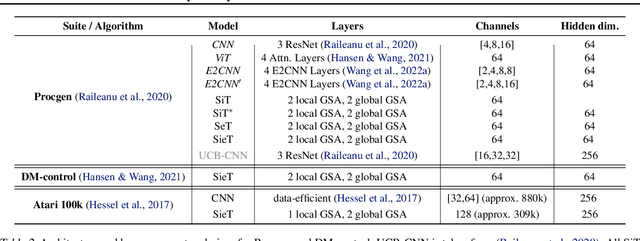
An open challenge in reinforcement learning (RL) is the effective deployment of a trained policy to new or slightly different situations as well as semantically-similar environments. We introduce Symmetry-Invariant Transformer (SiT), a scalable vision transformer (ViT) that leverages both local and global data patterns in a self-supervised manner to improve generalisation. Central to our approach is Graph Symmetric Attention, which refines the traditional self-attention mechanism to preserve graph symmetries, resulting in invariant and equivariant latent representations. We showcase SiT's superior generalization over ViTs on MiniGrid and Procgen RL benchmarks, and its sample efficiency on Atari 100k and CIFAR10.
Many-Shot In-Context Learning
Apr 17, 2024

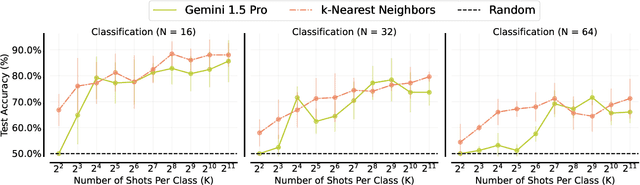
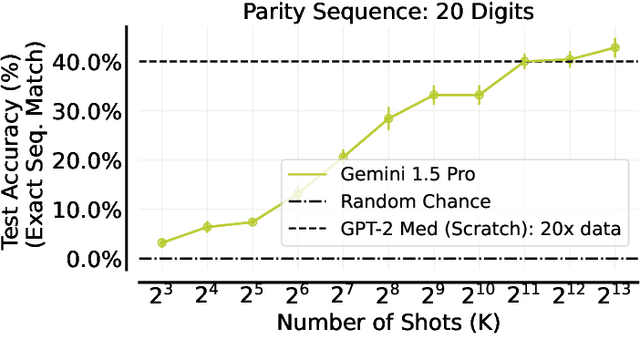
Large language models (LLMs) excel at few-shot in-context learning (ICL) -- learning from a few examples provided in context at inference, without any weight updates. Newly expanded context windows allow us to investigate ICL with hundreds or thousands of examples -- the many-shot regime. Going from few-shot to many-shot, we observe significant performance gains across a wide variety of generative and discriminative tasks. While promising, many-shot ICL can be bottlenecked by the available amount of human-generated examples. To mitigate this limitation, we explore two new settings: Reinforced and Unsupervised ICL. Reinforced ICL uses model-generated chain-of-thought rationales in place of human examples. Unsupervised ICL removes rationales from the prompt altogether, and prompts the model only with domain-specific questions. We find that both Reinforced and Unsupervised ICL can be quite effective in the many-shot regime, particularly on complex reasoning tasks. Finally, we demonstrate that, unlike few-shot learning, many-shot learning is effective at overriding pretraining biases and can learn high-dimensional functions with numerical inputs. Our analysis also reveals the limitations of next-token prediction loss as an indicator of downstream ICL performance.
Stop Regressing: Training Value Functions via Classification for Scalable Deep RL
Mar 06, 2024

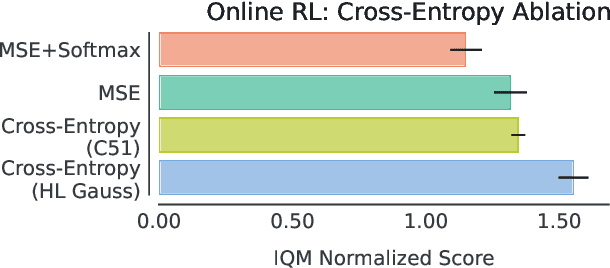

Value functions are a central component of deep reinforcement learning (RL). These functions, parameterized by neural networks, are trained using a mean squared error regression objective to match bootstrapped target values. However, scaling value-based RL methods that use regression to large networks, such as high-capacity Transformers, has proven challenging. This difficulty is in stark contrast to supervised learning: by leveraging a cross-entropy classification loss, supervised methods have scaled reliably to massive networks. Observing this discrepancy, in this paper, we investigate whether the scalability of deep RL can also be improved simply by using classification in place of regression for training value functions. We demonstrate that value functions trained with categorical cross-entropy significantly improves performance and scalability in a variety of domains. These include: single-task RL on Atari 2600 games with SoftMoEs, multi-task RL on Atari with large-scale ResNets, robotic manipulation with Q-transformers, playing Chess without search, and a language-agent Wordle task with high-capacity Transformers, achieving state-of-the-art results on these domains. Through careful analysis, we show that the benefits of categorical cross-entropy primarily stem from its ability to mitigate issues inherent to value-based RL, such as noisy targets and non-stationarity. Overall, we argue that a simple shift to training value functions with categorical cross-entropy can yield substantial improvements in the scalability of deep RL at little-to-no cost.
Transformers Can Achieve Length Generalization But Not Robustly
Feb 14, 2024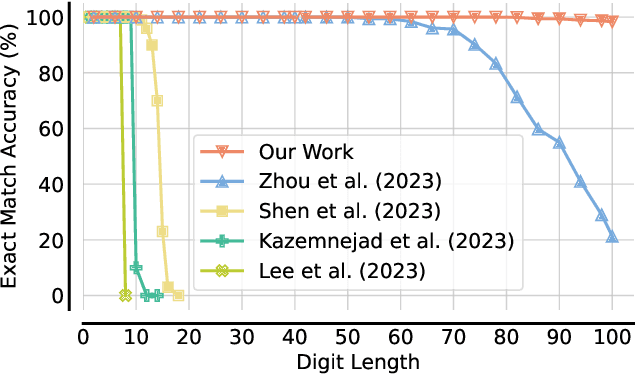
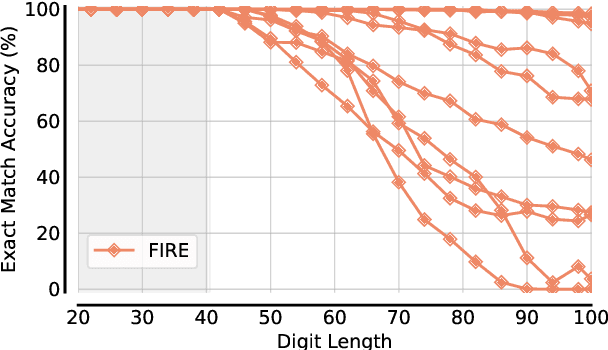
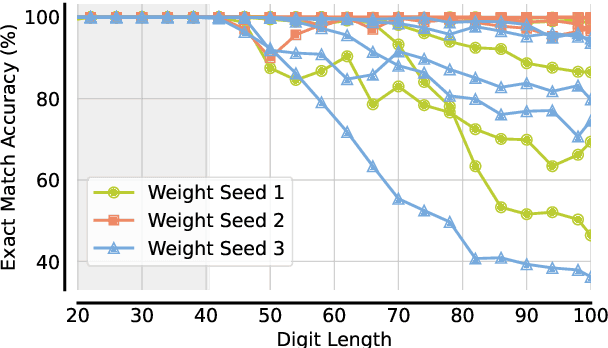
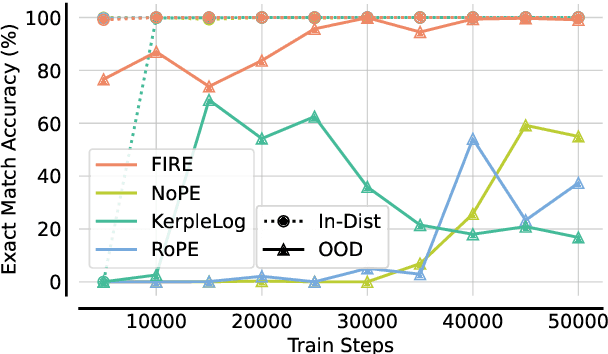
Length generalization, defined as the ability to extrapolate from shorter training sequences to longer test ones, is a significant challenge for language models. This issue persists even with large-scale Transformers handling relatively straightforward tasks. In this paper, we test the Transformer's ability of length generalization using the task of addition of two integers. We show that the success of length generalization is intricately linked to the data format and the type of position encoding. Using the right combination of data format and position encodings, we show for the first time that standard Transformers can extrapolate to a sequence length that is 2.5x the input length. Nevertheless, unlike in-distribution generalization, length generalization remains fragile, significantly influenced by factors like random weight initialization and training data order, leading to large variances across different random seeds.
V-STaR: Training Verifiers for Self-Taught Reasoners
Feb 09, 2024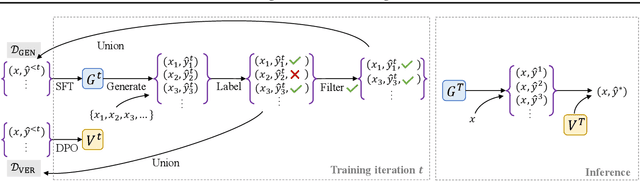
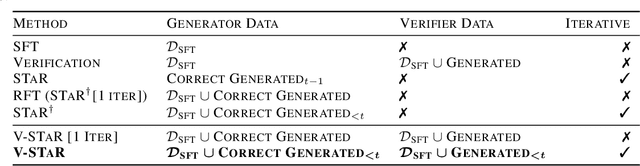
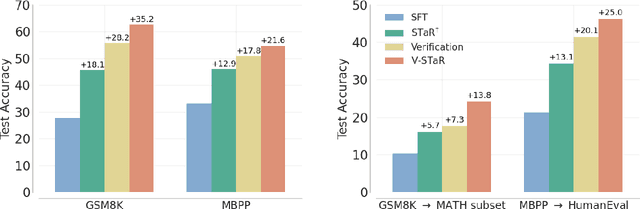
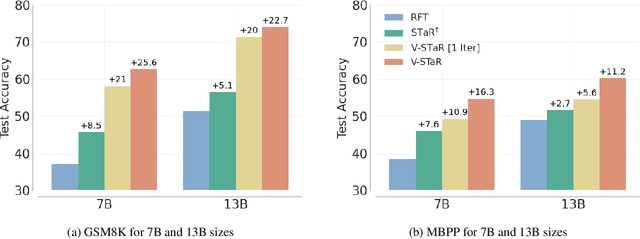
Common self-improvement approaches for large language models (LLMs), such as STaR (Zelikman et al., 2022), iteratively fine-tune LLMs on self-generated solutions to improve their problem-solving ability. However, these approaches discard the large amounts of incorrect solutions generated during this process, potentially neglecting valuable information in such solutions. To address this shortcoming, we propose V-STaR that utilizes both the correct and incorrect solutions generated during the self-improvement process to train a verifier using DPO that judges correctness of model-generated solutions. This verifier is used at inference time to select one solution among many candidate solutions. Running V-STaR for multiple iterations results in progressively better reasoners and verifiers, delivering a 4% to 17% test accuracy improvement over existing self-improvement and verification approaches on common code generation and math reasoning benchmarks with LLaMA2 models.