 Add to Chrome
 Add to Firefox
 Add to Edge
Efficient Safety Alignment of Language Models via Latent Personality Traits
Jul 08, 2026
Current safety methods for large language models are known to be vulnerable to adversarial attacks, motivating research into robust alternatives. Latent Adversarial Training (LAT) is among the most effective defenses, but can degrade utility and requires training on large datasets of harmful prompts. We introduce Latent Personality Alignment (LPA), which replaces explicit harm refusal with adversarial training on just 66 harm-agnostic statements drawn from psychometric personality literature. We hypothesize that personality-anchored representations share latent structure with harm avoidance, so adversarially stabilizing them implicitly constrains the subspace exploited by jailbreak attacks. LPA achieves near-zero attack success rates on HarmBench across direct requests and five jailbreak methods, despite never seeing harmful content during training and no loss of performance on standard benchmarks. Moreover, the training process is lightweight; the entire procedure completes in minutes on a single GPU and uses 75x fewer examples than standard LAT. Extensive ablations demonstrate the robustness, efficiency, and generalization of our method.

How Much is Left? LLMs Linearly Encode Their Remaining Output Length
Jul 06, 2026Large language models generate one token at a time, yet their responses show remarkably consistent length structure: step-by-step solutions converge in predictable token counts, retrievals stop after a few sentences, retractions extend responses by measurable amounts. We ask whether the model carries an internal estimate of how much response remains. Training minimal-capacity linear probes on frozen hidden states of three open-weight 7-8B models across seven completion-style datasets, we find three converging pieces of evidence. First, total response length is linearly decodable from the prompt's last hidden state alone, before any output is emitted. Second, probe directions trained on natural-language datasets transfer broadly, including to controlled synthetic completions never seen in training, outperforming a statistical baseline; the converse direction generally fails, and this asymmetry is itself informative. Third, on curated high-loss completions, the probe's per-position estimate shifts upward at the moment the model retracts and restarts a partial solution, a directional behavior no position-only predictor can reproduce (qualitative, not aggregate). We frame this as approximate estimation of remaining generation length, distinct from exact-counting impossibility results for transformers, and interpret it as evidence that LLMs maintain a plan-like internal representation of output length (decodable, not necessarily used causally).
Safety from Honesty in a Disinterested AI Predictor
Jun 28, 2026As AI systems become more capable, training procedures that optimize for downstream outcomes risk introducing implicit agency: goal-directed behavior that designers never specified. We present a formal safety argument for the Scientist AI (SAI) Predictor, trained to approximate the Bayesian posterior conditioned on a dataset of "epistemically contextualized" natural-language statements. We argue that such a Predictor can honestly predict agents, actions, and their consequences without itself being an agent that selects outputs to achieve goals. This rests on data representation and on the training procedure. Epistemic contextualization of text distinguishes latent factual claims from communication acts, so expressions of goals are treated as evidence to be explained rather than drives the model adopts. With a posterior-seeking training objective, this is intended to drive the Predictor toward calibrated, cautious predictions. Training proceeds so downstream effects of deploying a prediction never serve as a reward signal; any agency the system needs is supplied by explicit scaffolding constrained by guardrails. We prove that, under assumptions on the training dynamics and on the argued sparsity of dangerous Predictors, the probability that training produces a Predictor whose guarded deployment carries residual harm above a specified threshold is small: a dangerous Predictor would have to underestimate harm in a coordinated way across many queries while such coordinated patterns are rare under the initialization distribution and receive no direct training signal. Safety and accuracy are jointly supported in this framework, since the constraints that secure accuracy are the same ones that make coordinated deception costly. These guarantees against misalignment and agency arising from within the Predictor itself do not preclude the use of the Predictor as part of an agentic system.
Beyond Scalar Rewards: An Axiomatic Framework for Lexicographic MDPs
May 17, 2025Recent work has formalized the reward hypothesis through the lens of expected utility theory, by interpreting reward as utility. Hausner's foundational work showed that dropping the continuity axiom leads to a generalization of expected utility theory where utilities are lexicographically ordered vectors of arbitrary dimension. In this paper, we extend this result by identifying a simple and practical condition under which preferences cannot be represented by scalar rewards, necessitating a 2-dimensional reward function. We provide a full characterization of such reward functions, as well as the general d-dimensional case, in Markov Decision Processes (MDPs) under a memorylessness assumption on preferences. Furthermore, we show that optimal policies in this setting retain many desirable properties of their scalar-reward counterparts, while in the Constrained MDP (CMDP) setting -- another common multiobjective setting -- they do not.
Superintelligent Agents Pose Catastrophic Risks: Can Scientist AI Offer a Safer Path?
Feb 21, 2025The leading AI companies are increasingly focused on building generalist AI agents -- systems that can autonomously plan, act, and pursue goals across almost all tasks that humans can perform. Despite how useful these systems might be, unchecked AI agency poses significant risks to public safety and security, ranging from misuse by malicious actors to a potentially irreversible loss of human control. We discuss how these risks arise from current AI training methods. Indeed, various scenarios and experiments have demonstrated the possibility of AI agents engaging in deception or pursuing goals that were not specified by human operators and that conflict with human interests, such as self-preservation. Following the precautionary principle, we see a strong need for safer, yet still useful, alternatives to the current agency-driven trajectory. Accordingly, we propose as a core building block for further advances the development of a non-agentic AI system that is trustworthy and safe by design, which we call Scientist AI. This system is designed to explain the world from observations, as opposed to taking actions in it to imitate or please humans. It comprises a world model that generates theories to explain data and a question-answering inference machine. Both components operate with an explicit notion of uncertainty to mitigate the risks of overconfident predictions. In light of these considerations, a Scientist AI could be used to assist human researchers in accelerating scientific progress, including in AI safety. In particular, our system can be employed as a guardrail against AI agents that might be created despite the risks involved. Ultimately, focusing on non-agentic AI may enable the benefits of AI innovation while avoiding the risks associated with the current trajectory. We hope these arguments will motivate researchers, developers, and policymakers to favor this safer path.
Can Safety Fine-Tuning Be More Principled? Lessons Learned from Cybersecurity
Jan 19, 2025As LLMs develop increasingly advanced capabilities, there is an increased need to minimize the harm that could be caused to society by certain model outputs; hence, most LLMs have safety guardrails added, for example via fine-tuning. In this paper, we argue the position that current safety fine-tuning is very similar to a traditional cat-and-mouse game (or arms race) between attackers and defenders in cybersecurity. Model jailbreaks and attacks are patched with bandaids to target the specific attack mechanism, but many similar attack vectors might remain. When defenders are not proactively coming up with principled mechanisms, it becomes very easy for attackers to sidestep any new defenses. We show how current defenses are insufficient to prevent new adversarial jailbreak attacks, reward hacking, and loss of control problems. In order to learn from past mistakes in cybersecurity, we draw analogies with historical examples and develop lessons learned that can be applied to LLM safety. These arguments support the need for new and more principled approaches to designing safe models, which are architected for security from the beginning. We describe several such approaches from the AI literature.
Addressing Sample Inefficiency in Multi-View Representation Learning
Dec 17, 2023
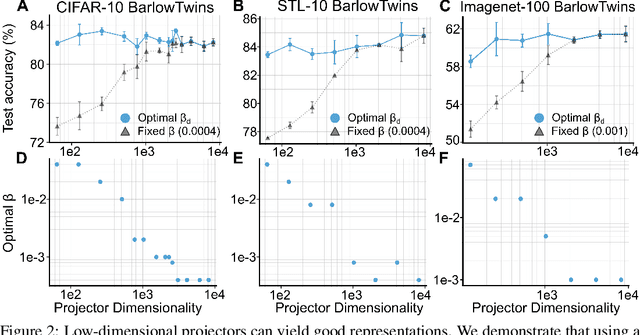
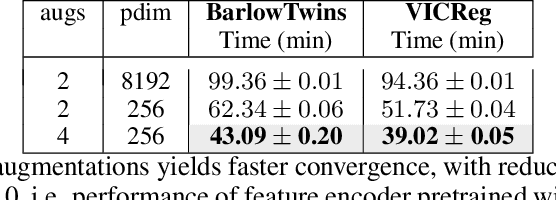

Non-contrastive self-supervised learning (NC-SSL) methods like BarlowTwins and VICReg have shown great promise for label-free representation learning in computer vision. Despite the apparent simplicity of these techniques, researchers must rely on several empirical heuristics to achieve competitive performance, most notably using high-dimensional projector heads and two augmentations of the same image. In this work, we provide theoretical insights on the implicit bias of the BarlowTwins and VICReg loss that can explain these heuristics and guide the development of more principled recommendations. Our first insight is that the orthogonality of the features is more critical than projector dimensionality for learning good representations. Based on this, we empirically demonstrate that low-dimensional projector heads are sufficient with appropriate regularization, contrary to the existing heuristic. Our second theoretical insight suggests that using multiple data augmentations better represents the desiderata of the SSL objective. Based on this, we demonstrate that leveraging more augmentations per sample improves representation quality and trainability. In particular, it improves optimization convergence, leading to better features emerging earlier in the training. Remarkably, we demonstrate that we can reduce the pretraining dataset size by up to 4x while maintaining accuracy and improving convergence simply by using more data augmentations. Combining these insights, we present practical pretraining recommendations that improve wall-clock time by 2x and improve performance on CIFAR-10/STL-10 datasets using a ResNet-50 backbone. Thus, this work provides a theoretical insight into NC-SSL and produces practical recommendations for enhancing its sample and compute efficiency.
EuclidNets: An Alternative Operation for Efficient Inference of Deep Learning Models
Dec 22, 2022With the advent of deep learning application on edge devices, researchers actively try to optimize their deployments on low-power and restricted memory devices. There are established compression method such as quantization, pruning, and architecture search that leverage commodity hardware. Apart from conventional compression algorithms, one may redesign the operations of deep learning models that lead to more efficient implementation. To this end, we propose EuclidNet, a compression method, designed to be implemented on hardware which replaces multiplication, $xw$, with Euclidean distance $(x-w)^2$. We show that EuclidNet is aligned with matrix multiplication and it can be used as a measure of similarity in case of convolutional layers. Furthermore, we show that under various transformations and noise scenarios, EuclidNet exhibits the same performance compared to the deep learning models designed with multiplication operations.
A Reproducible and Realistic Evaluation of Partial Domain Adaptation Methods
Oct 03, 2022
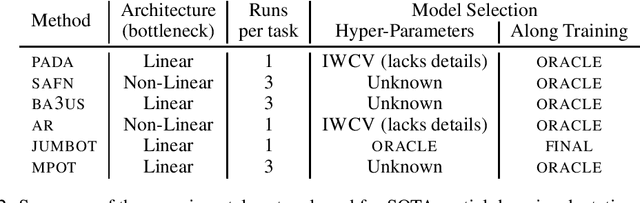

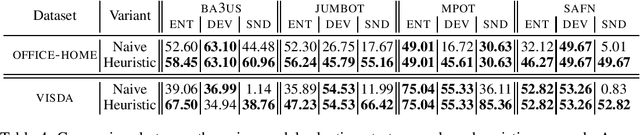
Unsupervised Domain Adaptation (UDA) aims at classifying unlabeled target images leveraging source labeled ones. In this work, we consider the Partial Domain Adaptation (PDA) variant, where we have extra source classes not present in the target domain. Most successful algorithms use model selection strategies that rely on target labels to find the best hyper-parameters and/or models along training. However, these strategies violate the main assumption in PDA: only unlabeled target domain samples are available. Moreover, there are also inconsistencies in the experimental settings - architecture, hyper-parameter tuning, number of runs - yielding unfair comparisons. The main goal of this work is to provide a realistic evaluation of PDA methods with the different model selection strategies under a consistent evaluation protocol. We evaluate 7 representative PDA algorithms on 2 different real-world datasets using 7 different model selection strategies. Our two main findings are: (i) without target labels for model selection, the accuracy of the methods decreases up to 30 percentage points; (ii) only one method and model selection pair performs well on both datasets. Experiments were performed with our PyTorch framework, BenchmarkPDA, which we open source.
On the Generalization of Representations in Reinforcement Learning
Mar 01, 2022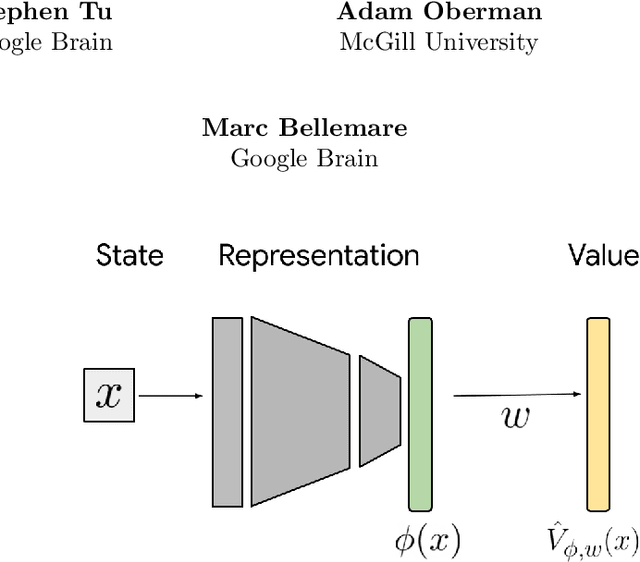
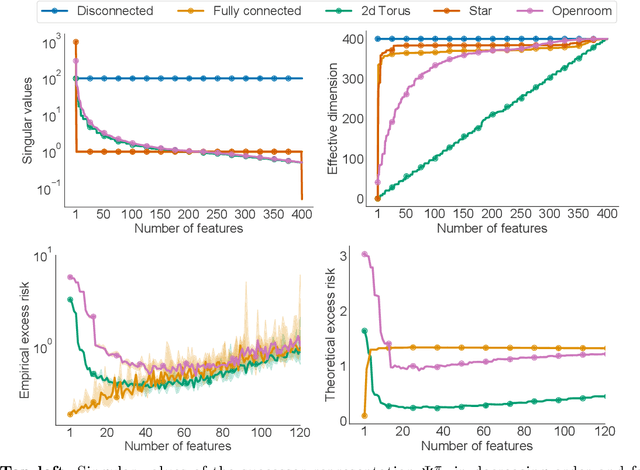
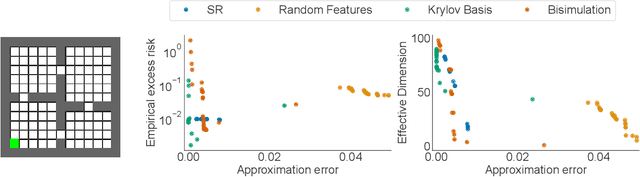
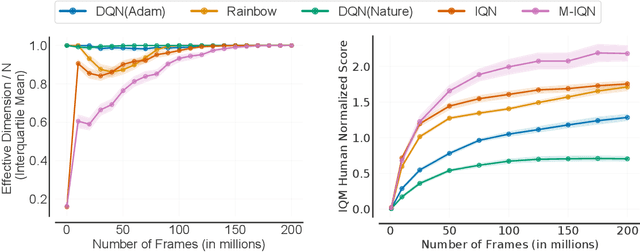
In reinforcement learning, state representations are used to tractably deal with large problem spaces. State representations serve both to approximate the value function with few parameters, but also to generalize to newly encountered states. Their features may be learned implicitly (as part of a neural network) or explicitly (for example, the successor representation of \citet{dayan1993improving}). While the approximation properties of representations are reasonably well-understood, a precise characterization of how and when these representations generalize is lacking. In this work, we address this gap and provide an informative bound on the generalization error arising from a specific state representation. This bound is based on the notion of effective dimension which measures the degree to which knowing the value at one state informs the value at other states. Our bound applies to any state representation and quantifies the natural tension between representations that generalize well and those that approximate well. We complement our theoretical results with an empirical survey of classic representation learning methods from the literature and results on the Arcade Learning Environment, and find that the generalization behaviour of learned representations is well-explained by their effective dimension.