 Add to Chrome
 Add to Firefox
 Add to Edge
MPA: Multimodal Prototype Augmentation for Few-Shot Learning
Feb 09, 2026
Recently, few-shot learning (FSL) has become a popular task that aims to recognize new classes from only a few labeled examples and has been widely applied in fields such as natural science, remote sensing, and medical images. However, most existing methods focus only on the visual modality and compute prototypes directly from raw support images, which lack comprehensive and rich multimodal information. To address these limitations, we propose a novel Multimodal Prototype Augmentation FSL framework called MPA, including LLM-based Multi-Variant Semantic Enhancement (LMSE), Hierarchical Multi-View Augmentation (HMA), and an Adaptive Uncertain Class Absorber (AUCA). LMSE leverages large language models to generate diverse paraphrased category descriptions, enriching the support set with additional semantic cues. HMA exploits both natural and multi-view augmentations to enhance feature diversity (e.g., changes in viewing distance, camera angles, and lighting conditions). AUCA models uncertainty by introducing uncertain classes via interpolation and Gaussian sampling, effectively absorbing uncertain samples. Extensive experiments on four single-domain and six cross-domain FSL benchmarks demonstrate that MPA achieves superior performance compared to existing state-of-the-art methods across most settings. Notably, MPA surpasses the second-best method by 12.29% and 24.56% in the single-domain and cross-domain setting, respectively, in the 5-way 1-shot setting.

FactGuard: Event-Centric and Commonsense-Guided Fake News Detection
Nov 13, 2025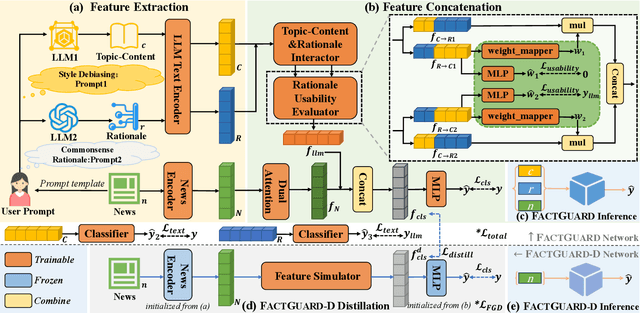
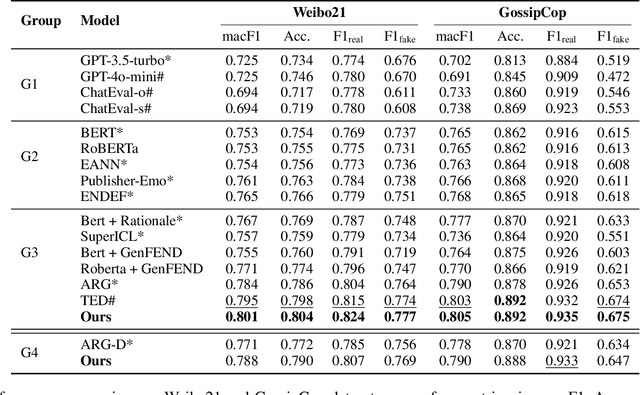
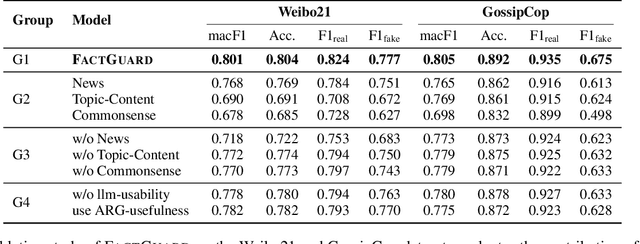
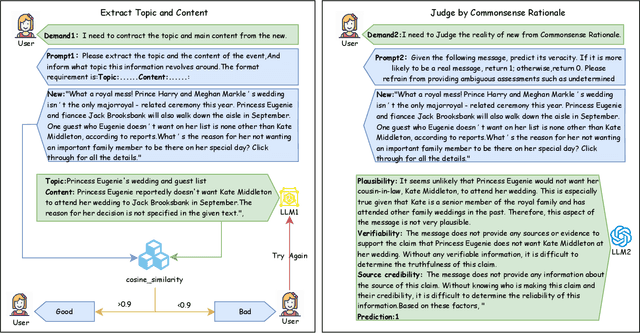
Fake news detection methods based on writing style have achieved remarkable progress. However, as adversaries increasingly imitate the style of authentic news, the effectiveness of such approaches is gradually diminishing. Recent research has explored incorporating large language models (LLMs) to enhance fake news detection. Yet, despite their transformative potential, LLMs remain an untapped goldmine for fake news detection, with their real-world adoption hampered by shallow functionality exploration, ambiguous usability, and prohibitive inference costs. In this paper, we propose a novel fake news detection framework, dubbed FactGuard, that leverages LLMs to extract event-centric content, thereby reducing the impact of writing style on detection performance. Furthermore, our approach introduces a dynamic usability mechanism that identifies contradictions and ambiguous cases in factual reasoning, adaptively incorporating LLM advice to improve decision reliability. To ensure efficiency and practical deployment, we employ knowledge distillation to derive FactGuard-D, enabling the framework to operate effectively in cold-start and resource-constrained scenarios. Comprehensive experiments on two benchmark datasets demonstrate that our approach consistently outperforms existing methods in both robustness and accuracy, effectively addressing the challenges of style sensitivity and LLM usability in fake news detection.
Inference Attacks in Machine Learning as a Service: A Taxonomy, Review, and Promising Directions
Jun 04, 2024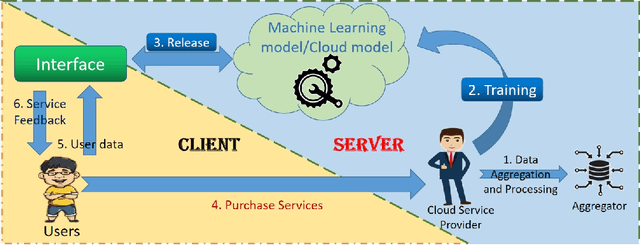

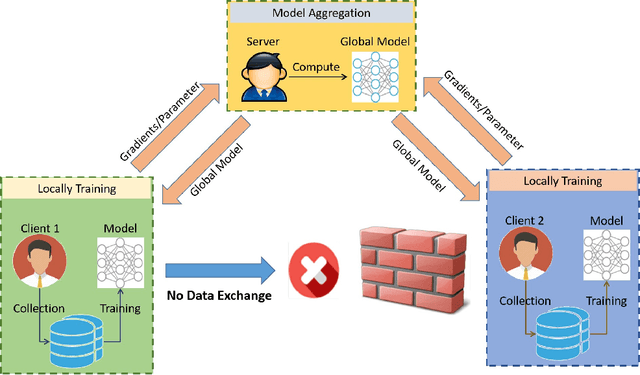

The prosperity of machine learning has also brought people's concerns about data privacy. Among them, inference attacks can implement privacy breaches in various MLaaS scenarios and model training/prediction phases. Specifically, inference attacks can perform privacy inference on undisclosed target training sets based on outputs of the target model, including but not limited to statistics, membership, semantics, data representation, etc. For instance, infer whether the target data has the characteristics of AIDS. In addition, the rapid development of the machine learning community in recent years, especially the surge of model types and application scenarios, has further stimulated the inference attacks' research. Thus, studying inference attacks and analyzing them in depth is urgent and significant. However, there is still a gap in the systematic discussion of inference attacks from taxonomy, global perspective, attack, and defense perspectives. This survey provides an in-depth and comprehensive inference of attacks and corresponding countermeasures in ML-as-a-service based on taxonomy and the latest researches. Without compromising researchers' intuition, we first propose the 3MP taxonomy based on the community research status, trying to normalize the confusing naming system of inference attacks. Also, we analyze the pros and cons of each type of inference attack, their workflow, countermeasure, and how they interact with other attacks. In the end, we point out several promising directions for researchers from a more comprehensive and novel perspective.