 Add to Chrome
 Add to Firefox
 Add to Edge
Croissant Baker: Metadata Generation for Discoverable, Governable, and Reusable ML Datasets
May 14, 2026
Croissant has emerged as the metadata standard for machine learning datasets, providing a structured, JSON-LD-based format that makes dataset discovery, automated ingestion, and reproducible analysis machine-checkable across ML platforms. Adoption has accelerated, and NeurIPS now requires Croissant metadata in every submission to its dataset tracks. Yet in practice Croissant generation usually starts with uploading data to a public platform, a path infeasible for governed and large local repositories that hold much of the high-value data ML increasingly relies on. We release Croissant Baker, a local-first, open-source command-line tool that generates validated Croissant metadata directly from a dataset directory through a modular handler registry. We evaluate Croissant Baker on over 140 datasets, scaling to MIMIC-IV at 886 million rows and 374 Parquet files. On held-out comparisons against producer-authored or standards-derived ground truth, Croissant Baker reaches 97-100% agreement across multiple domains.

Towards Optimizing and Evaluating a Retrieval Augmented QA Chatbot using LLMs with Human in the Loop
Jul 08, 2024
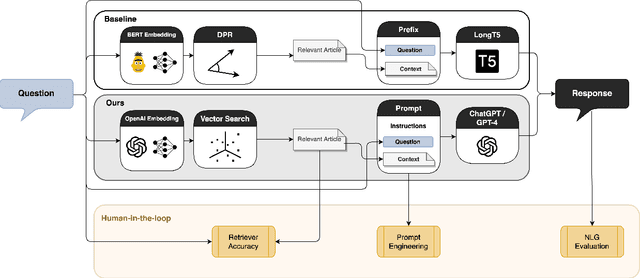
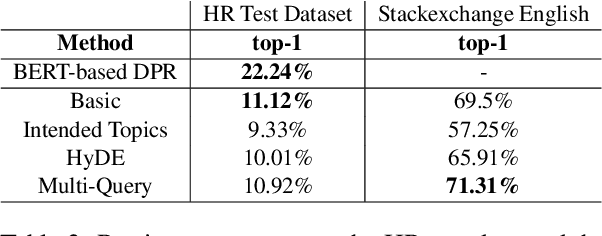
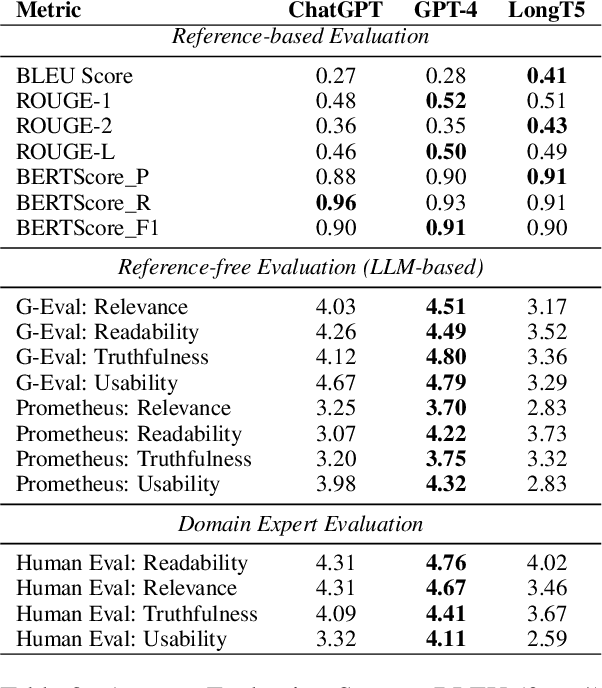
Large Language Models have found application in various mundane and repetitive tasks including Human Resource (HR) support. We worked with the domain experts of SAP SE to develop an HR support chatbot as an efficient and effective tool for addressing employee inquiries. We inserted a human-in-the-loop in various parts of the development cycles such as dataset collection, prompt optimization, and evaluation of generated output. By enhancing the LLM-driven chatbot's response quality and exploring alternative retrieval methods, we have created an efficient, scalable, and flexible tool for HR professionals to address employee inquiries effectively. Our experiments and evaluation conclude that GPT-4 outperforms other models and can overcome inconsistencies in data through internal reasoning capabilities. Additionally, through expert analysis, we infer that reference-free evaluation metrics such as G-Eval and Prometheus demonstrate reliability closely aligned with that of human evaluation.