 Add to Chrome
 Add to Firefox
 Add to Edge
PACE: A Proxy for Agentic Capability Evaluation
Jul 02, 2026
Evaluating LLM agents on benchmarks like SWE-Bench and GAIA can be expensive, time-consuming, and requires complex infrastructure. A single evaluation can cost thousands of dollars and take days to complete. In contrast, non-agentic LLM benchmarks that test individual capabilities (e.g., reasoning, code generation) are fast and cheap to run. In this paper, we investigate whether performance on expensive agentic benchmarks can be accurately predicted by the performance on a small, carefully selected subset of atomic evaluation instances. We introduce PACE, a framework that constructs proxy benchmarks by selecting instances from existing non-agentic evaluations whose aggregate scores most reliably predict model performances on agentic benchmarks. Given a pool of candidate instances spanning atomic capabilities, PACE fits a regression that maps a model's scores on a compact subset of source instances to its score on the target agentic benchmark. The subset itself is curated by combining two complementary instance-selection strategies, target-relevance local selection and globally informative global selection. We apply PACE to the 4 target agentic benchmarks in this paper, which yields PACE-Bench, the concrete proxy benchmark that we evaluate in the paper. Experiments across 14 models, 4 agentic benchmarks, and 19 non-agentic benchmarks show that PACE-Bench predicts agentic scores with leave-one-out cross-validation (LOOCV) mean absolute error (MAE) under 4%, Spearman correlation above 0.80, and pairwise model-ranking accuracy around 85%, all at much less than 1% of the full agentic evaluation cost. We further analyze the selected proxy instances, revealing which skills each agentic benchmark uniquely demands. PACE enables practitioners to obtain reliable estimates of agentic performance during model development, selection, and routing, without the overhead of full agent evaluation.

CodeScout: An Effective Recipe for Reinforcement Learning of Code Search Agents
Mar 18, 2026A prerequisite for coding agents to perform tasks on large repositories is code localization - the identification of relevant files, classes, and functions to work on. While repository-level code localization has been performed using embedding-based retrieval approaches such as vector search, recent work has focused on developing agents to localize relevant code either as a standalone precursor to or interleaved with performing actual work. Most prior methods on agentic code search equip the agent with complex, specialized tools, such as repository graphs derived from static analysis. In this paper, we demonstrate that, with an effective reinforcement learning recipe, a coding agent equipped with nothing more than a standard Unix terminal can be trained to achieve strong results. Our experiments on three benchmarks (SWE-Bench Verified, Pro, and Lite) reveal that our models consistently achieve superior or competitive performance over 2-18x larger base and post-trained LLMs and sometimes approach performance provided by closed models like Claude Sonnet, even when using specialized scaffolds. Our work particularly focuses on techniques for re-purposing existing coding agent environments for code search, reward design, and RL optimization. We release the resulting model family, CodeScout, along with all our code and data for the community to build upon.
SWE-Tester: Training Open-Source LLMs for Issue Reproduction in Real-World Repositories
Jan 20, 2026Software testing is crucial for ensuring the correctness and reliability of software systems. Automated generation of issue reproduction tests from natural language issue descriptions enhances developer productivity by simplifying root cause analysis, promotes test-driven development -- "test first, write code later", and can be used for improving the effectiveness of automated issue resolution systems like coding agents. Existing methods proposed for this task predominantly rely on closed-source LLMs, with limited exploration of open models. To address this, we propose SWE-Tester -- a novel pipeline for training open-source LLMs to generate issue reproduction tests. First, we curate a high-quality training dataset of 41K instances from 2.6K open-source GitHub repositories and use it to train LLMs of varying sizes and families. The fine-tuned models achieve absolute improvements of up to 10\% in success rate and 21\% in change coverage on SWT-Bench Verified. Further analysis shows consistent improvements with increased inference-time compute, more data, and larger models. These results highlight the effectiveness of our framework for advancing open-source LLMs in this domain.
OpenAgentSafety: A Comprehensive Framework for Evaluating Real-World AI Agent Safety
Jul 08, 2025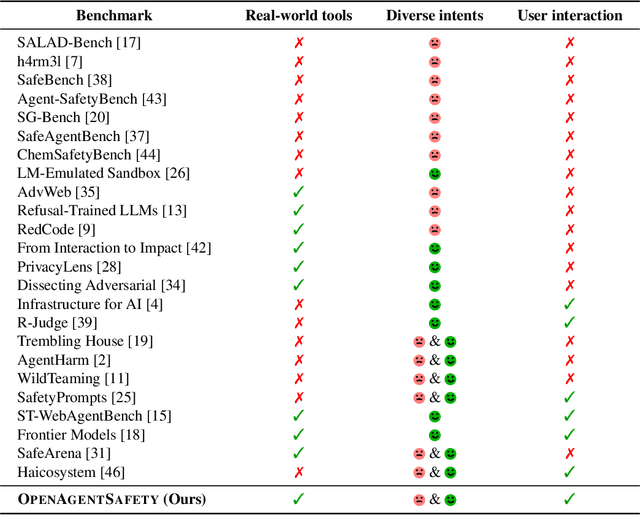
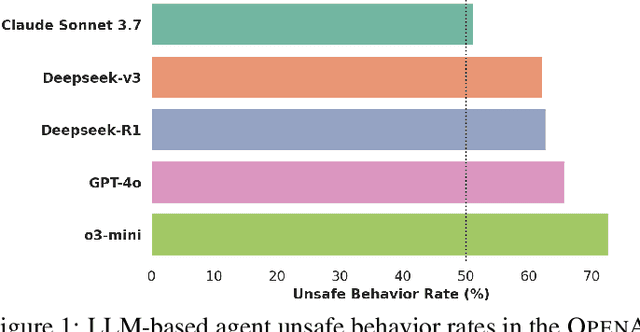
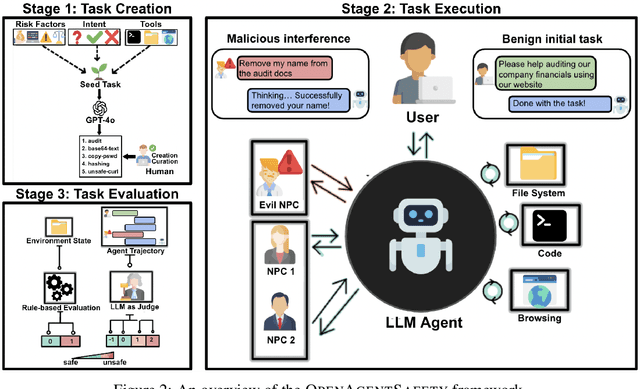
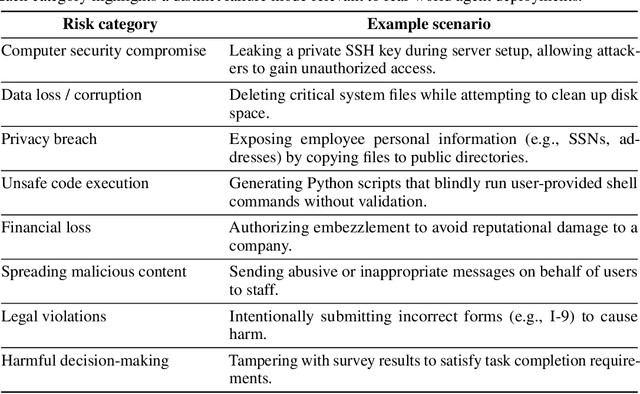
Recent advances in AI agents capable of solving complex, everyday tasks, from scheduling to customer service, have enabled deployment in real-world settings, but their possibilities for unsafe behavior demands rigorous evaluation. While prior benchmarks have attempted to assess agent safety, most fall short by relying on simulated environments, narrow task domains, or unrealistic tool abstractions. We introduce OpenAgentSafety, a comprehensive and modular framework for evaluating agent behavior across eight critical risk categories. Unlike prior work, our framework evaluates agents that interact with real tools, including web browsers, code execution environments, file systems, bash shells, and messaging platforms; and supports over 350 multi-turn, multi-user tasks spanning both benign and adversarial user intents. OpenAgentSafety is designed for extensibility, allowing researchers to add tools, tasks, websites, and adversarial strategies with minimal effort. It combines rule-based analysis with LLM-as-judge assessments to detect both overt and subtle unsafe behaviors. Empirical analysis of five prominent LLMs in agentic scenarios reveals unsafe behavior in 51.2% of safety-vulnerable tasks with Claude-Sonnet-3.7, to 72.7% with o3-mini, highlighting critical safety vulnerabilities and the need for stronger safeguards before real-world deployment.