 Add to Chrome
 Add to Firefox
 Add to Edge
Predictable GRPO: A Closed-Form Model of Training Dynamics
Jul 01, 2026
We develop a first-principles reduced-order model of these dynamics. Under a single mean-field assumption that summarizes the policy by its expected reward, we reduce the GRPO update to a stochastically-forced damped oscillator whose mass, damping, and stiffness are fixed in closed form by the optimizer hyperparameters together with a single measured curvature scale -- momentum supplies the inertia, off-policy lag erodes the damping, and the group size enters, to leading order, as a noise temperature. The reduction has three consequences. First, it subsumes the empirical single-exponential saturation law as its overdamped limit, recasting the fitted plateau, timescale, and size exponent as the fixed point, inverse stiffness, and curvature-scaling exponent of the underlying potential, and adding, through the retained inertial term, the slow-start phase the single exponential cannot represent. Second, it yields predictions tied to independently measurable quantities rather than fitted ones: group-size invariance of the deterministic trajectory with a $1/G$ stationary fluctuation, a sharp stability threshold in the refresh interval, and an overdamped-to-oscillatory transition. Third, it furnishes diagnostics that separate failure modes a reward curve alone conflates -- reward hacking, advantage degeneracy, policy concentration, and dynamical instability. Across three models and two group sizes, the closed-form trajectory fits training reward to $R^2 \geq 0.91$ and the mean trajectory is group-size invariant to leading order -- on both the reward curve and out-of-distribution transfer to eight math benchmarks -- while the within-group reward spread retains a residual $G$-dependence that the leading-order temperature picture does not capture.

Predictive Scaling Laws for Efficient GRPO Training of Large Reasoning Models
Jul 24, 2025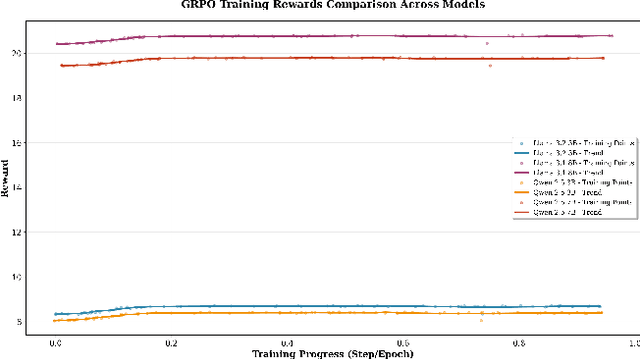
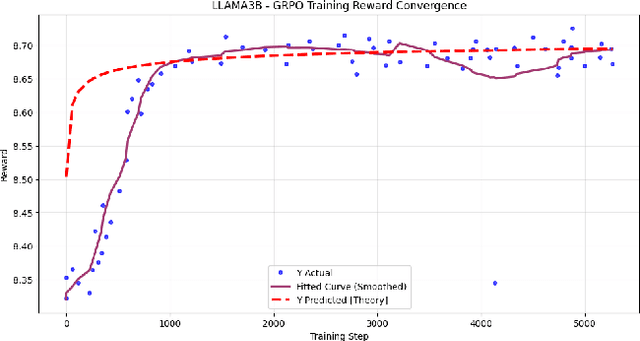
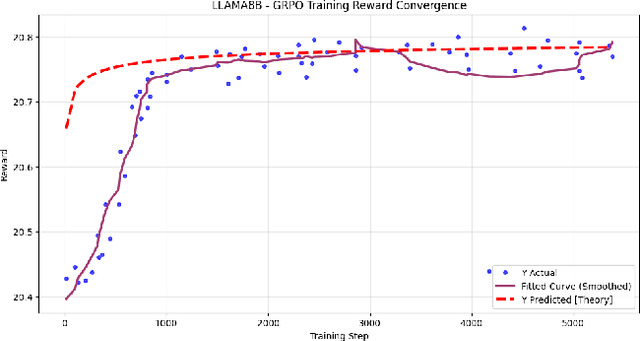
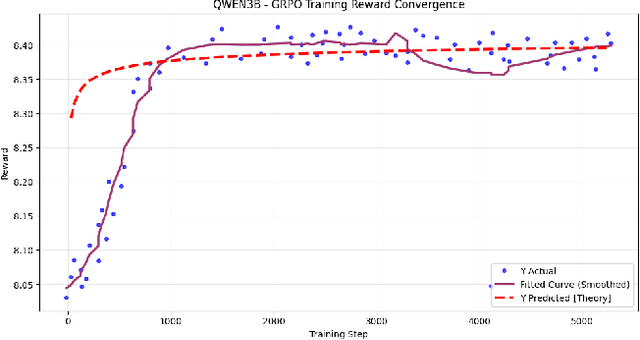
Fine-tuning large language models (LLMs) for reasoning tasks using reinforcement learning methods like Group Relative Policy Optimization (GRPO) is computationally expensive. To address this, we propose a predictive framework that models training dynamics and helps optimize resource usage. Through experiments on Llama and Qwen models (3B 8B), we derive an empirical scaling law based on model size, initial performance, and training progress. This law predicts reward trajectories and identifies three consistent training phases: slow start, rapid improvement, and plateau. We find that training beyond certain number of an epoch offers little gain, suggesting earlier stopping can significantly reduce compute without sacrificing performance. Our approach generalizes across model types, providing a practical guide for efficient GRPO-based fine-tuning.