 Add to Chrome
 Add to Firefox
 Add to Edge
$μ$Match: Foundation Models for Semi-supervised Learning and Domain Adaptation in EM
Jun 19, 2026
Vision foundation models have substantially advanced computer vision, enabling state-of-the-art performance in zero- and few-shot settings. They have been successfully applied to biomedical imaging tasks ranging from organ segmentation in computed tomography to cell segmentation in light microscopy. Electron microscopy (EM) is a central modality for analyzing cellular ultrastructure due to its nanometer-scale resolution. However, the application of foundation models in EM has so far been limited to specific organelles, such as mitochondria, largely due to the diversity of segmentation tasks and the scarcity of comprehensively annotated data. As a result, EM segmentation still predominantly relies on supervised learning, requiring extensive manual annotation and limiting ultrastructural analysis. To address this gap, we propose $μ$Match, a framework for semi-supervised learning and domain adaptation that leverages foundation models. We implement state-of-the-art student-teacher-based methods and evaluate multiple foundation models (SAM, SAM2, $μ$SAM, DINOv2/v3) on challenging EM tasks, including mitochondrion, nucleus, and neurite segmentation. Our results demonstrate consistent improvements over strong baselines and highlight a path toward substantially reducing the annotation effort in EM.

Croissant Baker: Metadata Generation for Discoverable, Governable, and Reusable ML Datasets
May 14, 2026Croissant has emerged as the metadata standard for machine learning datasets, providing a structured, JSON-LD-based format that makes dataset discovery, automated ingestion, and reproducible analysis machine-checkable across ML platforms. Adoption has accelerated, and NeurIPS now requires Croissant metadata in every submission to its dataset tracks. Yet in practice Croissant generation usually starts with uploading data to a public platform, a path infeasible for governed and large local repositories that hold much of the high-value data ML increasingly relies on. We release Croissant Baker, a local-first, open-source command-line tool that generates validated Croissant metadata directly from a dataset directory through a modular handler registry. We evaluate Croissant Baker on over 140 datasets, scaling to MIMIC-IV at 886 million rows and 374 Parquet files. On held-out comparisons against producer-authored or standards-derived ground truth, Croissant Baker reaches 97-100% agreement across multiple domains.
Evaluating Vision Foundation Models for Pixel and Object Classification in Microscopy
Mar 20, 2026Deep learning underlies most modern approaches and tools in computer vision, including biomedical imaging. However, for interactive semantic segmentation (often called pixel classification in this context) and interactive object-level classification (object classification), feature-based shallow learning remains widely used. This is due to the diversity of data in this domain, the lack of large pretraining datasets, and the need for computational and label efficiency. In contrast, state-of-the-art tools for many other vision tasks in microscopy - most notably cellular instance segmentation - already rely on deep learning and have recently benefited substantially from vision foundation models (VFMs), particularly SAM. Here, we investigate whether VFMs can also improve pixel and object classification compared to current approaches. To this end, we evaluate several VFMs, including general-purpose models (SAM, SAM2, DINOv3) and domain-specific ones ($μ$SAM, PathoSAM), in combination with shallow learning and attentive probing on five diverse and challenging datasets. Our results demonstrate consistent improvements over hand-crafted features and provide a clear pathway toward practical improvements. Furthermore, our study establishes a benchmark for VFMs in microscopy and informs future developments in this area.
Revisiting foundation models for cell instance segmentation
Mar 18, 2026Cell segmentation is a fundamental task in microscopy image analysis. Several foundation models for cell segmentation have been introduced, virtually all of them are extensions of Segment Anything Model (SAM), improving it for microscopy data. Recently, SAM2 and SAM3 have been published, further improving and extending the capabilities of general-purpose segmentation foundation models. Here, we comprehensively evaluate foundation models for cell segmentation (CellPoseSAM, CellSAM, $μ$SAM) and for general-purpose segmentation (SAM, SAM2, SAM3) on a diverse set of (light) microscopy datasets, for tasks including cell, nucleus and organoid segmentation. Furthermore, we introduce a new instance segmentation strategy called automatic prompt generation (APG) that can be used to further improve SAM-based microscopy foundation models. APG consistently improves segmentation results for $μ$SAM, which is used as the base model, and is competitive with the state-of-the-art model CellPoseSAM. Moreover, our work provides important lessons for adaptation strategies of SAM-style models to microscopy and provides a strategy for creating even more powerful microscopy foundation models. Our code is publicly available at https://github.com/computational-cell-analytics/micro-sam.
BioimageAIpub: a toolbox for AI-ready bioimaging data publishing
Dec 17, 2025Modern bioimage analysis approaches are data hungry, making it necessary for researchers to scavenge data beyond those collected within their (bio)imaging facilities. In addition to scale, bioimaging datasets must be accompanied with suitable, high-quality annotations and metadata. Although established data repositories such as the Image Data Resource (IDR) and BioImage Archive offer rich metadata, their contents typically cannot be directly consumed by image analysis tools without substantial data wrangling. Such a tedious assembly and conversion of (meta)data can account for a dedicated amount of time investment for researchers, hindering the development of more powerful analysis tools. Here, we introduce BioimageAIpub, a workflow that streamlines bioimaging data conversion, enabling a seamless upload to HuggingFace, a widely used platform for sharing machine learning datasets and models.
Tiling artifacts and trade-offs of feature normalization in the segmentation of large biological images
Mar 25, 2025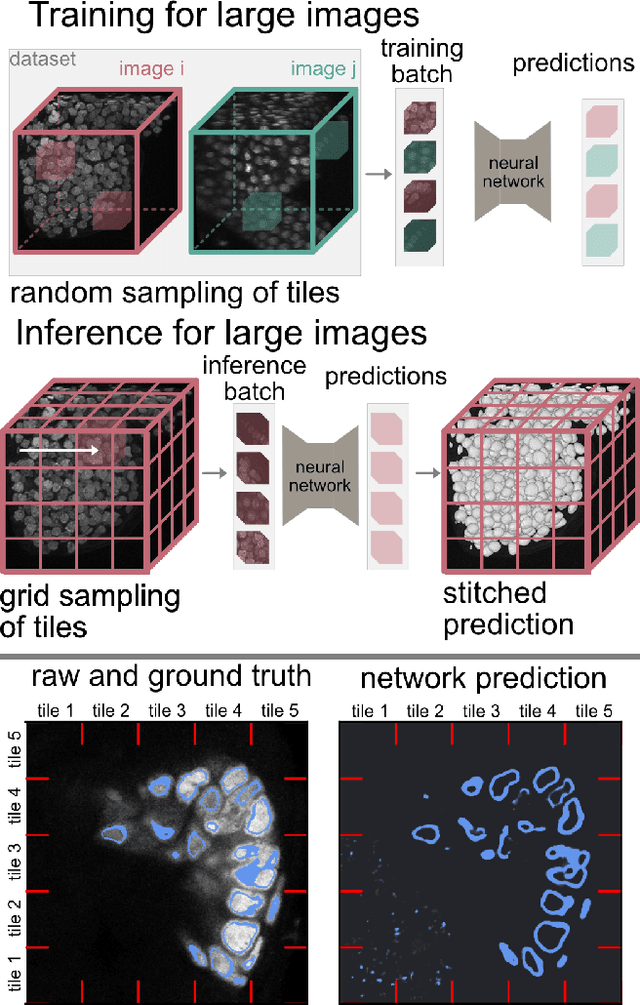


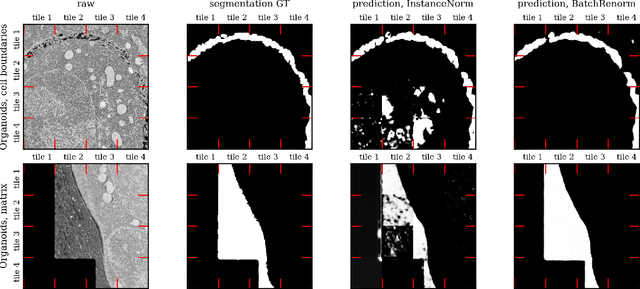
Segmentation of very large images is a common problem in microscopy, medical imaging or remote sensing. The problem is usually addressed by sliding window inference, which can theoretically lead to seamlessly stitched predictions. However, in practice many of the popular pipelines still suffer from tiling artifacts. We investigate the root cause of these issues and show that they stem from the normalization layers within the neural networks. We propose indicators to detect normalization issues and further explore the trade-offs between artifact-free and high-quality predictions, using three diverse microscopy datasets as examples. Finally, we propose to use BatchRenorm as the most suitable normalization strategy, which effectively removes tiling artifacts and enhances transfer performance, thereby improving the reusability of trained networks for new datasets.
MedicoSAM: Towards foundation models for medical image segmentation
Jan 20, 2025Medical image segmentation is an important analysis task in clinical practice and research. Deep learning has massively advanced the field, but current approaches are mostly based on models trained for a specific task. Training such models or adapting them to a new condition is costly due to the need for (manually) labeled data. The emergence of vision foundation models, especially Segment Anything, offers a path to universal segmentation for medical images, overcoming these issues. Here, we study how to improve Segment Anything for medical images by comparing different finetuning strategies on a large and diverse dataset. We evaluate the finetuned models on a wide range of interactive and (automatic) semantic segmentation tasks. We find that the performance can be clearly improved for interactive segmentation. However, semantic segmentation does not benefit from pretraining on medical images. Our best model, MedicoSAM, is publicly available at https://github.com/computational-cell-analytics/medico-sam. We show that it is compatible with existing tools for data annotation and believe that it will be of great practical value.
ViM-UNet: Vision Mamba for Biomedical Segmentation
Apr 11, 2024CNNs, most notably the UNet, are the default architecture for biomedical segmentation. Transformer-based approaches, such as UNETR, have been proposed to replace them, benefiting from a global field of view, but suffering from larger runtimes and higher parameter counts. The recent Vision Mamba architecture offers a compelling alternative to transformers, also providing a global field of view, but at higher efficiency. Here, we introduce ViM-UNet, a novel segmentation architecture based on it and compare it to UNet and UNETR for two challenging microscopy instance segmentation tasks. We find that it performs similarly or better than UNet, depending on the task, and outperforms UNETR while being more efficient. Our code is open source and documented at https://github.com/constantinpape/torch-em/blob/main/vimunet.md.
Probabilistic Domain Adaptation for Biomedical Image Segmentation
Mar 21, 2023Segmentation is a key analysis tasks in biomedical imaging. Given the many different experimental settings in this field, the lack of generalization limits the use of deep learning in practice. Domain adaptation is a promising remedy: it trains a model for a given task on a source dataset with labels and adapts it to a target dataset without additional labels. We introduce a probabilistic domain adaptation method, building on self-training approaches and the Probabilistic UNet. We use the latter to sample multiple segmentation hypothesis to implement better pseudo-label filtering. We further study joint and separate source-target training strategies and evaluate our method on three challenging domain adaptation tasks for biomedical segmentation.