 Add to Chrome
 Add to Firefox
 Add to Edge
TINA+: Probing Residual Visual Knowledge in Unlearned Diffusion Models via Diffusion-Consistent Text-Free Inversion
Aug 18, 2026
Although text-to-image diffusion models exhibit remarkable generative power, concept erasure techniques are essential for preventing harmful content. Existing adversarial probes evaluate these methods by testing whether erased concepts can still be recovered. However, existing erasure and probe methods remain largely text-centric, focusing on whether the text-to-image mapping is severed while overlooking whether the corresponding visual knowledge remains. To investigate this question from a visual perspective, we leverage diffusion inversion to probe whether a generative trajectory can reconstruct visual instances of an erased concept. Under a null-text condition, standard inversion avoids the textual pathway but amplifies approximation errors, hindering faithful trajectory recovery. To address this challenge, we introduce TINA+, a diffusion-consistent Text-free INversion Attack equipped with optimization-based inversion. We also find that unconstrained diffusion inversion may discover spurious trajectories, even allowing a randomly initialized diffusion model to reconstruct the target concept. Such trajectories may falsely indicate residual visual knowledge. TINA+ therefore introduces Diffusion-Consistent Trajectory Regularization to suppress this failure mode. By penalizing trajectories that fall far below the expected marginal energy evolution of diffusion, TINA+ suppresses spurious inversion paths while preserving its ability to recover erased concepts. Experiments across twelve erasure methods, four concept-erasure tasks, and different model architectures demonstrate that TINA+ reliably probes residual visual knowledge through diffusion-consistent visual trajectories. These results provide stronger evidence that current methods often obscure concepts by severing text-image links rather than eliminating the underlying visual knowledge.

SpaceEra++: A Unified Framework Towards 3D Spatial Reasoning in Video
Jul 02, 2026Visual-spatial understanding, defined as the ability to infer object relationships and scene layouts from visual inputs, is fundamental to downstream tasks such as robotic navigation and embodied interaction. However, pre-trained vision-language models (VLMs) remain constrained by spatial uncertainty stemming from inherently 2D observations and by the scarcity of data for 3D spatial understanding. To address these limitations, we proposed a novel framework, SpaceEra, in the NeurIPS 2025 Spotlight paper. Although it achieved significant performance gains, we further observed that its effectiveness is hindered by insufficient input from scanning videos and weak reasoning constraints. To tackle these newly emerged challenges, we extend the original framework into a comprehensive system, termed SpaceEra++, which spans data construction, model design, training optimization, and prompting inference. Specifically, to alleviate input insufficiency, we introduce ScenePick, a frame sampling strategy that balances spatial coverage with object semantics to produce compact yet comprehensive scene representations. In addition, to enhance spatial reasoning, we develop SpaceAlign, which enforces pairwise object constraints by jointly exploiting absolute coordinates and relative spatial relations, thereby aligning optimization with spatial accuracy. Extensive experiments across multiple benchmarks demonstrate consistent improvements over strong baselines, while ablation studies validate both the individual and joint contributions of each component, and further analyses provide guidance for future research.
SpatialUAV: Benchmarking Spatial Intelligence for Low-Altitude UAV Perception, Collaboration, and Motion
Jun 30, 2026Spatial intelligence is essential for low-altitude unmanned aerial vehicle (UAV) perception, collaboration, and navigation. However, existing UAV benchmarks often emphasize image-level recognition, single-view understanding, or narrow answer formats, leaving 3D spatial inference, multi-view collaboration, scene dynamics, and diverse task formulations insufficiently evaluated. To address these gaps, we introduce SpatialUAV, a real low-altitude UAV benchmark comprising 4,331 curated instances across 14 fine-grained task types, covering semantic discrimination, spatial relation, aerial--aerial collaboration, aerial--ground collaboration, and motion understanding. SpatialUAV organizes all samples into a unified visual-input--question--answer schema, while supporting seven input configurations and nine answer formats, including option labels, region identifiers, geometric values, cross-view correspondences, and free-form motion descriptions. To ensure reliable and grounded evaluation, our data construction pipeline integrates detector-assisted regions, depth supervision, metadata-derived rules, extensive manual annotation, blind filtering, and multi-turn human validation, together with task-specific metrics for heterogeneous outputs. Evaluating representative vision-language models across three categories, we show that current models remain far from human-level performance, with pronounced bottlenecks in cross-view association, structured grounding, geometric reasoning, and temporal viewpoint understanding. These results offer empirical guidance for advancing low-altitude UAV spatial intelligence. Code and data are available at https://github.com/Hyu-Zhang/SpatialUAV.
NTIRE 2026 Challenge on Video Saliency Prediction: Methods and Results
Apr 16, 2026This paper presents an overview of the NTIRE 2026 Challenge on Video Saliency Prediction. The goal of the challenge participants was to develop automatic saliency map prediction methods for the provided video sequences. The novel dataset of 2,000 diverse videos with an open license was prepared for this challenge. The fixations and corresponding saliency maps were collected using crowdsourced mouse tracking and contain viewing data from over 5,000 assessors. Evaluation was performed on a subset of 800 test videos using generally accepted quality metrics. The challenge attracted over 20 teams making submissions, and 7 teams passed the final phase with code review. All data used in this challenge is made publicly available - https://github.com/msu-video-group/NTIRE26_Saliency_Prediction.
ViSAGE @ NTIRE 2026 Challenge on Video Saliency Prediction
Apr 09, 2026In this report, we present our champion solution for the NTIRE 2026 Challenge on Video Saliency Prediction held in conjunction with CVPR 2026. To exploit complementary inductive biases for video saliency, we propose Video Saliency with Adaptive Gated Experts (ViSAGE), a multi-expert ensemble framework. Each specialized decoder performs adaptive gating and modulation to refine spatio-temporal features. The complementary predictions from different experts are then fused at inference. ViSAGE thereby aggregates diverse inductive biases to capture complex spatio-temporal saliency cues in videos. On the Private Test set, ViSAGE ranked first on two out of four evaluation metrics, and outperformed most competing solutions on the other two metrics, demonstrating its effectiveness and generalization ability. Our code has been released at https://github.com/iLearn-Lab/CVPRW26-ViSAGE.
TINA: Text-Free Inversion Attack for Unlearned Text-to-Image Diffusion Models
Mar 18, 2026Although text-to-image diffusion models exhibit remarkable generative power, concept erasure techniques are essential for their safe deployment to prevent the creation of harmful content. This has fostered a dynamic interplay between the development of erasure defenses and the adversarial probes designed to bypass them, and this co-evolution has progressively enhanced the efficacy of erasure methods. However, this adversarial co-evolution has converged on a narrow, text-centric paradigm that equates erasure with severing the text-to-image mapping, ignoring that the underlying visual knowledge related to undesired concepts still persist. To substantiate this claim, we investigate from a visual perspective, leveraging DDIM inversion to probe whether a generative pathway for the erased concept can still be found. However, identifying such a visual generative pathway is challenging because standard text-guided DDIM inversion is actively resisted by text-centric defenses within the erased model. To address this, we introduce TINA, a novel Text-free INversion Attack, which enforces this visual-only probe by operating under a null-text condition, thereby avoiding existing text-centric defenses. Moreover, TINA integrates an optimization procedure to overcome the accumulating approximation errors that arise when standard inversion operates without its usual textual guidance. Our experiments demonstrate that TINA regenerates erased concepts from models treated with state-of-the-art unlearning. The success of TINA proves that current methods merely obscure concepts, highlighting an urgent need for paradigms that operate directly on internal visual knowledge.
DKDM: Data-Free Knowledge Distillation for Diffusion Models with Any Architecture
Sep 05, 2024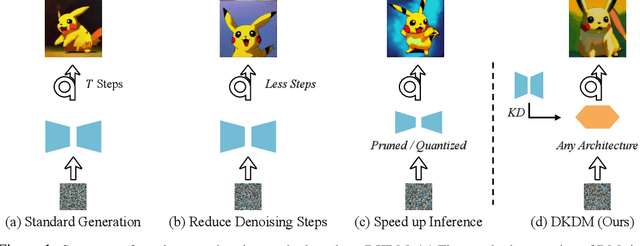
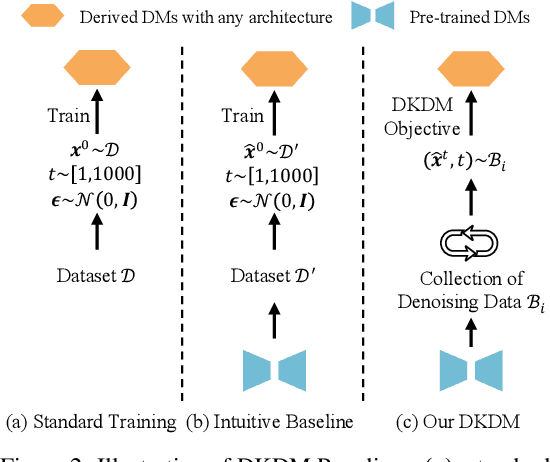
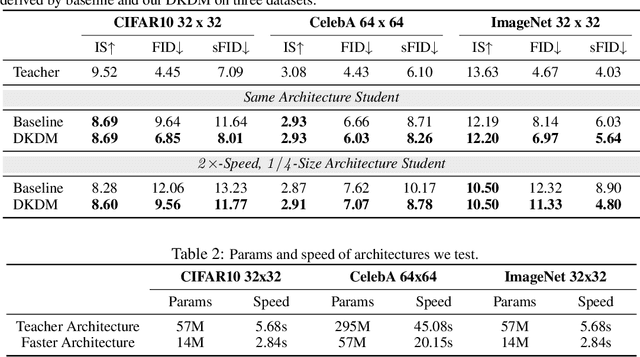

Diffusion models (DMs) have demonstrated exceptional generative capabilities across various areas, while they are hindered by slow inference speeds and high computational demands during deployment. The most common way to accelerate DMs involves reducing the number of denoising steps during generation, achieved through faster sampling solvers or knowledge distillation (KD). In contrast to prior approaches, we propose a novel method that transfers the capability of large pretrained DMs to faster architectures. Specifically, we employ KD in a distinct manner to compress DMs by distilling their generative ability into more rapid variants. Furthermore, considering that the source data is either unaccessible or too enormous to store for current generative models, we introduce a new paradigm for their distillation without source data, termed Data-Free Knowledge Distillation for Diffusion Models (DKDM). Generally, our established DKDM framework comprises two main components: 1) a DKDM objective that uses synthetic denoising data produced by pretrained DMs to optimize faster DMs without source data, and 2) a dynamic iterative distillation method that flexibly organizes the synthesis of denoising data, preventing it from slowing down the optimization process as the generation is slow. To our knowledge, this is the first attempt at using KD to distill DMs into any architecture in a data-free manner. Importantly, our DKDM is orthogonal to most existing acceleration methods, such as denoising step reduction, quantization and pruning. Experiments show that our DKDM is capable of deriving 2x faster DMs with performance remaining on par with the baseline. Notably, our DKDM enables pretrained DMs to function as "datasets" for training new DMs.