 Add to Chrome
 Add to Firefox
 Add to Edge
Task Adaptive Feature Distribution Based Network for Few-shot Fine-grained Target Classification
Oct 13, 2024
Metric-based few-shot fine-grained classification has shown promise due to its simplicity and efficiency. However, existing methods often overlook task-level special cases and struggle with accurate category description and irrelevant sample information. To tackle these, we propose TAFD-Net: a task adaptive feature distribution network. It features a task-adaptive component for embedding to capture task-level nuances, an asymmetric metric for calculating feature distribution similarities between query samples and support categories, and a contrastive measure strategy to boost performance. Extensive experiments have been conducted on three datasets and the experimental results show that our proposed algorithm outperforms recent incremental learning algorithms.

Computer-aided Colorization State-of-the-science: A Survey
Oct 03, 2024This paper reviews published research in the field of computer-aided colorization technology. We argue that the colorization task originates from computer graphics, prospers by introducing computer vision, and tends to the fusion of vision and graphics, so we put forward our taxonomy and organize the whole paper chronologically. We extend the existing reconstruction-based colorization evaluation techniques, considering that aesthetic assessment of colored images should be introduced to ensure that colorization satisfies human visual-related requirements and emotions more closely. We perform the colorization aesthetic assessment on seven representative unconditional colorization models and discuss the difference between our assessment and the existing reconstruction-based metrics. Finally, this paper identifies unresolved issues and proposes fruitful areas for future research and development. Access to the project associated with this survey can be obtained at https://github.com/DanielCho-HK/Colorization.
Large Margin Prototypical Network for Few-shot Relation Classification with Fine-grained Features
Sep 06, 2024Relation classification (RC) plays a pivotal role in both natural language understanding and knowledge graph completion. It is generally formulated as a task to recognize the relationship between two entities of interest appearing in a free-text sentence. Conventional approaches on RC, regardless of feature engineering or deep learning based, can obtain promising performance on categorizing common types of relation leaving a large proportion of unrecognizable long-tail relations due to insufficient labeled instances for training. In this paper, we consider few-shot learning is of great practical significance to RC and thus improve a modern framework of metric learning for few-shot RC. Specifically, we adopt the large-margin ProtoNet with fine-grained features, expecting they can generalize well on long-tail relations. Extensive experiments were conducted by FewRel, a large-scale supervised few-shot RC dataset, to evaluate our framework: LM-ProtoNet (FGF). The results demonstrate that it can achieve substantial improvements over many baseline approaches.
MOBIUS: Towards the Next Generation of Query-Ad Matching in Baidu's Sponsored Search
Sep 05, 2024


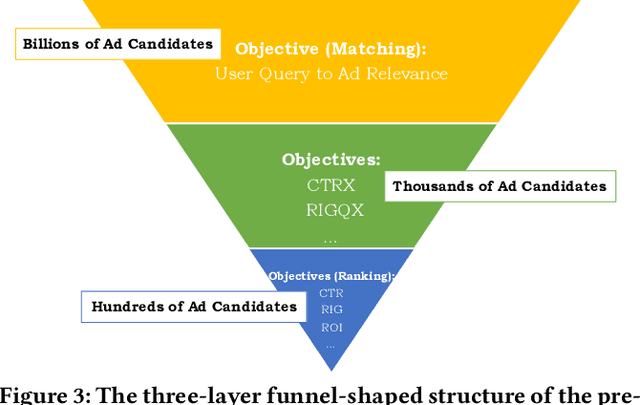
Baidu runs the largest commercial web search engine in China, serving hundreds of millions of online users every day in response to a great variety of queries. In order to build a high-efficiency sponsored search engine, we used to adopt a three-layer funnel-shaped structure to screen and sort hundreds of ads from billions of ad candidates subject to the requirement of low response latency and the restraints of computing resources. Given a user query, the top matching layer is responsible for providing semantically relevant ad candidates to the next layer, while the ranking layer at the bottom concerns more about business indicators (e.g., CPM, ROI, etc.) of those ads. The clear separation between the matching and ranking objectives results in a lower commercial return. The Mobius project has been established to address this serious issue. It is our first attempt to train the matching layer to consider CPM as an additional optimization objective besides the query-ad relevance, via directly predicting CTR (click-through rate) from billions of query-ad pairs. Specifically, this paper will elaborate on how we adopt active learning to overcome the insufficiency of click history at the matching layer when training our neural click networks offline, and how we use the SOTA ANN search technique for retrieving ads more efficiently (Here ``ANN'' stands for approximate nearest neighbor search). We contribute the solutions to Mobius-V1 as the first version of our next generation query-ad matching system.
EMP: Enhance Memory in Data Pruning
Aug 28, 2024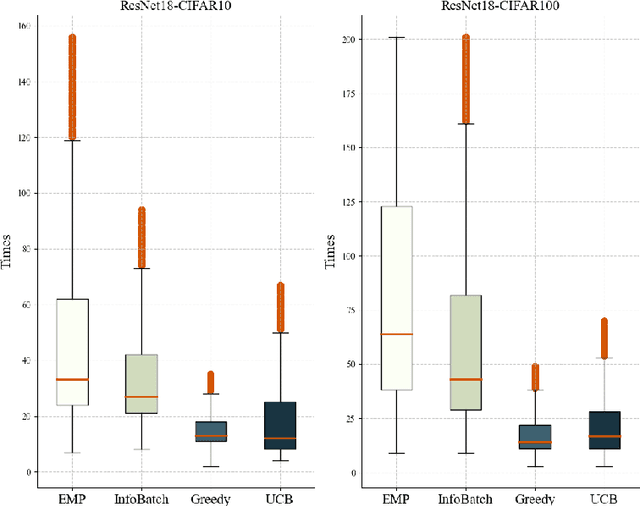
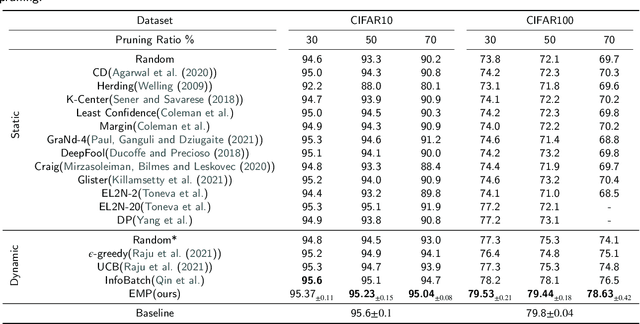
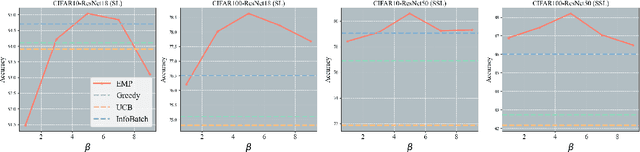
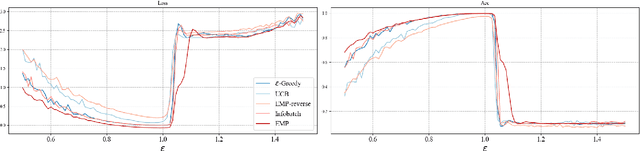
Recently, large language and vision models have shown strong performance, but due to high pre-training and fine-tuning costs, research has shifted towards faster training via dataset pruning. Previous methods used sample loss as an evaluation criterion, aiming to select the most "difficult" samples for training. However, when the pruning rate increases, the number of times each sample is trained becomes more evenly distributed, which causes many critical or general samples to not be effectively fitted. We refer to this as Low-Frequency Learning (LFL). In other words, LFL prevents the model from remembering most samples. In our work, we decompose the scoring function of LFL, provide a theoretical explanation for the inefficiency of LFL, and propose adding a memory term to the scoring function to enhance the model's memory capability, along with an approximation of this memory term. Similarly, we explore memory in Self-Supervised Learning (SSL), marking the first discussion on SSL memory. Using contrastive learning, we derive the memory term both theoretically and experimentally. Finally, we propose Enhance Memory Pruning (EMP), which addresses the issue of insufficient memory under high pruning rates by enhancing the model's memory of data, thereby improving its performance. We evaluated the performance of EMP in tasks such as image classification, natural language understanding, and model pre-training. The results show that EMP can improve model performance under extreme pruning rates. For example, in the CIFAR100-ResNet50 pre-training task, with 70\% pruning, EMP outperforms current methods by 2.2\%.
Timeline and Boundary Guided Diffusion Network for Video Shadow Detection
Aug 21, 2024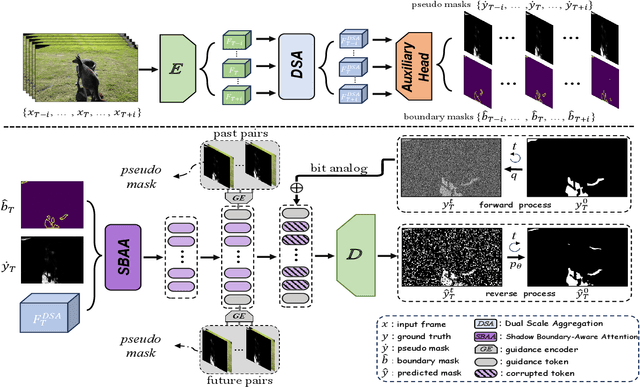
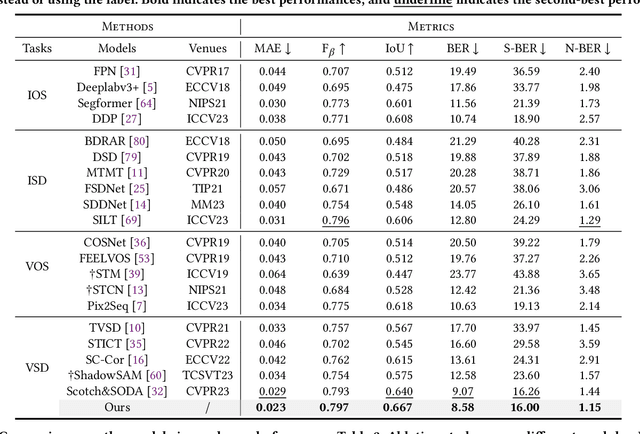
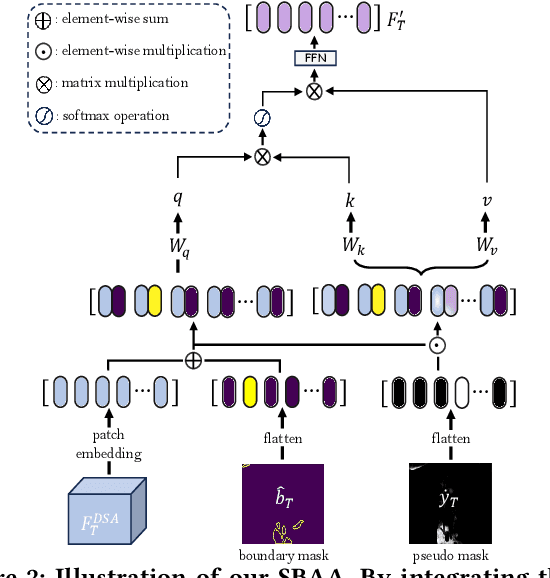
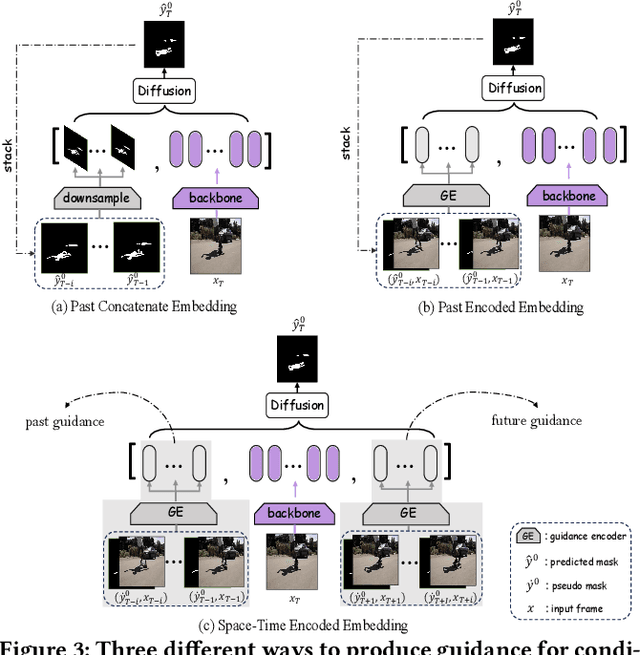
Video Shadow Detection (VSD) aims to detect the shadow masks with frame sequence. Existing works suffer from inefficient temporal learning. Moreover, few works address the VSD problem by considering the characteristic (i.e., boundary) of shadow. Motivated by this, we propose a Timeline and Boundary Guided Diffusion (TBGDiff) network for VSD where we take account of the past-future temporal guidance and boundary information jointly. In detail, we design a Dual Scale Aggregation (DSA) module for better temporal understanding by rethinking the affinity of the long-term and short-term frames for the clipped video. Next, we introduce Shadow Boundary Aware Attention (SBAA) to utilize the edge contexts for capturing the characteristics of shadows. Moreover, we are the first to introduce the Diffusion model for VSD in which we explore a Space-Time Encoded Embedding (STEE) to inject the temporal guidance for Diffusion to conduct shadow detection. Benefiting from these designs, our model can not only capture the temporal information but also the shadow property. Extensive experiments show that the performance of our approach overtakes the state-of-the-art methods, verifying the effectiveness of our components. We release the codes, weights, and results at \url{https://github.com/haipengzhou856/TBGDiff}.
A Convex-optimization-based Layer-wise Post-training Pruner for Large Language Models
Aug 07, 2024
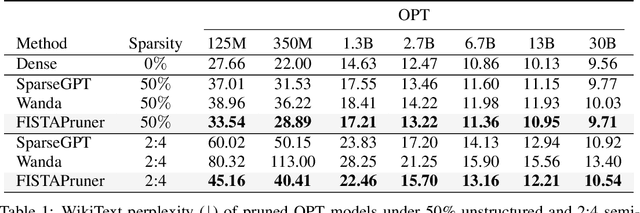


Pruning is a critical strategy for compressing trained large language models (LLMs), aiming at substantial memory conservation and computational acceleration without compromising performance. However, existing pruning methods often necessitate inefficient retraining for billion-scale LLMs or rely on heuristic methods such as the optimal brain surgeon framework, which degrade performance. In this paper, we introduce FISTAPruner, the first post-training pruner based on convex optimization models and algorithms. Specifically, we propose a convex optimization model incorporating $\ell_1$ norm to induce sparsity and utilize the FISTA solver for optimization. FISTAPruner incorporates an intra-layer cumulative error correction mechanism and supports parallel pruning. We comprehensively evaluate FISTAPruner on models such as OPT, LLaMA, LLaMA-2, and LLaMA-3 with 125M to 70B parameters under unstructured and 2:4 semi-structured sparsity, demonstrating superior performance over existing state-of-the-art methods across various language benchmarks.
Less is More: Sparse Watermarking in LLMs with Enhanced Text Quality
Jul 17, 2024With the widespread adoption of Large Language Models (LLMs), concerns about potential misuse have emerged. To this end, watermarking has been adapted to LLM, enabling a simple and effective way to detect and monitor generated text. However, while the existing methods can differentiate between watermarked and unwatermarked text with high accuracy, they often face a trade-off between the quality of the generated text and the effectiveness of the watermarking process. In this work, we present a novel type of LLM watermark, Sparse Watermark, which aims to mitigate this trade-off by applying watermarks to a small subset of generated tokens distributed across the text. The key strategy involves anchoring watermarked tokens to words that have specific Part-of-Speech (POS) tags. Our experimental results demonstrate that the proposed watermarking scheme achieves high detectability while generating text that outperforms previous LLM watermarking methods in quality across various tasks
Last-iterate Convergence Separation between Extra-gradient and Optimism in Constrained Periodic Games
Jun 15, 2024Last-iterate behaviors of learning algorithms in repeated two-player zero-sum games have been extensively studied due to their wide applications in machine learning and related tasks. Typical algorithms that exhibit the last-iterate convergence property include optimistic and extra-gradient methods. However, most existing results establish these properties under the assumption that the game is time-independent. Recently, (Feng et al, 2023) studied the last-iterate behaviors of optimistic and extra-gradient methods in games with a time-varying payoff matrix, and proved that in an unconstrained periodic game, extra-gradient method converges to the equilibrium while optimistic method diverges. This finding challenges the conventional wisdom that these two methods are expected to behave similarly as they do in time-independent games. However, compared to unconstrained games, games with constrains are more common both in practical and theoretical studies. In this paper, we investigate the last-iterate behaviors of optimistic and extra-gradient methods in the constrained periodic games, demonstrating that similar separation results for last-iterate convergence also hold in this setting.
Detecting Adversarial Data via Perturbation Forgery
May 25, 2024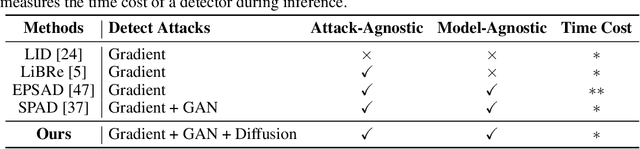
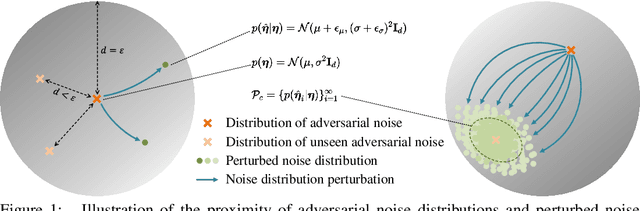
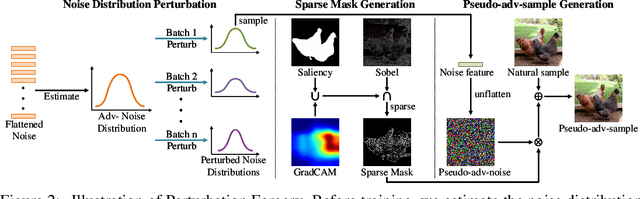
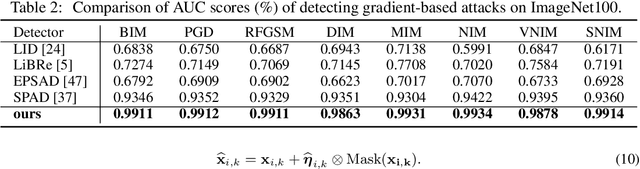
As a defense strategy against adversarial attacks, adversarial detection aims to identify and filter out adversarial data from the data flow based on discrepancies in distribution and noise patterns between natural and adversarial data. Although previous detection methods achieve high performance in detecting gradient-based adversarial attacks, new attacks based on generative models with imbalanced and anisotropic noise patterns evade detection. Even worse, existing techniques either necessitate access to attack data before deploying a defense or incur a significant time cost for inference, rendering them impractical for defending against newly emerging attacks that are unseen by defenders. In this paper, we explore the proximity relationship between adversarial noise distributions and demonstrate the existence of an open covering for them. By learning to distinguish this open covering from the distribution of natural data, we can develop a detector with strong generalization capabilities against all types of adversarial attacks. Based on this insight, we heuristically propose Perturbation Forgery, which includes noise distribution perturbation, sparse mask generation, and pseudo-adversarial data production, to train an adversarial detector capable of detecting unseen gradient-based, generative-model-based, and physical adversarial attacks, while remaining agnostic to any specific models. Comprehensive experiments conducted on multiple general and facial datasets, with a wide spectrum of attacks, validate the strong generalization of our method.