 Add to Chrome
 Add to Firefox
 Add to Edge
Unleashing Low-Bit Inference on Ascend NPUs: A Comprehensive Evaluation of HiFloat Formats
Feb 13, 2026
As LLMs scale, low-bit floating-point formats like MXFP and NVFP4 offer new opportunities for precision and efficiency. In this work, we evaluate HiFloat (HiF8 and HiF4), a family of formats tailored for Ascend NPUs. Through rigorous comparison across weight-activation and KV-cache tasks, we provide three key insights: (1) INT8 suits narrow-range data, while floating-point formats excel with high-variance data; (2) in 4-bit regimes, HiF4's hierarchical scaling prevents the accuracy collapse seen in integer formats; and (3) HiFloat is fully compatible with state-of-the-art post-training quantization frameworks. Overall, HiFloat provides a solution for high-efficiency LLM inference on NPUs.

How Order-Sensitive Are LLMs? OrderProbe for Deterministic Structural Reconstruction
Jan 13, 2026Large language models (LLMs) excel at semantic understanding, yet their ability to reconstruct internal structure from scrambled inputs remains underexplored. Sentence-level restoration is ill-posed for automated evaluation because multiple valid word orders often exist. We introduce OrderProbe, a deterministic benchmark for structural reconstruction using fixed four-character expressions in Chinese, Japanese, and Korean, which have a unique canonical order and thus support exact-match scoring. We further propose a diagnostic framework that evaluates models beyond recovery accuracy, including semantic fidelity, logical validity, consistency, robustness sensitivity, and information density. Experiments on twelve widely used LLMs show that structural reconstruction remains difficult even for frontier systems: zero-shot recovery frequently falls below 35%. We also observe a consistent dissociation between semantic recall and structural planning, suggesting that structural robustness is not an automatic byproduct of semantic competence.
FASP: Fast and Accurate Structured Pruning of Large Language Models
Jan 16, 2025
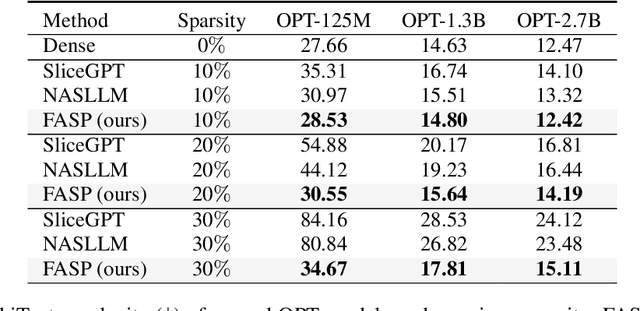

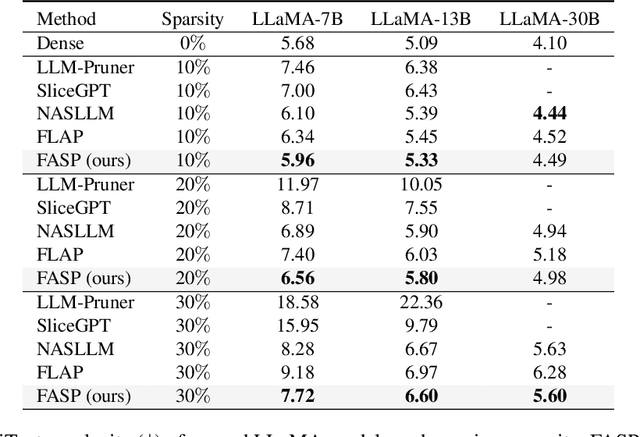
The rapid increase in the size of large language models (LLMs) has significantly escalated their computational and memory demands, posing challenges for efficient deployment, especially on resource-constrained devices. Structured pruning has emerged as an effective model compression method that can reduce these demands while preserving performance. In this paper, we introduce FASP (Fast and Accurate Structured Pruning), a novel structured pruning framework for LLMs that emphasizes both speed and accuracy. FASP employs a distinctive pruning structure that interlinks sequential layers, allowing for the removal of columns in one layer while simultaneously eliminating corresponding rows in the preceding layer without incurring additional performance loss. The pruning metric, inspired by Wanda, is computationally efficient and effectively selects components to prune. Additionally, we propose a restoration mechanism that enhances model fidelity by adjusting the remaining weights post-pruning. We evaluate FASP on the OPT and LLaMA model families, demonstrating superior performance in terms of perplexity and accuracy on downstream tasks compared to state-of-the-art methods. Our approach achieves significant speed-ups, pruning models such as OPT-125M in 17 seconds and LLaMA-30B in 15 minutes on a single NVIDIA RTX 4090 GPU, making it a highly practical solution for optimizing LLMs.
A Convex-optimization-based Layer-wise Post-training Pruner for Large Language Models
Aug 07, 2024
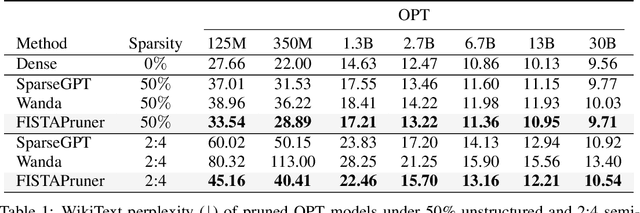


Pruning is a critical strategy for compressing trained large language models (LLMs), aiming at substantial memory conservation and computational acceleration without compromising performance. However, existing pruning methods often necessitate inefficient retraining for billion-scale LLMs or rely on heuristic methods such as the optimal brain surgeon framework, which degrade performance. In this paper, we introduce FISTAPruner, the first post-training pruner based on convex optimization models and algorithms. Specifically, we propose a convex optimization model incorporating $\ell_1$ norm to induce sparsity and utilize the FISTA solver for optimization. FISTAPruner incorporates an intra-layer cumulative error correction mechanism and supports parallel pruning. We comprehensively evaluate FISTAPruner on models such as OPT, LLaMA, LLaMA-2, and LLaMA-3 with 125M to 70B parameters under unstructured and 2:4 semi-structured sparsity, demonstrating superior performance over existing state-of-the-art methods across various language benchmarks.
Adapprox: Adaptive Approximation in Adam Optimization via Randomized Low-Rank Matrices
Mar 22, 2024As deep learning models exponentially increase in size, optimizers such as Adam encounter significant memory consumption challenges due to the storage of first and second moment data. Current memory-efficient methods like Adafactor and CAME often compromise accuracy with their matrix factorization techniques. Addressing this, we introduce Adapprox, a novel approach that employs randomized low-rank matrix approximation for a more effective and accurate approximation of Adam's second moment. Adapprox features an adaptive rank selection mechanism, finely balancing accuracy and memory efficiency, and includes an optional cosine similarity guidance strategy to enhance stability and expedite convergence. In GPT-2 training and downstream tasks, Adapprox surpasses AdamW by achieving 34.5% to 49.9% and 33.8% to 49.9% memory savings for the 117M and 345M models, respectively, with the first moment enabled, and further increases these savings without the first moment. Besides, it enhances convergence speed and improves downstream task performance relative to its counterparts.