 Add to Chrome
 Add to Firefox
 Add to Edge
Has the Machine Learning Review Process Become More Arbitrary as the Field Has Grown? The NeurIPS 2021 Consistency Experiment
Jun 05, 2023
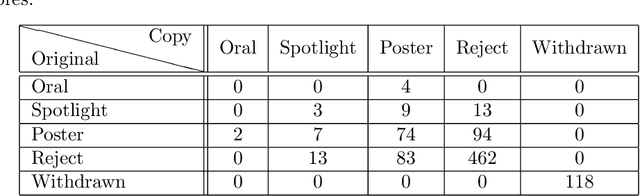
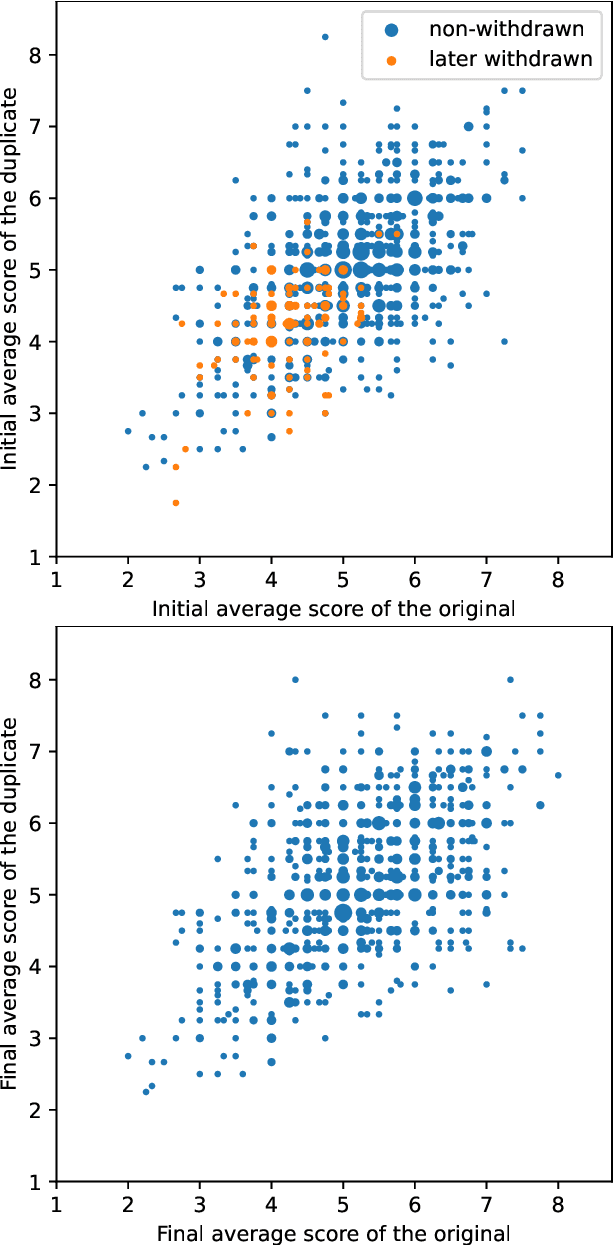
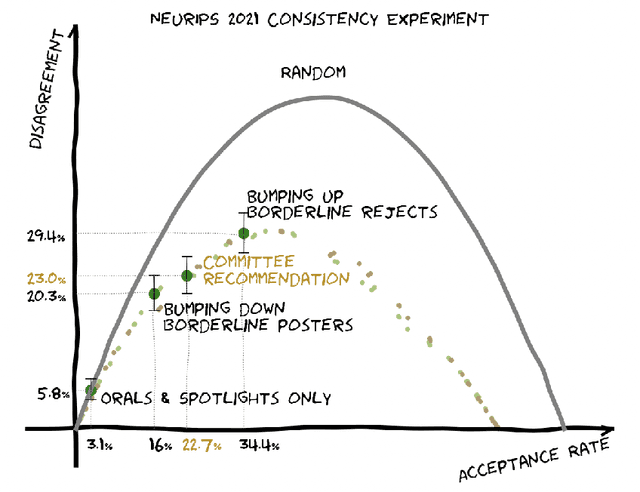
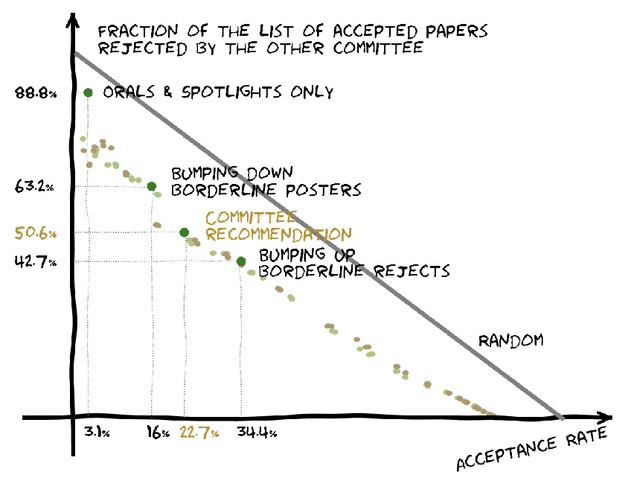
We present the NeurIPS 2021 consistency experiment, a larger-scale variant of the 2014 NeurIPS experiment in which 10% of conference submissions were reviewed by two independent committees to quantify the randomness in the review process. We observe that the two committees disagree on their accept/reject recommendations for 23% of the papers and that, consistent with the results from 2014, approximately half of the list of accepted papers would change if the review process were randomly rerun. Our analysis suggests that making the conference more selective would increase the arbitrariness of the process. Taken together with previous research, our results highlight the inherent difficulty of objectively measuring the quality of research, and suggest that authors should not be excessively discouraged by rejected work.

Beyond Positive Scaling: How Negation Impacts Scaling Trends of Language Models
May 27, 2023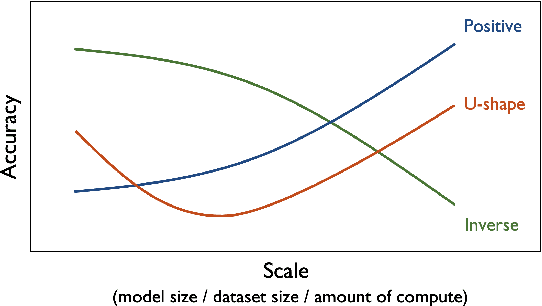
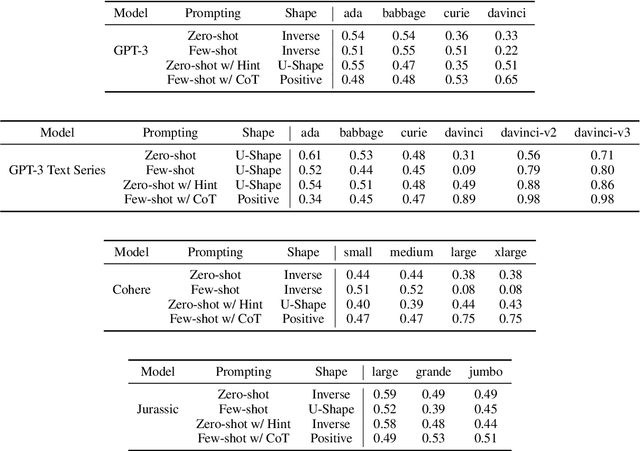
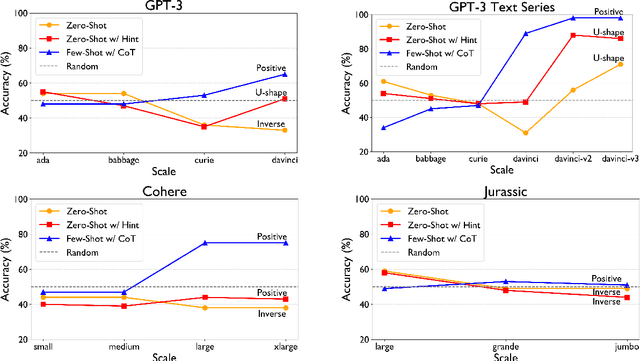
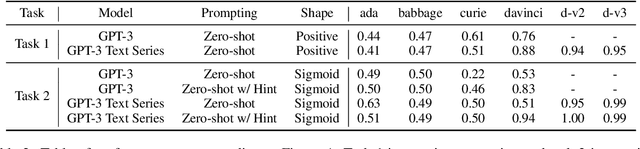
Language models have been shown to exhibit positive scaling, where performance improves as models are scaled up in terms of size, compute, or data. In this work, we introduce NeQA, a dataset consisting of questions with negation in which language models do not exhibit straightforward positive scaling. We show that this task can exhibit inverse scaling, U-shaped scaling, or positive scaling, and the three scaling trends shift in this order as we use more powerful prompting methods or model families. We hypothesize that solving NeQA depends on two subtasks: question answering (task 1) and negation understanding (task 2). We find that task 1 has linear scaling, while task 2 has sigmoid-shaped scaling with an emergent transition point, and composing these two scaling trends yields the final scaling trend of NeQA. Our work reveals and provides a way to analyze the complex scaling trends of language models.
Backpack Language Models
May 26, 2023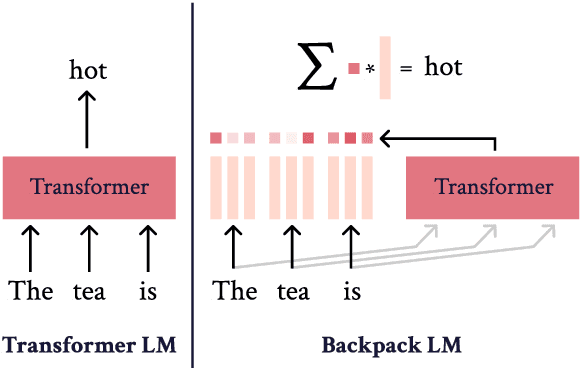
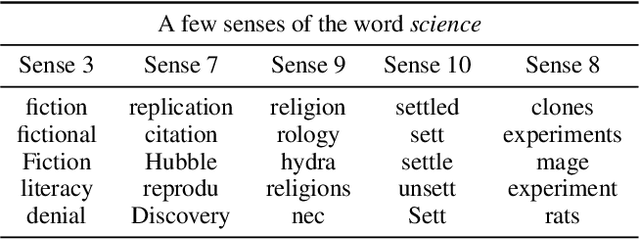
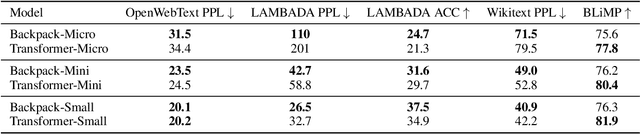
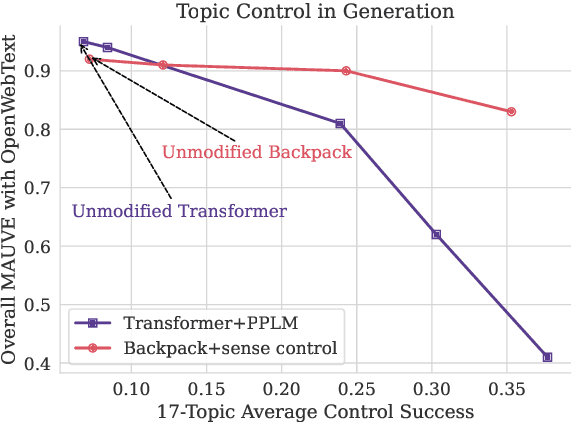
We present Backpacks: a new neural architecture that marries strong modeling performance with an interface for interpretability and control. Backpacks learn multiple non-contextual sense vectors for each word in a vocabulary, and represent a word in a sequence as a context-dependent, non-negative linear combination of sense vectors in this sequence. We find that, after training, sense vectors specialize, each encoding a different aspect of a word. We can interpret a sense vector by inspecting its (non-contextual, linear) projection onto the output space, and intervene on these interpretable hooks to change the model's behavior in predictable ways. We train a 170M-parameter Backpack language model on OpenWebText, matching the loss of a GPT-2 small (124Mparameter) Transformer. On lexical similarity evaluations, we find that Backpack sense vectors outperform even a 6B-parameter Transformer LM's word embeddings. Finally, we present simple algorithms that intervene on sense vectors to perform controllable text generation and debiasing. For example, we can edit the sense vocabulary to tend more towards a topic, or localize a source of gender bias to a sense vector and globally suppress that sense.
DoReMi: Optimizing Data Mixtures Speeds Up Language Model Pretraining
May 24, 2023The mixture proportions of pretraining data domains (e.g., Wikipedia, books, web text) greatly affect language model (LM) performance. In this paper, we propose Domain Reweighting with Minimax Optimization (DoReMi), which first trains a small proxy model using group distributionally robust optimization (Group DRO) over domains to produce domain weights (mixture proportions) without knowledge of downstream tasks. We then resample a dataset with these domain weights and train a larger, full-sized model. In our experiments, we use DoReMi on a 280M-parameter proxy model to find domain weights for training an 8B-parameter model (30x larger) more efficiently. On The Pile, DoReMi improves perplexity across all domains, even when it downweights a domain. DoReMi improves average few-shot downstream accuracy by 6.5% points over a baseline model trained using The Pile's default domain weights and reaches the baseline accuracy with 2.6x fewer training steps. On the GLaM dataset, DoReMi, which has no knowledge of downstream tasks, even matches the performance of using domain weights tuned on downstream tasks.
Lexinvariant Language Models
May 24, 2023


Token embeddings, a mapping from discrete lexical symbols to continuous vectors, are at the heart of any language model (LM). However, lexical symbol meanings can also be determined and even redefined by their structural role in a long context. In this paper, we ask: is it possible for a language model to be performant without \emph{any} fixed token embeddings? Such a language model would have to rely entirely on the co-occurence and repetition of tokens in the context rather than the \textit{a priori} identity of any token. To answer this, we study \textit{lexinvariant}language models that are invariant to lexical symbols and therefore do not need fixed token embeddings in practice. First, we prove that we can construct a lexinvariant LM to converge to the true language model at a uniform rate that is polynomial in terms of the context length, with a constant factor that is sublinear in the vocabulary size. Second, to build a lexinvariant LM, we simply encode tokens using random Gaussian vectors, such that each token maps to the same representation within each sequence but different representations across sequences. Empirically, we demonstrate that it can indeed attain perplexity comparable to that of a standard language model, given a sufficiently long context. We further explore two properties of the lexinvariant language models: First, given text generated from a substitution cipher of English, it implicitly implements Bayesian in-context deciphering and infers the mapping to the underlying real tokens with high accuracy. Second, it has on average 4X better accuracy over synthetic in-context reasoning tasks. Finally, we discuss regularizing standard language models towards lexinvariance and potential practical applications.
Sophia: A Scalable Stochastic Second-order Optimizer for Language Model Pre-training
May 23, 2023Given the massive cost of language model pre-training, a non-trivial improvement of the optimization algorithm would lead to a material reduction on the time and cost of training. Adam and its variants have been state-of-the-art for years, and more sophisticated second-order (Hessian-based) optimizers often incur too much per-step overhead. In this paper, we propose Sophia, Second-order Clipped Stochastic Optimization, a simple scalable second-order optimizer that uses a light-weight estimate of the diagonal Hessian as the pre-conditioner. The update is the moving average of the gradients divided by the moving average of the estimated Hessian, followed by element-wise clipping. The clipping controls the worst-case update size and tames the negative impact of non-convexity and rapid change of Hessian along the trajectory. Sophia only estimates the diagonal Hessian every handful of iterations, which has negligible average per-step time and memory overhead. On language modeling with GPT-2 models of sizes ranging from 125M to 770M, Sophia achieves a 2x speed-up compared with Adam in the number of steps, total compute, and wall-clock time. Theoretically, we show that Sophia adapts to the curvature in different components of the parameters, which can be highly heterogeneous for language modeling tasks. Our run-time bound does not depend on the condition number of the loss.
AlpacaFarm: A Simulation Framework for Methods that Learn from Human Feedback
May 22, 2023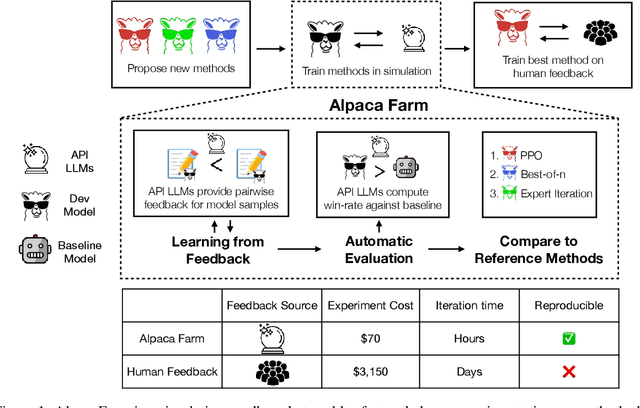
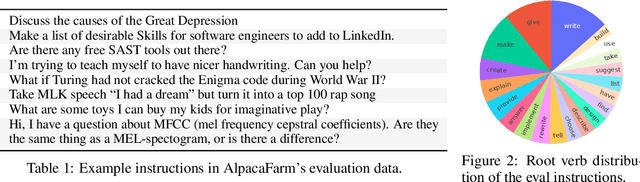
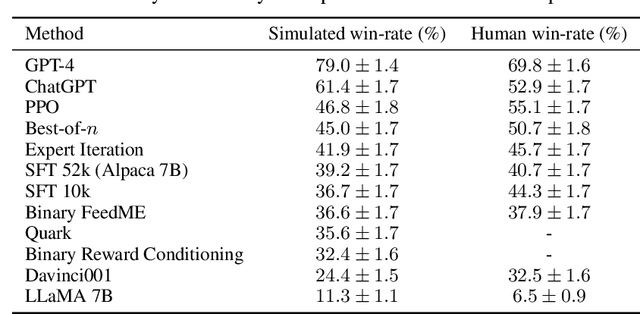

Large language models (LLMs) such as ChatGPT have seen widespread adoption due to their ability to follow user instructions well. Developing these LLMs involves a complex yet poorly understood workflow requiring training with human feedback. Replicating and understanding this instruction-following process faces three major challenges: the high cost of data collection, the lack of trustworthy evaluation, and the absence of reference method implementations. We address these challenges with AlpacaFarm, a simulator that enables research and development for learning from feedback at a low cost. First, we design LLM prompts to simulate human feedback that are 45x cheaper than crowdworkers and display high agreement with humans. Second, we propose an automatic evaluation and validate it against human instructions obtained on real-world interactions. Third, we contribute reference implementations for several methods (PPO, best-of-n, expert iteration, and more) that learn from pairwise feedback. Finally, as an end-to-end validation of AlpacaFarm, we train and evaluate eleven models on 10k pairs of real human feedback and show that rankings of models trained in AlpacaFarm match rankings of models trained on human data. As a demonstration of the research possible in AlpacaFarm, we find that methods that use a reward model can substantially improve over supervised fine-tuning and that our reference PPO implementation leads to a +10% improvement in win-rate against Davinci003. We release all components of AlpacaFarm at https://github.com/tatsu-lab/alpaca_farm.
PRODIGY: Enabling In-context Learning Over Graphs
May 21, 2023In-context learning is the ability of a pretrained model to adapt to novel and diverse downstream tasks by conditioning on prompt examples, without optimizing any parameters. While large language models have demonstrated this ability, how in-context learning could be performed over graphs is unexplored. In this paper, we develop \textbf{Pr}etraining \textbf{O}ver \textbf{D}iverse \textbf{I}n-Context \textbf{G}raph S\textbf{y}stems (PRODIGY), the first pretraining framework that enables in-context learning over graphs. The key idea of our framework is to formulate in-context learning over graphs with a novel \emph{prompt graph} representation, which connects prompt examples and queries. We then propose a graph neural network architecture over the prompt graph and a corresponding family of in-context pretraining objectives. With PRODIGY, the pretrained model can directly perform novel downstream classification tasks on unseen graphs via in-context learning. We provide empirical evidence of the effectiveness of our framework by showcasing its strong in-context learning performance on tasks involving citation networks and knowledge graphs. Our approach outperforms the in-context learning accuracy of contrastive pretraining baselines with hard-coded adaptation by 18\% on average across all setups. Moreover, it also outperforms standard finetuning with limited data by 33\% on average with in-context learning.
Cheaply Evaluating Inference Efficiency Metrics for Autoregressive Transformer APIs
May 03, 2023Large language models (LLMs) power many state-of-the-art systems in natural language processing. However, these models are extremely computationally expensive, even at inference time, raising the natural question: when is the extra cost of deploying a larger model worth the anticipated boost in capabilities? Better understanding this tradeoff fundamentally could benefit from an inference efficiency metric that is both (i) easily comparable across models from different providers, and (ii) representative of the true cost of running queries in an isolated performance environment. Unfortunately, access to LLMs today is largely restricted to black-box text generation APIs and raw runtimes measured through this interface do not satisfy these desiderata: model providers can apply various software and hardware optimizations orthogonal to the model, and models served on shared infrastructure are susceptible to performance contention. To circumvent these problems, we propose a new metric for comparing inference efficiency across models. This metric puts models on equal footing as though they were served (i) on uniform hardware and software, and (ii) without performance contention. We call this metric the \emph{idealized runtime}, and we propose a methodology to efficiently estimate this metric for autoregressive Transformer models. We also propose cost-aware variants that incorporate the number of accelerators needed to serve the model. Using these metrics, we compare ten state-of-the-art LLMs to provide the first analysis of inference efficiency-capability tradeoffs; we make several observations from this analysis, including the fact that the superior inference runtime performance of certain APIs is often a byproduct of optimizations within the API rather than the underlying model. Our methodology also facilitates the efficient comparison of different software and hardware stacks.
Evaluating Verifiability in Generative Search Engines
Apr 19, 2023Generative search engines directly generate responses to user queries, along with in-line citations. A prerequisite trait of a trustworthy generative search engine is verifiability, i.e., systems should cite comprehensively (high citation recall; all statements are fully supported by citations) and accurately (high citation precision; every cite supports its associated statement). We conduct human evaluation to audit four popular generative search engines -- Bing Chat, NeevaAI, perplexity.ai, and YouChat -- across a diverse set of queries from a variety of sources (e.g., historical Google user queries, dynamically-collected open-ended questions on Reddit, etc.). We find that responses from existing generative search engines are fluent and appear informative, but frequently contain unsupported statements and inaccurate citations: on average, a mere 51.5% of generated sentences are fully supported by citations and only 74.5% of citations support their associated sentence. We believe that these results are concerningly low for systems that may serve as a primary tool for information-seeking users, especially given their facade of trustworthiness. We hope that our results further motivate the development of trustworthy generative search engines and help researchers and users better understand the shortcomings of existing commercial systems.