 Add to Chrome
 Add to Firefox
 Add to Edge
Power Echoes: Investigating Moderation Biases in Online Power-Asymmetric Conflicts
Mar 02, 2026
Online power-asymmetric conflicts are prevalent, and most platforms rely on human moderators to conduct moderation currently. Previous studies have been continuously focusing on investigating human moderation biases in different scenarios, while moderation biases under power-asymmetric conflicts remain unexplored. Therefore, we aim to investigate the types of power-related biases human moderators exhibit in power-asymmetric conflict moderation (RQ1) and further explore the influence of AI's suggestions on these biases (RQ2). For this goal, we conducted a mixed design experiment with 50 participants by leveraging the real conflicts between consumers and merchants as a scenario. Results suggest several biases towards supporting the powerful party within these two moderation modes. AI assistance alleviates most biases of human moderation, but also amplifies a few. Based on these results, we propose several insights into future research on human moderation and human-AI collaborative moderation systems for power-asymmetric conflicts.

A Curriculum Learning Approach to Reinforcement Learning: Leveraging RAG for Multimodal Question Answering
Aug 14, 2025This paper describes the solutions of the Dianping-Trust-Safety team for the META CRAG-MM challenge. The challenge requires building a comprehensive retrieval-augmented generation system capable for multi-modal multi-turn question answering. The competition consists of three tasks: (1) answering questions using structured data retrieved from an image-based mock knowledge graph, (2) synthesizing information from both knowledge graphs and web search results, and (3) handling multi-turn conversations that require context understanding and information aggregation from multiple sources. For Task 1, our solution is based on the vision large language model, enhanced by supervised fine-tuning with knowledge distilled from GPT-4.1. We further applied curriculum learning strategies to guide reinforcement learning, resulting in improved answer accuracy and reduced hallucination. For Task 2 and Task 3, we additionally leveraged web search APIs to incorporate external knowledge, enabling the system to better handle complex queries and multi-turn conversations. Our approach achieved 1st place in Task 1 with a significant lead of 52.38\%, and 3rd place in Task 3, demonstrating the effectiveness of the integration of curriculum learning with reinforcement learning in our training pipeline.
Query-aware Tip Generation for Vertical Search
Oct 19, 2020
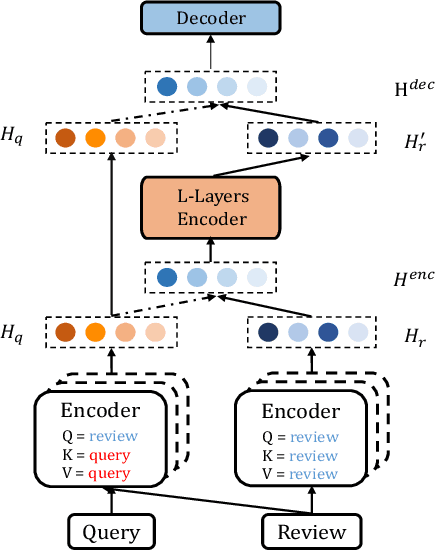

As a concise form of user reviews, tips have unique advantages to explain the search results, assist users' decision making, and further improve user experience in vertical search scenarios. Existing work on tip generation does not take query into consideration, which limits the impact of tips in search scenarios. To address this issue, this paper proposes a query-aware tip generation framework, integrating query information into encoding and subsequent decoding processes. Two specific adaptations of Transformer and Recurrent Neural Network (RNN) are proposed. For Transformer, the query impact is incorporated into the self-attention computation of both the encoder and the decoder. As for RNN, the query-aware encoder adopts a selective network to distill query-relevant information from the review, while the query-aware decoder integrates the query information into the attention computation during decoding. The framework consistently outperforms the competing methods on both public and real-world industrial datasets. Last but not least, online deployment experiments on Dianping demonstrate the advantage of the proposed framework for tip generation as well as its online business values.