 Add to Chrome
 Add to Firefox
 Add to Edge
MemeBench: What LVLMs Miss When Interpreting Culture-Dependent Memes
Jul 30, 2026
Large vision-language models have improved at describing visual content, but accurate descriptions do not ensure interpretation when meaning depends on knowledge beyond the pixels. Memes expose this gap because they rely on cultural entities, background knowledge, and community conventions. Most meme benchmarks reduce interpretation to labels or holistic scores, obscuring where an explanation breaks down. We introduce MemeBench, a diagnostic benchmark of 1,253 Chinese and English memes with human-written references and quality-controlled VIKR annotations, centered on anime, comics, games, and adjacent online subcultures. Its VIKR schema decomposes explanations into Visual clues, Identity links, Knowledge units, and Reasoning mechanisms. Across 26 LVLMs, every model covers visible content more reliably than the knowledge needed to interpret it, and even the strongest retains a 22.6% Visual-Knowledge gap. To test whether this diagnosis can guide improvement, we introduce KAR, an entity-guided retrieval baseline built on CultureBase. Across four controlled models, KAR raises VIKR Success by 3.6-7.4% and, compared with generic retrieval, repairs more answers and breaks fewer. Yet both retrieval conditions improve Identity and Knowledge while reducing Visual coverage in every comparison. MemeBench reveals whether an interpretation succeeds, what is missing, and whether targeted evidence fills the diagnosed gap.

Power Echoes: Investigating Moderation Biases in Online Power-Asymmetric Conflicts
Mar 02, 2026Online power-asymmetric conflicts are prevalent, and most platforms rely on human moderators to conduct moderation currently. Previous studies have been continuously focusing on investigating human moderation biases in different scenarios, while moderation biases under power-asymmetric conflicts remain unexplored. Therefore, we aim to investigate the types of power-related biases human moderators exhibit in power-asymmetric conflict moderation (RQ1) and further explore the influence of AI's suggestions on these biases (RQ2). For this goal, we conducted a mixed design experiment with 50 participants by leveraging the real conflicts between consumers and merchants as a scenario. Results suggest several biases towards supporting the powerful party within these two moderation modes. AI assistance alleviates most biases of human moderation, but also amplifies a few. Based on these results, we propose several insights into future research on human moderation and human-AI collaborative moderation systems for power-asymmetric conflicts.
Hyper Adversarial Tuning for Boosting Adversarial Robustness of Pretrained Large Vision Models
Oct 08, 2024
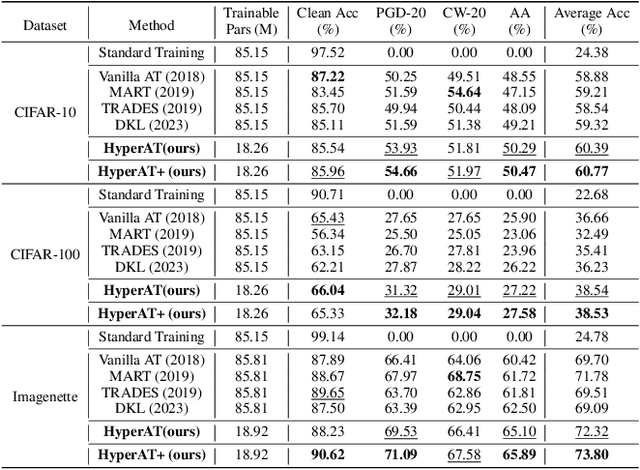


Large vision models have been found vulnerable to adversarial examples, emphasizing the need for enhancing their adversarial robustness. While adversarial training is an effective defense for deep convolutional models, it often faces scalability issues with large vision models due to high computational costs. Recent approaches propose robust fine-tuning methods, such as adversarial tuning of low-rank adaptation (LoRA) in large vision models, but they still struggle to match the accuracy of full parameter adversarial fine-tuning. The integration of various defense mechanisms offers a promising approach to enhancing the robustness of large vision models, yet this paradigm remains underexplored. To address this, we propose hyper adversarial tuning (HyperAT), which leverages shared defensive knowledge among different methods to improve model robustness efficiently and effectively simultaneously. Specifically, adversarial tuning of each defense method is formulated as a learning task, and a hypernetwork generates LoRA specific to this defense. Then, a random sampling and tuning strategy is proposed to extract and facilitate the defensive knowledge transfer between different defenses. Finally, diverse LoRAs are merged to enhance the adversarial robustness. Experiments on various datasets and model architectures demonstrate that HyperAT significantly enhances the adversarial robustness of pretrained large vision models without excessive computational overhead, establishing a new state-of-the-art benchmark.