 Add to Chrome
 Add to Firefox
 Add to Edge
A Generative Model for Closed-Loop Microsimulation of Signalized Intersections
Jun 22, 2026
Traffic microsimulators rely on hand-crafted behavior models that reproduce aggregate flow but miss the heterogeneous interactions between vehicles at signalized intersections. Learned trajectory predictors capture richer interactions but are short-horizon and tend to be unstable when run in closed loop. We present Enactor, an actor-centric generative model for closed-loop intersection microsimulation. The model focuses on vehicles; pedestrians are included as context that can influence vehicle decisions but not predicted. Dynamic actors and lane polylines are encoded in polar coordinates referenced to the intersection center. A transformer with separate spatial and temporal attention blocks predicts a distribution over each actor's next-step motion ($s$, $α$). Training uses a closed-loop curriculum so the model is exposed to its own predictions. We evaluate Enactor in two regimes. In a 4000-second simulation-in-the-loop test at two intersection geometries, Enactor controls every dynamic vehicle against a continuously refreshing actor set rather than the fixed cohort that learned trajectory predictors are usually evaluated against. It recovers the SUMO data generator's speed and travel-time distributions with KL divergence over an order of magnitude lower than a recent transformer baseline on travel time, and substantially lower on speed (roughly $5\times$ lower at Site 1), and reduces red-light violations relative to the same baseline by more than an order of magnitude. An ablation isolates the leader rear-bumper feature as the change with the largest effect on intersection-aware safety metrics. We also evaluate on real-world field data and apply the same architecture to naturalistic vehicle trajectories from a fish-eye camera at a signalized intersection and evaluate it on multi-horizon predictive tasks. Enactor outperforms a constant-velocity baseline at every horizon evaluated.

Residual Modeling for High-Fidelity Learned Compression of Scientific Data
Jun 03, 2026Lossy compression is essential for massive spatiotemporal data from scientific simulations. Learned compressors can achieve high compression ratios at moderate accuracy targets, but their aggregate reconstruction losses do not guarantee accuracy for each block. Existing Guaranteed Autoencoder (GAE) methods add a per-block residual correction by retaining SVD/PCA-style coefficients until the target is met. This works at moderate tolerances, but in the high-fidelity regime with block-level NRMSE from 10^-6 to 10^-4, the number of retained coefficients grows quickly and the correction stream dominates the total rate. We propose a residual-centric view: the learned residual is structurally different from the original scientific field and should be coded with a representation designed for that residual. We introduce two residual coders. LBRC is a deterministic, training-free pipeline that adaptively quantizes the learned residual to the target NRMSE and losslessly encodes the resulting integer residual using 3D Lorenzo differencing, zigzag mapping, bit-plane coding, and entropy coding. NGLR adds a causal neural predictor that outputs a normalized bias for an integer-rounded Lorenzo prediction in the same deterministic integer pipeline, reducing the entropy of the remaining residual code while preserving deterministic decoding. The predictor weights are serialized and counted in the bitstream. Across E3SM, JHTDB, and ERA5 at block-level NRMSE targets from 10^-6 to 10^-4, LBRC improves compression ratio over GAE by 30-60% and is broadly competitive with SZ. NGLR adds a further 10-40% over LBRC and outperforms SZ in the evaluated high-fidelity regime. These results show that residual representations tailored to learned-compressor residuals can preserve the advantage of learned compression when global residual correction becomes rate-dominant.
Enactor: From Traffic Simulators to Surrogate World Models
Mar 18, 2026Traffic microsimulators are widely used to evaluate road network performance under various ``what-if" conditions. However, the behavior models controlling the actions of the actors are overly simplistic and fails to capture realistic actor-actor interactions. Deep learning-based methods have been applied to model vehicles and pedestrians as ``agents" responding to their surrounding ``environment" (including lanes, signals, and neighboring agents). Although effective in learning actor-actor interaction, these approaches fail to generate physically consistent trajectories over long time periods, and they do not explicitly address the complex dynamics that arise at traffic intersections which is a critical location in urban networks. Inspired by the World Model paradigm, we have developed an actor centric generative model using transformer-based architecture that is able to capture the actor-actor interaction, at the same time understanding the geometry to the traffic intersection to generate physically grounded trajectories that are based on learned behavior. Moreover, we test the model in a live ``simulation-in-the-loop" setting, where we generate the initial conditions of the actors using SUMO and then let the model control the dynamics of the actors. We let the simulation run for 40000 timesteps (4000 seconds), testing the performance of the model on long timerange and evaluating the trajectories on traffic engineering related metrics. Experimental results demonstrate that the proposed framework effectively captures complex actor-actor interactions and generates long-horizon, physically consistent trajectories, while requiring significantly fewer training samples than traditional agent-centric generative approaches. Our model is able to outperform the baseline in traffic related as well as aggregate metrics where our model beats the baseline by more than 10x on the KL-Divergence.
Generative Latent Diffusion for Efficient Spatiotemporal Data Reduction
Jul 02, 2025Generative models have demonstrated strong performance in conditional settings and can be viewed as a form of data compression, where the condition serves as a compact representation. However, their limited controllability and reconstruction accuracy restrict their practical application to data compression. In this work, we propose an efficient latent diffusion framework that bridges this gap by combining a variational autoencoder with a conditional diffusion model. Our method compresses only a small number of keyframes into latent space and uses them as conditioning inputs to reconstruct the remaining frames via generative interpolation, eliminating the need to store latent representations for every frame. This approach enables accurate spatiotemporal reconstruction while significantly reducing storage costs. Experimental results across multiple datasets show that our method achieves up to 10 times higher compression ratios than rule-based state-of-the-art compressors such as SZ3, and up to 63 percent better performance than leading learning-based methods under the same reconstruction error.
IntTrajSim: Trajectory Prediction for Simulating Multi-Vehicle driving at Signalized Intersections
Jun 10, 2025
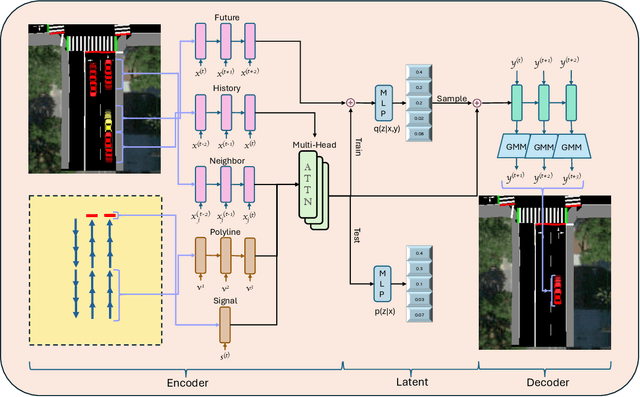
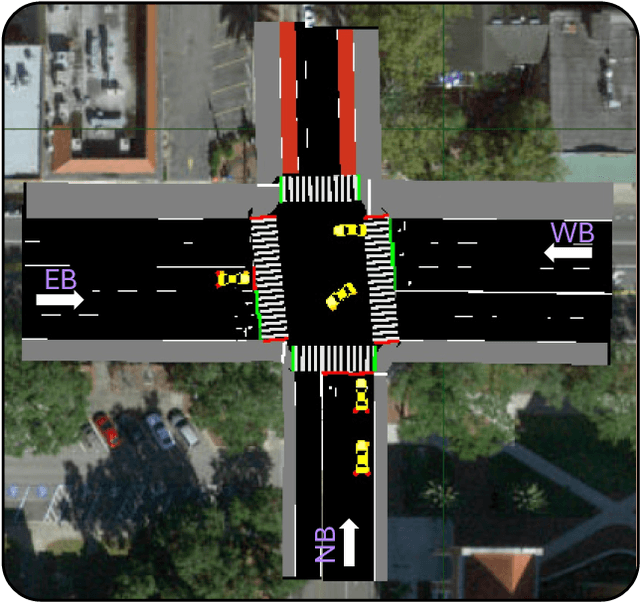
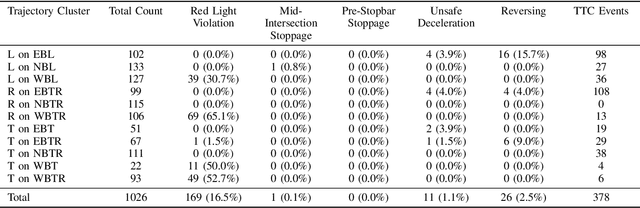
Traffic simulators are widely used to study the operational efficiency of road infrastructure, but their rule-based approach limits their ability to mimic real-world driving behavior. Traffic intersections are critical components of the road infrastructure, both in terms of safety risk (nearly 28% of fatal crashes and 58% of nonfatal crashes happen at intersections) as well as the operational efficiency of a road corridor. This raises an important question: can we create a data-driven simulator that can mimic the macro- and micro-statistics of the driving behavior at a traffic intersection? Deep Generative Modeling-based trajectory prediction models provide a good starting point to model the complex dynamics of vehicles at an intersection. But they are not tested in a "live" micro-simulation scenario and are not evaluated on traffic engineering-related metrics. In this study, we propose traffic engineering-related metrics to evaluate generative trajectory prediction models and provide a simulation-in-the-loop pipeline to do so. We also provide a multi-headed self-attention-based trajectory prediction model that incorporates the signal information, which outperforms our previous models on the evaluation metrics.
Evaluating Generative Vehicle Trajectory Models for Traffic Intersection Dynamics
Jun 10, 2025Traffic Intersections are vital to urban road networks as they regulate the movement of people and goods. However, they are regions of conflicting trajectories and are prone to accidents. Deep Generative models of traffic dynamics at signalized intersections can greatly help traffic authorities better understand the efficiency and safety aspects. At present, models are evaluated on computational metrics that primarily look at trajectory reconstruction errors. They are not evaluated online in a `live' microsimulation scenario. Further, these metrics do not adequately consider traffic engineering-specific concerns such as red-light violations, unallowed stoppage, etc. In this work, we provide a comprehensive analytics tool to train, run, and evaluate models with metrics that give better insights into model performance from a traffic engineering point of view. We train a state-of-the-art multi-vehicle trajectory forecasting model on a large dataset collected by running a calibrated scenario of a real-world urban intersection. We then evaluate the performance of the prediction models, online in a microsimulator, under unseen traffic conditions. We show that despite using ideally-behaved trajectories as input, and achieving low trajectory reconstruction errors, the generated trajectories show behaviors that break traffic rules. We introduce new metrics to evaluate such undesired behaviors and present our results.
Guaranteed Conditional Diffusion: 3D Block-based Models for Scientific Data Compression
Feb 18, 2025This paper proposes a new compression paradigm -- Guaranteed Conditional Diffusion with Tensor Correction (GCDTC) -- for lossy scientific data compression. The framework is based on recent conditional diffusion (CD) generative models, and it consists of a conditional diffusion model, tensor correction, and error guarantee. Our diffusion model is a mixture of 3D conditioning and 2D denoising U-Net. The approach leverages a 3D block-based compressing module to address spatiotemporal correlations in structured scientific data. Then, the reverse diffusion process for 2D spatial data is conditioned on the ``slices'' of content latent variables produced by the compressing module. After training, the denoising decoder reconstructs the data with zero noise and content latent variables, and thus it is entirely deterministic. The reconstructed outputs of the CD model are further post-processed by our tensor correction and error guarantee steps to control and ensure a maximum error distortion, which is an inevitable requirement in lossy scientific data compression. Our experiments involving two datasets generated by climate and chemical combustion simulations show that our framework outperforms standard convolutional autoencoders and yields competitive compression quality with an existing scientific data compression algorithm.
Foundation Model for Lossy Compression of Spatiotemporal Scientific Data
Dec 22, 2024We present a foundation model (FM) for lossy scientific data compression, combining a variational autoencoder (VAE) with a hyper-prior structure and a super-resolution (SR) module. The VAE framework uses hyper-priors to model latent space dependencies, enhancing compression efficiency. The SR module refines low-resolution representations into high-resolution outputs, improving reconstruction quality. By alternating between 2D and 3D convolutions, the model efficiently captures spatiotemporal correlations in scientific data while maintaining low computational cost. Experimental results demonstrate that the FM generalizes well to unseen domains and varying data shapes, achieving up to 4 times higher compression ratios than state-of-the-art methods after domain-specific fine-tuning. The SR module improves compression ratio by 30 percent compared to simple upsampling techniques. This approach significantly reduces storage and transmission costs for large-scale scientific simulations while preserving data integrity and fidelity.
Attention Based Machine Learning Methods for Data Reduction with Guaranteed Error Bounds
Sep 09, 2024Scientific applications in fields such as high energy physics, computational fluid dynamics, and climate science generate vast amounts of data at high velocities. This exponential growth in data production is surpassing the advancements in computing power, network capabilities, and storage capacities. To address this challenge, data compression or reduction techniques are crucial. These scientific datasets have underlying data structures that consist of structured and block structured multidimensional meshes where each grid point corresponds to a tensor. It is important that data reduction techniques leverage strong spatial and temporal correlations that are ubiquitous in these applications. Additionally, applications such as CFD, process tensors comprising hundred plus species and their attributes at each grid point. Reduction techniques should be able to leverage interrelationships between the elements in each tensor. In this paper, we propose an attention-based hierarchical compression method utilizing a block-wise compression setup. We introduce an attention-based hyper-block autoencoder to capture inter-block correlations, followed by a block-wise encoder to capture block-specific information. A PCA-based post-processing step is employed to guarantee error bounds for each data block. Our method effectively captures both spatiotemporal and inter-variable correlations within and between data blocks. Compared to the state-of-the-art SZ3, our method achieves up to 8 times higher compression ratio on the multi-variable S3D dataset. When evaluated on single-variable setups using the E3SM and XGC datasets, our method still achieves up to 3 times and 2 times higher compression ratio, respectively.
Video-based Pedestrian and Vehicle Traffic Analysis During Football Games
Aug 04, 2024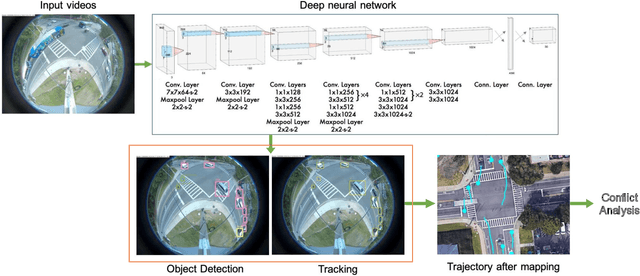
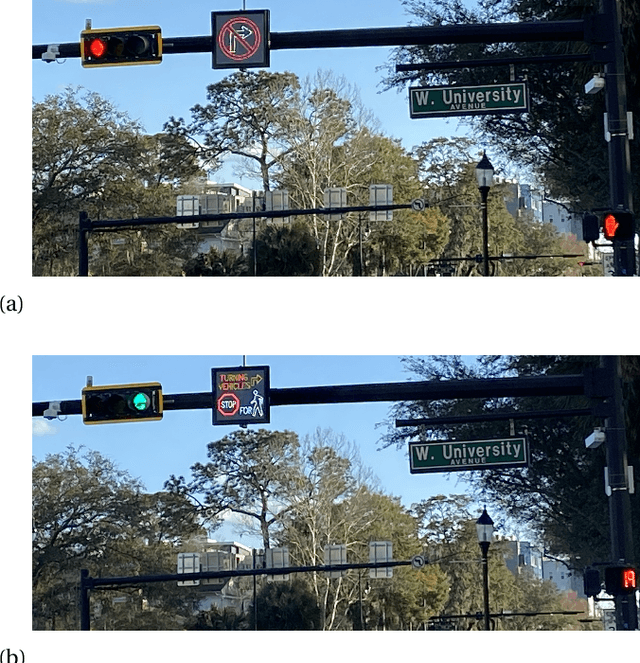
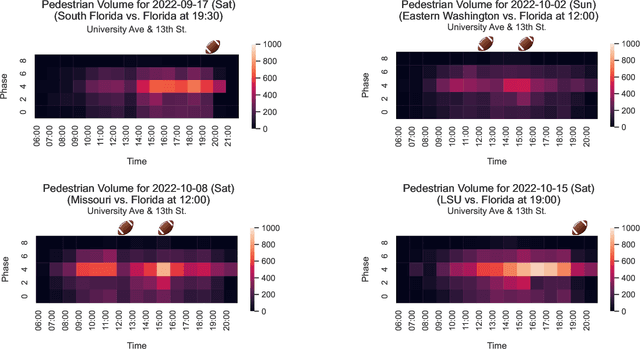
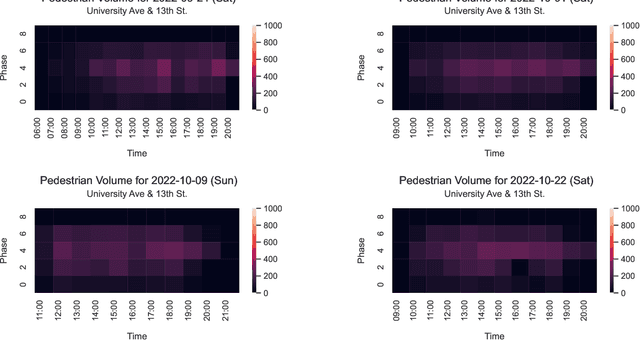
This paper utilizes video analytics to study pedestrian and vehicle traffic behavior, focusing on analyzing traffic patterns during football gamedays. The University of Florida (UF) hosts six to seven home football games on Saturdays during the college football season, attracting significant pedestrian activity. Through video analytics, this study provides valuable insights into the impact of these events on traffic volumes and safety at intersections. Comparing pedestrian and vehicle activities on gamedays versus non-gamedays reveals differing patterns. For example, pedestrian volume substantially increases during gamedays, which is positively correlated with the probability of the away team winning. This correlation is likely because fans of the home team enjoy watching difficult games. Win probabilities as an early predictor of pedestrian volumes at intersections can be a tool to help traffic professionals anticipate traffic management needs. Pedestrian-to-vehicle (P2V) conflicts notably increase on gamedays, particularly a few hours before games start. Addressing this, a "Barnes Dance" movement phase within the intersection is recommended. Law enforcement presence during high-activity gamedays can help ensure pedestrian compliance and enhance safety. In contrast, we identified that vehicle-to-vehicle (V2V) conflicts generally do not increase on gamedays and may even decrease due to heightened driver caution.