 Add to Chrome
 Add to Firefox
 Add to Edge
Understanding Social Reasoning in Language Models with Language Models
Jun 21, 2023
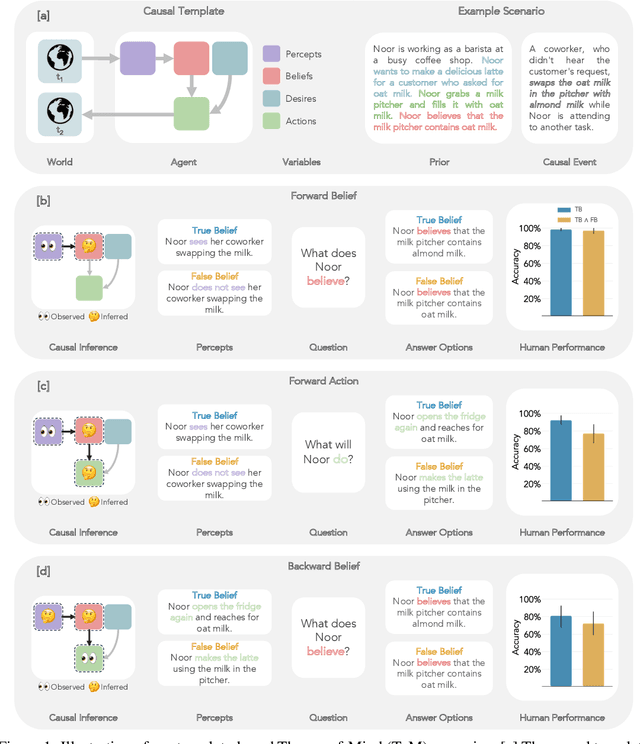

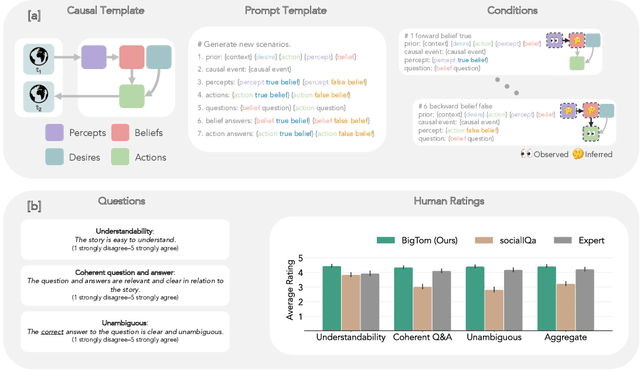
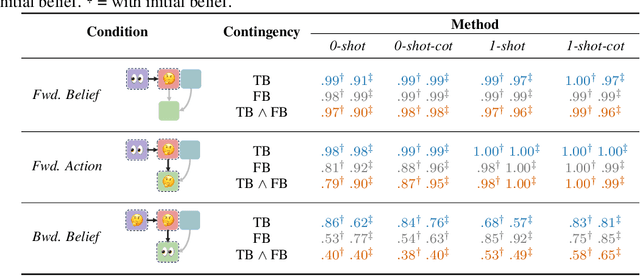
As Large Language Models (LLMs) become increasingly integrated into our everyday lives, understanding their ability to comprehend human mental states becomes critical for ensuring effective interactions. However, despite the recent attempts to assess the Theory-of-Mind (ToM) reasoning capabilities of LLMs, the degree to which these models can align with human ToM remains a nuanced topic of exploration. This is primarily due to two distinct challenges: (1) the presence of inconsistent results from previous evaluations, and (2) concerns surrounding the validity of existing evaluation methodologies. To address these challenges, we present a novel framework for procedurally generating evaluations with LLMs by populating causal templates. Using our framework, we create a new social reasoning benchmark (BigToM) for LLMs which consists of 25 controls and 5,000 model-written evaluations. We find that human participants rate the quality of our benchmark higher than previous crowd-sourced evaluations and comparable to expert-written evaluations. Using BigToM, we evaluate the social reasoning capabilities of a variety of LLMs and compare model performances with human performance. Our results suggest that GPT4 has ToM capabilities that mirror human inference patterns, though less reliable, while other LLMs struggle.

Just One Byte : A Note on Low-Bandwidth Decentralized Language Model Finetuning Using Shared Randomness
Jun 16, 2023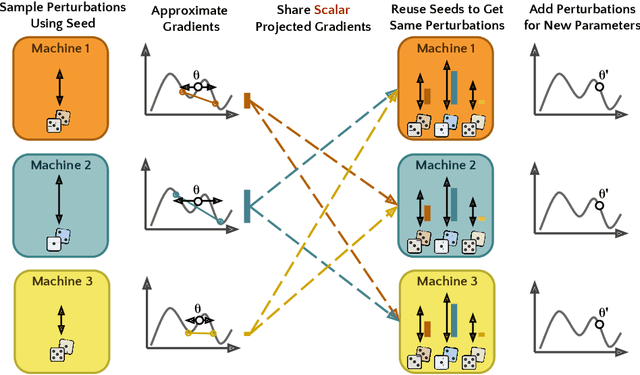
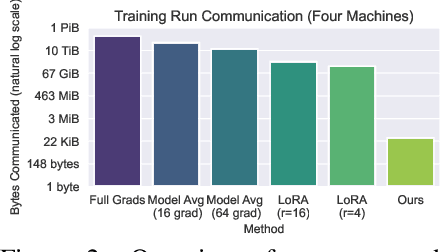
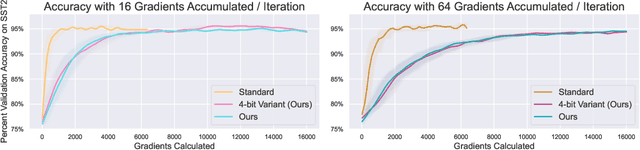
Language model training in distributed settings is limited by the communication cost of gradient exchanges. In this short note, we extend recent work from Malladi et al. (2023), using shared randomness to perform distributed fine-tuning with low bandwidth. The method is a natural decentralized extension of memory-efficient Simultaneous Perturbation Stochastic Approximation (SPSA). Each iteration, each machine seeds a Random Number Generator (RNG) to perform local reproducible perturbations on model weights and calculate and exchange scalar projected gradients, which are then used to update each model. By using a (machine, sample) identifier as the random seed, each model can regenerate one another's perturbations. As machines only exchange single-byte projected gradients, this is highly communication efficient. There are also potential privacy benefits, as projected gradients may be calculated on different training data, and models never access the other's data. Our approach not only drastically reduces communication bandwidth requirements but also accommodates dynamic addition or removal of machines during the training process and retains the memory-efficient and inference-only advantages of recent work. We perform proof-of-concept experiments to demonstrate the potential usefulness of this method, building off of rich literature on distributed optimization and memory-efficient training.
Certified Reasoning with Language Models
Jun 06, 2023Language models often achieve higher accuracy when reasoning step-by-step in complex tasks. However, their reasoning can be unsound, inconsistent, or rely on undesirable prior assumptions. To tackle these issues, we introduce a class of tools for language models called guides that use state and incremental constraints to guide generation. A guide can be invoked by the model to constrain its own generation to a set of valid statements given by the tool. In turn, the model's choices can change the guide's state. We show how a general system for logical reasoning can be used as a guide, which we call LogicGuide. Given a reasoning problem in natural language, a model can formalize its assumptions for LogicGuide and then guarantee that its reasoning steps are sound. In experiments with the PrOntoQA and ProofWriter reasoning datasets, LogicGuide significantly improves the performance of GPT-3, GPT-3.5 Turbo and LLaMA (accuracy gains up to 35%). LogicGuide also drastically reduces content effects: the interference of prior and current assumptions that both humans and language models have been shown to suffer from. Finally, we explore bootstrapping LLaMA 13B from its own reasoning and find that LogicGuide is critical: by training only on certified self-generated reasoning, LLaMA can self-improve, avoiding learning from its own hallucinations.
Strategic Reasoning with Language Models
May 30, 2023Strategic reasoning enables agents to cooperate, communicate, and compete with other agents in diverse situations. Existing approaches to solving strategic games rely on extensive training, yielding strategies that do not generalize to new scenarios or games without retraining. Large Language Models (LLMs), with their ability to comprehend and generate complex, context-rich language, could prove powerful as tools for strategic gameplay. This paper introduces an approach that uses pretrained LLMs with few-shot chain-of-thought examples to enable strategic reasoning for AI agents. Our approach uses systematically generated demonstrations of reasoning about states, values, and beliefs to prompt the model. Using extensive variations of simple matrix games, we show that strategies that are derived based on systematically generated prompts generalize almost perfectly to new game structures, alternate objectives, and hidden information. Additionally, we demonstrate our approach can lead to human-like negotiation strategies in realistic scenarios without any extra training or fine-tuning. Our results highlight the ability of LLMs, guided by systematic reasoning demonstrations, to adapt and excel in diverse strategic scenarios.
Characterizing tradeoffs between teaching via language and demonstrations in multi-agent systems
May 19, 2023
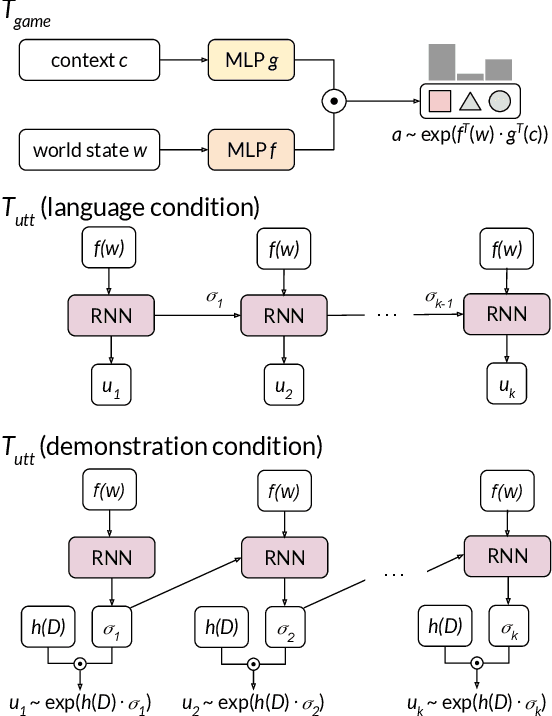

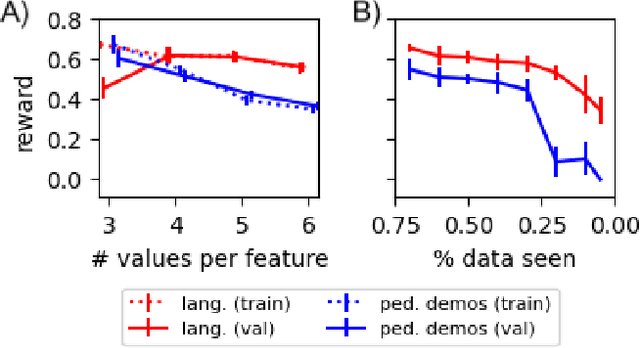
Humans teach others about the world through language and demonstration. When might one of these modalities be more effective than the other? In this work, we study the factors that modulate the effectiveness of language vs. demonstration using multi-agent systems to model human communication. Specifically, we train neural network agents to teach via language or demonstration in a grounded communication task, manipulating 1) the inherent difficulty of the task and 2) the competence of the teacher. We find that teaching by demonstration is more effective in the simplest settings, but language is more effective as task difficulty increases, due to its ability to generalize more effectively to unseen scenarios. Overall, these results provide converging evidence for a tradeoff between language and demonstration as teaching modalities in humans, and make the novel predictions that demonstration may be optimal for easy tasks, while language enables generalization in more challenging settings.
Interpretability at Scale: Identifying Causal Mechanisms in Alpaca
May 15, 2023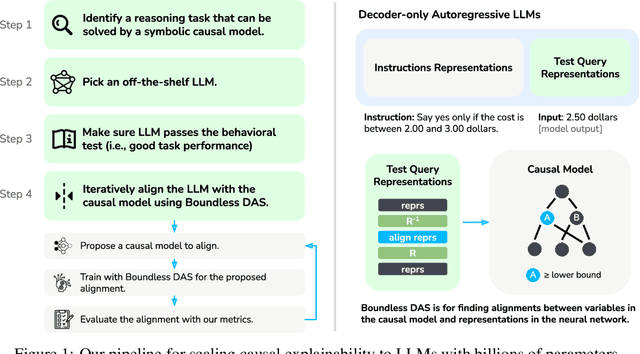
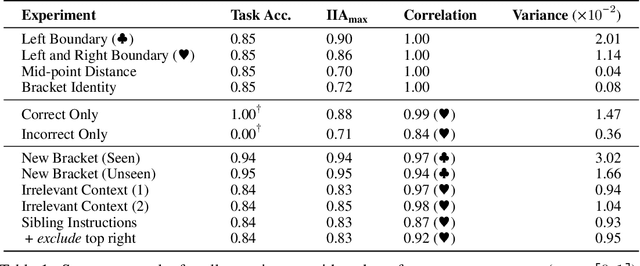
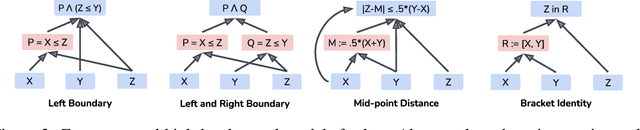
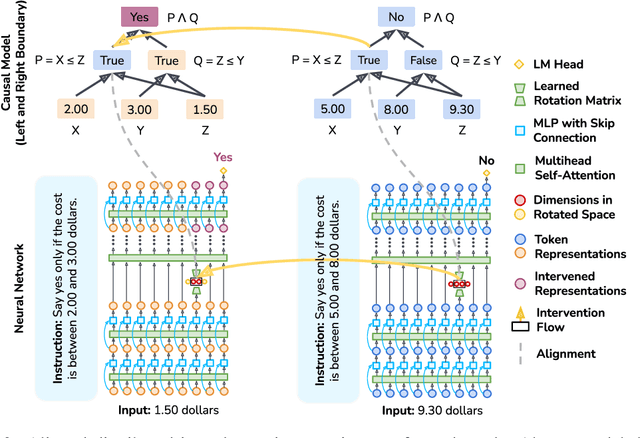
Obtaining human-interpretable explanations of large, general-purpose language models is an urgent goal for AI safety. However, it is just as important that our interpretability methods are faithful to the causal dynamics underlying model behavior and able to robustly generalize to unseen inputs. Distributed Alignment Search (DAS) is a powerful gradient descent method grounded in a theory of causal abstraction that uncovered perfect alignments between interpretable symbolic algorithms and small deep learning models fine-tuned for specific tasks. In the present paper, we scale DAS significantly by replacing the remaining brute-force search steps with learned parameters -- an approach we call DAS. This enables us to efficiently search for interpretable causal structure in large language models while they follow instructions. We apply DAS to the Alpaca model (7B parameters), which, off the shelf, solves a simple numerical reasoning problem. With DAS, we discover that Alpaca does this by implementing a causal model with two interpretable boolean variables. Furthermore, we find that the alignment of neural representations with these variables is robust to changes in inputs and instructions. These findings mark a first step toward deeply understanding the inner-workings of our largest and most widely deployed language models.
Overinformative Question Answering by Humans and Machines
May 11, 2023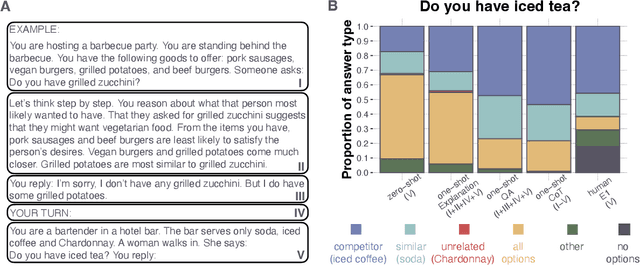

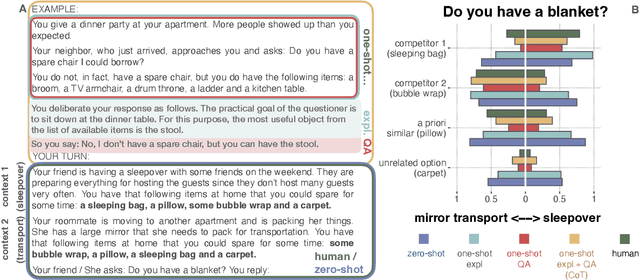
When faced with a polar question, speakers often provide overinformative answers going beyond a simple "yes" or "no". But what principles guide the selection of additional information? In this paper, we provide experimental evidence from two studies suggesting that overinformativeness in human answering is driven by considerations of relevance to the questioner's goals which they flexibly adjust given the functional context in which the question is uttered. We take these human results as a strong benchmark for investigating question-answering performance in state-of-the-art neural language models, conducting an extensive evaluation on items from human experiments. We find that most models fail to adjust their answering behavior in a human-like way and tend to include irrelevant information. We show that GPT-3 is highly sensitive to the form of the prompt and only achieves human-like answer patterns when guided by an example and cognitively-motivated explanation.
Bayesian Reinforcement Learning with Limited Cognitive Load
May 05, 2023All biological and artificial agents must learn and make decisions given limits on their ability to process information. As such, a general theory of adaptive behavior should be able to account for the complex interactions between an agent's learning history, decisions, and capacity constraints. Recent work in computer science has begun to clarify the principles that shape these dynamics by bridging ideas from reinforcement learning, Bayesian decision-making, and rate-distortion theory. This body of work provides an account of capacity-limited Bayesian reinforcement learning, a unifying normative framework for modeling the effect of processing constraints on learning and action selection. Here, we provide an accessible review of recent algorithms and theoretical results in this setting, paying special attention to how these ideas can be applied to studying questions in the cognitive and behavioral sciences.
Solving Math Word Problems by Combining Language Models With Symbolic Solvers
Apr 16, 2023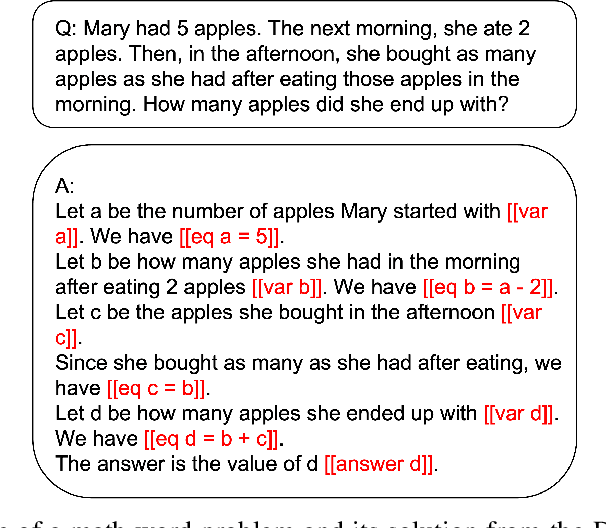
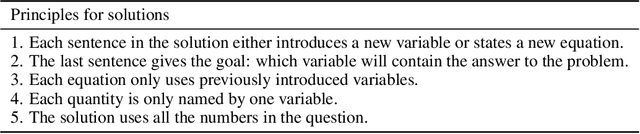
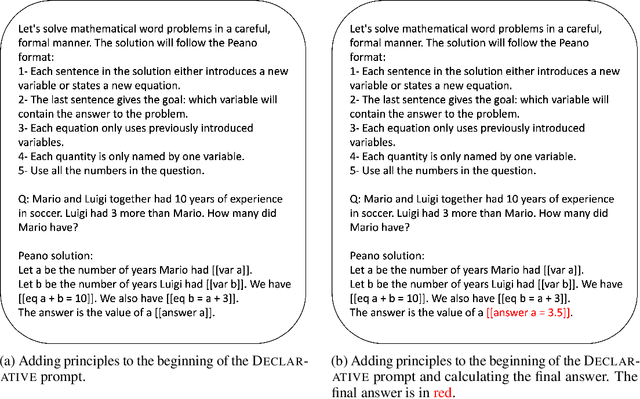
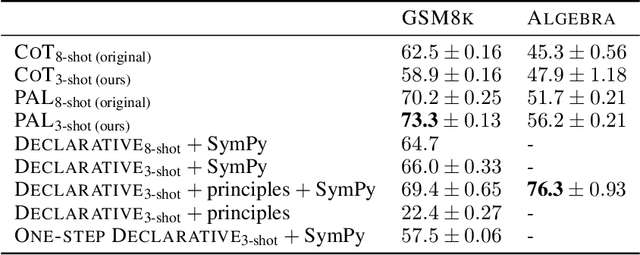
Automatically generating high-quality step-by-step solutions to math word problems has many applications in education. Recently, combining large language models (LLMs) with external tools to perform complex reasoning and calculation has emerged as a promising direction for solving math word problems, but prior approaches such as Program-Aided Language model (PAL) are biased towards simple procedural problems and less effective for problems that require declarative reasoning. We propose an approach that combines an LLM that can incrementally formalize word problems as a set of variables and equations with an external symbolic solver that can solve the equations. Our approach achieves comparable accuracy to the original PAL on the GSM8K benchmark of math word problems and outperforms PAL by an absolute 20% on ALGEBRA, a new dataset of more challenging word problems extracted from Algebra textbooks. Our work highlights the benefits of using declarative and incremental representations when interfacing with an external tool for solving complex math word problems. Our data and prompts are publicly available at https://github.com/joyheyueya/declarative-math-word-problem.
Why think step-by-step? Reasoning emerges from the locality of experience
Apr 07, 2023Humans have a powerful and mysterious capacity to reason. By working through a series of purely mental steps, we can make inferences we would not be capable of making directly -- despite that fact that we get no additional data from the world. Similarly, large language models can perform better at complex tasks through chain-of-thought reasoning, where they generate intermediate steps before answering a question. We use language models to investigate the questions of when and why reasoning is helpful, testing the hypothesis that reasoning is effective when training data consisting of local clusters of variables that influence each other strongly. These training conditions enable the chaining of accurate local inferences in order to estimate relationships between variables that were not seen together in training. We train an autoregressive transformer on samples from joint distributions defined by Bayes nets, but only include a subset of all the variables in each sample. We compare language models' ability to match conditional probabilities both with and without intermediate reasoning steps, finding that intermediate steps help only when the training data is locally structured with respect to dependencies between variables. Furthermore, intermediate variables need to be relevant to the relationship between observed information and target inferences. Our results illustrate how the statistical structure of training data drives the effectiveness of reasoning step by step.