 Add to Chrome
 Add to Firefox
 Add to Edge
Confirming Our Biases? Evaluating the Capabilities, Risks, and Societal Impact of Large Language Models
Aug 07, 2026
It is well established that large language models (LLMs) are sensitive to prompt framing, reflecting patterns in their training data or prior prompts. In this study, we investigate the extent to which LLMs reinforce users biases expressed in the prompts and examine the boundary between implicit framing effects and explicit prompt manipulation. Specifically, we evaluate how susceptible LLMs are to direct and suggestive prompts that encourage models to support or challenge particular positions. We evaluate six LLMs using 160 distinct prompts spanning ten topics across opinion-based and factual domains. The prompts systematically vary in prompting strategy, support versus challenge instructions, prompt polarity, users' expressed beliefs, and topic domain, spanning both opinion-based and factual questions. Our results show that LLMs systematically adapt their responses to align with prompt framing, even in factual contexts. This suggests that prompt framing can outweigh factual consistency in model responses. Overall, our findings delineate the extent and boundaries of LLM manipulability. Furthermore, the results imply that LLMs can reinforce subtle user biases and are susceptible to explicit prompt manipulation even in domains where responses should remain factually stable.

Computational models of pragmatic reasoning with flexible generation of meaning and expression alternatives
Jul 20, 2026Pragmatic language use requires reasoning about alternatives: the alternative expressions a speaker might have chosen, or the alternative interpretations a listener might entertain. Formal and computational models of pragmatics must therefore specify the sets of alternatives that interlocutors reason over, which is often done through manual specification. Here we propose a framework, ScAffolded Generative models for Explanation (SAGE), that combines the explanatory transparency of cognitive models with the generative flexibility of language models (LMs). SAGE decomposes a pragmatic process into three kinds of modules: proposers, which use LMs to generate an open-ended space of candidate alternatives; evaluators, which assess those alternatives (e.g., their semantics, complexity, or typicality); and selectors, which implement the rule-based computational steps of a cognitively motivated task analysis. We assess SAGE in three case studies spanning pragmatic generation and interpretation-referential expression generation, manner (M-)implicatures, and Gricean conversational implicatures. SAGE models are evaluated critically using established methods from computational cognitive modeling, including ablations, baseline comparisons, and quantitative fit to human data. Across studies, SAGE models achieved high accuracy and often outperformed baselines, but component-level analyses reveal an asymmetry: LM proposers reliably generated alternatives well-suited to pragmatic modeling, whereas LM evaluators are better at providing intuitive judgements rather than judgements of theoretical or formal measures. We discuss the promise and the limitations of neuro-symbolic models as candidate explanatory accounts of human pragmatic language use.
Agent-based imitation dynamics can yield efficiently compressed population-level vocabularies
Mar 16, 2026Natural languages have been argued to evolve under pressure to efficiently compress meanings into words by optimizing the Information Bottleneck (IB) complexity-accuracy tradeoff. However, the underlying social dynamics that could drive the optimization of a language's vocabulary towards efficiency remain largely unknown. In parallel, evolutionary game theory has been invoked to explain the emergence of language from rudimentary agent-level dynamics, but it has not yet been tested whether such an approach can lead to efficient compression in the IB sense. Here, we provide a unified model integrating evolutionary game theory with the IB framework and show how near-optimal compression can arise in a population through an independently motivated dynamic of imprecise strategy imitation in signaling games. We find that key parameters of the model -- namely, those that regulate precision in these games, as well as players' tendency to confuse similar states -- lead to constrained variation of the tradeoffs achieved by emergent vocabularies. Our results suggest that evolutionary game dynamics could potentially provide a mechanistic basis for the evolution of vocabularies with information-theoretically optimal and empirically attested properties.
On Emergent Social World Models -- Evidence for Functional Integration of Theory of Mind and Pragmatic Reasoning in Language Models
Feb 10, 2026This paper investigates whether LMs recruit shared computational mechanisms for general Theory of Mind (ToM) and language-specific pragmatic reasoning in order to contribute to the general question of whether LMs may be said to have emergent "social world models", i.e., representations of mental states that are repurposed across tasks (the functional integration hypothesis). Using behavioral evaluations and causal-mechanistic experiments via functional localization methods inspired by cognitive neuroscience, we analyze LMs' performance across seven subcategories of ToM abilities (Beaudoin et al., 2020) on a substantially larger localizer dataset than used in prior like-minded work. Results from stringent hypothesis-driven statistical testing offer suggestive evidence for the functional integration hypothesis, indicating that LMs may develop interconnected "social world models" rather than isolated competencies. This work contributes novel ToM localizer data, methodological refinements to functional localization techniques, and empirical insights into the emergence of social cognition in artificial systems.
Act or Clarify? Modeling Sensitivity to Uncertainty and Cost in Communication
Feb 02, 2026When deciding how to act under uncertainty, agents may choose to act to reduce uncertainty or they may act despite that uncertainty.In communicative settings, an important way of reducing uncertainty is by asking clarification questions (CQs). We predict that the decision to ask a CQ depends on both contextual uncertainty and the cost of alternative actions, and that these factors interact: uncertainty should matter most when acting incorrectly is costly. We formalize this interaction in a computational model based on expected regret: how much an agent stands to lose by acting now rather than with full information. We test these predictions in two experiments, one examining purely linguistic responses to questions and another extending to choices between clarification and non-linguistic action. Taken together, our results suggest a rational tradeoff: humans tend to seek clarification proportional to the risk of substantial loss when acting under uncertainty.
Linking forward-pass dynamics in Transformers and real-time human processing
Apr 18, 2025Modern AI models are increasingly being used as theoretical tools to study human cognition. One dominant approach is to evaluate whether human-derived measures (such as offline judgments or real-time processing) are predicted by a model's output: that is, the end-product of forward pass(es) through the network. At the same time, recent advances in mechanistic interpretability have begun to reveal the internal processes that give rise to model outputs, raising the question of whether models and humans might arrive at outputs using similar "processing strategies". Here, we investigate the link between real-time processing in humans and "layer-time" dynamics in Transformer models. Across five studies spanning domains and modalities, we test whether the dynamics of computation in a single forward pass of pre-trained Transformers predict signatures of processing in humans, above and beyond properties of the model's output probability distribution. We consistently find that layer-time dynamics provide additional predictive power on top of output measures. Our results suggest that Transformer processing and human processing may be facilitated or impeded by similar properties of an input stimulus, and this similarity has emerged through general-purpose objectives such as next-token prediction or image recognition. Our work suggests a new way of using AI models to study human cognition: not just as a black box mapping stimuli to responses, but potentially also as explicit processing models.
Non-literal Understanding of Number Words by Language Models
Feb 10, 2025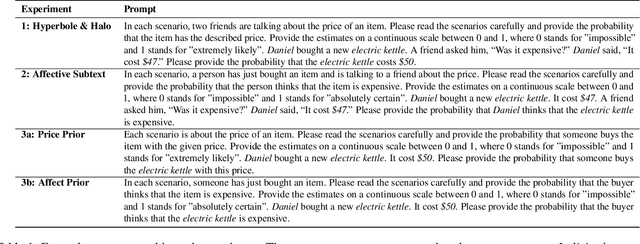
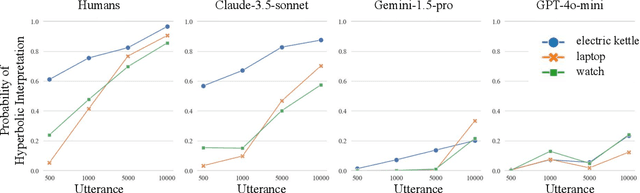

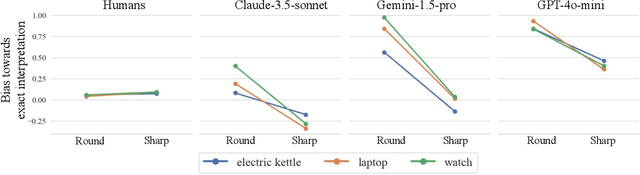
Humans naturally interpret numbers non-literally, effortlessly combining context, world knowledge, and speaker intent. We investigate whether large language models (LLMs) interpret numbers similarly, focusing on hyperbole and pragmatic halo effects. Through systematic comparison with human data and computational models of pragmatic reasoning, we find that LLMs diverge from human interpretation in striking ways. By decomposing pragmatic reasoning into testable components, grounded in the Rational Speech Act framework, we pinpoint where LLM processing diverges from human cognition -- not in prior knowledge, but in reasoning with it. This insight leads us to develop a targeted solution -- chain-of-thought prompting inspired by an RSA model makes LLMs' interpretations more human-like. Our work demonstrates how computational cognitive models can both diagnose AI-human differences and guide development of more human-like language understanding capabilities.
Cognitive Modeling with Scaffolded LLMs: A Case Study of Referential Expression Generation
Jul 04, 2024To what extent can LLMs be used as part of a cognitive model of language generation? In this paper, we approach this question by exploring a neuro-symbolic implementation of an algorithmic cognitive model of referential expression generation by Dale & Reiter (1995). The symbolic task analysis implements the generation as an iterative procedure that scaffolds symbolic and gpt-3.5-turbo-based modules. We compare this implementation to an ablated model and a one-shot LLM-only baseline on the A3DS dataset (Tsvilodub & Franke, 2023). We find that our hybrid approach is cognitively plausible and performs well in complex contexts, while allowing for more open-ended modeling of language generation in a larger domain.
Bayesian Statistical Modeling with Predictors from LLMs
Jun 13, 2024State of the art large language models (LLMs) have shown impressive performance on a variety of benchmark tasks and are increasingly used as components in larger applications, where LLM-based predictions serve as proxies for human judgements or decision. This raises questions about the human-likeness of LLM-derived information, alignment with human intuition, and whether LLMs could possibly be considered (parts of) explanatory models of (aspects of) human cognition or language use. To shed more light on these issues, we here investigate the human-likeness of LLMs' predictions for multiple-choice decision tasks from the perspective of Bayesian statistical modeling. Using human data from a forced-choice experiment on pragmatic language use, we find that LLMs do not capture the variance in the human data at the item-level. We suggest different ways of deriving full distributional predictions from LLMs for aggregate, condition-level data, and find that some, but not all ways of obtaining condition-level predictions yield adequate fits to human data. These results suggests that assessment of LLM performance depends strongly on seemingly subtle choices in methodology, and that LLMs are at best predictors of human behavior at the aggregate, condition-level, for which they are, however, not designed to, or usually used to, make predictions in the first place.
Experimental Pragmatics with Machines: Testing LLM Predictions for the Inferences of Plain and Embedded Disjunctions
May 09, 2024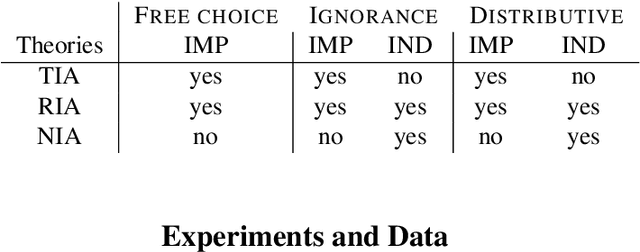

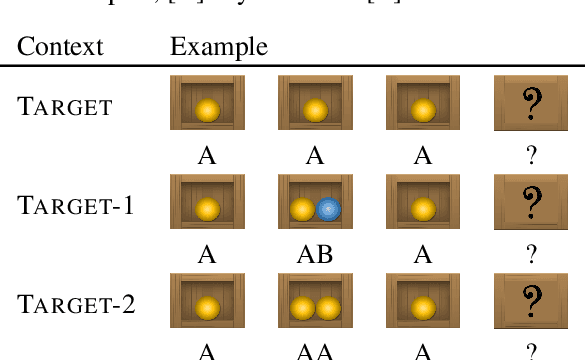
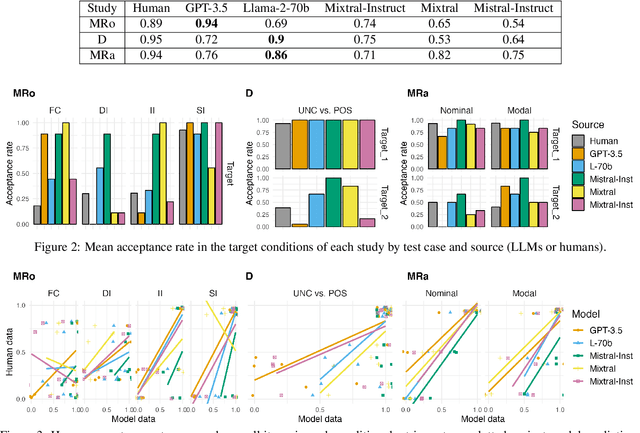
Human communication is based on a variety of inferences that we draw from sentences, often going beyond what is literally said. While there is wide agreement on the basic distinction between entailment, implicature, and presupposition, the status of many inferences remains controversial. In this paper, we focus on three inferences of plain and embedded disjunctions, and compare them with regular scalar implicatures. We investigate this comparison from the novel perspective of the predictions of state-of-the-art large language models, using the same experimental paradigms as recent studies investigating the same inferences with humans. The results of our best performing models mostly align with those of humans, both in the large differences we find between those inferences and implicatures, as well as in fine-grained distinctions among different aspects of those inferences.