 Add to Chrome
 Add to Firefox
 Add to Edge
Representing expertise accelerates learning from pedagogical interaction data
Apr 14, 2026
Work in cognitive science and artificial intelligence has suggested that exposing learning agents to traces of interaction between multiple individuals can improve performance in a variety of settings, yet it remains unknown which features of interactions contribute to this improvement. We examined the factors that support the effectiveness of interaction data, using a controlled paradigm that allowed us to precisely operationalize key distinctions between interaction and an expert acting alone. We generated synthetic datasets of simple interactions between an expert and a novice in a spatial navigation task, and then trained transformer models on those datasets, evaluating performance after exposure to different datasets. Our experiments showed that models trained on pedagogical interactions were more robust across a variety of scenarios compared to models trained only on expert demonstrations, and that having the ability to represent epistemically distinct agents led to expert-like behavior even when expert behavior was rarely observed.

Characterizing tradeoffs between teaching via language and demonstrations in multi-agent systems
May 19, 2023
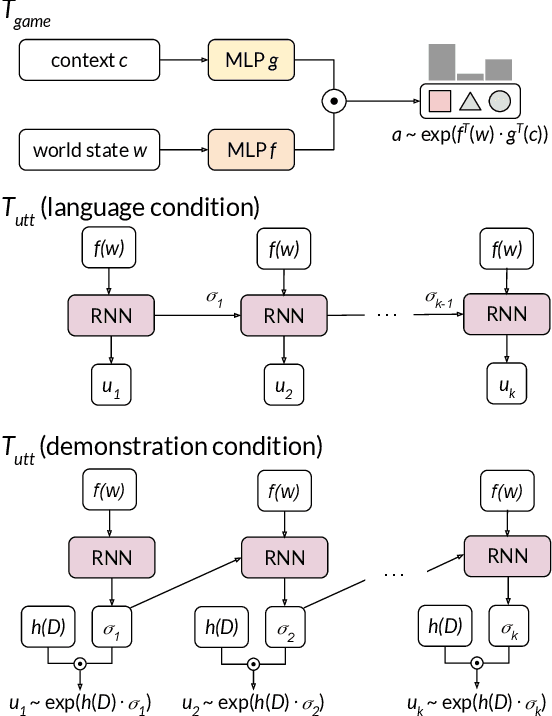

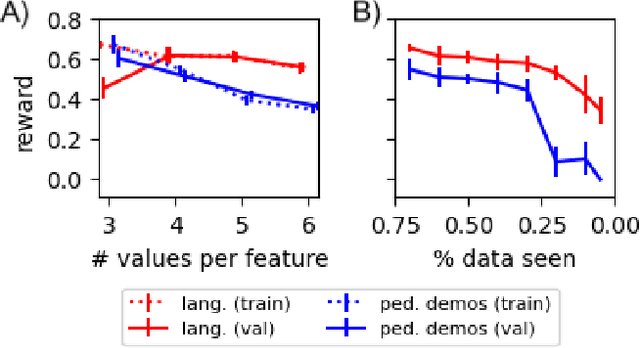
Humans teach others about the world through language and demonstration. When might one of these modalities be more effective than the other? In this work, we study the factors that modulate the effectiveness of language vs. demonstration using multi-agent systems to model human communication. Specifically, we train neural network agents to teach via language or demonstration in a grounded communication task, manipulating 1) the inherent difficulty of the task and 2) the competence of the teacher. We find that teaching by demonstration is more effective in the simplest settings, but language is more effective as task difficulty increases, due to its ability to generalize more effectively to unseen scenarios. Overall, these results provide converging evidence for a tradeoff between language and demonstration as teaching modalities in humans, and make the novel predictions that demonstration may be optimal for easy tasks, while language enables generalization in more challenging settings.