 Add to Chrome
 Add to Firefox
 Add to Edge
Data reuse enables cost-efficient randomized trials of medical AI models
Nov 13, 2025
Randomized controlled trials (RCTs) are indispensable for establishing the clinical value of medical artificial-intelligence (AI) tools, yet their high cost and long timelines hinder timely validation as new models emerge rapidly. Here, we propose BRIDGE, a data-reuse RCT design for AI-based risk models. AI risk models support a broad range of interventions, including screening, treatment selection, and clinical alerts. BRIDGE trials recycle participant-level data from completed trials of AI models when legacy and updated models make concordant predictions, thereby reducing the enrollment requirement for subsequent trials. We provide a practical checklist for investigators to assess whether reusing data from previous trials allows for valid causal inference and preserves type I error. Using real-world datasets across breast cancer, cardiovascular disease, and sepsis, we demonstrate concordance between successive AI models, with up to 64.8% overlap in top 5% high-risk cohorts. We then simulate a series of breast cancer screening studies, where our design reduced required enrollment by 46.6%--saving over US$2.8 million--while maintaining 80% power. By transforming trials into adaptive, modular studies, our proposed design makes Level I evidence generation feasible for every model iteration, thereby accelerating cost-effective translation of AI into routine care.

PLUTO: Pathology-Universal Transformer
May 13, 2024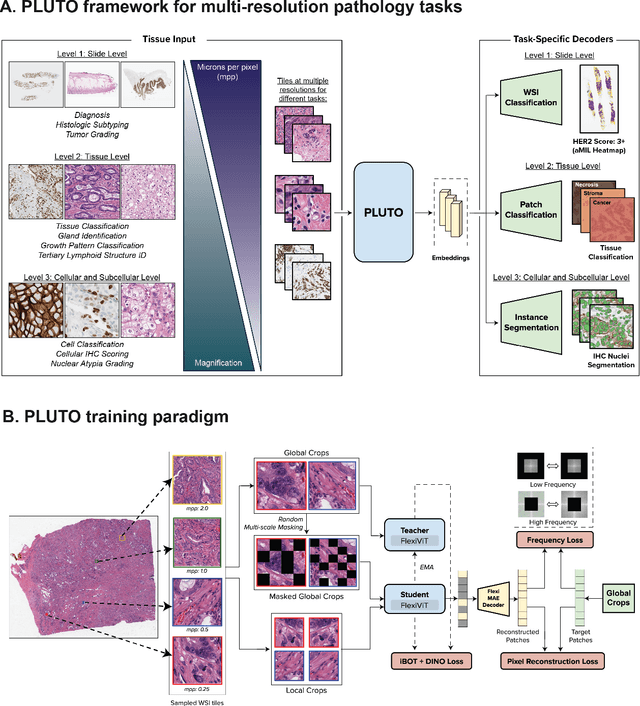
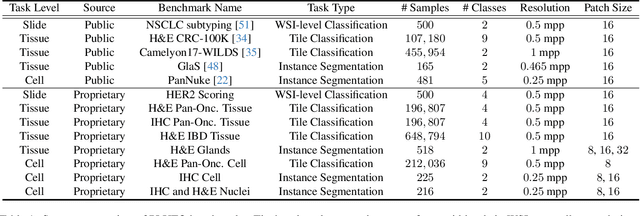
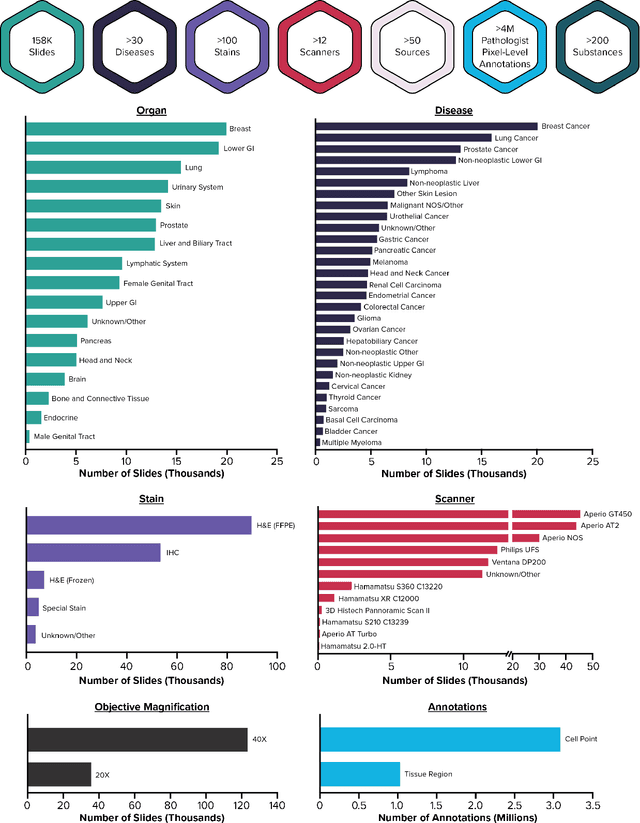
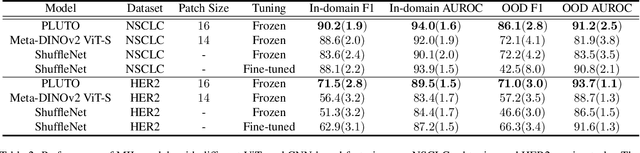
Pathology is the study of microscopic inspection of tissue, and a pathology diagnosis is often the medical gold standard to diagnose disease. Pathology images provide a unique challenge for computer-vision-based analysis: a single pathology Whole Slide Image (WSI) is gigapixel-sized and often contains hundreds of thousands to millions of objects of interest across multiple resolutions. In this work, we propose PathoLogy Universal TransfOrmer (PLUTO): a light-weight pathology FM that is pre-trained on a diverse dataset of 195 million image tiles collected from multiple sites and extracts meaningful representations across multiple WSI scales that enable a large variety of downstream pathology tasks. In particular, we design task-specific adaptation heads that utilize PLUTO's output embeddings for tasks which span pathology scales ranging from subcellular to slide-scale, including instance segmentation, tile classification, and slide-level prediction. We compare PLUTO's performance to other state-of-the-art methods on a diverse set of external and internal benchmarks covering multiple biologically relevant tasks, tissue types, resolutions, stains, and scanners. We find that PLUTO matches or outperforms existing task-specific baselines and pathology-specific foundation models, some of which use orders-of-magnitude larger datasets and model sizes when compared to PLUTO. Our findings present a path towards a universal embedding to power pathology image analysis, and motivate further exploration around pathology foundation models in terms of data diversity, architectural improvements, sample efficiency, and practical deployability in real-world applications.
Improved statistical benchmarking of digital pathology models using pairwise frames evaluation
Jun 07, 2023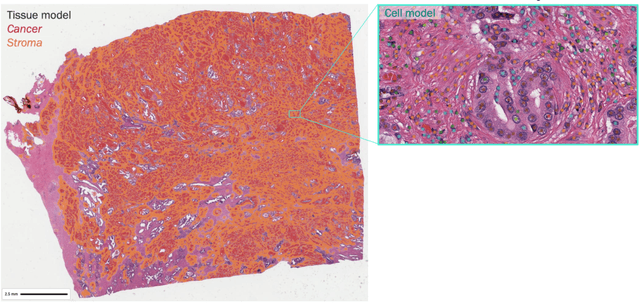
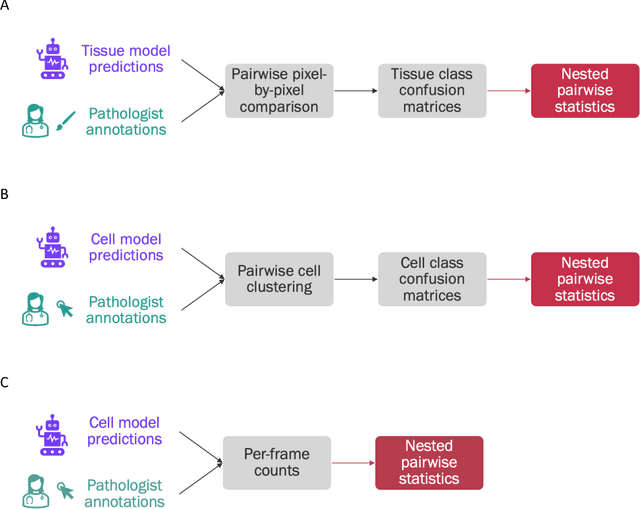
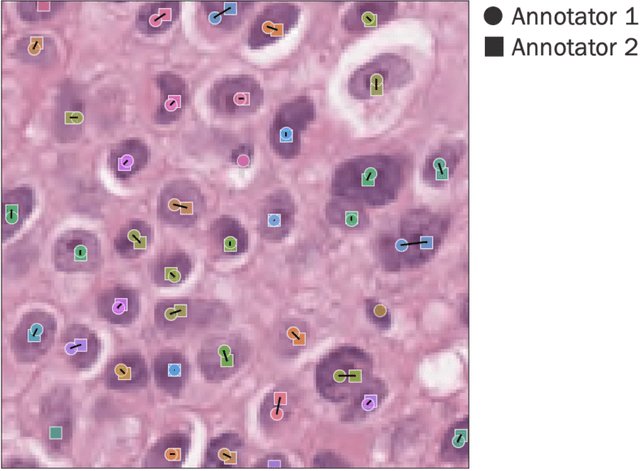
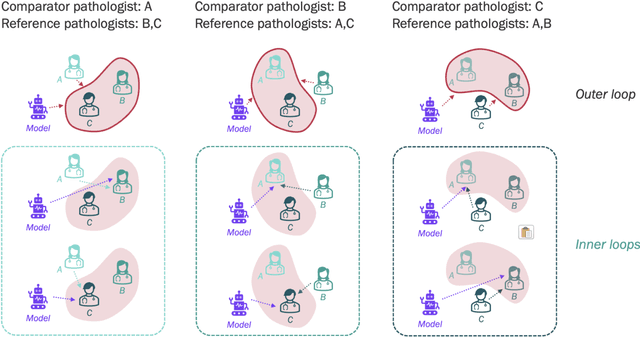
Nested pairwise frames is a method for relative benchmarking of cell or tissue digital pathology models against manual pathologist annotations on a set of sampled patches. At a high level, the method compares agreement between a candidate model and pathologist annotations with agreement among pathologists' annotations. This evaluation framework addresses fundamental issues of data size and annotator variability in using manual pathologist annotations as a source of ground truth for model validation. We implemented nested pairwise frames evaluation for tissue classification, cell classification, and cell count prediction tasks and show results for cell and tissue models deployed on an H&E-stained melanoma dataset.