 Add to Chrome
 Add to Firefox
 Add to Edge
Efficient Human-Contact Representation for Human-Scene Interaction
Aug 10, 2026
Human-scene interaction is an active research topic with several industrial applications in virtual reality, gaming, robotics, and surveillance. Despite significant progress in network architectures to improve the results or optimize models' parameters for fast inference speed, the efficient representation of contact between humans and their environments remains an open challenge. In this paper, we propose a new efficient human-contact representation for human-scene interaction. Our primary contribution is the introduction of sparse contact masks that strategically select essential contact information, significantly reducing redundant data in high-dimensional inputs. Leveraging this efficient contact representation, we propose a suite of sparse operators to replace traditional dense operators within deep network layers for faster computation. Our approach not only enhances computational speed but also filters out non-essential contact data, thereby improving the precision of human-scene interaction models. To validate the effectiveness of our method, we conduct intensive experiments across three public benchmark datasets, focusing on two critical tasks for human-scene interaction: contact prediction and scene synthesis. The experimental results show that our approach outperforms state-of-the-art models in reconstruction accuracy and achieves a computation speed-up of at least 12 times over recent baselines.

AffordMatcher: Affordance Learning in 3D Scenes from Visual Signifiers
Mar 30, 2026Affordance learning is a complex challenge in many applications, where existing approaches primarily focus on the geometric structures, visual knowledge, and affordance labels of objects to determine interactable regions. However, extending this learning capability to a scene is significantly more complicated, as incorporating object- and scene-level semantics is not straightforward. In this work, we introduce AffordBridge, a large-scale dataset with 291,637 functional interaction annotations across 685 high-resolution indoor scenes in the form of point clouds. Our affordance annotations are complemented by RGB images that are linked to the same instances within the scenes. Building upon our dataset, we propose AffordMatcher, an affordance learning method that establishes coherent semantic correspondences between image-based and point cloud-based instances for keypoint matching, enabling a more precise identification of affordance regions based on cues, so-called visual signifiers. Experimental results on our dataset demonstrate the effectiveness of our approach compared to other methods.
AeroScene: Progressive Scene Synthesis for Aerial Robotics
Mar 24, 2026Generative models have shown substantial impact across multiple domains, their potential for scene synthesis remains underexplored in robotics. This gap is more evident in drone simulators, where simulation environments still rely heavily on manual efforts, which are time-consuming to create and difficult to scale. In this work, we introduce AeroScene, a hierarchical diffusion model for progressive 3D scene synthesis. Our approach leverages hierarchy-aware tokenization and multi-branch feature extraction to reason across both global layouts and local details, ensuring physical plausibility and semantic consistency. This makes AeroScene particularly suited for generating realistic scenes for aerial robotics tasks such as navigation, landing, and perching. We demonstrate its effectiveness through extensive experiments on our newly collected dataset and a public benchmark, showing that AeroScene significantly outperforms prior methods. Furthermore, we use AeroScene to generate a large-scale dataset of over 1,000 physics-ready, high fidelity 3D scenes that can be directly integrated into NVIDIA Isaac Sim. Finally, we illustrate the utility of these generated environments on downstream drone navigation tasks. Our code and dataset are publicly available at aioz-ai.github.io/AeroScene/
FedEFM: Federated Endovascular Foundation Model with Unseen Data
Jan 28, 2025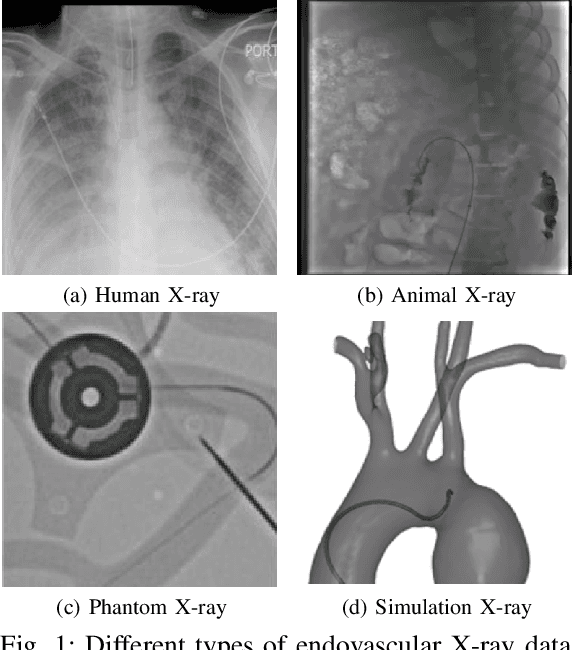
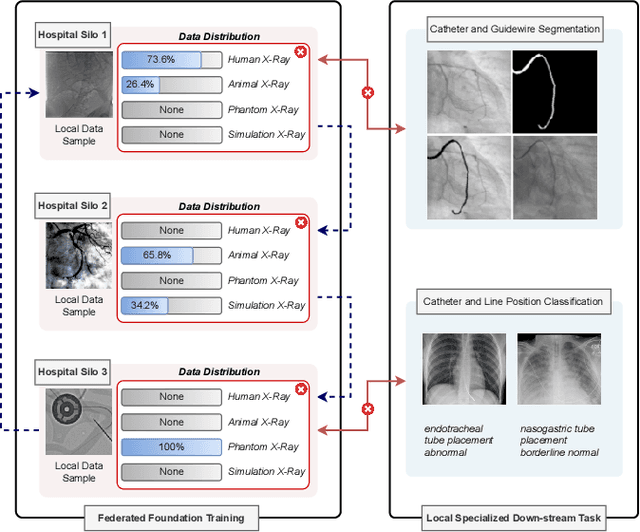
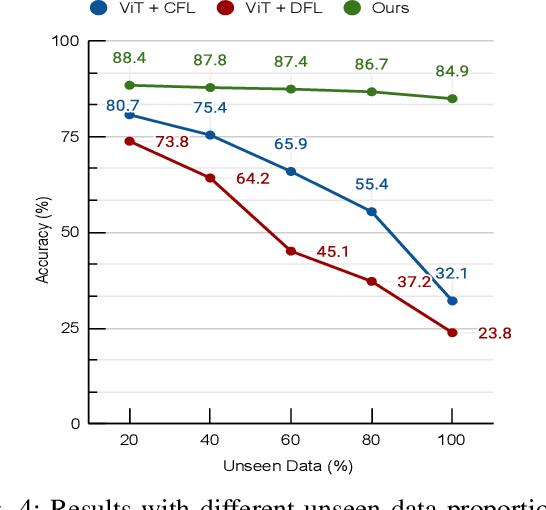
In endovascular surgery, the precise identification of catheters and guidewires in X-ray images is essential for reducing intervention risks. However, accurately segmenting catheter and guidewire structures is challenging due to the limited availability of labeled data. Foundation models offer a promising solution by enabling the collection of similar domain data to train models whose weights can be fine-tuned for downstream tasks. Nonetheless, large-scale data collection for training is constrained by the necessity of maintaining patient privacy. This paper proposes a new method to train a foundation model in a decentralized federated learning setting for endovascular intervention. To ensure the feasibility of the training, we tackle the unseen data issue using differentiable Earth Mover's Distance within a knowledge distillation framework. Once trained, our foundation model's weights provide valuable initialization for downstream tasks, thereby enhancing task-specific performance. Intensive experiments show that our approach achieves new state-of-the-art results, contributing to advancements in endovascular intervention and robotic-assisted endovascular surgery, while addressing the critical issue of data sharing in the medical domain.
Generalization of GANs under Lipschitz continuity and data augmentation
Apr 06, 2021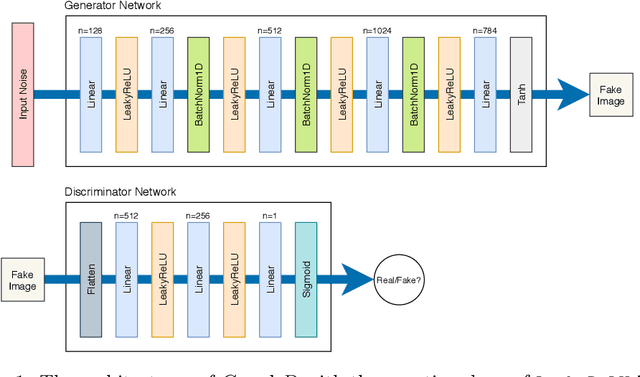
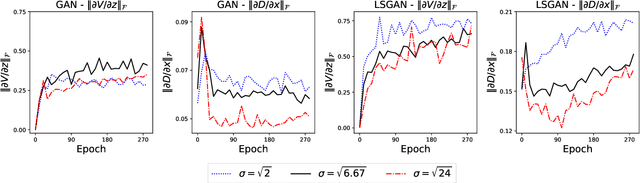
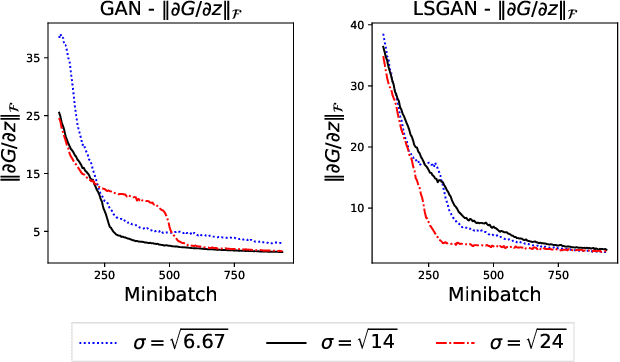
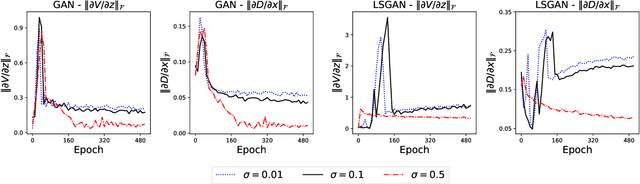
Generative adversarial networks (GANs) have been being widely used in various applications. Arguably, GANs are really complex, and little has been known about their generalization. In this paper, we make a comprehensive analysis about generalization of GANs. We decompose the generalization error into an explicit composition: generator error + discriminator error + optimization error. The first two errors show the capacity of the player's families, are irreducible and optimizer-independent. We then provide both uniform and non-uniform generalization bounds in different scenarios, thanks to our new bridge between Lipschitz continuity and generalization. Our bounds overcome some major limitations of existing ones. In particular, our bounds show that penalizing the zero- and first-order informations of the GAN loss will improve generalization, answering the long mystery of why imposing a Lipschitz constraint can help GANs perform better in practice. Finally, we show why data augmentation penalizes the zero- and first-order informations of the loss, helping the players generalize better, and hence explaining the highly successful use of data augmentation for GANs.