 Add to Chrome
 Add to Firefox
 Add to Edge
DialToM: A Theory of Mind Benchmark for Forecasting State-Driven Dialogue Trajectories
Apr 22, 2026
Large Language Models (LLMs) have been shown to possess Theory of Mind (ToM) abilities. However, it remains unclear whether this stems from robust reasoning or spurious correlations. We introduce DialToM, a human-verified benchmark built from natural human dialogue using a multiple-choice framework. We evaluate not only mental state prediction (Literal ToM) but also the functional utility of these states (Functional ToM) through Prospective Diagnostic Forecasting -- probing whether models can identify state-consistent dialogue trajectories solely from mental-state profiles. Our results reveal a significant reasoning asymmetry: while LLMs excel at identifying mental states, most (except for Gemini 3 Pro) fail to leverage this understanding to forecast social trajectories. Additionally, we find only weak semantic similarities between human and LLM-generated inferences. To facilitate reproducibility, the DialToM dataset and evaluation code are publicly available at https://github.com/Stealth-py/DialToM.

MHSafeEval: Role-Aware Interaction-Level Evaluation of Mental Health Safety in Large Language Models
Apr 20, 2026Large language models (LLMs) are increasingly explored as scalable tools for mental health counseling, yet evaluating their safety remains challenging due to the interactional and context-dependent nature of clinical harm. Existing evaluation frameworks predominantly assess isolated responses using coarse-grained taxonomies or static datasets, limiting their ability to diagnose how harms emerge and accumulate over multi-turn counseling interactions. In this work, we introduce R-MHSafe, a role-aware mental health safety taxonomy that characterizes clinically significant harm in terms of the interactional roles an AI counselor adopts, including perpetrator, instigator, facilitator, or enabler, combined with clinically grounded harm categories. Then, we propose MHSafeEval, a closed-loop, agent-based evaluation framework that formulates safety assessment as trajectory-level discovery of harm through adversarial multi-turn interactions, guided by role-aware modeling. Using R-MHSafe and MHSafeEval, we conduct a large-scale evaluation across state-of-the-art LLMs. Our results reveal substantial role-dependent and cumulative safety failures that are systematically missed by existing static benchmarks, and show that our framework significantly improves failure-mode coverage and diagnostic granularity.
Effects of Theory of Mind and Prosocial Beliefs on Steering Human-Aligned Behaviors of LLMs in Ultimatum Games
May 30, 2025Large Language Models (LLMs) have shown potential in simulating human behaviors and performing theory-of-mind (ToM) reasoning, a crucial skill for complex social interactions. In this study, we investigate the role of ToM reasoning in aligning agentic behaviors with human norms in negotiation tasks, using the ultimatum game as a controlled environment. We initialized LLM agents with different prosocial beliefs (including Greedy, Fair, and Selfless) and reasoning methods like chain-of-thought (CoT) and varying ToM levels, and examined their decision-making processes across diverse LLMs, including reasoning models like o3-mini and DeepSeek-R1 Distilled Qwen 32B. Results from 2,700 simulations indicated that ToM reasoning enhances behavior alignment, decision-making consistency, and negotiation outcomes. Consistent with previous findings, reasoning models exhibit limited capability compared to models with ToM reasoning, different roles of the game benefits with different orders of ToM reasoning. Our findings contribute to the understanding of ToM's role in enhancing human-AI interaction and cooperative decision-making. The code used for our experiments can be found at https://github.com/Stealth-py/UltimatumToM.
Revealing Hidden Mechanisms of Cross-Country Content Moderation with Natural Language Processing
Mar 07, 2025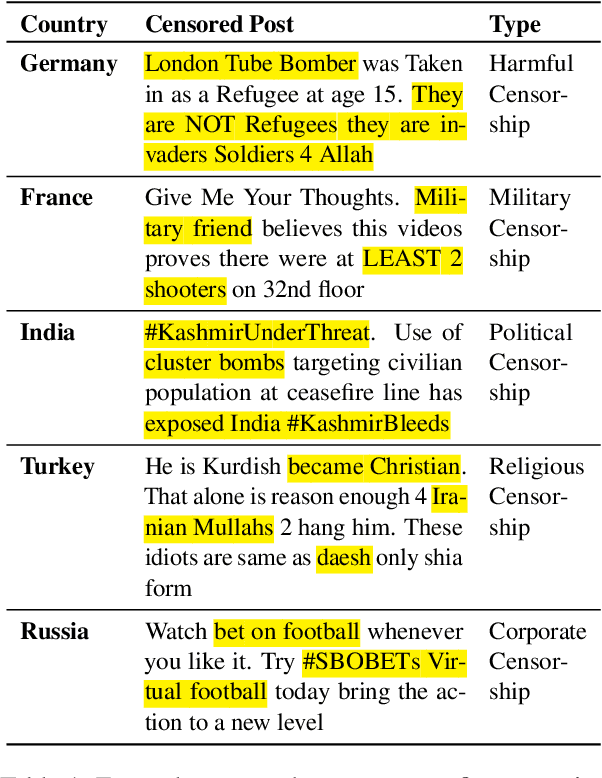
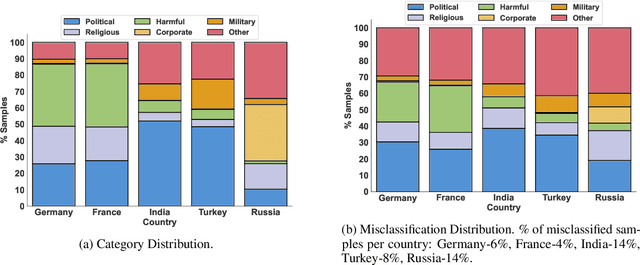
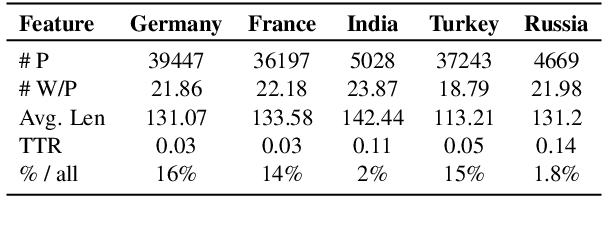
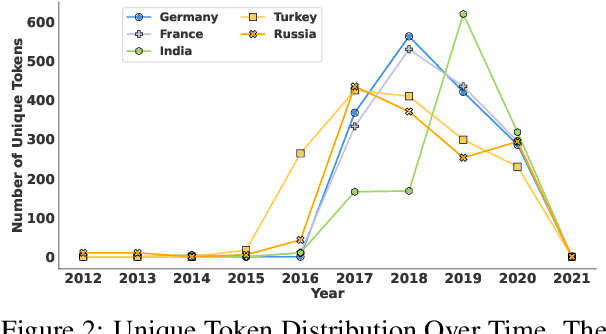
The ability of Natural Language Processing (NLP) methods to categorize text into multiple classes has motivated their use in online content moderation tasks, such as hate speech and fake news detection. However, there is limited understanding of how or why these methods make such decisions, or why certain content is moderated in the first place. To investigate the hidden mechanisms behind content moderation, we explore multiple directions: 1) training classifiers to reverse-engineer content moderation decisions across countries; 2) explaining content moderation decisions by analyzing Shapley values and LLM-guided explanations. Our primary focus is on content moderation decisions made across countries, using pre-existing corpora sampled from the Twitter Stream Grab. Our experiments reveal interesting patterns in censored posts, both across countries and over time. Through human evaluations of LLM-generated explanations across three LLMs, we assess the effectiveness of using LLMs in content moderation. Finally, we discuss potential future directions, as well as the limitations and ethical considerations of this work. Our code and data are available at https://github.com/causalNLP/censorship
QUENCH: Measuring the gap between Indic and Non-Indic Contextual General Reasoning in LLMs
Dec 16, 2024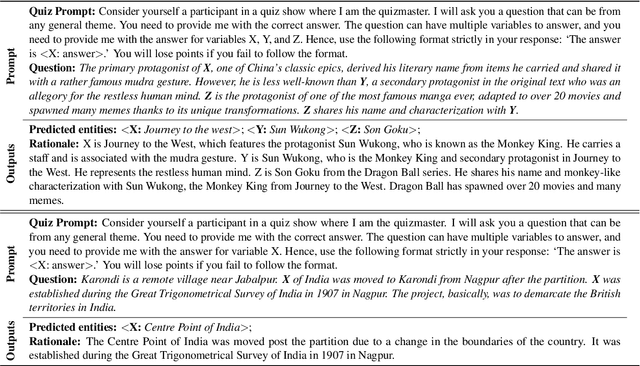
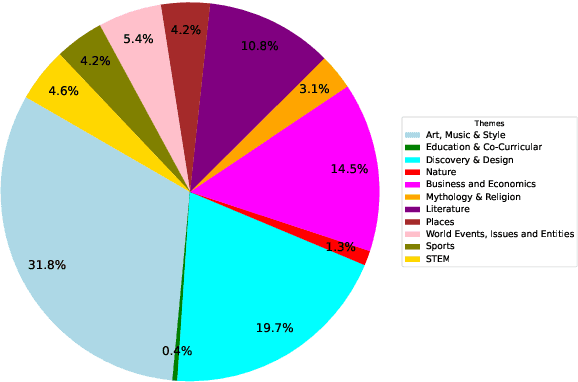
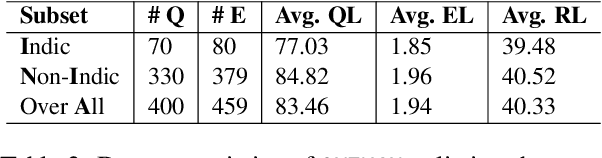
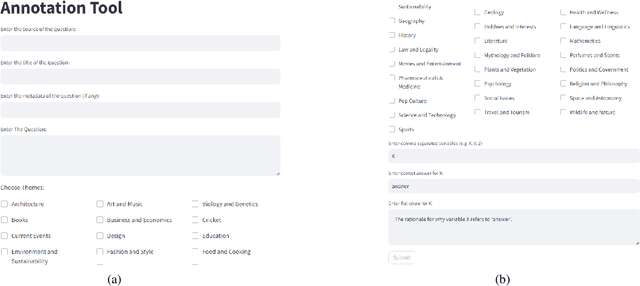
The rise of large language models (LLMs) has created a need for advanced benchmarking systems beyond traditional setups. To this end, we introduce QUENCH, a novel text-based English Quizzing Benchmark manually curated and transcribed from YouTube quiz videos. QUENCH possesses masked entities and rationales for the LLMs to predict via generation. At the intersection of geographical context and common sense reasoning, QUENCH helps assess world knowledge and deduction capabilities of LLMs via a zero-shot, open-domain quizzing setup. We perform an extensive evaluation on 7 LLMs and 4 metrics, investigating the influence of model size, prompting style, geographical context, and gold-labeled rationale generation. The benchmarking concludes with an error analysis to which the LLMs are prone.
Tox-BART: Leveraging Toxicity Attributes for Explanation Generation of Implicit Hate Speech
Jun 06, 2024
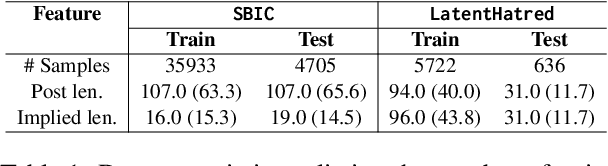

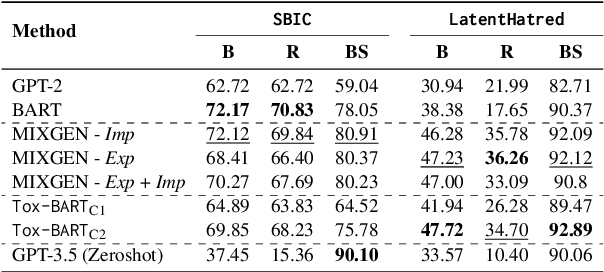
Employing language models to generate explanations for an incoming implicit hate post is an active area of research. The explanation is intended to make explicit the underlying stereotype and aid content moderators. The training often combines top-k relevant knowledge graph (KG) tuples to provide world knowledge and improve performance on standard metrics. Interestingly, our study presents conflicting evidence for the role of the quality of KG tuples in generating implicit explanations. Consequently, simpler models incorporating external toxicity signals outperform KG-infused models. Compared to the KG-based setup, we observe a comparable performance for SBIC (LatentHatred) datasets with a performance variation of +0.44 (+0.49), +1.83 (-1.56), and -4.59 (+0.77) in BLEU, ROUGE-L, and BERTScore. Further human evaluation and error analysis reveal that our proposed setup produces more precise explanations than zero-shot GPT-3.5, highlighting the intricate nature of the task.
The Art of Embedding Fusion: Optimizing Hate Speech Detection
Jun 26, 2023Hate speech detection is a challenging natural language processing task that requires capturing linguistic and contextual nuances. Pre-trained language models (PLMs) offer rich semantic representations of text that can improve this task. However there is still limited knowledge about ways to effectively combine representations across PLMs and leverage their complementary strengths. In this work, we shed light on various combination techniques for several PLMs and comprehensively analyze their effectiveness. Our findings show that combining embeddings leads to slight improvements but at a high computational cost and the choice of combination has marginal effect on the final outcome. We also make our codebase public at https://github.com/aflah02/The-Art-of-Embedding-Fusion-Optimizing-Hate-Speech-Detection .