 Add to Chrome
 Add to Firefox
 Add to Edge
On Reasoning Behind Next Occupation Recommendation
Apr 23, 2026
In this work, we develop a novel reasoning approach to enhance the performance of large language models (LLMs) in future occupation prediction. In this approach, a reason generator first derives a ``reason'' for a user using his/her past education and career history. The reason summarizes the user's preference and is used as the input of an occupation predictor to recommend the user's next occupation. This two-step occupation prediction approach is, however, non-trivial as LLMs are not aligned with career paths or the unobserved reasons behind each occupation decision. We therefore propose to fine-tune LLMs improving their reasoning and occupation prediction performance. We first derive high-quality oracle reasons, as measured by factuality, coherence and utility criteria, using a LLM-as-a-Judge. These oracle reasons are then used to fine-tune small LLMs to perform reason generation and next occupation prediction. Our extensive experiments show that: (a) our approach effectively enhances LLM's accuracy in next occupation prediction making them comparable to fully supervised methods and outperforming unsupervised methods; (b) a single LLM fine-tuned to perform reason generation and occupation prediction outperforms two LLMs fine-tuned to perform the tasks separately; and (c) the next occupation prediction accuracy depends on the quality of generated reasons. Our code is available at https://github.com/Sarasarahhhhh/job_prediction.

DialToM: A Theory of Mind Benchmark for Forecasting State-Driven Dialogue Trajectories
Apr 22, 2026Large Language Models (LLMs) have been shown to possess Theory of Mind (ToM) abilities. However, it remains unclear whether this stems from robust reasoning or spurious correlations. We introduce DialToM, a human-verified benchmark built from natural human dialogue using a multiple-choice framework. We evaluate not only mental state prediction (Literal ToM) but also the functional utility of these states (Functional ToM) through Prospective Diagnostic Forecasting -- probing whether models can identify state-consistent dialogue trajectories solely from mental-state profiles. Our results reveal a significant reasoning asymmetry: while LLMs excel at identifying mental states, most (except for Gemini 3 Pro) fail to leverage this understanding to forecast social trajectories. Additionally, we find only weak semantic similarities between human and LLM-generated inferences. To facilitate reproducibility, the DialToM dataset and evaluation code are publicly available at https://github.com/Stealth-py/DialToM.
MHSafeEval: Role-Aware Interaction-Level Evaluation of Mental Health Safety in Large Language Models
Apr 20, 2026Large language models (LLMs) are increasingly explored as scalable tools for mental health counseling, yet evaluating their safety remains challenging due to the interactional and context-dependent nature of clinical harm. Existing evaluation frameworks predominantly assess isolated responses using coarse-grained taxonomies or static datasets, limiting their ability to diagnose how harms emerge and accumulate over multi-turn counseling interactions. In this work, we introduce R-MHSafe, a role-aware mental health safety taxonomy that characterizes clinically significant harm in terms of the interactional roles an AI counselor adopts, including perpetrator, instigator, facilitator, or enabler, combined with clinically grounded harm categories. Then, we propose MHSafeEval, a closed-loop, agent-based evaluation framework that formulates safety assessment as trajectory-level discovery of harm through adversarial multi-turn interactions, guided by role-aware modeling. Using R-MHSafe and MHSafeEval, we conduct a large-scale evaluation across state-of-the-art LLMs. Our results reveal substantial role-dependent and cumulative safety failures that are systematically missed by existing static benchmarks, and show that our framework significantly improves failure-mode coverage and diagnostic granularity.
Leveraging Large Language Models for Career Mobility Analysis: A Study of Gender, Race, and Job Change Using U.S. Online Resume Profiles
Nov 15, 2025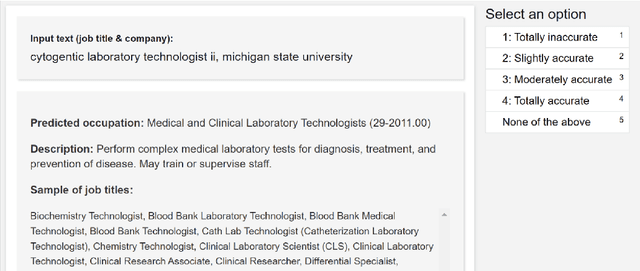
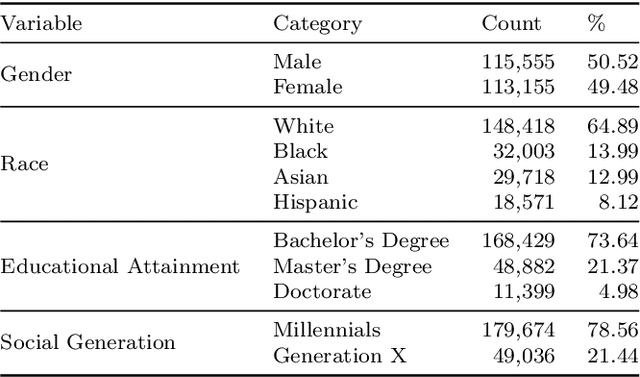
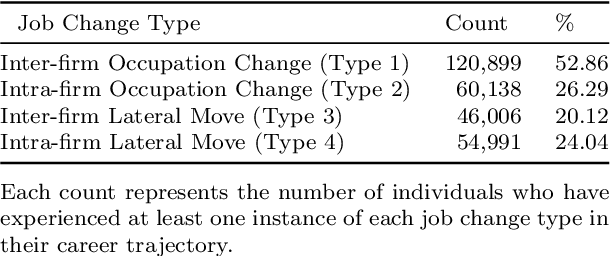
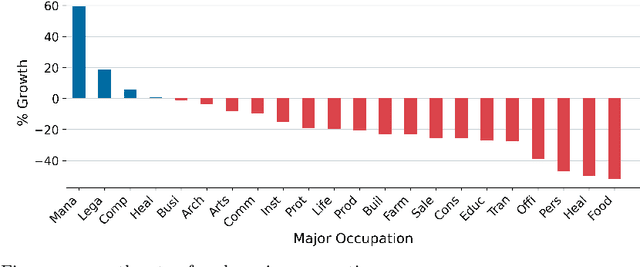
We present a large-scale analysis of career mobility of college-educated U.S. workers using online resume profiles to investigate how gender, race, and job change options are associated with upward mobility. This study addresses key research questions of how the job changes affect their upward career mobility, and how the outcomes of upward career mobility differ by gender and race. We address data challenges -- such as missing demographic attributes, missing wage data, and noisy occupation labels -- through various data processing and Artificial Intelligence (AI) methods. In particular, we develop a large language models (LLMs) based occupation classification method known as FewSOC that achieves accuracy significantly higher than the original occupation labels in the resume dataset. Analysis of 228,710 career trajectories reveals that intra-firm occupation change has been found to facilitate upward mobility most strongly, followed by inter-firm occupation change and inter-firm lateral move. Women and Black college graduates experience significantly lower returns from job changes than men and White peers. Multilevel sensitivity analyses confirm that these disparities are robust to cluster-level heterogeneity and reveal additional intersectional patterns.
Effects of Theory of Mind and Prosocial Beliefs on Steering Human-Aligned Behaviors of LLMs in Ultimatum Games
May 30, 2025Large Language Models (LLMs) have shown potential in simulating human behaviors and performing theory-of-mind (ToM) reasoning, a crucial skill for complex social interactions. In this study, we investigate the role of ToM reasoning in aligning agentic behaviors with human norms in negotiation tasks, using the ultimatum game as a controlled environment. We initialized LLM agents with different prosocial beliefs (including Greedy, Fair, and Selfless) and reasoning methods like chain-of-thought (CoT) and varying ToM levels, and examined their decision-making processes across diverse LLMs, including reasoning models like o3-mini and DeepSeek-R1 Distilled Qwen 32B. Results from 2,700 simulations indicated that ToM reasoning enhances behavior alignment, decision-making consistency, and negotiation outcomes. Consistent with previous findings, reasoning models exhibit limited capability compared to models with ToM reasoning, different roles of the game benefits with different orders of ToM reasoning. Our findings contribute to the understanding of ToM's role in enhancing human-AI interaction and cooperative decision-making. The code used for our experiments can be found at https://github.com/Stealth-py/UltimatumToM.
A Multi-Stage Framework with Taxonomy-Guided Reasoning for Occupation Classification Using Large Language Models
Mar 17, 2025Automatically annotating job data with standardized occupations from taxonomies, known as occupation classification, is crucial for labor market analysis. However, this task is often hindered by data scarcity and the challenges of manual annotations. While large language models (LLMs) hold promise due to their extensive world knowledge and in-context learning capabilities, their effectiveness depends on their knowledge of occupational taxonomies, which remains unclear. In this study, we assess the ability of LLMs to generate precise taxonomic entities from taxonomy, highlighting their limitations. To address these challenges, we propose a multi-stage framework consisting of inference, retrieval, and reranking stages, which integrates taxonomy-guided reasoning examples to enhance performance by aligning outputs with taxonomic knowledge. Evaluations on a large-scale dataset show significant improvements in classification accuracy. Furthermore, we demonstrate the framework's adaptability for multi-label skill classification. Our results indicate that the framework outperforms existing LLM-based methods, offering a practical and scalable solution for occupation classification and related tasks across LLMs.
Consistent Client Simulation for Motivational Interviewing-based Counseling
Feb 05, 2025Simulating human clients in mental health counseling is crucial for training and evaluating counselors (both human or simulated) in a scalable manner. Nevertheless, past research on client simulation did not focus on complex conversation tasks such as mental health counseling. In these tasks, the challenge is to ensure that the client's actions (i.e., interactions with the counselor) are consistent with with its stipulated profiles and negative behavior settings. In this paper, we propose a novel framework that supports consistent client simulation for mental health counseling. Our framework tracks the mental state of a simulated client, controls its state transitions, and generates for each state behaviors consistent with the client's motivation, beliefs, preferred plan to change, and receptivity. By varying the client profile and receptivity, we demonstrate that consistent simulated clients for different counseling scenarios can be effectively created. Both our automatic and expert evaluations on the generated counseling sessions also show that our client simulation method achieves higher consistency than previous methods.
CAMI: A Counselor Agent Supporting Motivational Interviewing through State Inference and Topic Exploration
Feb 05, 2025Conversational counselor agents have become essential tools for addressing the rising demand for scalable and accessible mental health support. This paper introduces CAMI, a novel automated counselor agent grounded in Motivational Interviewing (MI) -- a client-centered counseling approach designed to address ambivalence and facilitate behavior change. CAMI employs a novel STAR framework, consisting of client's state inference, motivation topic exploration, and response generation modules, leveraging large language models (LLMs). These components work together to evoke change talk, aligning with MI principles and improving counseling outcomes for clients from diverse backgrounds. We evaluate CAMI's performance through both automated and manual evaluations, utilizing simulated clients to assess MI skill competency, client's state inference accuracy, topic exploration proficiency, and overall counseling success. Results show that CAMI not only outperforms several state-of-the-art methods but also shows more realistic counselor-like behavior. Additionally, our ablation study underscores the critical roles of state inference and topic exploration in achieving this performance.
Speaker Verification in Agent-Generated Conversations
May 16, 2024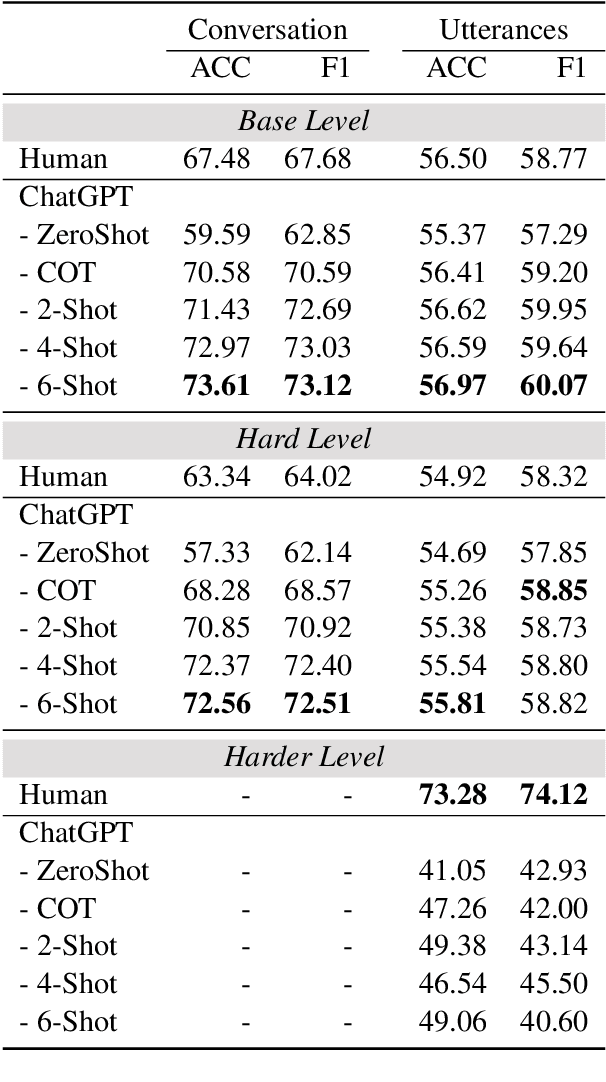
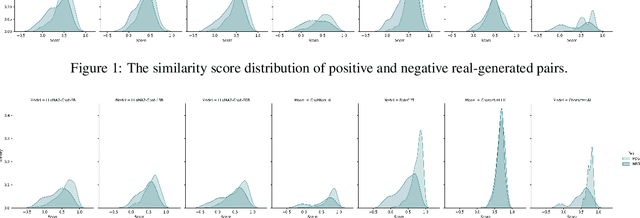
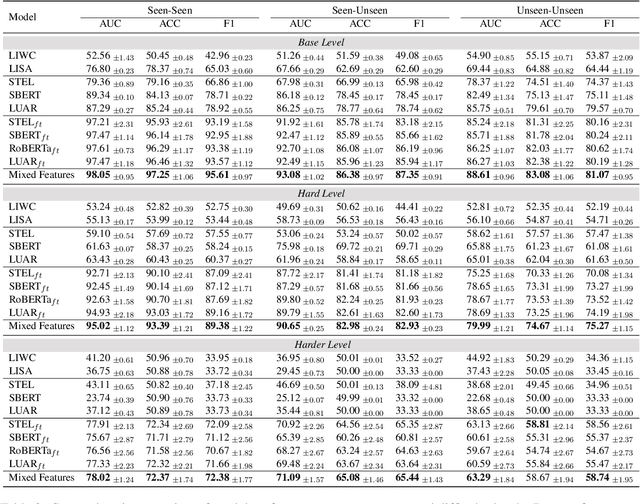
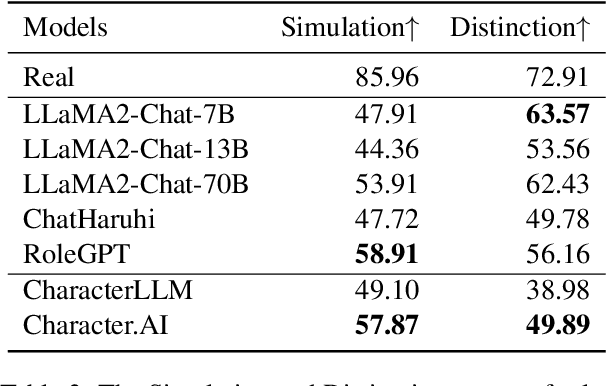
The recent success of large language models (LLMs) has attracted widespread interest to develop role-playing conversational agents personalized to the characteristics and styles of different speakers to enhance their abilities to perform both general and special purpose dialogue tasks. However, the ability to personalize the generated utterances to speakers, whether conducted by human or LLM, has not been well studied. To bridge this gap, our study introduces a novel evaluation challenge: speaker verification in agent-generated conversations, which aimed to verify whether two sets of utterances originate from the same speaker. To this end, we assemble a large dataset collection encompassing thousands of speakers and their utterances. We also develop and evaluate speaker verification models under experiment setups. We further utilize the speaker verification models to evaluate the personalization abilities of LLM-based role-playing models. Comprehensive experiments suggest that the current role-playing models fail in accurately mimicking speakers, primarily due to their inherent linguistic characteristics.
Transforming Facial Weight of Real Images by Editing Latent Space of StyleGAN
Nov 05, 2020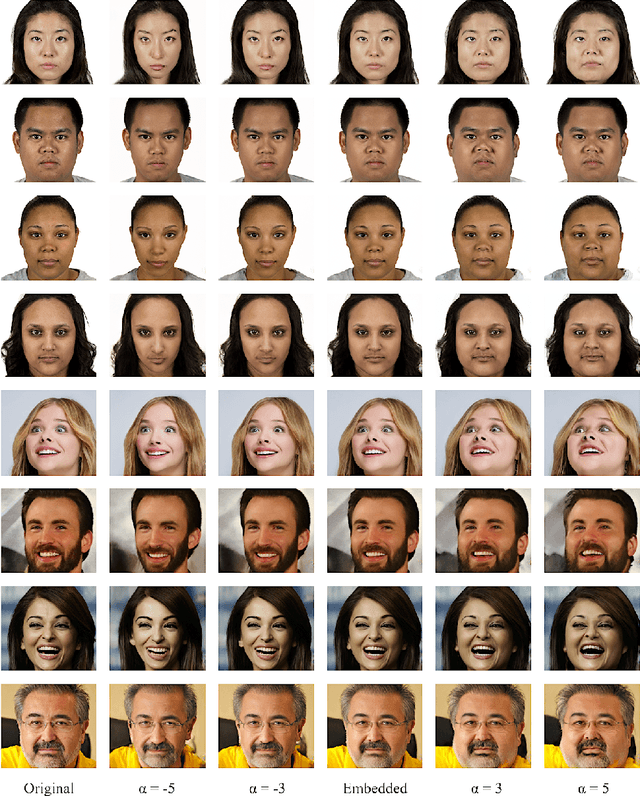
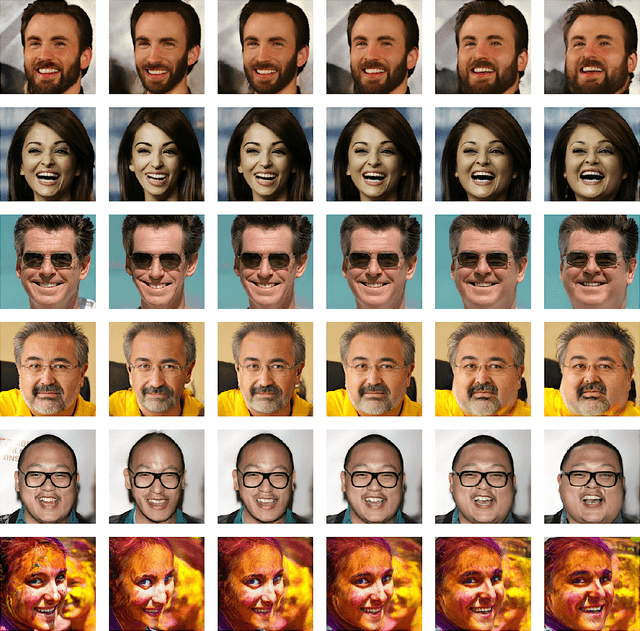
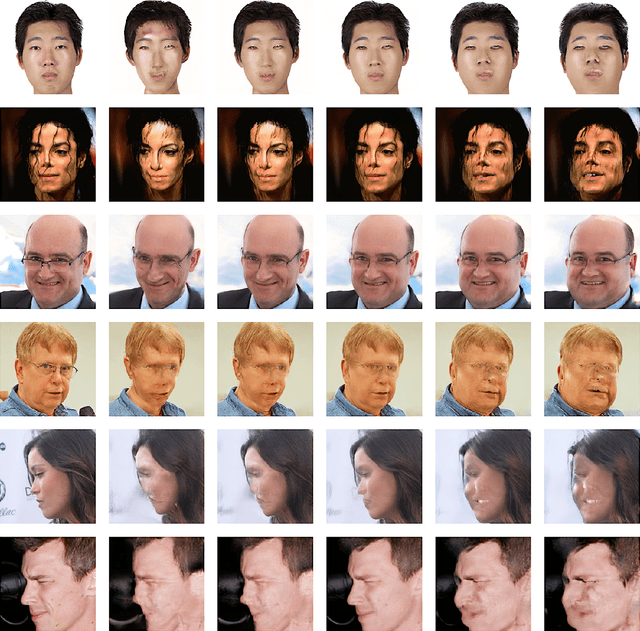
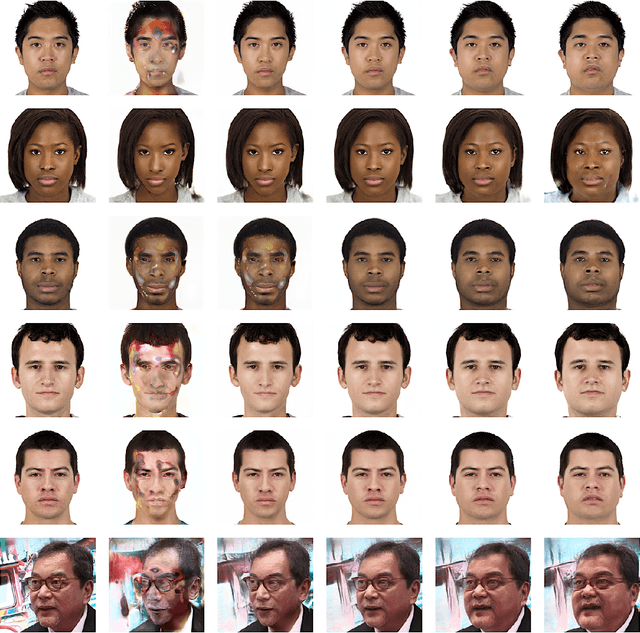
We present an invert-and-edit framework to automatically transform facial weight of an input face image to look thinner or heavier by leveraging semantic facial attributes encoded in the latent space of Generative Adversarial Networks (GANs). Using a pre-trained StyleGAN as the underlying generator, we first employ an optimization-based embedding method to invert the input image into the StyleGAN latent space. Then, we identify the facial-weight attribute direction in the latent space via supervised learning and edit the inverted latent code by moving it positively or negatively along the extracted feature axis. Our framework is empirically shown to produce high-quality and realistic facial-weight transformations without requiring training GANs with a large amount of labeled face images from scratch. Ultimately, our framework can be utilized as part of an intervention to motivate individuals to make healthier food choices by visualizing the future impacts of their behavior on appearance.