 Add to Chrome
 Add to Firefox
 Add to Edge
IndicDB -- Benchmarking Multilingual Text-to-SQL Capabilities in Indian Languages
Apr 15, 2026
While Large Language Models (LLMs) have significantly advanced Text-to-SQL performance, existing benchmarks predominantly focus on Western contexts and simplified schemas, leaving a gap in real-world, non-Western applications. We present IndicDB, a multilingual Text-to-SQL benchmark for evaluating cross-lingual semantic parsing across diverse Indic languages. The relational schemas are sourced from open-data platforms, including the National Data and Analytics Platform (NDAP) and the India Data Portal (IDP), ensuring realistic administrative data complexity. IndicDB comprises 20 databases across 237 tables. To convert denormalized government data into rich relational structures, we employ an iterative three-agent framework (Architect, Auditor, Refiner) to ensure structural rigor and high relational density (11.85 tables per database; join depths up to six). Our pipeline is value-aware, difficulty-calibrated, and join-enforced, generating 15,617 tasks across English, Hindi, and five Indic languages. We evaluate cross-lingual semantic parsing performance of state-of-the-art models (DeepSeek v3.2, MiniMax 2.7, LLaMA 3.3, Qwen3) across seven linguistic variants. Results show a 9.00% performance drop from English to Indic languages, revealing an "Indic Gap" driven by harder schema linking, increased structural ambiguity, and limited external knowledge. IndicDB serves as a rigorous benchmark for multilingual Text-to-SQL. Code and data: https://anonymous.4open.science/r/multilingualText2Sql-Indic--DDCC/

CLIP-Inspector: Model-Level Backdoor Detection for Prompt-Tuned CLIP via OOD Trigger Inversion
Apr 10, 2026Organisations with limited data and computational resources increasingly outsource model training to Machine Learning as a Service (MLaaS) providers, who adapt vision-language models (VLMs) such as CLIP to downstream tasks via prompt tuning rather than training from scratch. This semi-honest setting creates a security risk where a malicious provider can follow the prompt-tuning protocol yet implant a backdoor, forcing triggered inputs to be classified into an attacker-chosen class, even for out-of-distribution (OOD) data. Such backdoors leave encoders untouched, making them undetectable to existing methods that focus on encoder corruption. Other data-level methods that sanitize data before training or during inference, also fail to answer the critical question, "Is the delivered model backdoored or not?" To address this model-level verification problem, we introduce CLIP-Inspector (CI), a backdoor detection method designed for prompt-tuned CLIP models. Assuming white-box access to the delivered model and a pool of unlabeled OOD images, CI reconstructs possible triggers for each class to determine if the model exhibits backdoor behaviour or not. Additionally, we demonstrate that using CI's reconstructed trigger for fine-tuning on correctly labeled triggered inputs enables us to re-align the model and reduce backdoor effectiveness. Through extensive experiments across ten datasets and four backdoor attacks, we demonstrate that CI can reconstruct effective triggers in a single epoch using only 1,000 OOD images, achieving a 94% detection accuracy (47/50 models). Compared to adapted trigger-inversion baselines, CI yields a markedly higher AUROC score (0.973 vs 0.495/0.687), thus enabling the vetting and post-hoc repair of prompt-tuned CLIP models to ensure safe deployment.
DISSECT: Diagnosing Where Vision Ends and Language Priors Begin in Scientific VLMs
Apr 06, 2026When asked to describe a molecular diagram, a Vision-Language Model correctly identifies ``a benzene ring with an -OH group.'' When asked to reason about the same image, it answers incorrectly. The model can see but it cannot think about what it sees. We term this the perception-integration gap: a failure where visual information is successfully extracted but lost during downstream reasoning, invisible to single-configuration benchmarks that conflate perception with integration under one accuracy number. To systematically expose such failures, we introduce DISSECT, a 12,000-question diagnostic benchmark spanning Chemistry (7,000) and Biology (5,000). Every question is evaluated under five input modes -- Vision+Text, Text-Only, Vision-Only, Human Oracle, and a novel Model Oracle in which the VLM first verbalizes the image and then reasons from its own description -- yielding diagnostic gaps that decompose performance into language-prior exploitation, visual extraction, perception fidelity, and integration effectiveness. Evaluating 18~VLMs, we find that: (1) Chemistry exhibits substantially lower language-prior exploitability than Biology, confirming molecular visual content as a harder test of genuine visual reasoning; (2) Open-source models consistently score higher when reasoning from their own verbalized descriptions than from raw images, exposing a systematic integration bottleneck; and (3) Closed-source models show no such gap, indicating that bridging perception and integration is the frontier separating open-source from closed-source multimodal capability. The Model Oracle protocol is both model and benchmark agnostic, applicable post-hoc to any VLM evaluation to diagnose integration failures.
CAGE: Bridging the Accuracy-Aesthetics Gap in Educational Diagrams via Code-Anchored Generative Enhancement
Apr 06, 2026Educational diagrams -- labeled illustrations of biological processes, chemical structures, physical systems, and mathematical concepts -- are essential cognitive tools in K-12 instruction. Yet no existing method can generate them both accurately and engagingly. Open-source diffusion models produce visually rich images but catastrophically garble text labels. Code-based generation via LLMs guarantees label correctness but yields visually flat outputs. Closed-source APIs partially bridge this gap but remain unreliable and prohibitively expensive at educational scale. We quantify this accuracy-aesthetics dilemma across all three paradigms on 400 K-12 diagram prompts, measuring both label fidelity and visual quality through complementary automated and human evaluation protocols. To resolve it, we propose CAGE (Code-Anchored Generative Enhancement): an LLM synthesizes executable code producing a structurally correct diagram, then a diffusion model conditioned on the programmatic output via ControlNet refines it into a visually polished graphic while preserving label fidelity. We also introduce EduDiagram-2K, a collection of 2,000 paired programmatic-stylized diagrams enabling this pipeline, and present proof-of-concept results and a research agenda for the multimedia community.
Public Profile Matters: A Scalable Integrated Approach to Recommend Citations in the Wild
Mar 18, 2026Proper citation of relevant literature is essential for contextualising and validating scientific contributions. While current citation recommendation systems leverage local and global textual information, they often overlook the nuances of the human citation behaviour. Recent methods that incorporate such patterns improve performance but incur high computational costs and introduce systematic biases into downstream rerankers. To address this, we propose Profiler, a lightweight, non-learnable module that captures human citation patterns efficiently and without bias, significantly enhancing candidate retrieval. Furthermore, we identify a critical limitation in current evaluation protocol: the systems are assessed in a transductive setting, which fails to reflect real-world scenarios. We introduce a rigorous Inductive evaluation setting that enforces strict temporal constraints, simulating the recommendation of citations for newly authored papers in the wild. Finally, we present DAVINCI, a novel reranking model that integrates profiler-derived confidence priors with semantic information via an adaptive vector-gating mechanism. Our system achieves new state-of-the-art results across multiple benchmark datasets, demonstrating superior efficiency and generalisability.
Tox-BART: Leveraging Toxicity Attributes for Explanation Generation of Implicit Hate Speech
Jun 06, 2024
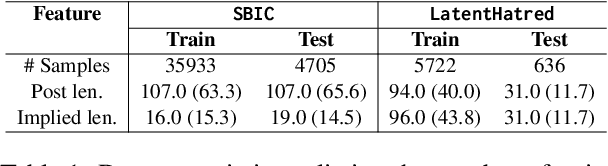

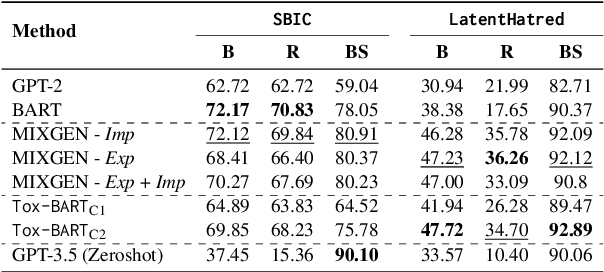
Employing language models to generate explanations for an incoming implicit hate post is an active area of research. The explanation is intended to make explicit the underlying stereotype and aid content moderators. The training often combines top-k relevant knowledge graph (KG) tuples to provide world knowledge and improve performance on standard metrics. Interestingly, our study presents conflicting evidence for the role of the quality of KG tuples in generating implicit explanations. Consequently, simpler models incorporating external toxicity signals outperform KG-infused models. Compared to the KG-based setup, we observe a comparable performance for SBIC (LatentHatred) datasets with a performance variation of +0.44 (+0.49), +1.83 (-1.56), and -4.59 (+0.77) in BLEU, ROUGE-L, and BERTScore. Further human evaluation and error analysis reveal that our proposed setup produces more precise explanations than zero-shot GPT-3.5, highlighting the intricate nature of the task.
SymTax: Symbiotic Relationship and Taxonomy Fusion for Effective Citation Recommendation
May 26, 2024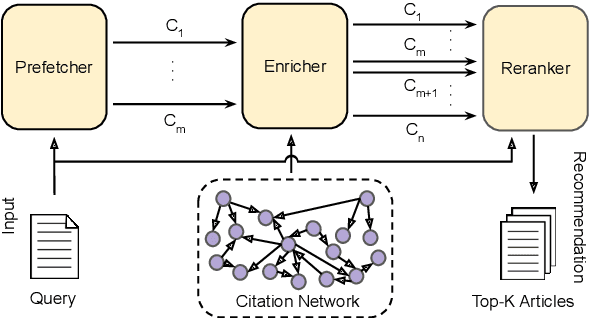
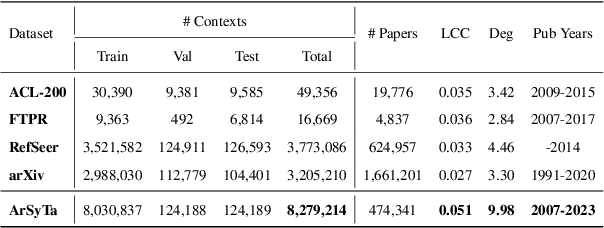
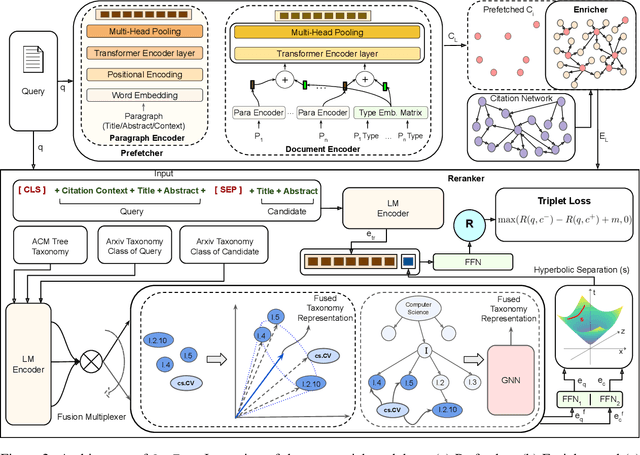
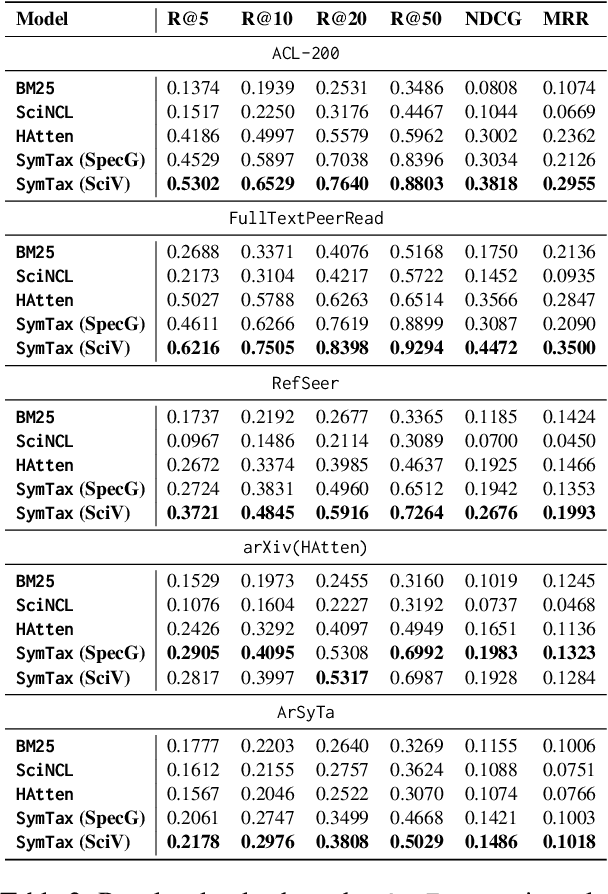
Citing pertinent literature is pivotal to writing and reviewing a scientific document. Existing techniques mainly focus on the local context or the global context for recommending citations but fail to consider the actual human citation behaviour. We propose SymTax, a three-stage recommendation architecture that considers both the local and the global context, and additionally the taxonomical representations of query-candidate tuples and the Symbiosis prevailing amongst them. SymTax learns to embed the infused taxonomies in the hyperbolic space and uses hyperbolic separation as a latent feature to compute query-candidate similarity. We build a novel and large dataset ArSyTa containing 8.27 million citation contexts and describe the creation process in detail. We conduct extensive experiments and ablation studies to demonstrate the effectiveness and design choice of each module in our framework. Also, combinatorial analysis from our experiments shed light on the choice of language models (LMs) and fusion embedding, and the inclusion of section heading as a signal. Our proposed module that captures the symbiotic relationship solely leads to performance gains of 26.66% and 39.25% in Recall@5 w.r.t. SOTA on ACL-200 and RefSeer datasets, respectively. The complete framework yields a gain of 22.56% in Recall@5 wrt SOTA on our proposed dataset. The code and dataset are available at https://github.com/goyalkaraniit/SymTax
Probing Critical Learning Dynamics of PLMs for Hate Speech Detection
Feb 03, 2024Despite the widespread adoption, there is a lack of research into how various critical aspects of pretrained language models (PLMs) affect their performance in hate speech detection. Through five research questions, our findings and recommendations lay the groundwork for empirically investigating different aspects of PLMs' use in hate speech detection. We deep dive into comparing different pretrained models, evaluating their seed robustness, finetuning settings, and the impact of pretraining data collection time. Our analysis reveals early peaks for downstream tasks during pretraining, the limited benefit of employing a more recent pretraining corpus, and the significance of specific layers during finetuning. We further call into question the use of domain-specific models and highlight the need for dynamic datasets for benchmarking hate speech detection.
Exploiting Representation Bias for Data Distillation in Abstractive Text Summarization
Dec 20, 2023
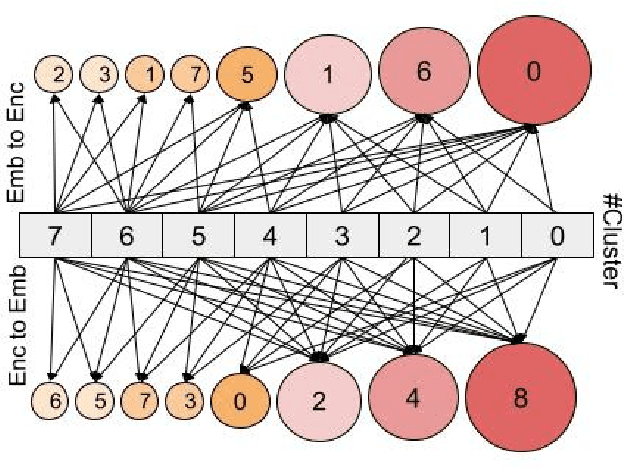
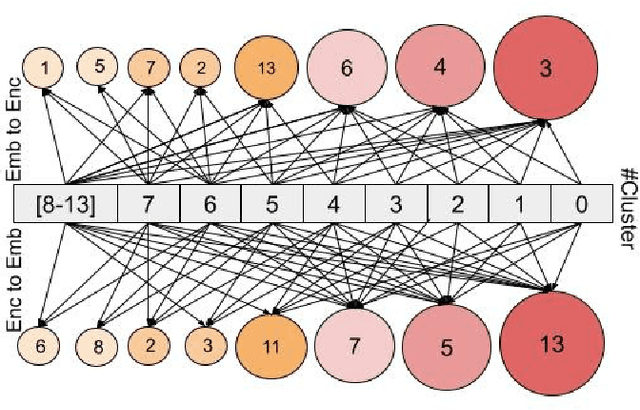
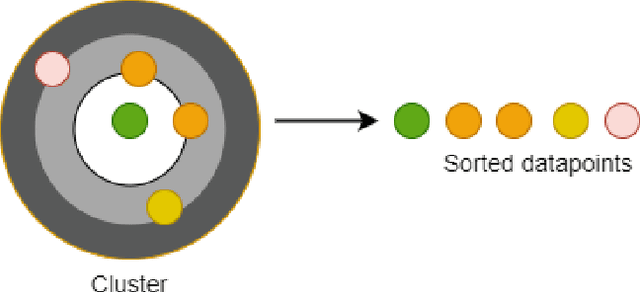
Abstractive text summarization is surging with the number of training samples to cater to the needs of the deep learning models. These models tend to exploit the training data representations to attain superior performance by improving the quantitative element of the resultant summary. However, increasing the size of the training set may not always be the ideal solution to maximize the performance, and therefore, a need to revisit the quality of training samples and the learning protocol of deep learning models is a must. In this paper, we aim to discretize the vector space of the abstractive text summarization models to understand the characteristics learned between the input embedding space and the models' encoder space. We show that deep models fail to capture the diversity of the input space. Further, the distribution of data points on the encoder space indicates that an unchecked increase in the training samples does not add value; rather, a tear-down of data samples is highly needed to make the models focus on variability and faithfulness. We employ clustering techniques to learn the diversity of a model's sample space and how data points are mapped from the embedding space to the encoder space and vice versa. Further, we devise a metric to filter out redundant data points to make the model more robust and less data hungry. We benchmark our proposed method using quantitative metrics, such as Rouge, and qualitative metrics, such as BERTScore, FEQA and Pyramid score. We also quantify the reasons that inhibit the models from learning the diversity from the varied input samples.
Army of Thieves: Enhancing Black-Box Model Extraction via Ensemble based sample selection
Nov 08, 2023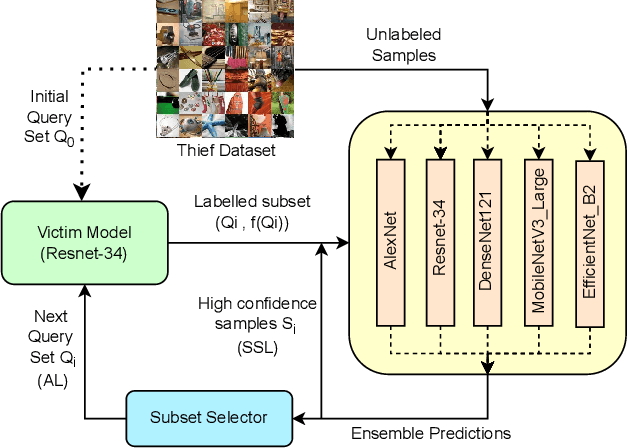
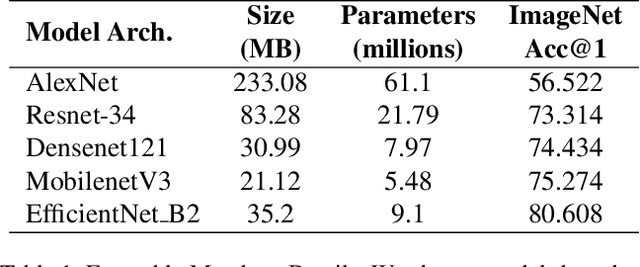

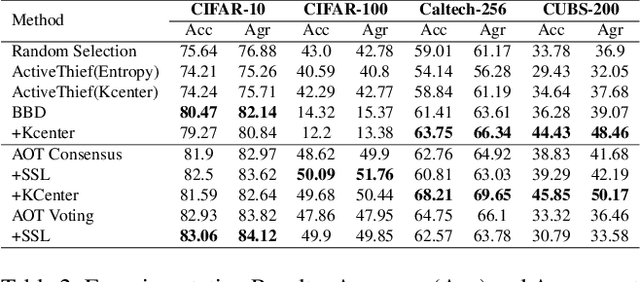
Machine Learning (ML) models become vulnerable to Model Stealing Attacks (MSA) when they are deployed as a service. In such attacks, the deployed model is queried repeatedly to build a labelled dataset. This dataset allows the attacker to train a thief model that mimics the original model. To maximize query efficiency, the attacker has to select the most informative subset of data points from the pool of available data. Existing attack strategies utilize approaches like Active Learning and Semi-Supervised learning to minimize costs. However, in the black-box setting, these approaches may select sub-optimal samples as they train only one thief model. Depending on the thief model's capacity and the data it was pretrained on, the model might even select noisy samples that harm the learning process. In this work, we explore the usage of an ensemble of deep learning models as our thief model. We call our attack Army of Thieves(AOT) as we train multiple models with varying complexities to leverage the crowd's wisdom. Based on the ensemble's collective decision, uncertain samples are selected for querying, while the most confident samples are directly included in the training data. Our approach is the first one to utilize an ensemble of thief models to perform model extraction. We outperform the base approaches of existing state-of-the-art methods by at least 3% and achieve a 21% higher adversarial sample transferability than previous work for models trained on the CIFAR-10 dataset.