 Add to Chrome
 Add to Firefox
 Add to Edge
SENTRY: SAM2-Enhanced Neighbor-Aware and Temporally Reasoned Memory for Visual Tracking
Jun 24, 2026
We revisit the memory update mechanism in SAM2-based visual object tracking and identify confidence-only mask selection as the dominant cause of drift under occlusion, rapid motion, and distractors. We introduce SENTRY, a training-free, plug-and-play, refine-before-write module that validates each memory update for short-horizon temporal consistency before committing it. SENTRY aggregates diverse segmentation hypotheses per frame, backtracks them into short tracklets, and uses neighbor-aware cycle-consistent matching against recent trajectories to favor temporally and geometrically consistent masks. It leaves the base architecture untouched, replacing confidence-driven writes with consistency-validated ones. For fair evaluation, we re-evaluate major open-source SAM2-based trackers across all available scales and datasets, filling gaps in prior reports. Integrated into five strong baselines, SENTRY delivers consistent gains across nine benchmarks, achieving new zero-shot SOTA on LaSOT, LaSOT_ext, GOT-10k, VOT20, VOT22, and DiDi. Despite these checks, the SAM2-L version runs at 32.8 FPS on an A100, and across compatible hosts adds only about 0.4--0.6 GB VRAM. Our results provide the first unified all-scale evaluation of SAM2-based trackers and show that enforcing temporal validity at write time stabilizes memory-augmented tracking without retraining. Project page: https://hamadya.github.io/SENTRY/page/

Falcon: Functional Assembly and Language for Compositional Reasoning in X-ray
Jun 24, 2026Conventional vision-language models are largely object-centric, focusing on detecting and describing individual entities. In safety-critical X-ray baggage screening, however, threat often emerges not from a single object but from the functional compatibility of spatially dispersed components, such as batteries, detonators, and explosive charges. We formalize this setting as \emph{compositional threat reasoning}, where risk is modeled as a relational property of grounded regions rather than an independent detection outcome. We introduce \textbf{Falcon}, a multimodal framework that abstracts segmentation-aware region features into a structured safety state capturing component presence, pairwise functional compatibility, and scene-level risk. This structured representation is injected into the language model as an explicit intermediate interface, encouraging relationally consistent and safety-aware reasoning. To evaluate this problem, we present \textbf{Falcon-X}, a benchmark that unifies dense grounding with structured supervision over component completeness and risk inference in cluttered X-ray imagery. Experiments show that while existing multimodal models adapt to appearance, they struggle with compositional safety reasoning. Falcon improves functional grounding and produces more coherent threat assessments, establishing compositional safety reasoning as a distinct evaluation paradigm for multimodal systems.
Polycepta: Object-Centric Appearance Estimation for Multi-Object Tracking
Jun 23, 2026The tracking-by-detection paradigm in multi-object tracking (MOT) typically relies on static appearance descriptors to complement motion estimation. However, these descriptors are frame-independent, limiting their robustness as visual cues. Since such descriptors are often obtained from computationally intensive pretrained backbones, real-time MOT systems frequently abandon appearance cues altogether and rely solely on motion prediction and geometric association. In this work, we introduce Polycepta, an object-centric appearance state estimation framework that reformulates appearance modeling as a recursive estimation problem rather than a frame-wise matching task. Polycepta constructs and continuously updates an independent appearance state for each tracked object, enabling future appearance representations to be estimated from accumulated observations. Polycepta is encouraged to learn the appearance-state construction of object-specific representations rather than memorize them through a proposed learning strategy, enabling appearance estimation for unseen classes. A key property of Polycepta is that the quality of appearance estimation improves as object states evolve during inference. While conventional appearance descriptors remain static or degrade over time, Polycepta progressively refines appearance estimates as additional observations are accumulated. Extensive experiments on KITTI, the Waymo Open Dataset, and MOT17 demonstrate consistent reductions in identity switches and improvements in tracking performance when integrated into the tracking-by-detection pipelines. Polycepta operates at 90.57 Hz and delivers state-of-the-art performance on the KITTI benchmark when integrated into the RobMOT framework, achieving a MOTA of 92.27\%.
Collaborative Trajectory Prediction via Late Fusion
Apr 24, 2026Predicting future trajectories of surrounding traffic agents is critical for safe autonomous navigation and collision avoidance. Despite all advances in the trajectory forecasting realm, the prediction models remains vulnerable to uncertainty caused by occlusions, limited sensing range, and perception errors. Collaborative vehicle-to-vehicle (V2V) approaches help reduce this uncertainty by sharing complementary information. Existing collaborative trajectory prediction methods typically fuse feature maps at the perception stage to construct a holistic scene view. Further this holistic representation is decoded into the future trajectories. Such design incurs substantial communication overhead due to the exchange of high-dimensional feature representations and often assumes idealized bandwidth and synchronization, limiting practical deployment. We address these limitations by shifting collaboration from perception to the prediction module and introducing a late-fusion framework for shared forecasts. The framework is model-agnostic and treats collaborating vehicles as independent asynchronous agents. We evaluate the approach on the OPV2V, V2V4Real, and DeepAccident datasets, comparing individual and collaborative forecasting. Across all datasets, late fusion consistently reduces miss rate and improves trajectory success rate ($\mathrm{TSR}_{0.5}$), defined as the fraction of ground-truth agents with final displacement error below 0.5 m. On the real-world V2V4Real dataset, collaborative prediction improves the success rate by $1.69\%$ and $1.22\%$ for both intelligent vehicles, respectively, compared with individual forecasting.
SPARROW: Learning Spatial Precision and Temporal Referential Consistency in Pixel-Grounded Video MLLMs
Mar 12, 2026Multimodal large language models (MLLMs) have advanced from image-level reasoning to pixel-level grounding, but extending these capabilities to videos remains challenging as models must achieve spatial precision and temporally consistent reference tracking. Existing video MLLMs often rely on a static segmentation token ([SEG]) for frame-wise grounding, which provides semantics but lacks temporal context, causing spatial drift, identity switches, and unstable initialization when objects move or reappear. We introduce SPARROW, a pixel-grounded video MLLM that unifies spatial accuracy and temporal stability through two key components: (i) Target-Specific Tracked Features (TSF), which inject temporally aligned referent cues during training, and (ii) a dual-prompt design that decodes box ([BOX]) and segmentation ([SEG]) tokens to fuse geometric priors with semantic grounding. SPARROW is supported by a curated referential video dataset of 30,646 videos and 45,231 Q&A pairs and operates end-to-end without external detectors via a class-agnostic SAM2-based proposer. Integrated into three recent open-source video MLLMs (UniPixel, GLUS, and VideoGLaMM), SPARROW delivers consistent gains across six benchmarks, improving up to +8.9 J&F on RVOS, +5 mIoU on visual grounding, and +5.4 CLAIR on GCG. These results demonstrate that SPARROW substantially improves referential stability, spatial precision, and temporal coherence in pixel-grounded video understanding. Project page: https://risys-lab.github.io/SPARROW
Rethinking Memory Design in SAM-Based Visual Object Tracking
Dec 27, 2025\noindent Memory has become the central mechanism enabling robust visual object tracking in modern segmentation-based frameworks. Recent methods built upon Segment Anything Model 2 (SAM2) have demonstrated strong performance by refining how past observations are stored and reused. However, existing approaches address memory limitations in a method-specific manner, leaving the broader design principles of memory in SAM-based tracking poorly understood. Moreover, it remains unclear how these memory mechanisms transfer to stronger, next-generation foundation models such as Segment Anything Model 3 (SAM3). In this work, we present a systematic memory-centric study of SAM-based visual object tracking. We first analyze representative SAM2-based trackers and show that most methods primarily differ in how short-term memory frames are selected, while sharing a common object-centric representation. Building on this insight, we faithfully reimplement these memory mechanisms within the SAM3 framework and conduct large-scale evaluations across ten diverse benchmarks, enabling a controlled analysis of memory design independent of backbone strength. Guided by our empirical findings, we propose a unified hybrid memory framework that explicitly decomposes memory into short-term appearance memory and long-term distractor-resolving memory. This decomposition enables the integration of existing memory policies in a modular and principled manner. Extensive experiments demonstrate that the proposed framework consistently improves robustness under long-term occlusion, complex motion, and distractor-heavy scenarios on both SAM2 and SAM3 backbones. Code is available at: https://github.com/HamadYA/SAM3_Tracking_Zoo. \textbf{This is a preprint. Some results are being finalized and may be updated in a future revision.}
Cytoplasmic Strings Analysis in Human Embryo Time-Lapse Videos using Deep Learning Framework
Dec 10, 2025Infertility is a major global health issue, and while in-vitro fertilization has improved treatment outcomes, embryo selection remains a critical bottleneck. Time-lapse imaging enables continuous, non-invasive monitoring of embryo development, yet most automated assessment methods rely solely on conventional morphokinetic features and overlook emerging biomarkers. Cytoplasmic Strings, thin filamentous structures connecting the inner cell mass and trophectoderm in expanded blastocysts, have been associated with faster blastocyst formation, higher blastocyst grades, and improved viability. However, CS assessment currently depends on manual visual inspection, which is labor-intensive, subjective, and severely affected by detection and subtle visual appearance. In this work, we present, to the best of our knowledge, the first computational framework for CS analysis in human IVF embryos. We first design a human-in-the-loop annotation pipeline to curate a biologically validated CS dataset from TLI videos, comprising 13,568 frames with highly sparse CS-positive instances. Building on this dataset, we propose a two-stage deep learning framework that (i) classifies CS presence at the frame level and (ii) localizes CS regions in positive cases. To address severe imbalance and feature uncertainty, we introduce the Novel Uncertainty-aware Contractive Embedding (NUCE) loss, which couples confidence-aware reweighting with an embedding contraction term to form compact, well-separated class clusters. NUCE consistently improves F1-score across five transformer backbones, while RF-DETR-based localization achieves state-of-the-art (SOTA) detection performance for thin, low-contrast CS structures. The source code will be made publicly available at: https://github.com/HamadYA/CS_Detection.
Towards Accurate State Estimation: Kalman Filter Incorporating Motion Dynamics for 3D Multi-Object Tracking
May 12, 2025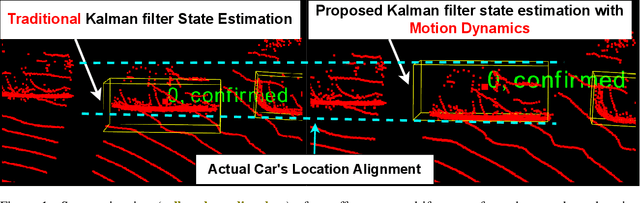
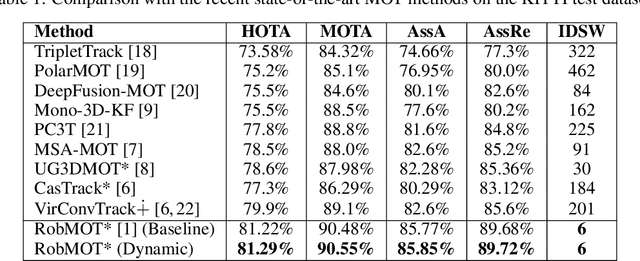
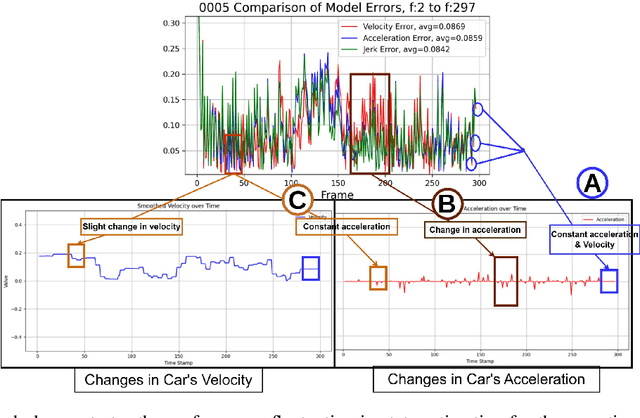
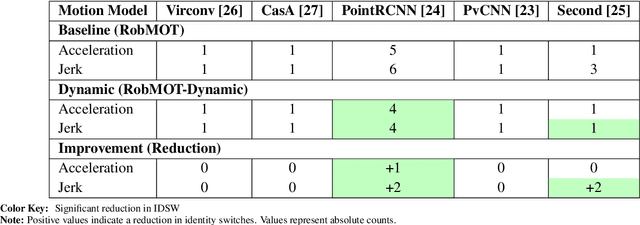
This work addresses the critical lack of precision in state estimation in the Kalman filter for 3D multi-object tracking (MOT) and the ongoing challenge of selecting the appropriate motion model. Existing literature commonly relies on constant motion models for estimating the states of objects, neglecting the complex motion dynamics unique to each object. Consequently, trajectory division and imprecise object localization arise, especially under occlusion conditions. The core of these challenges lies in the limitations of the current Kalman filter formulation, which fails to account for the variability of motion dynamics as objects navigate their environments. This work introduces a novel formulation of the Kalman filter that incorporates motion dynamics, allowing the motion model to adaptively adjust according to changes in the object's movement. The proposed Kalman filter substantially improves state estimation, localization, and trajectory prediction compared to the traditional Kalman filter. This is reflected in tracking performance that surpasses recent benchmarks on the KITTI and Waymo Open Datasets, with margins of 0.56\% and 0.81\% in higher order tracking accuracy (HOTA) and multi-object tracking accuracy (MOTA), respectively. Furthermore, the proposed Kalman filter consistently outperforms the baseline across various detectors. Additionally, it shows an enhanced capability in managing long occlusions compared to the baseline Kalman filter, achieving margins of 1.22\% in higher order tracking accuracy (HOTA) and 1.55\% in multi-object tracking accuracy (MOTA) on the KITTI dataset. The formulation's efficiency is evident, with an additional processing time of only approximately 0.078 ms per frame, ensuring its applicability in real-time applications.
Multi-Resolution Pathology-Language Pre-training Model with Text-Guided Visual Representation
Apr 26, 2025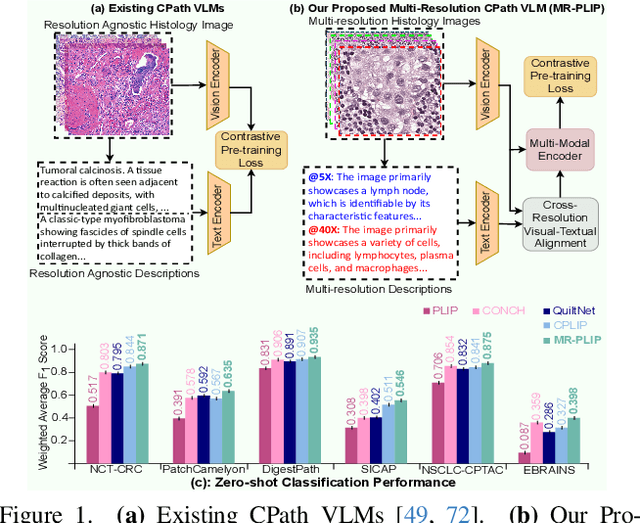
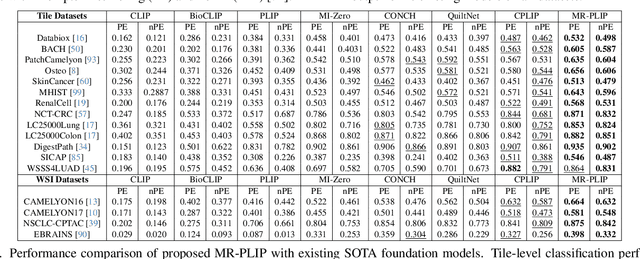
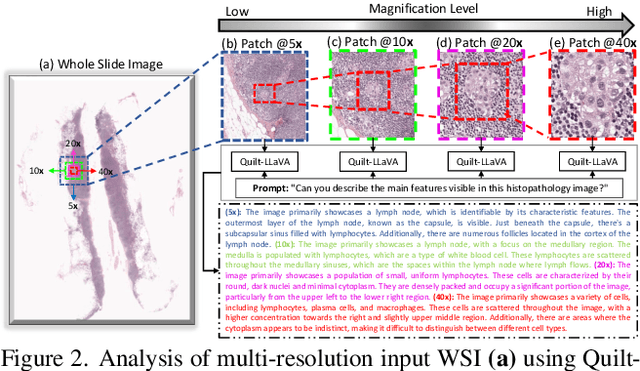
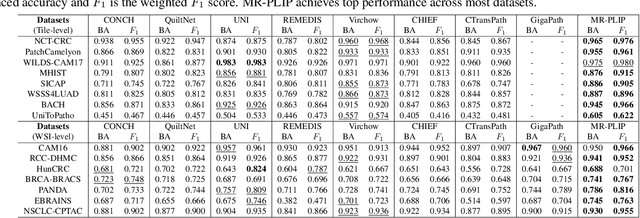
In Computational Pathology (CPath), the introduction of Vision-Language Models (VLMs) has opened new avenues for research, focusing primarily on aligning image-text pairs at a single magnification level. However, this approach might not be sufficient for tasks like cancer subtype classification, tissue phenotyping, and survival analysis due to the limited level of detail that a single-resolution image can provide. Addressing this, we propose a novel multi-resolution paradigm leveraging Whole Slide Images (WSIs) to extract histology patches at multiple resolutions and generate corresponding textual descriptions through advanced CPath VLM. We introduce visual-textual alignment at multiple resolutions as well as cross-resolution alignment to establish more effective text-guided visual representations. Cross-resolution alignment using a multimodal encoder enhances the model's ability to capture context from multiple resolutions in histology images. Our model aims to capture a broader range of information, supported by novel loss functions, enriches feature representation, improves discriminative ability, and enhances generalization across different resolutions. Pre-trained on a comprehensive TCGA dataset with 34 million image-language pairs at various resolutions, our fine-tuned model outperforms state-of-the-art (SOTA) counterparts across multiple datasets and tasks, demonstrating its effectiveness in CPath. The code is available on GitHub at: https://github.com/BasitAlawode/MR-PLIP
DyCON: Dynamic Uncertainty-aware Consistency and Contrastive Learning for Semi-supervised Medical Image Segmentation
Apr 06, 2025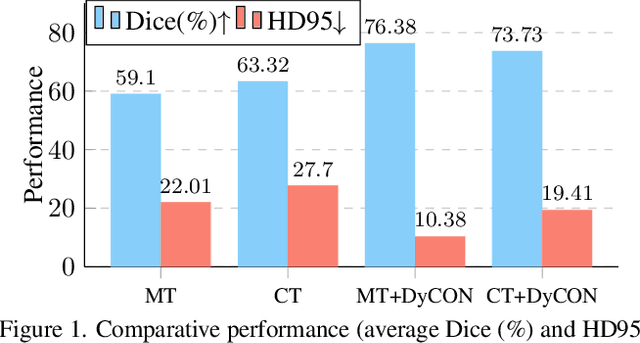
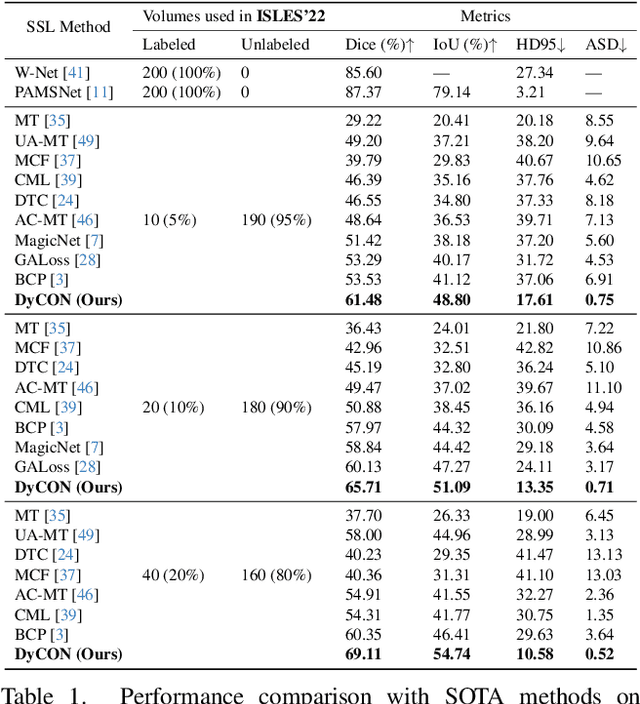
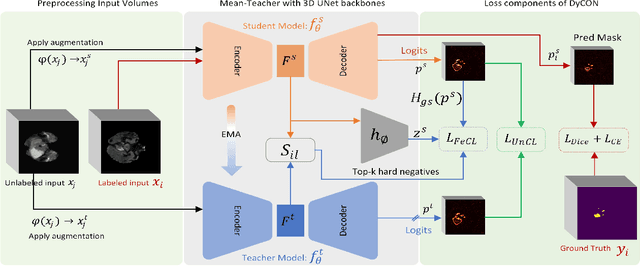
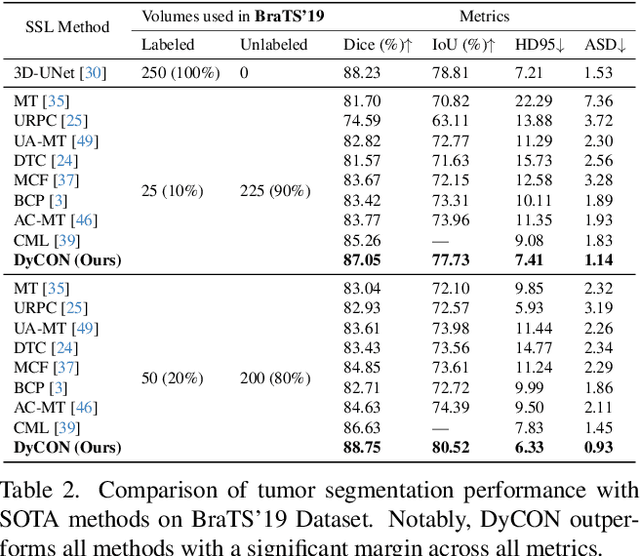
Semi-supervised learning in medical image segmentation leverages unlabeled data to reduce annotation burdens through consistency learning. However, current methods struggle with class imbalance and high uncertainty from pathology variations, leading to inaccurate segmentation in 3D medical images. To address these challenges, we present DyCON, a Dynamic Uncertainty-aware Consistency and Contrastive Learning framework that enhances the generalization of consistency methods with two complementary losses: Uncertainty-aware Consistency Loss (UnCL) and Focal Entropy-aware Contrastive Loss (FeCL). UnCL enforces global consistency by dynamically weighting the contribution of each voxel to the consistency loss based on its uncertainty, preserving high-uncertainty regions instead of filtering them out. Initially, UnCL prioritizes learning from uncertain voxels with lower penalties, encouraging the model to explore challenging regions. As training progress, the penalty shift towards confident voxels to refine predictions and ensure global consistency. Meanwhile, FeCL enhances local feature discrimination in imbalanced regions by introducing dual focal mechanisms and adaptive confidence adjustments into the contrastive principle. These mechanisms jointly prioritizes hard positives and negatives while focusing on uncertain sample pairs, effectively capturing subtle lesion variations under class imbalance. Extensive evaluations on four diverse medical image segmentation datasets (ISLES'22, BraTS'19, LA, Pancreas) show DyCON's superior performance against SOTA methods.