 Add to Chrome
 Add to Firefox
 Add to Edge
Collaborative Trajectory Prediction via Late Fusion
Apr 24, 2026
Predicting future trajectories of surrounding traffic agents is critical for safe autonomous navigation and collision avoidance. Despite all advances in the trajectory forecasting realm, the prediction models remains vulnerable to uncertainty caused by occlusions, limited sensing range, and perception errors. Collaborative vehicle-to-vehicle (V2V) approaches help reduce this uncertainty by sharing complementary information. Existing collaborative trajectory prediction methods typically fuse feature maps at the perception stage to construct a holistic scene view. Further this holistic representation is decoded into the future trajectories. Such design incurs substantial communication overhead due to the exchange of high-dimensional feature representations and often assumes idealized bandwidth and synchronization, limiting practical deployment. We address these limitations by shifting collaboration from perception to the prediction module and introducing a late-fusion framework for shared forecasts. The framework is model-agnostic and treats collaborating vehicles as independent asynchronous agents. We evaluate the approach on the OPV2V, V2V4Real, and DeepAccident datasets, comparing individual and collaborative forecasting. Across all datasets, late fusion consistently reduces miss rate and improves trajectory success rate ($\mathrm{TSR}_{0.5}$), defined as the fraction of ground-truth agents with final displacement error below 0.5 m. On the real-world V2V4Real dataset, collaborative prediction improves the success rate by $1.69\%$ and $1.22\%$ for both intelligent vehicles, respectively, compared with individual forecasting.

Visual Prompt Based Reasoning for Offroad Mapping using Multimodal LLMs
Apr 06, 2026Traditional approaches to off-road autonomy rely on separate models for terrain classification, height estimation, and quantifying slip or slope conditions. Utilizing several models requires training each component separately, having task specific datasets, and fine-tuning. In this work, we present a zero-shot approach leveraging SAM2 for environment segmentation and a vision-language model (VLM) to reason about drivable areas. Our approach involves passing to the VLM both the original image and the segmented image annotated with numeric labels for each mask. The VLM is then prompted to identify which regions, represented by these numeric labels, are drivable. Combined with planning and control modules, this unified framework eliminates the need for explicit terrain-specific models and relies instead on the inherent reasoning capabilities of the VLM. Our approach surpasses state-of-the-art trainable models on high resolution segmentation datasets and enables full stack navigation in our Isaac Sim offroad environment.
EMT: A Visual Multi-Task Benchmark Dataset for Autonomous Driving in the Arab Gulf Region
Feb 26, 2025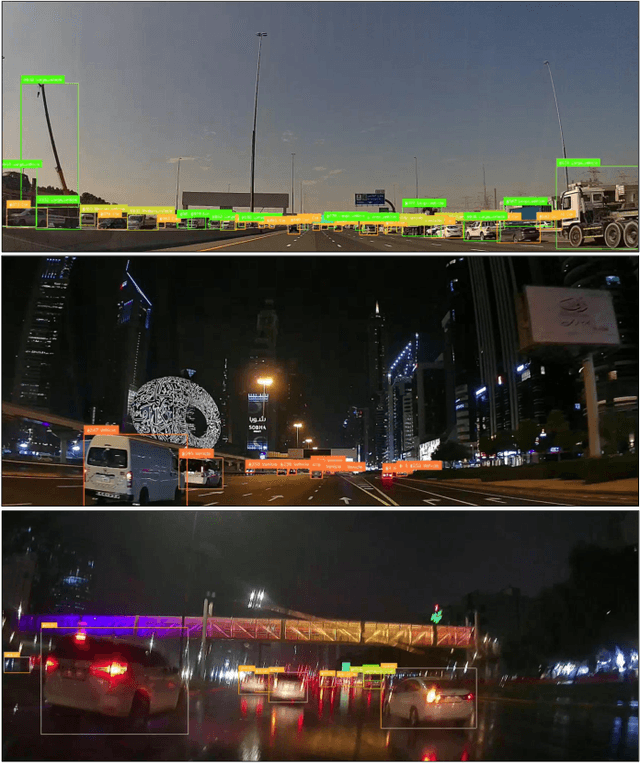

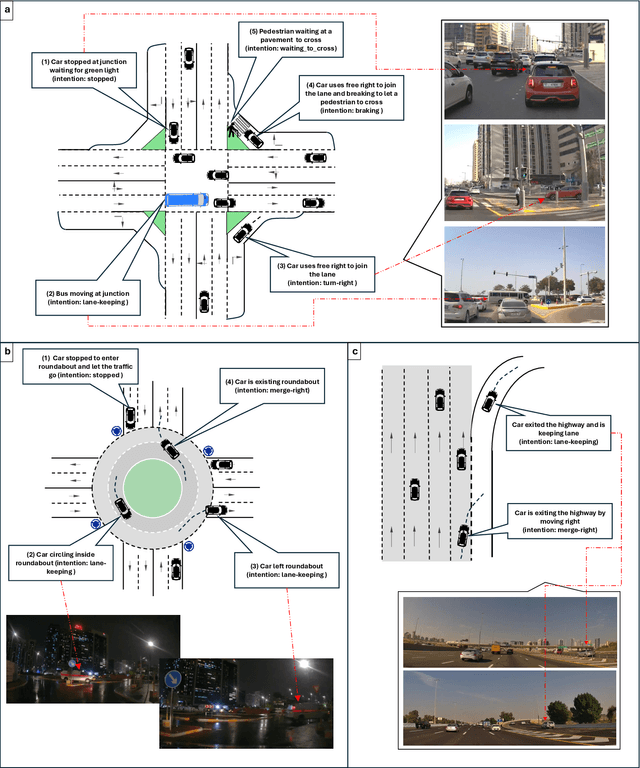
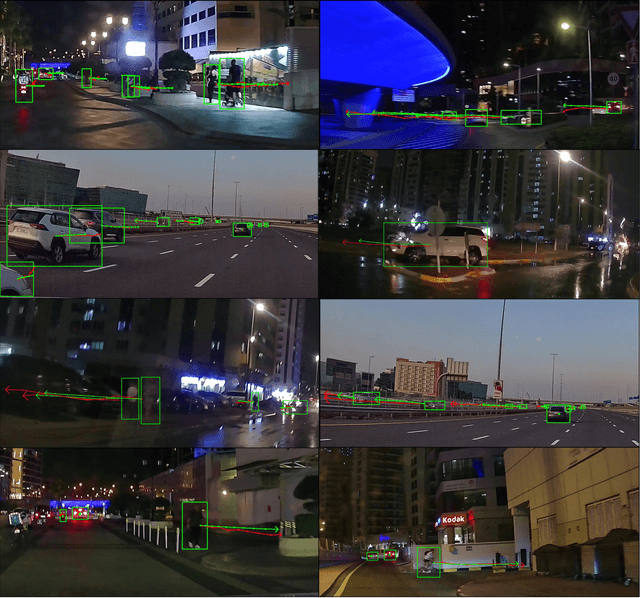
This paper introduces the Emirates Multi-Task (EMT) dataset - the first publicly available dataset for autonomous driving collected in the Arab Gulf region. The EMT dataset captures the unique road topology, high traffic congestion, and distinctive characteristics of the Gulf region, including variations in pedestrian clothing and weather conditions. It contains over 30,000 frames from a dash-camera perspective, along with 570,000 annotated bounding boxes, covering approximately 150 kilometers of driving routes. The EMT dataset supports three primary tasks: tracking, trajectory forecasting and intention prediction. Each benchmark dataset is complemented with corresponding evaluations: (1) multi-agent tracking experiments, focusing on multi-class scenarios and occlusion handling; (2) trajectory forecasting evaluation using deep sequential and interaction-aware models; and (3) intention benchmark experiments conducted for predicting agents intentions from observed trajectories. The dataset is publicly available at https://avlab.io/emt-dataset, and pre-processing scripts along with evaluation models can be accessed at https://github.com/AV-Lab/emt-dataset.