 Add to Chrome
 Add to Firefox
 Add to Edge
MLLM-HWSI: A Multimodal Large Language Model for Hierarchical Whole Slide Image Understanding
Mar 25, 2026
Whole Slide Images (WSIs) exhibit hierarchical structure, where diagnostic information emerges from cellular morphology, regional tissue organization, and global context. Existing Computational Pathology (CPath) Multimodal Large Language Models (MLLMs) typically compress an entire WSI into a single embedding, which hinders fine-grained grounding and ignores how pathologists synthesize evidence across different scales. We introduce \textbf{MLLM-HWSI}, a Hierarchical WSI-level MLLM that aligns visual features with pathology language at four distinct scales, cell as word, patch as phrase, region as sentence, and WSI as paragraph to support interpretable evidence-grounded reasoning. MLLM-HWSI decomposes each WSI into multi-scale embeddings with scale-specific projectors and jointly enforces (i) a hierarchical contrastive objective and (ii) a cross-scale consistency loss, preserving semantic coherence from cells to the WSI. We compute diagnostically relevant patches and aggregate segmented cell embeddings into a compact cellular token per-patch using a lightweight \textit{Cell-Cell Attention Fusion (CCAF)} transformer. The projected multi-scale tokens are fused with text tokens and fed to an instruction-tuned LLM for open-ended reasoning, VQA, report, and caption generation tasks. Trained in three stages, MLLM-HWSI achieves new SOTA results on 13 WSI-level benchmarks across six CPath tasks. By aligning language with multi-scale visual evidence, MLLM-HWSI provides accurate, interpretable outputs that mirror diagnostic workflows and advance holistic WSI understanding. Code is available at: \href{https://github.com/BasitAlawode/HWSI-MLLM}{GitHub}.

Multi-Resolution Pathology-Language Pre-training Model with Text-Guided Visual Representation
Apr 26, 2025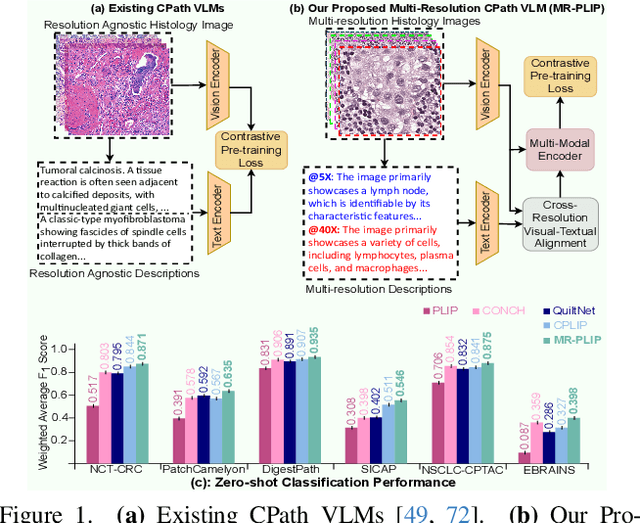
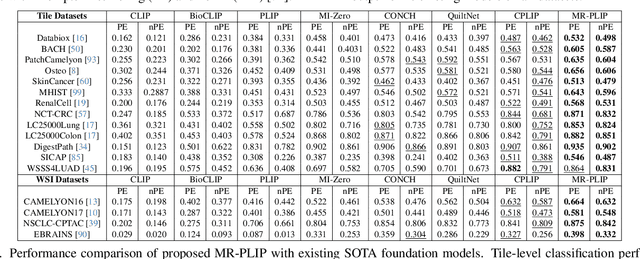
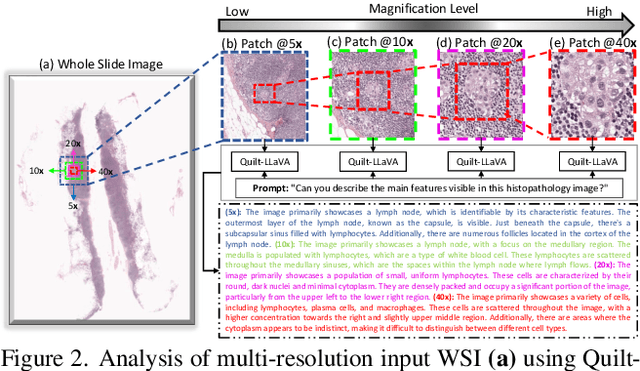
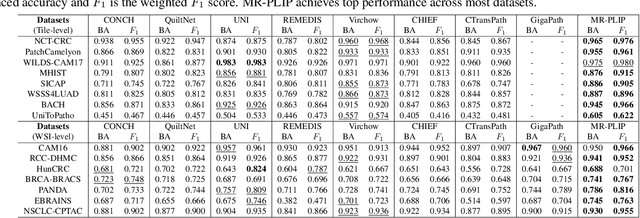
In Computational Pathology (CPath), the introduction of Vision-Language Models (VLMs) has opened new avenues for research, focusing primarily on aligning image-text pairs at a single magnification level. However, this approach might not be sufficient for tasks like cancer subtype classification, tissue phenotyping, and survival analysis due to the limited level of detail that a single-resolution image can provide. Addressing this, we propose a novel multi-resolution paradigm leveraging Whole Slide Images (WSIs) to extract histology patches at multiple resolutions and generate corresponding textual descriptions through advanced CPath VLM. We introduce visual-textual alignment at multiple resolutions as well as cross-resolution alignment to establish more effective text-guided visual representations. Cross-resolution alignment using a multimodal encoder enhances the model's ability to capture context from multiple resolutions in histology images. Our model aims to capture a broader range of information, supported by novel loss functions, enriches feature representation, improves discriminative ability, and enhances generalization across different resolutions. Pre-trained on a comprehensive TCGA dataset with 34 million image-language pairs at various resolutions, our fine-tuned model outperforms state-of-the-art (SOTA) counterparts across multiple datasets and tasks, demonstrating its effectiveness in CPath. The code is available on GitHub at: https://github.com/BasitAlawode/MR-PLIP