 Add to Chrome
 Add to Firefox
 Add to Edge
A Probabilistic Framework for Adapting to Changing and Recurring Concepts in Data Streams
Aug 18, 2024
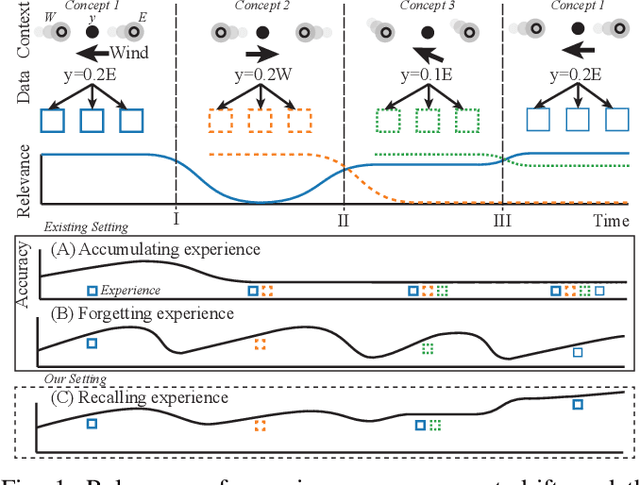
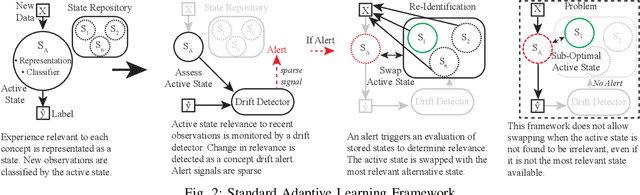
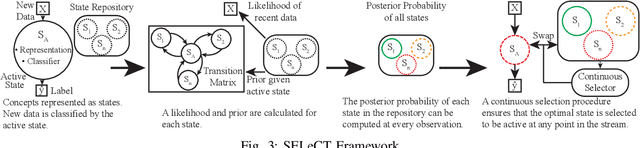
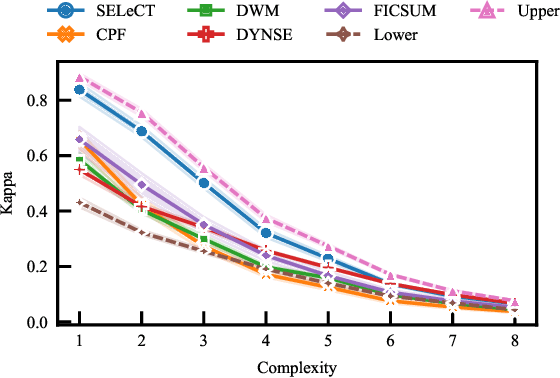
The distribution of streaming data often changes over time as conditions change, a phenomenon known as concept drift. Only a subset of previous experience, collected in similar conditions, is relevant to learning an accurate classifier for current data. Learning from irrelevant experience describing a different concept can degrade performance. A system learning from streaming data must identify which recent experience is irrelevant when conditions change and which past experience is relevant when concepts reoccur, \textit{e.g.,} when weather events or financial patterns repeat. Existing streaming approaches either do not consider experience to change in relevance over time and thus cannot handle concept drift, or only consider the recency of experience and thus cannot handle recurring concepts, or only sparsely evaluate relevance and thus fail when concept drift is missed. To enable learning in changing conditions, we propose SELeCT, a probabilistic method for continuously evaluating the relevance of past experience. SELeCT maintains a distinct internal state for each concept, representing relevant experience with a unique classifier. We propose a Bayesian algorithm for estimating state relevance, combining the likelihood of drawing recent observations from a given state with a transition pattern prior based on the system's current state.

Robust Active Learning (RoAL): Countering Dynamic Adversaries in Active Learning with Elastic Weight Consolidation
Aug 15, 2024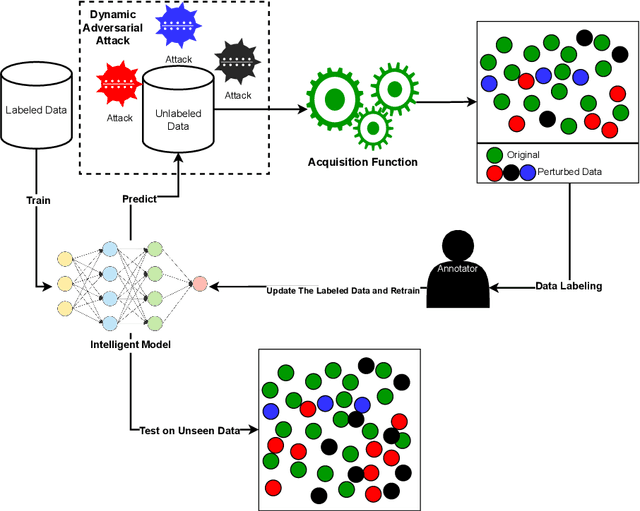
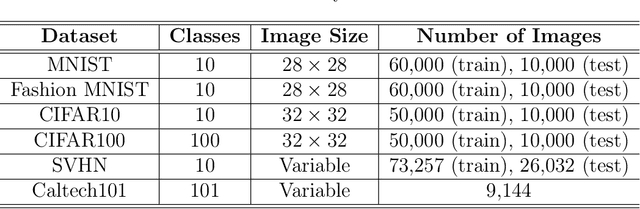
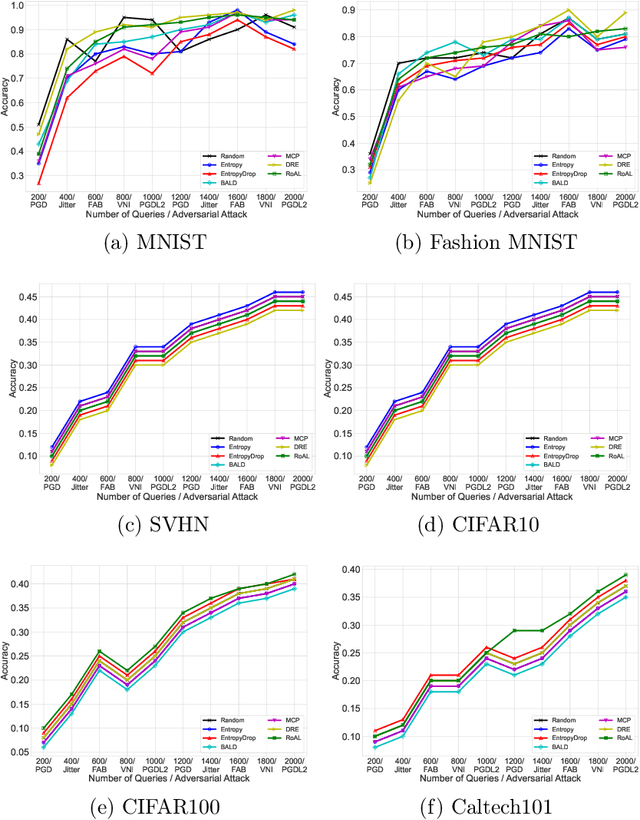
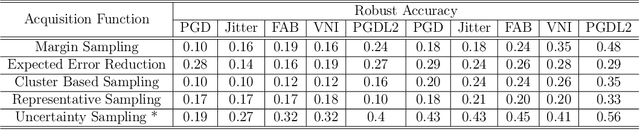
Despite significant advancements in active learning and adversarial attacks, the intersection of these two fields remains underexplored, particularly in developing robust active learning frameworks against dynamic adversarial threats. The challenge of developing robust active learning frameworks under dynamic adversarial attacks is critical, as these attacks can lead to catastrophic forgetting within the active learning cycle. This paper introduces Robust Active Learning (RoAL), a novel approach designed to address this issue by integrating Elastic Weight Consolidation (EWC) into the active learning process. Our contributions are threefold: First, we propose a new dynamic adversarial attack that poses significant threats to active learning frameworks. Second, we introduce a novel method that combines EWC with active learning to mitigate catastrophic forgetting caused by dynamic adversarial attacks. Finally, we conduct extensive experimental evaluations to demonstrate the efficacy of our approach. The results show that RoAL not only effectively counters dynamic adversarial threats but also significantly reduces the impact of catastrophic forgetting, thereby enhancing the robustness and performance of active learning systems in adversarial environments.
Unveiling the Power of Sparse Neural Networks for Feature Selection
Aug 08, 2024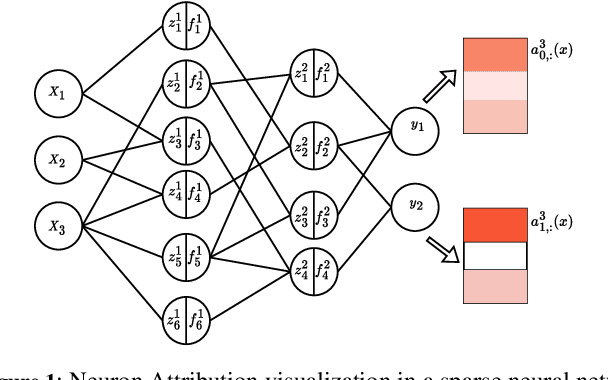
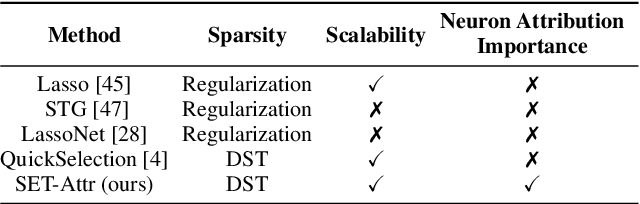
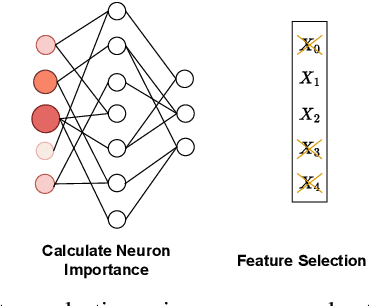
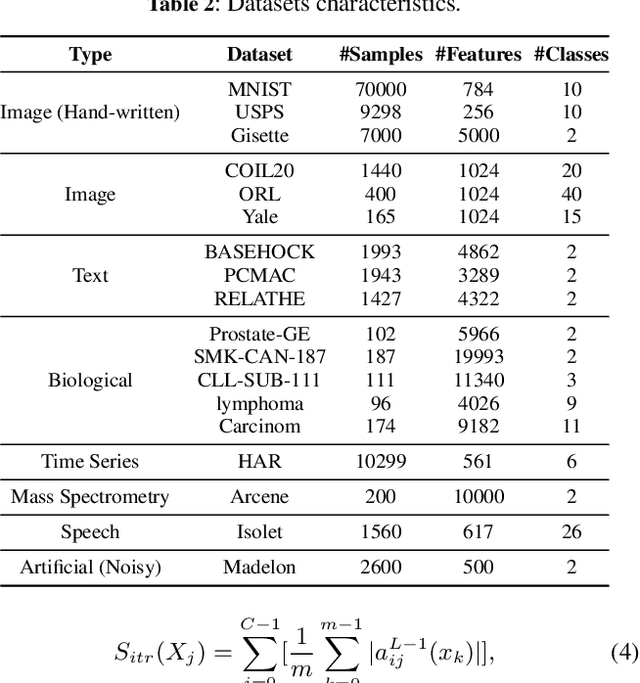
Sparse Neural Networks (SNNs) have emerged as powerful tools for efficient feature selection. Leveraging the dynamic sparse training (DST) algorithms within SNNs has demonstrated promising feature selection capabilities while drastically reducing computational overheads. Despite these advancements, several critical aspects remain insufficiently explored for feature selection. Questions persist regarding the choice of the DST algorithm for network training, the choice of metric for ranking features/neurons, and the comparative performance of these methods across diverse datasets when compared to dense networks. This paper addresses these gaps by presenting a comprehensive systematic analysis of feature selection with sparse neural networks. Moreover, we introduce a novel metric considering sparse neural network characteristics, which is designed to quantify feature importance within the context of SNNs. Our findings show that feature selection with SNNs trained with DST algorithms can achieve, on average, more than $50\%$ memory and $55\%$ FLOPs reduction compared to the dense networks, while outperforming them in terms of the quality of the selected features. Our code and the supplementary material are available on GitHub (\url{https://github.com/zahraatashgahi/Neuron-Attribution}).
(PASS) Visual Prompt Locates Good Structure Sparsity through a Recurrent HyperNetwork
Jul 24, 2024

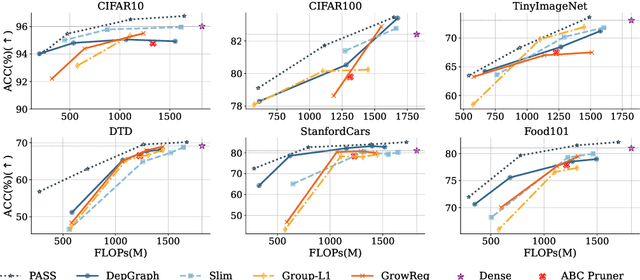

Large-scale neural networks have demonstrated remarkable performance in different domains like vision and language processing, although at the cost of massive computation resources. As illustrated by compression literature, structural model pruning is a prominent algorithm to encourage model efficiency, thanks to its acceleration-friendly sparsity patterns. One of the key questions of structural pruning is how to estimate the channel significance. In parallel, work on data-centric AI has shown that prompting-based techniques enable impressive generalization of large language models across diverse downstream tasks. In this paper, we investigate a charming possibility - \textit{leveraging visual prompts to capture the channel importance and derive high-quality structural sparsity}. To this end, we propose a novel algorithmic framework, namely \texttt{PASS}. It is a tailored hyper-network to take both visual prompts and network weight statistics as input, and output layer-wise channel sparsity in a recurrent manner. Such designs consider the intrinsic channel dependency between layers. Comprehensive experiments across multiple network architectures and six datasets demonstrate the superiority of \texttt{PASS} in locating good structural sparsity. For example, at the same FLOPs level, \texttt{PASS} subnetworks achieve $1\%\sim 3\%$ better accuracy on Food101 dataset; or with a similar performance of $80\%$ accuracy, \texttt{PASS} subnetworks obtain $0.35\times$ more speedup than the baselines.
Nerva: a Truly Sparse Implementation of Neural Networks
Jul 24, 2024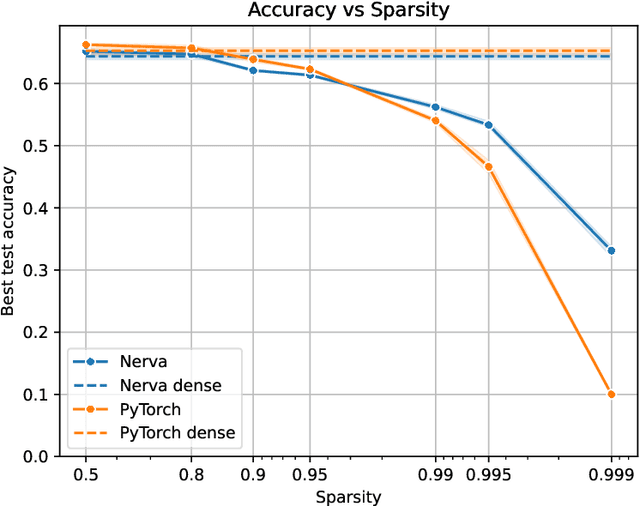
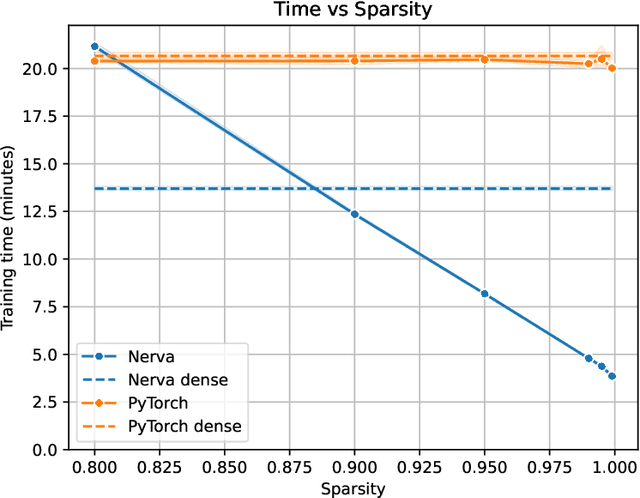
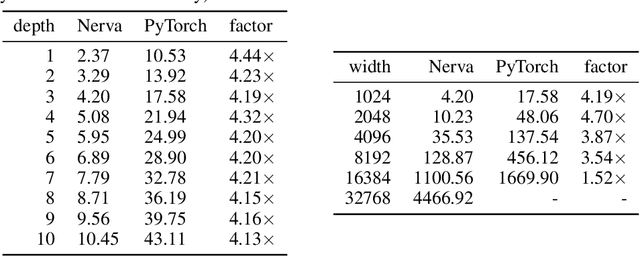
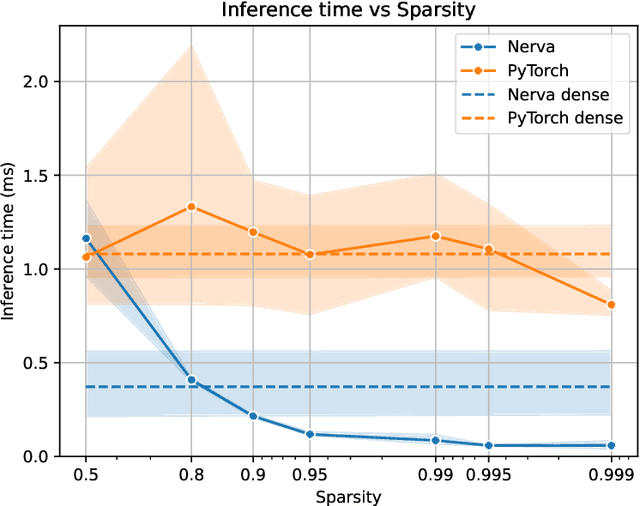
We introduce Nerva, a fast neural network library under development in C++. It supports sparsity by using the sparse matrix operations of Intel's Math Kernel Library (MKL), which eliminates the need for binary masks. We show that Nerva significantly decreases training time and memory usage while reaching equivalent accuracy to PyTorch. We run static sparse experiments with an MLP on CIFAR-10. On high sparsity levels like $99\%$, the runtime is reduced by a factor of $4\times$ compared to a PyTorch model using masks. Similar to other popular frameworks such as PyTorch and Keras, Nerva offers a Python interface for users to work with.
Dynamic Data Pruning for Automatic Speech Recognition
Jun 26, 2024
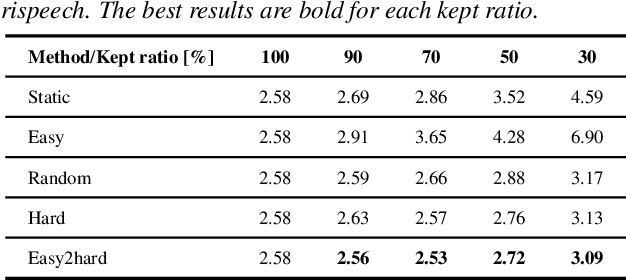
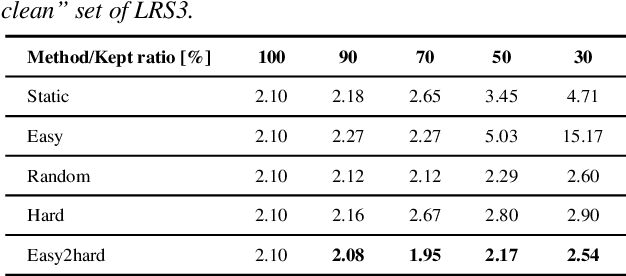
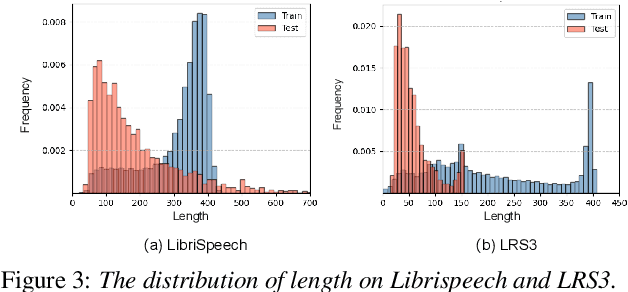
The recent success of Automatic Speech Recognition (ASR) is largely attributed to the ever-growing amount of training data. However, this trend has made model training prohibitively costly and imposed computational demands. While data pruning has been proposed to mitigate this issue by identifying a small subset of relevant data, its application in ASR has been barely explored, and existing works often entail significant overhead to achieve meaningful results. To fill this gap, this paper presents the first investigation of dynamic data pruning for ASR, finding that we can reach the full-data performance by dynamically selecting 70% of data. Furthermore, we introduce Dynamic Data Pruning for ASR (DDP-ASR), which offers several fine-grained pruning granularities specifically tailored for speech-related datasets, going beyond the conventional pruning of entire time sequences. Our intensive experiments show that DDP-ASR can save up to 1.6x training time with negligible performance loss.
Boosting Robustness in Preference-Based Reinforcement Learning with Dynamic Sparsity
Jun 10, 2024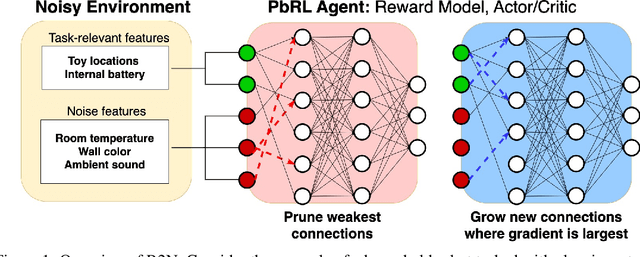
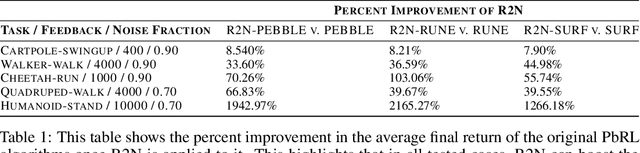
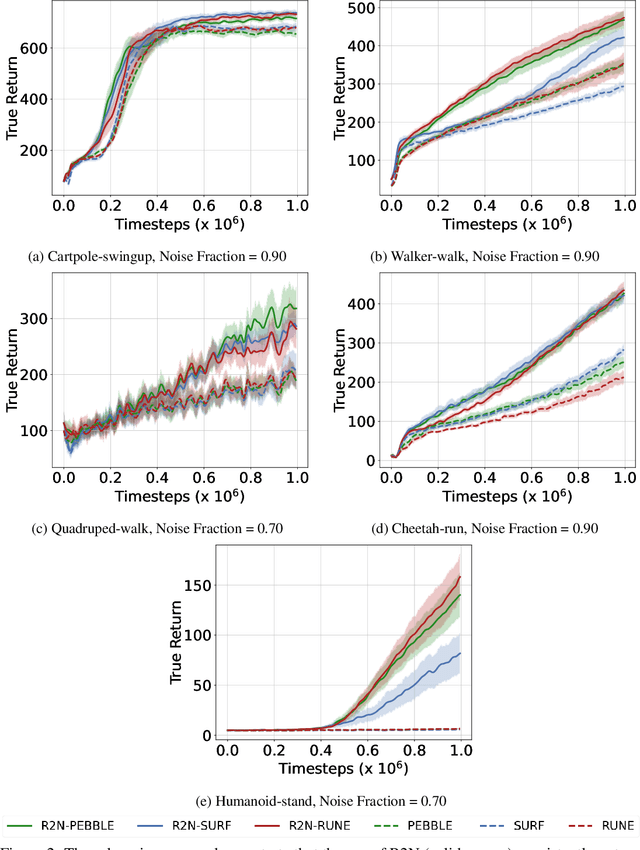
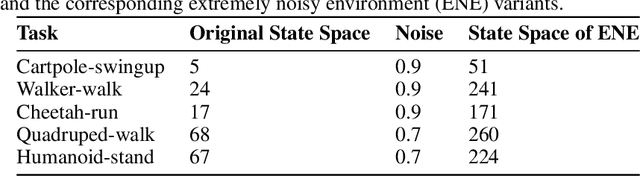
For autonomous agents to successfully integrate into human-centered environments, agents should be able to learn from and adapt to humans in their native settings. Preference-based reinforcement learning (PbRL) is a promising approach that learns reward functions from human preferences. This enables RL agents to adapt their behavior based on human desires. However, humans live in a world full of diverse information, most of which is not relevant to completing a particular task. It becomes essential that agents learn to focus on the subset of task-relevant environment features. Unfortunately, prior work has largely ignored this aspect; primarily focusing on improving PbRL algorithms in standard RL environments that are carefully constructed to contain only task-relevant features. This can result in algorithms that may not effectively transfer to a more noisy real-world setting. To that end, this work proposes R2N (Robust-to-Noise), the first PbRL algorithm that leverages principles of dynamic sparse training to learn robust reward models that can focus on task-relevant features. We study the effectiveness of R2N in the Extremely Noisy Environment setting, an RL problem setting where up to 95% of the state features are irrelevant distractions. In experiments with a simulated teacher, we demonstrate that R2N can adapt the sparse connectivity of its neural networks to focus on task-relevant features, enabling R2N to significantly outperform several state-of-the-art PbRL algorithms in multiple locomotion and control environments.
One-Shot Federated Learning with Bayesian Pseudocoresets
Jun 04, 2024
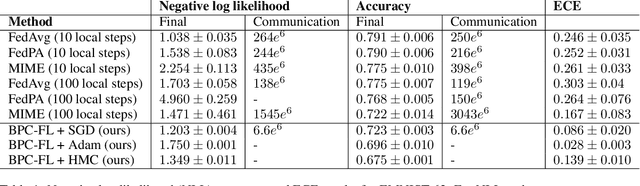
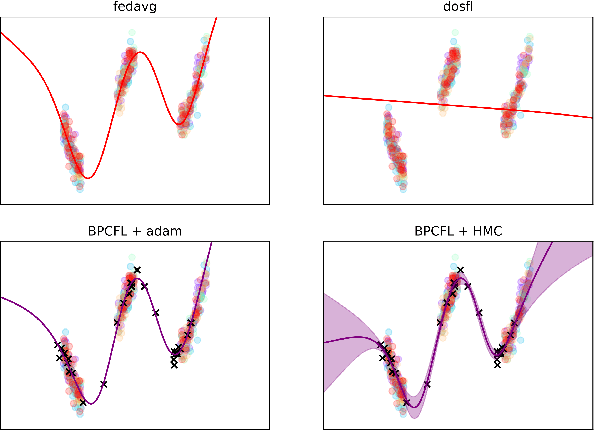
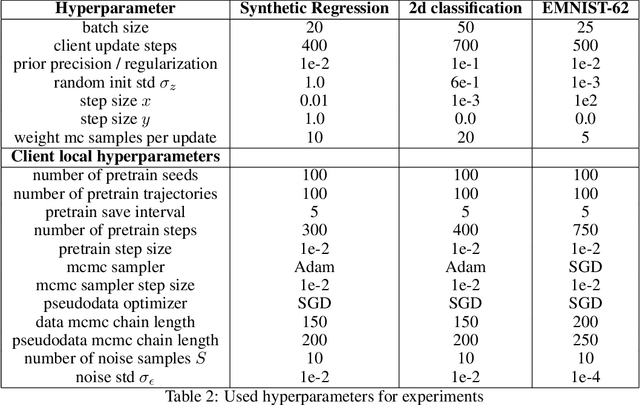
Optimization-based techniques for federated learning (FL) often come with prohibitive communication cost, as high dimensional model parameters need to be communicated repeatedly between server and clients. In this paper, we follow a Bayesian approach allowing to perform FL with one-shot communication, by solving the global inference problem as a product of local client posteriors. For models with multi-modal likelihoods, such as neural networks, a naive application of this scheme is hampered, since clients will capture different posterior modes, causing a destructive collapse of the posterior on the server side. Consequently, we explore approximate inference in the function-space representation of client posteriors, hence suffering less or not at all from multi-modality. We show that distributed function-space inference is tightly related to learning Bayesian pseudocoresets and develop a tractable Bayesian FL algorithm on this insight. We show that this approach achieves prediction performance competitive to state-of-the-art while showing a striking reduction in communication cost of up to two orders of magnitude. Moreover, due to its Bayesian nature, our method also delivers well-calibrated uncertainty estimates.
Efficient Exploration in Average-Reward Constrained Reinforcement Learning: Achieving Near-Optimal Regret With Posterior Sampling
May 29, 2024We present a new algorithm based on posterior sampling for learning in Constrained Markov Decision Processes (CMDP) in the infinite-horizon undiscounted setting. The algorithm achieves near-optimal regret bounds while being advantageous empirically compared to the existing algorithms. Our main theoretical result is a Bayesian regret bound for each cost component of $\tilde{O} (DS\sqrt{AT})$ for any communicating CMDP with $S$ states, $A$ actions, and diameter $D$. This regret bound matches the lower bound in order of time horizon $T$ and is the best-known regret bound for communicating CMDPs achieved by a computationally tractable algorithm. Empirical results show that our posterior sampling algorithm outperforms the existing algorithms for constrained reinforcement learning.
The Neutrality Fallacy: When Algorithmic Fairness Interventions are (Not) Positive Action
Apr 18, 2024Various metrics and interventions have been developed to identify and mitigate unfair outputs of machine learning systems. While individuals and organizations have an obligation to avoid discrimination, the use of fairness-aware machine learning interventions has also been described as amounting to 'algorithmic positive action' under European Union (EU) non-discrimination law. As the Court of Justice of the European Union has been strict when it comes to assessing the lawfulness of positive action, this would impose a significant legal burden on those wishing to implement fair-ml interventions. In this paper, we propose that algorithmic fairness interventions often should be interpreted as a means to prevent discrimination, rather than a measure of positive action. Specifically, we suggest that this category mistake can often be attributed to neutrality fallacies: faulty assumptions regarding the neutrality of fairness-aware algorithmic decision-making. Our findings raise the question of whether a negative obligation to refrain from discrimination is sufficient in the context of algorithmic decision-making. Consequently, we suggest moving away from a duty to 'not do harm' towards a positive obligation to actively 'do no harm' as a more adequate framework for algorithmic decision-making and fair ml-interventions.