 Add to Chrome
 Add to Firefox
 Add to Edge
Fingerprinting Concepts in Data Streams with Supervised and Unsupervised Meta-Information
Mar 11, 2026
Streaming sources of data are becoming more common as the ability to collect data in real-time grows. A major concern in dealing with data streams is concept drift, a change in the distribution of data over time, for example, due to changes in environmental conditions. Representing concepts (stationary periods featuring similar behaviour) is a key idea in adapting to concept drift. By testing the similarity of a concept representation to a window of observations, we can detect concept drift to a new or previously seen recurring concept. Concept representations are constructed using meta-information features, values describing aspects of concept behaviour. We find that previously proposed concept representations rely on small numbers of meta-information features. These representations often cannot distinguish concepts, leaving systems vulnerable to concept drift. We propose FiCSUM, a general framework to represent both supervised and unsupervised behaviours of a concept in a fingerprint, a vector of many distinct meta-information features able to uniquely identify more concepts. Our dynamic weighting strategy learns which meta-information features describe concept drift in a given dataset, allowing a diverse set of meta-information features to be used at once. FiCSUM outperforms state-of-the-art methods over a range of 11 real world and synthetic datasets in both accuracy and modeling underlying concept drift.

A Probabilistic Framework for Adapting to Changing and Recurring Concepts in Data Streams
Aug 18, 2024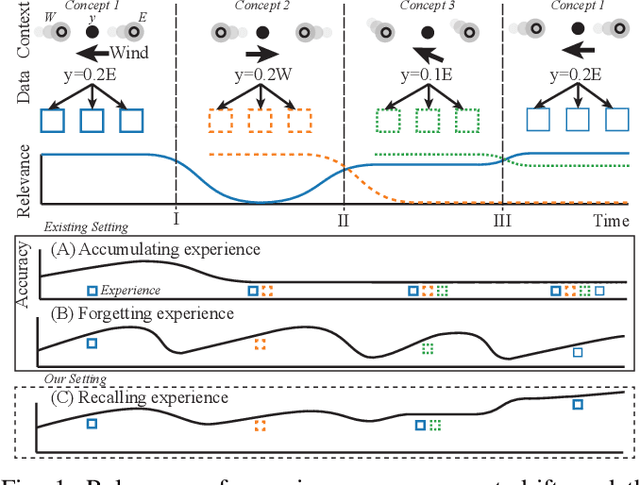
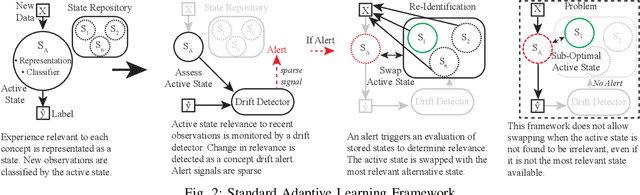
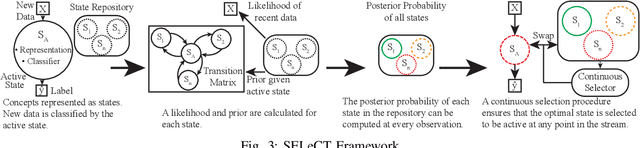
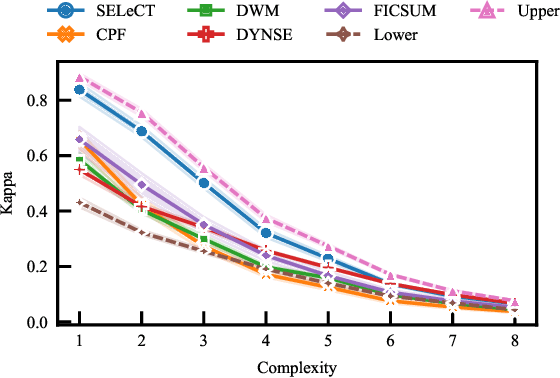
The distribution of streaming data often changes over time as conditions change, a phenomenon known as concept drift. Only a subset of previous experience, collected in similar conditions, is relevant to learning an accurate classifier for current data. Learning from irrelevant experience describing a different concept can degrade performance. A system learning from streaming data must identify which recent experience is irrelevant when conditions change and which past experience is relevant when concepts reoccur, \textit{e.g.,} when weather events or financial patterns repeat. Existing streaming approaches either do not consider experience to change in relevance over time and thus cannot handle concept drift, or only consider the recency of experience and thus cannot handle recurring concepts, or only sparsely evaluate relevance and thus fail when concept drift is missed. To enable learning in changing conditions, we propose SELeCT, a probabilistic method for continuously evaluating the relevance of past experience. SELeCT maintains a distinct internal state for each concept, representing relevant experience with a unique classifier. We propose a Bayesian algorithm for estimating state relevance, combining the likelihood of drawing recent observations from a given state with a transition pattern prior based on the system's current state.