 Add to Chrome
 Add to Firefox
 Add to Edge
Agent-X: Full Pipeline Acceleration of On-device AI Agents
May 11, 2026
LLM-based agents deliver state-of-the-art performance across tasks but incur high end-to-end latency on edge devices. We introduce Agent-X, a software-only, accuracy-preserving framework that accelerates both the prefill and decode stages of on-device agent workloads. Agent-X's two key components rewrite prompts to leverage prefix caching tailored to agent-specific input-token patterns and enable LLM-free speculative decoding for fast token generation with minimal overhead. On representative agentic workloads, Agent-X achieves a 1.61x end-to-end speedup in real systems with no accuracy loss and can be seamlessly integrated into existing on-device AI agents. To the best of our knowledge, ours is the first to systematically characterize and eliminate latency bottlenecks in on-device agents.

SpecMoE: A Fast and Efficient Mixture-of-Experts Inference via Self-Assisted Speculative Decoding
Apr 11, 2026The Mixture-of-Experts (MoE) architecture has emerged as a promising approach to mitigate the rising computational costs of large language models (LLMs) by selectively activating parameters. However, its high memory requirements and sub-optimal parameter efficiency pose significant challenges for efficient deployment. Although CPU-offloaded MoE inference systems have been proposed in the literature, they offer limited efficiency, particularly for large batch sizes. In this work, we propose SpecMoE, a memory-efficient MoE inference system based on our self-assisted speculative decoding algorithm. SpecMoE demonstrates the effectiveness of applying speculative decoding to MoE inference without requiring additional model training or fine-tuning. Our system improves inference throughput by up to $4.30\times$, while significantly reducing bandwidth requirements of both memory and interconnect on memory-constrained systems.
PASCAL: A Phase-Aware Scheduling Algorithm for Serving Reasoning-based Large Language Models
Feb 12, 2026The emergence of reasoning-based LLMs leveraging Chain-of-Thought (CoT) inference introduces new serving challenges, as their extended reasoning phases delay user-visible output and inflate Time-To-First-Token (TTFT). Existing LLM serving frameworks fail to distinguish between reasoning and answering phases, leading to performance degradation under GPU memory constraints. We present PASCAL, a phase-aware scheduling algorithm that prioritizes reasoning to reduce TTFT while using controlled preemption and token pacing during answering to preserve Quality-of-Experience (QoE). Our hierarchical scheduler combines instance-level placement with intra-instance execution and enables dynamic migration at phase boundaries to balance load and reduce interference. Across benchmarks using DeepSeek-R1-Distill-Qwen-32B, PASCAL reduces tail TTFT by up to 72% while maintaining answering phase SLO attainment, demonstrating the importance of phase-aware scheduling for reasoning-based LLM deployment.
The Cost of Dynamic Reasoning: Demystifying AI Agents and Test-Time Scaling from an AI Infrastructure Perspective
Jun 04, 2025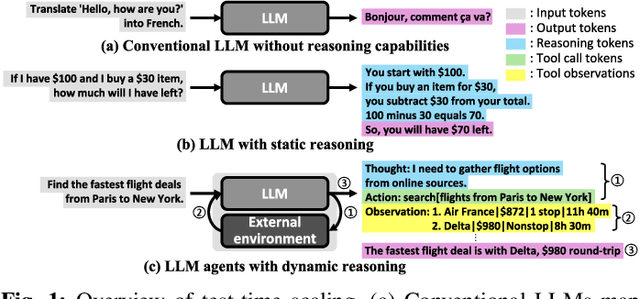
Large-language-model (LLM)-based AI agents have recently showcased impressive versatility by employing dynamic reasoning, an adaptive, multi-step process that coordinates with external tools. This shift from static, single-turn inference to agentic, multi-turn workflows broadens task generalization and behavioral flexibility, but it also introduces serious concerns about system-level cost, efficiency, and sustainability. This paper presents the first comprehensive system-level analysis of AI agents, quantifying their resource usage, latency behavior, energy consumption, and datacenter-wide power consumption demands across diverse agent designs and test-time scaling strategies. We further characterize how AI agent design choices, such as few-shot prompting, reflection depth, and parallel reasoning, impact accuracy-cost tradeoffs. Our findings reveal that while agents improve accuracy with increased compute, they suffer from rapidly diminishing returns, widening latency variance, and unsustainable infrastructure costs. Through detailed evaluation of representative agents, we highlight the profound computational demands introduced by AI agent workflows, uncovering a looming sustainability crisis. These results call for a paradigm shift in agent design toward compute-efficient reasoning, balancing performance with deployability under real-world constraints.
Debunking the CUDA Myth Towards GPU-based AI Systems
Dec 31, 2024

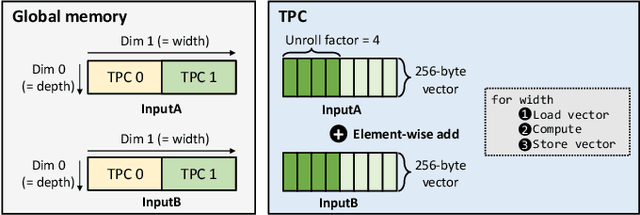

With the rise of AI, NVIDIA GPUs have become the de facto standard for AI system design. This paper presents a comprehensive evaluation of Intel Gaudi NPUs as an alternative to NVIDIA GPUs for AI model serving. First, we create a suite of microbenchmarks to compare Intel Gaudi-2 with NVIDIA A100, showing that Gaudi-2 achieves competitive performance not only in primitive AI compute, memory, and communication operations but also in executing several important AI workloads end-to-end. We then assess Gaudi NPU's programmability by discussing several software-level optimization strategies to employ for implementing critical FBGEMM operators and vLLM, evaluating their efficiency against GPU-optimized counterparts. Results indicate that Gaudi-2 achieves energy efficiency comparable to A100, though there are notable areas for improvement in terms of software maturity. Overall, we conclude that, with effective integration into high-level AI frameworks, Gaudi NPUs could challenge NVIDIA GPU's dominance in the AI server market, though further improvements are necessary to fully compete with NVIDIA's robust software ecosystem.
PREBA: A Hardware/Software Co-Design for Multi-Instance GPU based AI Inference Servers
Nov 28, 2024NVIDIA's Multi-Instance GPU (MIG) is a feature that enables system designers to reconfigure one large GPU into multiple smaller GPU slices. This work characterizes this emerging GPU and evaluates its effectiveness in designing high-performance AI inference servers. Our study reveals that the data preprocessing stage of AI inference causes significant performance bottlenecks to MIG. To this end, we present PREBA, which is a hardware/software co-design targeting MIG inference servers. Our first proposition is an FPGA-based data preprocessing accelerator that unlocks the full potential of MIG with domain-specific acceleration of data preprocessing. The MIG inference server unleashed from preprocessing overheads is then augmented with our dynamic batching system that enables high-performance inference. PREBA is implemented end-to-end in real systems, providing a 3.7x improvement in throughput, 3.4x reduction in tail latency, 3.5x improvement in energy-efficiency, and 3.0x improvement in cost-efficiency.
ElasticRec: A Microservice-based Model Serving Architecture Enabling Elastic Resource Scaling for Recommendation Models
Jun 11, 2024With the increasing popularity of recommendation systems (RecSys), the demand for compute resources in datacenters has surged. However, the model-wise resource allocation employed in current RecSys model serving architectures falls short in effectively utilizing resources, leading to sub-optimal total cost of ownership. We propose ElasticRec, a model serving architecture for RecSys providing resource elasticity and high memory efficiency. ElasticRec is based on a microservice-based software architecture for fine-grained resource allocation, tailored to the heterogeneous resource demands of RecSys. Additionally, ElasticRec achieves high memory efficiency via our utility-based resource allocation. Overall, ElasticRec achieves an average 3.3x reduction in memory allocation size and 8.1x increase in memory utility, resulting in an average 1.6x reduction in deployment cost compared to state-of-the-art RecSys inference serving system.
PreSto: An In-Storage Data Preprocessing System for Training Recommendation Models
Jun 11, 2024Training recommendation systems (RecSys) faces several challenges as it requires the "data preprocessing" stage to preprocess an ample amount of raw data and feed them to the GPU for training in a seamless manner. To sustain high training throughput, state-of-the-art solutions reserve a large fleet of CPU servers for preprocessing which incurs substantial deployment cost and power consumption. Our characterization reveals that prior CPU-centric preprocessing is bottlenecked on feature generation and feature normalization operations as it fails to reap out the abundant inter-/intra-feature parallelism in RecSys preprocessing. PreSto is a storage-centric preprocessing system leveraging In-Storage Processing (ISP), which offloads the bottlenecked preprocessing operations to our ISP units. We show that PreSto outperforms the baseline CPU-centric system with a $9.6\times$ speedup in end-to-end preprocessing time, $4.3\times$ enhancement in cost-efficiency, and $11.3\times$ improvement in energyefficiency on average for production-scale RecSys preprocessing.
LazyDP: Co-Designing Algorithm-Software for Scalable Training of Differentially Private Recommendation Models
Apr 12, 2024Differential privacy (DP) is widely being employed in the industry as a practical standard for privacy protection. While private training of computer vision or natural language processing applications has been studied extensively, the computational challenges of training of recommender systems (RecSys) with DP have not been explored. In this work, we first present our detailed characterization of private RecSys training using DP-SGD, root-causing its several performance bottlenecks. Specifically, we identify DP-SGD's noise sampling and noisy gradient update stage to suffer from a severe compute and memory bandwidth limitation, respectively, causing significant performance overhead in training private RecSys. Based on these findings, we propose LazyDP, an algorithm-software co-design that addresses the compute and memory challenges of training RecSys with DP-SGD. Compared to a state-of-the-art DP-SGD training system, we demonstrate that LazyDP provides an average 119x training throughput improvement while also ensuring mathematically equivalent, differentially private RecSys models to be trained.
Pre-gated MoE: An Algorithm-System Co-Design for Fast and Scalable Mixture-of-Expert Inference
Aug 23, 2023Large language models (LLMs) based on transformers have made significant strides in recent years, the success of which is driven by scaling up their model size. Despite their high algorithmic performance, the computational and memory requirements of LLMs present unprecedented challenges. To tackle the high compute requirements of LLMs, the Mixture-of-Experts (MoE) architecture was introduced which is able to scale its model size without proportionally scaling up its computational requirements. Unfortunately, MoE's high memory demands and dynamic activation of sparse experts restrict its applicability to real-world problems. Previous solutions that offload MoE's memory-hungry expert parameters to CPU memory fall short because the latency to migrate activated experts from CPU to GPU incurs high performance overhead. Our proposed Pre-gated MoE system effectively tackles the compute and memory challenges of conventional MoE architectures using our algorithm-system co-design. Pre-gated MoE employs our novel pre-gating function which alleviates the dynamic nature of sparse expert activation, allowing our proposed system to address the large memory footprint of MoEs while also achieving high performance. We demonstrate that Pre-gated MoE is able to improve performance, reduce GPU memory consumption, while also maintaining the same level of model quality. These features allow our Pre-gated MoE system to cost-effectively deploy large-scale LLMs using just a single GPU with high performance.