 Add to Chrome
 Add to Firefox
 Add to Edge
SpecMoE: A Fast and Efficient Mixture-of-Experts Inference via Self-Assisted Speculative Decoding
Apr 11, 2026
The Mixture-of-Experts (MoE) architecture has emerged as a promising approach to mitigate the rising computational costs of large language models (LLMs) by selectively activating parameters. However, its high memory requirements and sub-optimal parameter efficiency pose significant challenges for efficient deployment. Although CPU-offloaded MoE inference systems have been proposed in the literature, they offer limited efficiency, particularly for large batch sizes. In this work, we propose SpecMoE, a memory-efficient MoE inference system based on our self-assisted speculative decoding algorithm. SpecMoE demonstrates the effectiveness of applying speculative decoding to MoE inference without requiring additional model training or fine-tuning. Our system improves inference throughput by up to $4.30\times$, while significantly reducing bandwidth requirements of both memory and interconnect on memory-constrained systems.

PASCAL: A Phase-Aware Scheduling Algorithm for Serving Reasoning-based Large Language Models
Feb 12, 2026The emergence of reasoning-based LLMs leveraging Chain-of-Thought (CoT) inference introduces new serving challenges, as their extended reasoning phases delay user-visible output and inflate Time-To-First-Token (TTFT). Existing LLM serving frameworks fail to distinguish between reasoning and answering phases, leading to performance degradation under GPU memory constraints. We present PASCAL, a phase-aware scheduling algorithm that prioritizes reasoning to reduce TTFT while using controlled preemption and token pacing during answering to preserve Quality-of-Experience (QoE). Our hierarchical scheduler combines instance-level placement with intra-instance execution and enables dynamic migration at phase boundaries to balance load and reduce interference. Across benchmarks using DeepSeek-R1-Distill-Qwen-32B, PASCAL reduces tail TTFT by up to 72% while maintaining answering phase SLO attainment, demonstrating the importance of phase-aware scheduling for reasoning-based LLM deployment.
Debunking the CUDA Myth Towards GPU-based AI Systems
Dec 31, 2024

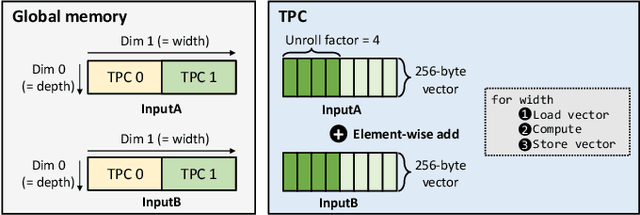

With the rise of AI, NVIDIA GPUs have become the de facto standard for AI system design. This paper presents a comprehensive evaluation of Intel Gaudi NPUs as an alternative to NVIDIA GPUs for AI model serving. First, we create a suite of microbenchmarks to compare Intel Gaudi-2 with NVIDIA A100, showing that Gaudi-2 achieves competitive performance not only in primitive AI compute, memory, and communication operations but also in executing several important AI workloads end-to-end. We then assess Gaudi NPU's programmability by discussing several software-level optimization strategies to employ for implementing critical FBGEMM operators and vLLM, evaluating their efficiency against GPU-optimized counterparts. Results indicate that Gaudi-2 achieves energy efficiency comparable to A100, though there are notable areas for improvement in terms of software maturity. Overall, we conclude that, with effective integration into high-level AI frameworks, Gaudi NPUs could challenge NVIDIA GPU's dominance in the AI server market, though further improvements are necessary to fully compete with NVIDIA's robust software ecosystem.