 Add to Chrome
 Add to Firefox
 Add to Edge
Agent-X: Full Pipeline Acceleration of On-device AI Agents
May 11, 2026
LLM-based agents deliver state-of-the-art performance across tasks but incur high end-to-end latency on edge devices. We introduce Agent-X, a software-only, accuracy-preserving framework that accelerates both the prefill and decode stages of on-device agent workloads. Agent-X's two key components rewrite prompts to leverage prefix caching tailored to agent-specific input-token patterns and enable LLM-free speculative decoding for fast token generation with minimal overhead. On representative agentic workloads, Agent-X achieves a 1.61x end-to-end speedup in real systems with no accuracy loss and can be seamlessly integrated into existing on-device AI agents. To the best of our knowledge, ours is the first to systematically characterize and eliminate latency bottlenecks in on-device agents.

The Cost of Dynamic Reasoning: Demystifying AI Agents and Test-Time Scaling from an AI Infrastructure Perspective
Jun 04, 2025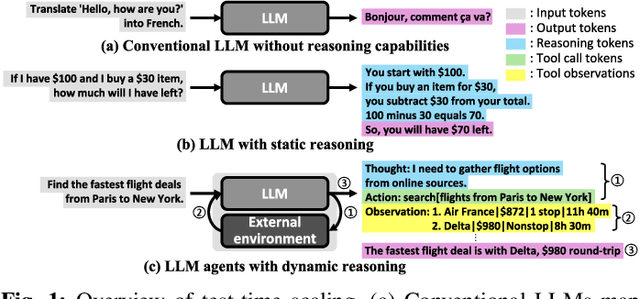
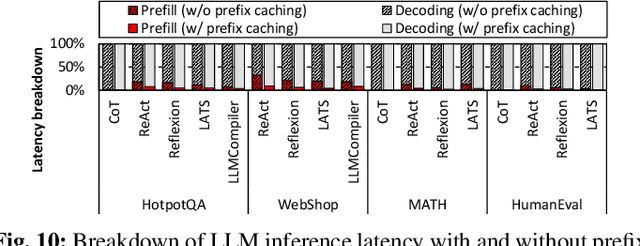
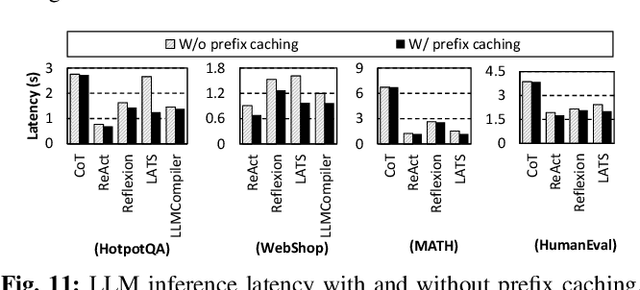
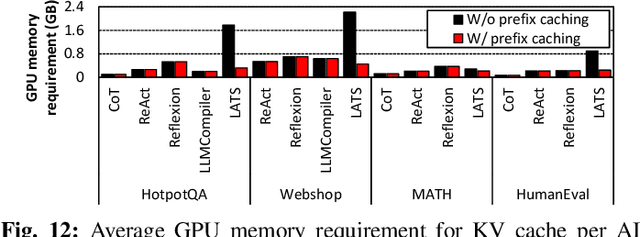
Large-language-model (LLM)-based AI agents have recently showcased impressive versatility by employing dynamic reasoning, an adaptive, multi-step process that coordinates with external tools. This shift from static, single-turn inference to agentic, multi-turn workflows broadens task generalization and behavioral flexibility, but it also introduces serious concerns about system-level cost, efficiency, and sustainability. This paper presents the first comprehensive system-level analysis of AI agents, quantifying their resource usage, latency behavior, energy consumption, and datacenter-wide power consumption demands across diverse agent designs and test-time scaling strategies. We further characterize how AI agent design choices, such as few-shot prompting, reflection depth, and parallel reasoning, impact accuracy-cost tradeoffs. Our findings reveal that while agents improve accuracy with increased compute, they suffer from rapidly diminishing returns, widening latency variance, and unsustainable infrastructure costs. Through detailed evaluation of representative agents, we highlight the profound computational demands introduced by AI agent workflows, uncovering a looming sustainability crisis. These results call for a paradigm shift in agent design toward compute-efficient reasoning, balancing performance with deployability under real-world constraints.