 Add to Chrome
 Add to Firefox
 Add to Edge
DepthART: Scaling Foundation Monocular Depth to Tiny Models
Jul 19, 2026
Recent geometric foundation models (e.g., Metric3D, Depth Anything and UniDepth) have substantially improved monocular depth estimation (MDE) in both cross-scene generalization and metric-scale prediction, yet these gains have not translated to tiny models. We bridge this gap with DepthART (Depth Anything Rethought for Tiny Models), which is a compact MDE model for on-device deployment across diverse scenes. We first identify two capacity-driven bottlenecks in tiny models: (i) overfitting to dataset-specific distribution bias and (ii) unstable metric adaptation under camera shift, where full fine-tuning easily damages transferable geometry. Accordingly, DepthART combines two simple but effective strategies: a bias-resistant data sampling scheme to reduce distribution bias under the same training budget, and a camera-conditioned fine-tuning protocol that freezes the distilled encoder and adjusts metric scale conditioned on intrinsics while better preserving cross-dataset generalization. Across datasets, DepthART consistently surpasses previous tiny baselines in both zero-shot generalization and metric accuracy (e.g., zero-shot $δ_1$=0.964 for DepthART-S on NYUD v2), and in some cases approaches heavy models. We further provide a scalable model family, with DepthART-S reaching 347/245 FPS (strict FP32) on an RTX A6000 at $224^2/448^2$, 102 FPS (TF32) on a Orin NX 8GB, and over 15 FPS (FP32) on a Jetson Nano 4GB.

NTIRE 2025 Challenge on HR Depth from Images of Specular and Transparent Surfaces
Jun 06, 2025This paper reports on the NTIRE 2025 challenge on HR Depth From images of Specular and Transparent surfaces, held in conjunction with the New Trends in Image Restoration and Enhancement (NTIRE) workshop at CVPR 2025. This challenge aims to advance the research on depth estimation, specifically to address two of the main open issues in the field: high-resolution and non-Lambertian surfaces. The challenge proposes two tracks on stereo and single-image depth estimation, attracting about 177 registered participants. In the final testing stage, 4 and 4 participating teams submitted their models and fact sheets for the two tracks.
The Fourth Monocular Depth Estimation Challenge
Apr 24, 2025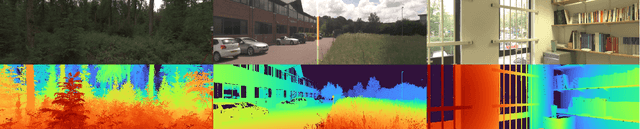
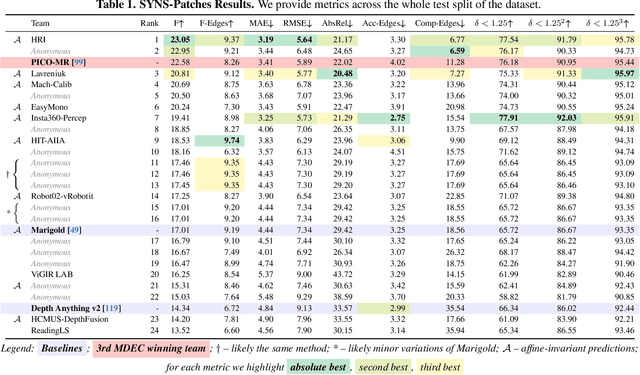
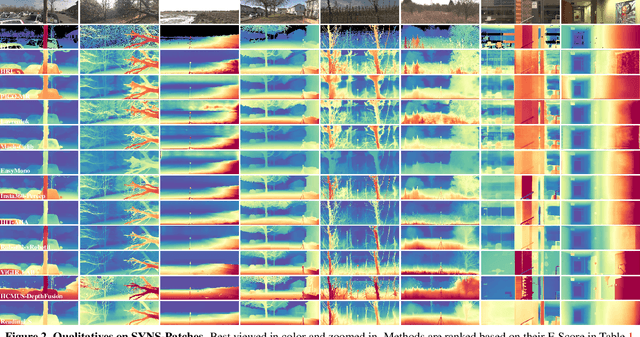
This paper presents the results of the fourth edition of the Monocular Depth Estimation Challenge (MDEC), which focuses on zero-shot generalization to the SYNS-Patches benchmark, a dataset featuring challenging environments in both natural and indoor settings. In this edition, we revised the evaluation protocol to use least-squares alignment with two degrees of freedom to support disparity and affine-invariant predictions. We also revised the baselines and included popular off-the-shelf methods: Depth Anything v2 and Marigold. The challenge received a total of 24 submissions that outperformed the baselines on the test set; 10 of these included a report describing their approach, with most leading methods relying on affine-invariant predictions. The challenge winners improved the 3D F-Score over the previous edition's best result, raising it from 22.58% to 23.05%.