 Add to Chrome
 Add to Firefox
 Add to Edge
Large Language Model assisted End-to-End Network Health Management based on Multi-Scale Semanticization
Jun 12, 2024
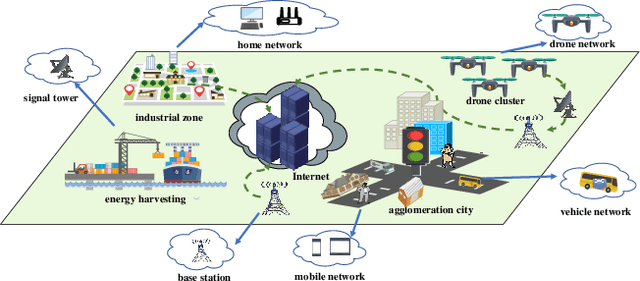


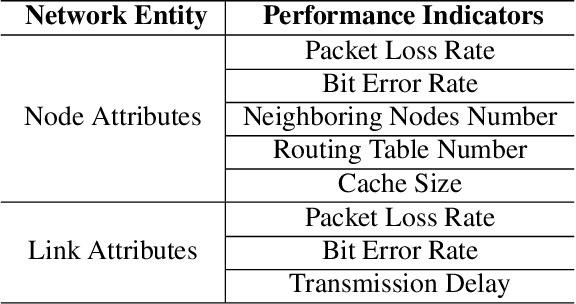
Network device and system health management is the foundation of modern network operations and maintenance. Traditional health management methods, relying on expert identification or simple rule-based algorithms, struggle to cope with the dynamic heterogeneous networks (DHNs) environment. Moreover, current state-of-the-art distributed anomaly detection methods, which utilize specific machine learning techniques, lack multi-scale adaptivity for heterogeneous device information, resulting in unsatisfactory diagnostic accuracy for DHNs. In this paper, we develop an LLM-assisted end-to-end intelligent network health management framework. The framework first proposes a Multi-Scale Semanticized Anomaly Detection Model (MSADM), incorporating semantic rule trees with an attention mechanism to address the multi-scale anomaly detection problem in DHNs. Secondly, a chain-of-thought-based large language model is embedded in downstream to adaptively analyze the fault detection results and produce an analysis report with detailed fault information and optimization strategies. Experimental results show that the accuracy of our proposed MSADM for heterogeneous network entity anomaly detection is as high as 91.31\%.

Enhancing User Interest based on Stream Clustering and Memory Networks in Large-Scale Recommender Systems
May 21, 2024


Recommender Systems (RSs) provide personalized recommendation service based on user interest, which are widely used in various platforms. However, there are lots of users with sparse interest due to lacking consumption behaviors, which leads to poor recommendation results for them. This problem is widespread in large-scale RSs and is particularly difficult to address. To solve this problem, we propose a novel solution named User Interest Enhancement (UIE) which enhances user interest including user profile and user history behavior sequences using the enhancement vectors and personalized enhancement vector generated based on stream clustering and memory networks from different perspectives. UIE not only remarkably improves model performance on the users with sparse interest but also significantly enhance model performance on other users. UIE is an end-to-end solution which is easy to be implemented based on ranking model. Moreover, we expand our solution and apply similar methods to long-tail items, which also achieves excellent improvement. Furthermore, we conduct extensive offline and online experiments in a large-scale industrial RS. The results demonstrate that our model outperforms other models remarkably, especially for the users with sparse interest. Until now, UIE has been fully deployed in multiple large-scale RSs and achieved remarkable improvements.
An Off-Policy Reinforcement Learning Algorithm Customized for Multi-Task Fusion in Large-Scale Recommender Systems
Apr 19, 2024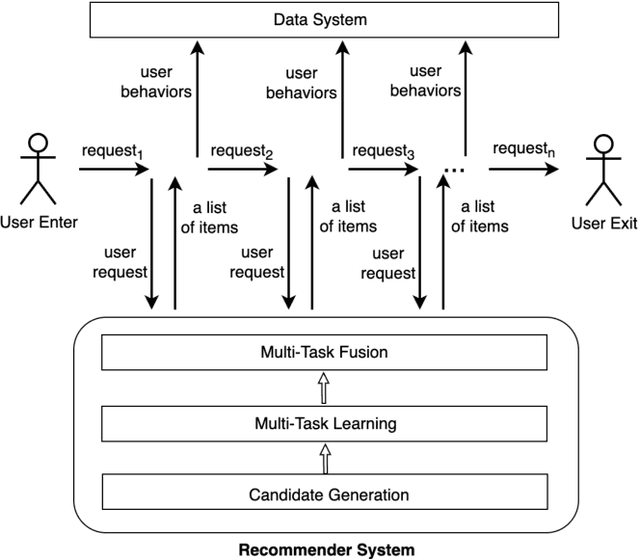
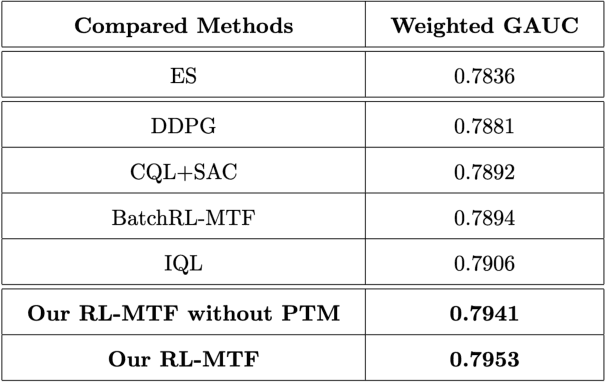


Recommender Systems (RSs) are widely used to provide personalized recommendation service. As the last critical stage of RSs, Multi-Task Fusion (MTF) is responsible for combining multiple scores outputted by Multi-Task Learning (MTL) into a final score to maximize user satisfaction, which determines the ultimate recommendation results. Recently, to optimize long-term user satisfaction within a recommendation session, Reinforcement Learning (RL) is used for MTF in the industry. However, the off-policy RL algorithms used for MTF so far have the following severe problems: 1) to avoid out-of-distribution (OOD) problem, their constraints are overly strict, which seriously damage their performance; 2) they are unaware of the exploration policy used for producing training data and never interact with real environment, so only suboptimal policy can be learned; 3) the traditional exploration policies are inefficient and hurt user experience. To solve the above problems, we propose a novel off-policy RL algorithm customized for MTF in large-scale RSs. Our RL-MTF algorithm integrates off-policy RL model with our online exploration policy to relax overstrict and complicated constraints, which significantly improves the performance of our RL model. We also design an extremely efficient exploration policy, which eliminates low-value exploration space and focuses on exploring potential high-value state-action pairs. Moreover, we adopt progressive training mode to further enhance our RL model's performance with the help of our exploration policy. We conduct extensive offline and online experiments in the short video channel of Tencent News. The results demonstrate that our RL-MTF model outperforms other models remarkably. Our RL-MTF model has been fully deployed in the short video channel of Tencent News for about one year. In addition, our solution has been used in other large-scale RSs in Tencent.
Self-Supervised Quantization-Aware Knowledge Distillation
Mar 17, 2024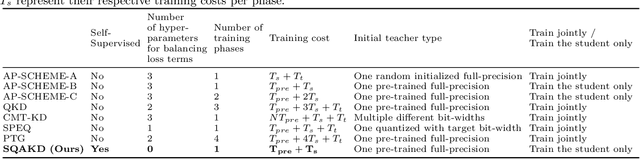
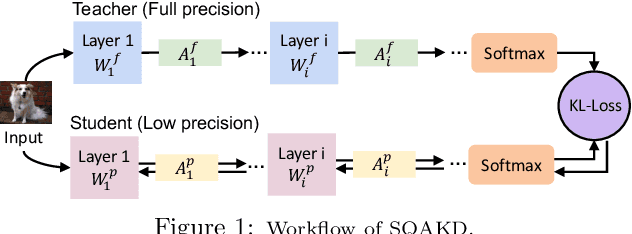
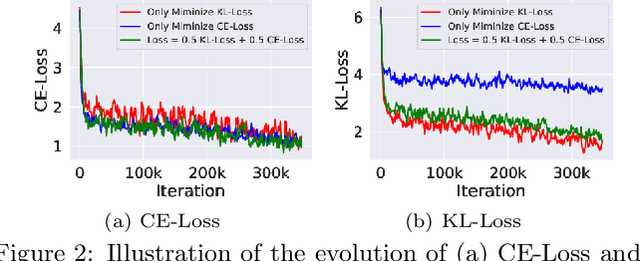
Quantization-aware training (QAT) and Knowledge Distillation (KD) are combined to achieve competitive performance in creating low-bit deep learning models. However, existing works applying KD to QAT require tedious hyper-parameter tuning to balance the weights of different loss terms, assume the availability of labeled training data, and require complex, computationally intensive training procedures for good performance. To address these limitations, this paper proposes a novel Self-Supervised Quantization-Aware Knowledge Distillation (SQAKD) framework. SQAKD first unifies the forward and backward dynamics of various quantization functions, making it flexible for incorporating various QAT works. Then it formulates QAT as a co-optimization problem that simultaneously minimizes the KL-Loss between the full-precision and low-bit models for KD and the discretization error for quantization, without supervision from labels. A comprehensive evaluation shows that SQAKD substantially outperforms the state-of-the-art QAT and KD works for a variety of model architectures. Our code is at: https://github.com/kaiqi123/SQAKD.git.
LiDAR-based Outdoor Crowd Management for Smart Campus on the Edge
Nov 29, 2023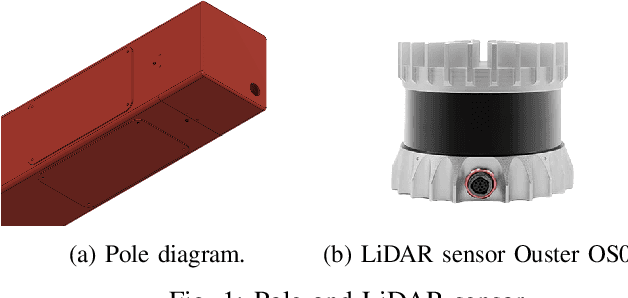
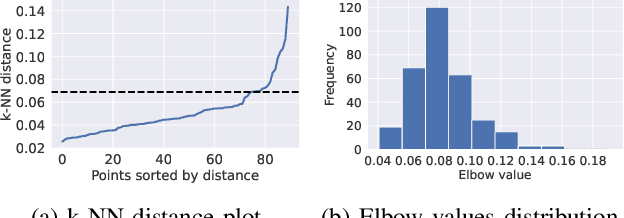
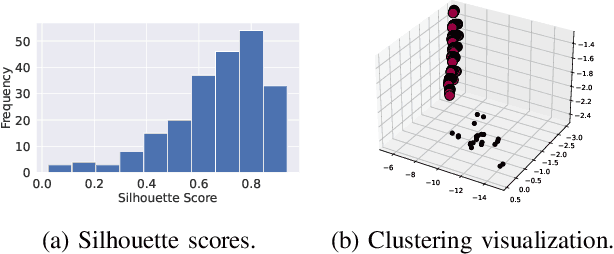
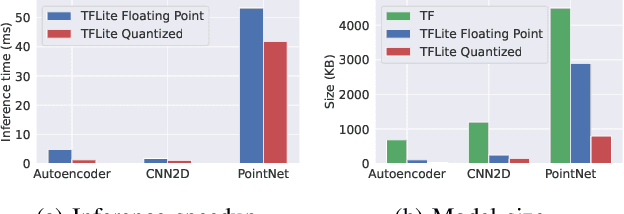
Crowd management is crucial for a smart campus. Popular methods are camera-based. However, conventional camera-based approaches may leak users' personally identifiable features, jeopardizing user's privacy, which limits its application. In this work, we investigate using affordable light detection and ranging (LiDAR) technology to perform outdoor crowd management leveraging edge computing. Specifically, we aim to count the number of people on a walkway of a university campus. Besides privacy protection, LiDAR sensors are superior to cameras since their performance will not be compromised when the campus is not well-illuminated. We deploy LiDAR sensors on light poles to collect data from the crowd on the campus and leverage edge accelerators to process data locally. We proposed two different methodologies in this work: 1) a non-convolutional neural network (CNN)-based approach, using clustering and autoencoder, and 2) a CNN-based approach that first projects point clouds to 2D planes and then processes the projection with conventional CNNs. Our first approach relies on careful feature engineering, whereas our second approach does not require such effort. However, the CNN-based approach requires more computational power than our non-CNN-based approach. We evaluate both approaches comprehensively with our hand-labeled real-life data collected from campus. Our evaluation results show that the first method achieves an accuracy of 85.4%, whereas the second method achieves 95.8%. Our CNN-based method outperforms existing solutions significantly. We also deploy our two models on an edge accelerator, TPU, to measure the speedup, leveraging this specialized accelerator.
Learn to Augment Network Simulators Towards Digital Network Twins
Nov 21, 2023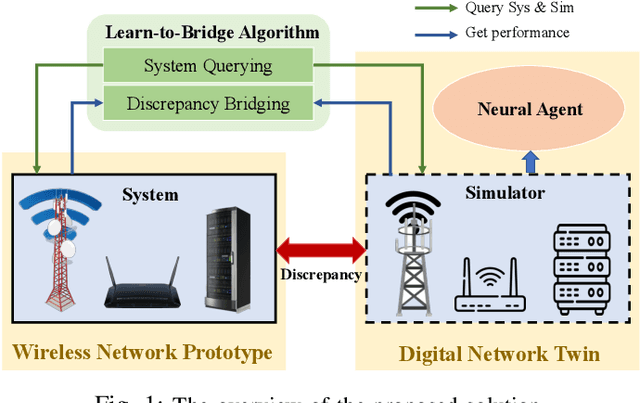
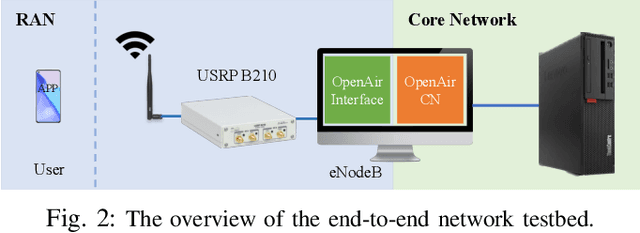
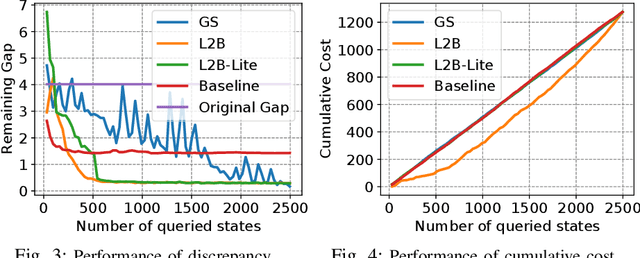
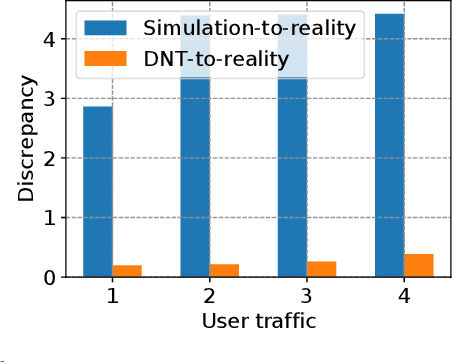
Digital network twin (DNT) is a promising paradigm to replicate real-world cellular networks toward continual assessment, proactive management, and what-if analysis. Existing discussions have been focusing on using only deep learning techniques to build DNTs, which raises widespread concerns regarding their generalization, explainability, and transparency. In this paper, we explore an alternative approach to augment network simulators with context-aware neural agents. The main challenge lies in the non-trivial simulation-to-reality (sim-to-real) discrepancy between offline simulators and real-world networks. To solve the challenge, we propose a new learn-to-bridge algorithm to cost-efficiently bridge the sim-to-real discrepancy in two alternative stages. In the first stage, we select states to query performances in real-world networks by using newly-designed cost-aware Bayesian optimization. In the second stage, we train the neural agent to learn the state context and bridge the probabilistic discrepancy based on Bayesian neural networks (BNN). In addition, we build a small-scale end-to-end network testbed based on OpenAirInterface RAN and Core with USRP B210 and a smartphone, and replicate the network in NS-3. The evaluation results show that, our proposed solution substantially outperforms existing methods, with more than 92\% reduction in the sim-to-real discrepancy.
Poster: Self-Supervised Quantization-Aware Knowledge Distillation
Sep 22, 2023Quantization-aware training (QAT) starts with a pre-trained full-precision model and performs quantization during retraining. However, existing QAT works require supervision from the labels and they suffer from accuracy loss due to reduced precision. To address these limitations, this paper proposes a novel Self-Supervised Quantization-Aware Knowledge Distillation framework (SQAKD). SQAKD first unifies the forward and backward dynamics of various quantization functions and then reframes QAT as a co-optimization problem that simultaneously minimizes the KL-Loss and the discretization error, in a self-supervised manner. The evaluation shows that SQAKD significantly improves the performance of various state-of-the-art QAT works. SQAKD establishes stronger baselines and does not require extensive labeled training data, potentially making state-of-the-art QAT research more accessible.
Bias of AI-Generated Content: An Examination of News Produced by Large Language Models
Sep 19, 2023Large language models (LLMs) have the potential to transform our lives and work through the content they generate, known as AI-Generated Content (AIGC). To harness this transformation, we need to understand the limitations of LLMs. Here, we investigate the bias of AIGC produced by seven representative LLMs, including ChatGPT and LLaMA. We collect news articles from The New York Times and Reuters, both known for their dedication to provide unbiased news. We then apply each examined LLM to generate news content with headlines of these news articles as prompts, and evaluate the gender and racial biases of the AIGC produced by the LLM by comparing the AIGC and the original news articles. We further analyze the gender bias of each LLM under biased prompts by adding gender-biased messages to prompts constructed from these news headlines. Our study reveals that the AIGC produced by each examined LLM demonstrates substantial gender and racial biases. Moreover, the AIGC generated by each LLM exhibits notable discrimination against females and individuals of the Black race. Among the LLMs, the AIGC generated by ChatGPT demonstrates the lowest level of bias, and ChatGPT is the sole model capable of declining content generation when provided with biased prompts.
UniSA: Unified Generative Framework for Sentiment Analysis
Sep 04, 2023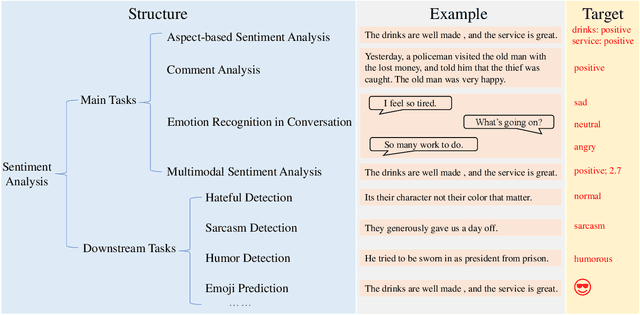
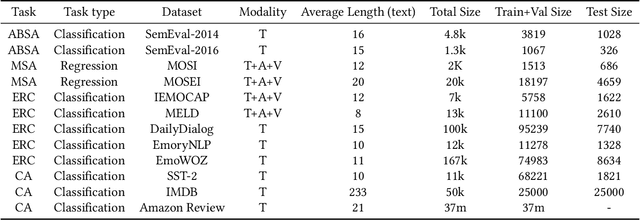


Sentiment analysis is a crucial task that aims to understand people's emotional states and predict emotional categories based on multimodal information. It consists of several subtasks, such as emotion recognition in conversation (ERC), aspect-based sentiment analysis (ABSA), and multimodal sentiment analysis (MSA). However, unifying all subtasks in sentiment analysis presents numerous challenges, including modality alignment, unified input/output forms, and dataset bias. To address these challenges, we propose a Task-Specific Prompt method to jointly model subtasks and introduce a multimodal generative framework called UniSA. Additionally, we organize the benchmark datasets of main subtasks into a new Sentiment Analysis Evaluation benchmark, SAEval. We design novel pre-training tasks and training methods to enable the model to learn generic sentiment knowledge among subtasks to improve the model's multimodal sentiment perception ability. Our experimental results show that UniSA performs comparably to the state-of-the-art on all subtasks and generalizes well to various subtasks in sentiment analysis.
Confidence-based federated distillation for vision-based lane-centering
Jun 05, 2023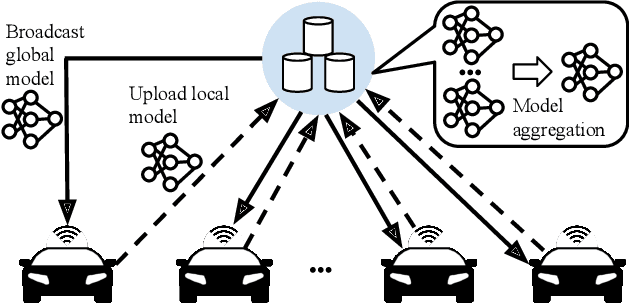
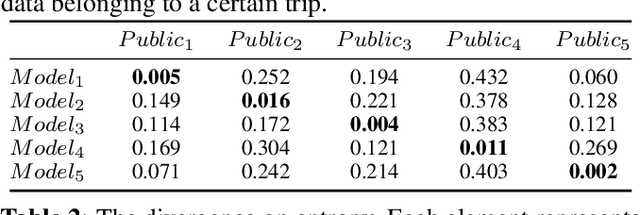
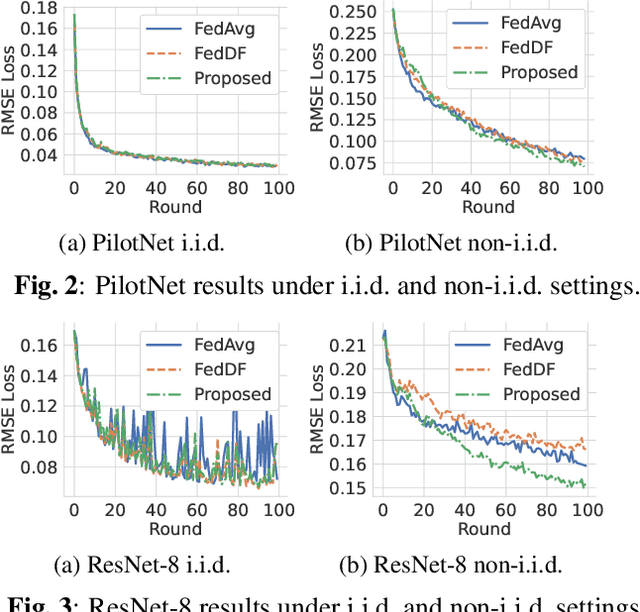
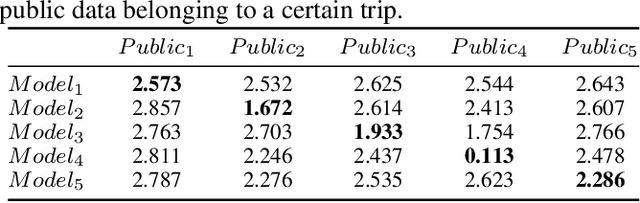
A fundamental challenge of autonomous driving is maintaining the vehicle in the center of the lane by adjusting the steering angle. Recent advances leverage deep neural networks to predict steering decisions directly from images captured by the car cameras. Machine learning-based steering angle prediction needs to consider the vehicle's limitation in uploading large amounts of potentially private data for model training. Federated learning can address these constraints by enabling multiple vehicles to collaboratively train a global model without sharing their private data, but it is difficult to achieve good accuracy as the data distribution is often non-i.i.d. across the vehicles. This paper presents a new confidence-based federated distillation method to improve the performance of federated learning for steering angle prediction. Specifically, it proposes the novel use of entropy to determine the predictive confidence of each local model, and then selects the most confident local model as the teacher to guide the learning of the global model. A comprehensive evaluation of vision-based lane centering shows that the proposed approach can outperform FedAvg and FedDF by 11.3% and 9%, respectively.