 Add to Chrome
 Add to Firefox
 Add to Edge
Hybrid-Field Joint Channel and Visible Region Estimation for RIS-Assisted Communications
Feb 06, 2026
In reconfigurable intelligent surface (RIS)-assisted millimeter-wave (mmWave) communication systems, the large-scale RIS introduces pronounced geometric effects that lead to the coexistence of far-field and near-field propagation. Furthermore, random blockages induce spatial non-stationarity across the RIS array, causing signals from different scatterers to illuminate only partial regions, referred to as visible regions (VRs). This renders conventional far-field and fully visible array-based channel models inadequate and makes channel estimation particularly challenging. In this paper, we investigate the non-stationary cascaded channel estimation problem in a hybrid-field propagation environment, where the RIS-base station (BS) link operates in the far-field, while the user-RIS link exhibits near-field characteristics with partial visibility. To address the resulting high-dimensional and coupled estimation problem, a reduced-dimensional sparse bilinear representation is developed by exploiting the structural characteristics of the cascaded channel. In particular, a dictionary compression technique is proposed to represent the high-dimensional coupled dictionary using a low-dimensional polar-domain dictionary weighted by a visibility matrix, thereby significantly reducing the problem scale. Based on this representation, a turbo-structured joint Bayesian estimation (TS-JBE) approach is proposed to simultaneously estimate the channel gains, VRs, and off-grid parameters, thereby avoiding error propagation inherent in existing sequential methods. Simulation results demonstrate that the proposed method significantly improves the estimation accuracy compared with existing approaches.

A Covariance-Surrogate Framework for Movable-Antenna Enabled Anti-Jamming with Unknown Jammers
Dec 23, 2025In this paper, we investigate a movable antenna (MA) enabled anti-jamming optimization problem, where a legitimate uplink system is exposed to multiple jammers with unknown jamming channels. To enhance the anti-jamming capability of the considered system, an MA array is deployed at the receiver, and the antenna positions and the minimum-variance distortionless-response (MVDR) receive beamformer are jointly optimized to maximize the output signal-to-interference-plus-noise ratio (SINR). The main challenge arises from the fact that the interference covariance matrix is unknown and nonlinearly dependent on the antenna positions. To overcome these issues, we propose a surrogate objective by replacing the unknown covariance with the sample covariance evaluated at the current antenna position anchor. Under a two-timescale framework, the surrogate objective is updated once per block (contains multiple snapshots) at the current anchor position, while the MVDR beamformer is adapted on a per-snapshot basis. We establish a local bound on the discrepancy between the surrogate and the true objective by leveraging matrix concentration inequalities, and further prove that a natural historical-averaging surrogate suffers from a non-vanishing geometric bias. Building on these insights, we develop a low-complexity projected trust-region (TR) surrogate optimization (PTRSO) algorithm that maintains the locality of each iteration via TR constraints and enforces feasibility through projection, which is guaranteed to converge to a stationary point near the anchor. Numerical results verify the effectiveness and robustness of the proposed PTRSO algorithm, which consistently achieves higher output SINR than existing baselines.
Robust Beamforming for Multiuser MIMO Systems with Unknown Channel Statistics: A Hybrid Offline-Online Framework
Dec 16, 2025Robust beamforming design under imperfect channel state information (CSI) is a fundamental challenge in multiuser multiple-input multiple-output (MU-MIMO) systems, particularly when the channel estimation error statistics are unknown. Conventional model-driven methods usually rely on prior knowledge of the error covariance matrix and data-driven deep learning approaches suffer from poor generalization capability to unseen channel conditions. To address these limitations, this paper proposes a hybrid offline-online framework that achieves effective offline learning and rapid online adaptation. In the offline phase, we propose a shared (among users) deep neural network (DNN) that is able to learn the channel estimation error covariance from observed samples, thus enabling robust beamforming without statistical priors. Meanwhile, to facilitate real-time deployment, we propose a sparse augmented low-rank (SALR) method to reduce complexity while maintaining comparable performance. In the online phase, we show that the proposed network can be rapidly fine-tuned with minimal gradient steps. Furthermore, a multiple basis model-agnostic meta-learning (MB-MAML) strategy is further proposed to maintain multiple meta-initializations and by dynamically selecting the best one online, we can improve the adaptation and generalization capability of the proposed framework under unseen or non-stationary channels. Simulation results demonstrate that the proposed offline-online framework exhibits strong robustness across diverse channel conditions and it is able to significantly outperform state-of-the-art (SOTA) baselines.
Cross-Sparsity-Enabled Multipath Perception via Structured Bayesian Inference for Multi-Target Estimation
Nov 18, 2025In this paper, we investigate a multi-target sensing system in multipath environment, where inter-target scattering gives rise to first-order reflected paths whose angles of departure (AoDs) and angles of arrival (AoAs) coincide with the direct-path angles of different targets. Unlike other multipath components, these first-order paths carry structural information that can be exploited as additional prior knowledge for target direction estimation. To exploit this property, we construct a sparse representation of the multi-target sensing channel and propose a novel cross sparsity structure under a three-layer hierarchical structured (3LHS) prior model, which leverages the first-order paths to enhance the prior probability of the direct paths and thereby improve the estimation accuracy. Building on this model, we propose a structured fast turbo variational Bayesian inference (SF-TVBI) algorithm, which integrates an efficient message-passing strategy to enable tractable probabilistic exchange within the cross sparsity, and a two-timescale update scheme to reduce the update frequency of the high-dimensional sparse vector. Simulation results demonstrate that leveraging the proposed cross sparsity structure is able to improve the target angle estimation accuracy substantially, and the SF-TVBI algorithm achieves estimation performance comparable to that of the Turbo-VBI, but with lower computational complexity.
Sensing-Then-Beamforming: Robust Transmission Design for RIS-Empowered Integrated Sensing and Covert Communication
Apr 18, 2025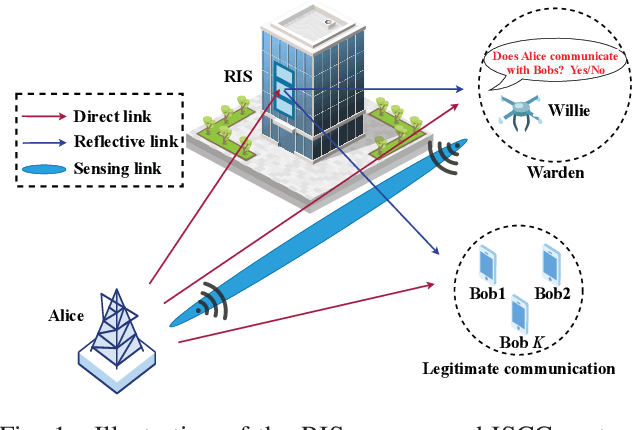
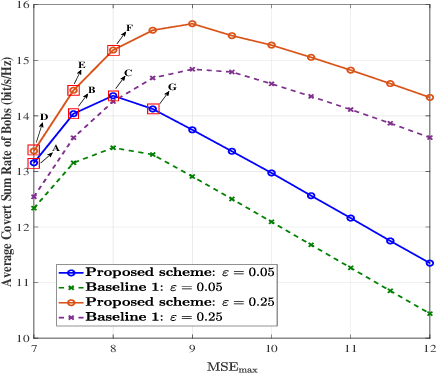
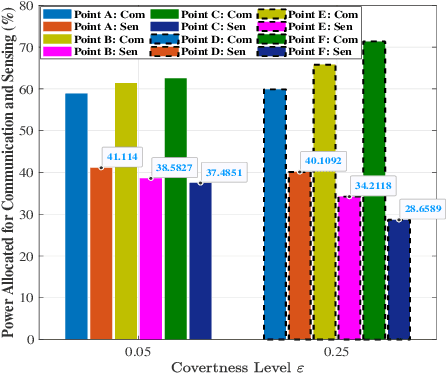
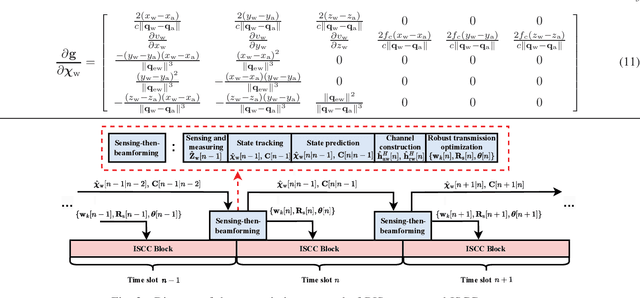
Traditional covert communication often relies on the knowledge of the warden's channel state information, which is inherently challenging to obtain due to the non-cooperative nature and potential mobility of the warden. The integration of sensing and communication technology provides a promising solution by enabling the legitimate transmitter to sense and track the warden, thereby enhancing transmission covertness. In this paper, we develop a framework for sensing-then-beamforming in reconfigurable intelligent surface (RIS)-empowered integrated sensing and covert communication (ISCC) systems, where the transmitter (Alice) estimates and tracks the mobile aerial warden's channel using sensing echo signals while simultaneously sending covert information to multiple legitimate users (Bobs) with the assistance of RIS, under the surveillance of the warden (Willie). Considering channel estimation errors, we formulate a robust non-convex optimization problem that jointly designs the communication beamformers, the sensing signal covariance matrix at Alice, and the phase shifts at the RIS to maximize the covert sum rate of Bobs while satisfying the constraints related to covert communication, sensing, transmitter power, and the unit modulus of the RIS elements. To solve this complex problem, we develop an efficient algorithm using alternating optimization, successive convex approximation, S-procedure, sequential rank-one constraint relaxation, and semidefinite relaxation techniques. Numerical results confirm the convergence of the proposed algorithm and demonstrate its effectiveness in tracking the warden's channel while ensuring robust covert transmission. Furthermore, the results highlight the advantages of using RIS to enhance the covert transmission rate compared to baseline schemes, and also illustrate the intricate trade-off between communication and sensing in ISCC systems.
Movable Antenna Enhanced Downlink Multi-User Integrated Sensing and Communication System
Mar 28, 2025


This work investigates the potential of exploiting movable antennas (MAs) to enhance the performance of a multi-user downlink integrated sensing and communication (ISAC) system. Specifically, we formulate an optimization problem to maximize the transmit beampattern gain for sensing while simultaneously meeting each user's communication requirement by jointly optimizing antenna positions and beamforming design. The problem formulated is highly non-convex and involves multivariate-coupled constraints. To address these challenges, we introduce a series of auxiliary random variables and transform the original problem into an augmented Lagrangian problem. A double-loop algorithm based on a penalty dual decomposition framework is then developed to solve the problem. Numerical results validate the effectiveness of the proposed design, demonstrating its superiority over MA designs based on successive convex approximation optimization and other baseline approaches in ISAC systems. The results also highlight the advantages of MAs in achieving better sensing performance and improved beam control, especially for sparse arrays with large apertures.
Ambiguity Function Analysis and Optimization of Frequency-Hopping MIMO Radar with Movable Antennas
Mar 06, 2025In this paper, we propose a movable antenna (MA)-enabled frequency-hopping (FH) multiple-input multiple-output (MIMO) radar system and investigate its sensing resolution. Specifically, we derive the expression of the ambiguity function and analyze the relationship between its main lobe width and the transmit antenna positions. In particular, the optimal antenna distribution to achieve the minimum main lobe width in the angular domain is characterized. We discover that this minimum width is related to the antenna size, the antenna number, and the target angle. Meanwhile, we present lower bounds of the ambiguity function in the Doppler and delay domains, and show that the impact of the antenna size on the radar performance in these two domains is very different from that in the angular domain. Moreover, the performance enhancement brought by MAs exhibits a certain trade-off between the main lobe width and the side lobe peak levels. Therefore, we propose to balance between minimizing the side lobe levels and narrowing the main lobe of the ambiguity function by optimizing the antenna positions. To achieve this goal, we propose a low-complexity algorithm based on the Rosen's gradient projection method, and show that its performance is very close to the baseline. Simulation results are presented to validate the theoretical analysis on the properties of the ambiguity function, and demonstrate that MAs can reduce the main lobe width and suppress the side lobe levels of the ambiguity function, thereby enhancing radar performance.
Antenna Position and Beamforming Optimization for Movable Antenna Enabled ISAC: Optimal Solutions and Efficient Algorithms
Feb 20, 2025In this paper, we propose an integrated sensing and communication (ISAC) system enabled by movable antennas (MAs), which can dynamically adjust antenna positions to enhance both sensing and communication performance for future wireless networks. To characterize the benefits of MA-enabled ISAC systems, we first derive the Cram\'er-Rao bound (CRB) for angle estimation error, which is then minimized for optimizing the antenna position vector (APV) and beamforming design, subject to a pre-defined signal-to-noise ratio (SNR) constraint to ensure the communication performance. In particular, for the case with receive MAs only, we provide a closed-form optimal antenna position solution, and show that employing MAs over conventional fixed-position antennas (FPAs) can achieve a sensing performance gain upper-bounded by 4.77 dB. On the other hand, for the case with transmit MAs only, we develop a boundary traversal breadth-first search (BT-BFS) algorithm to obtain the global optimal solution in the line-of-sight (LoS) channel scenario, along with a lower-complexity boundary traversal depth-first search (BT-DFS) algorithm to find a local optimal solution efficiently. While in the scenario with non-LoS (NLoS) channels, a majorization-minimization (MM) based Rosen's gradient projection (RGP) algorithm with an efficient initialization method is proposed to obtain stationary solutions for the considered problem, which can be extended to the general case with both transmit and receive MAs. Extensive numerical results are presented to verify the effectiveness of the proposed algorithms, and demonstrate the superiority of the considered MA-enabled ISAC system over conventional ISAC systems with FPAs in terms of sensing and communication performance trade-off.
CT3D++: Improving 3D Object Detection with Keypoint-induced Channel-wise Transformer
Jun 12, 2024
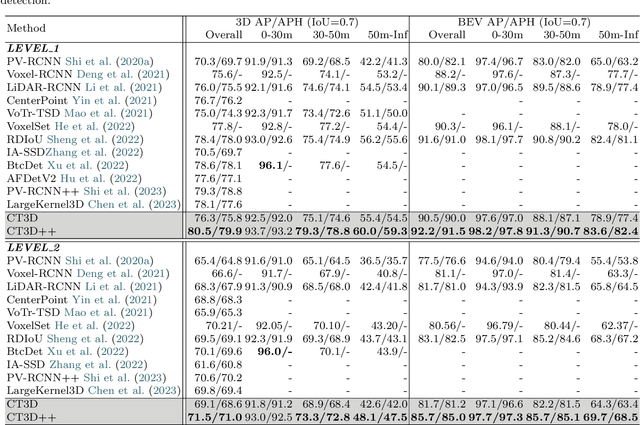

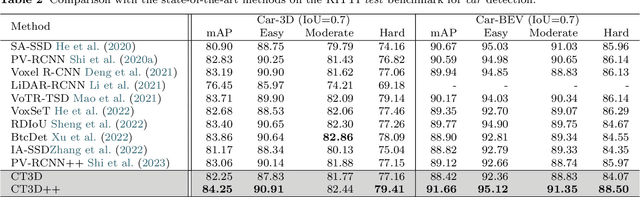
The field of 3D object detection from point clouds is rapidly advancing in computer vision, aiming to accurately and efficiently detect and localize objects in three-dimensional space. Current 3D detectors commonly fall short in terms of flexibility and scalability, with ample room for advancements in performance. In this paper, our objective is to address these limitations by introducing two frameworks for 3D object detection with minimal hand-crafted design. Firstly, we propose CT3D, which sequentially performs raw-point-based embedding, a standard Transformer encoder, and a channel-wise decoder for point features within each proposal. Secondly, we present an enhanced network called CT3D++, which incorporates geometric and semantic fusion-based embedding to extract more valuable and comprehensive proposal-aware information. Additionally, CT3D ++ utilizes a point-to-key bidirectional encoder for more efficient feature encoding with reduced computational cost. By replacing the corresponding components of CT3D with these novel modules, CT3D++ achieves state-of-the-art performance on both the KITTI dataset and the large-scale Way\-mo Open Dataset. The source code for our frameworks will be made accessible at https://github.com/hlsheng1/CT3D-plusplus.
CSI Transfer From Sub-6G to mmWave: Reduced-Overhead Multi-User Hybrid Beamforming
Mar 16, 2024Hybrid beamforming is vital in modern wireless systems, especially for massive MIMO and millimeter-wave deployments, offering efficient directional transmission with reduced hardware complexity. However, effective beamforming in multi-user scenarios relies heavily on accurate channel state information, the acquisition of which often incurs excessive pilot overhead, degrading system performance. To address this and inspired by the spatial congruence between sub-6GHz (sub-6G) and mmWave channels, we propose a Sub-6G information Aided Multi-User Hybrid Beamforming (SA-MUHBF) framework, avoiding excessive use of pilots. SA-MUHBF employs a convolutional neural network to predict mmWave beamspace from sub-6G channel estimate, followed by a novel multi-layer graph neural network for analog beam selection and a linear minimum mean-square error algorithm for digital beamforming. Numerical results demonstrate that SA-MUHBF efficiently predicts the mmWave beamspace representation and achieves superior spectrum efficiency over state-of-the-art benchmarks. Moreover, SA-MUHBF demonstrates robust performance across varied sub-6G system configurations and exhibits strong generalization to unseen scenarios.