 Add to Chrome
 Add to Firefox
 Add to Edge
Bidirectional Context Self-Distillation for Reinforcement Learning of Skill-Based LLM Agents
Aug 10, 2026
External natural-language skills provide large language model (LLM) agents with reusable and editable guidance for solving complex tasks. Yet their effectiveness depends not only on skill quality, but also on whether the policy can translate the provided guidance into appropriate actions. However, methods specifically designed to improve this skill-utilization ability remain largely underexplored. In practice, skill-based agents are commonly trained with reinforcement learning objectives centered on task-level rewards, which offer limited supervision and struggle to capture subtle differences in how effectively the policy uses the provided skills. We propose BCSD (Bidirectional Context Self-Distillation), a framework that combines self-distillation with reinforcement learning to train LLM agents to use external skills more effectively. Unlike prior self-distillation methods that rely on a single privileged context, BCSD evaluates each trajectory from two complementary skill-context views. The augmented view introduces higher-level Meta-Skill guidance, while the reduced view prunes general guidance to highlight task-specific skills. Their complementary token-level signals are combined to rescale the RL advantage. Experiments on ALFWorld and WebShop demonstrate that BCSD achieves the strongest overall performance across model scales, enabling agents to utilize external skills more effectively. Ablation studies further verify the complementary contributions of the augmented and reduced context views. Code will be released to ensure full reproducibility.

Q-TOD: A Query-driven Task-oriented Dialogue System
Oct 14, 2022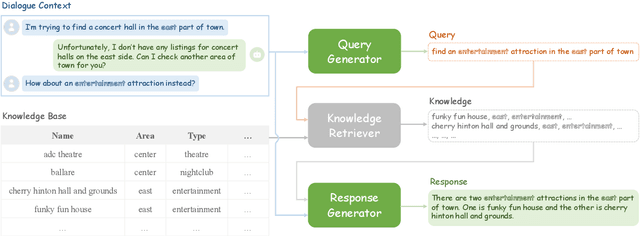
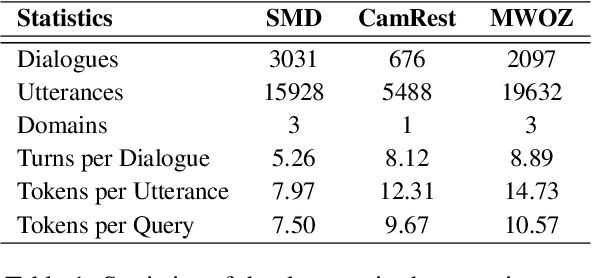
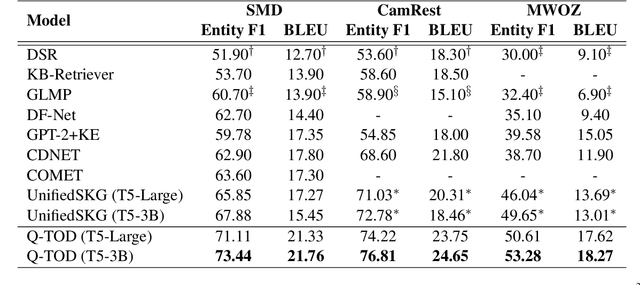
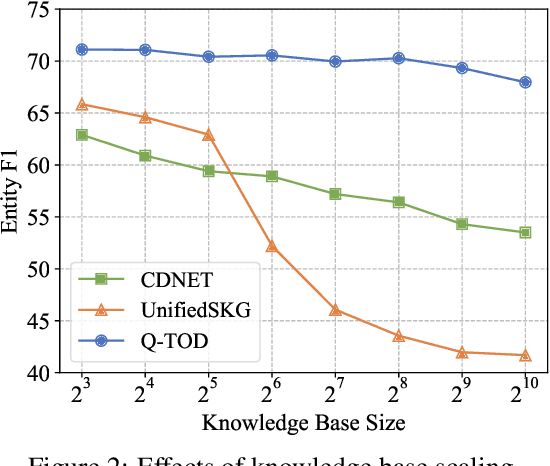
Existing pipelined task-oriented dialogue systems usually have difficulties adapting to unseen domains, whereas end-to-end systems are plagued by large-scale knowledge bases in practice. In this paper, we introduce a novel query-driven task-oriented dialogue system, namely Q-TOD. The essential information from the dialogue context is extracted into a query, which is further employed to retrieve relevant knowledge records for response generation. Firstly, as the query is in the form of natural language and not confined to the schema of the knowledge base, the issue of domain adaption is alleviated remarkably in Q-TOD. Secondly, as the query enables the decoupling of knowledge retrieval from the generation, Q-TOD gets rid of the issue of knowledge base scalability. To evaluate the effectiveness of the proposed Q-TOD, we collect query annotations for three publicly available task-oriented dialogue datasets. Comprehensive experiments verify that Q-TOD outperforms strong baselines and establishes a new state-of-the-art performance on these datasets.