 Add to Chrome
 Add to Firefox
 Add to Edge
MedBench v5: A Dynamic, Process-Oriented, and Hallucination-Aware Benchmark for Clinical Multimodal Models
Jun 25, 2026
Existing medical AI benchmarks lack process visibility, atomic skill evaluation, and integrated hallucination detection. We introduce MedBench v5, a redesigned benchmark for clinical multimodal models (language, vision-language, and agent systems) that moves from static QA to dynamic, process-oriented evaluation. MedBench v5 features: (1) a dual-dimensional framework combining Clinical Cognitive Responsiveness (14 sub-dimensions) and Medical Atomic Skills (4 agent environments), covering 63 tasks; (2) three switchable information-flow stressors (omission, contradiction, evidence delay) for factorized degradation analysis; (3) a dynamic process audit protocol with five reasoning nodes that produces model-specific failure fingerprints; (4) hallucination propagation monitoring across initiation, propagation, anchoring, and contradiction interaction-capturing silent hallucination. Experiments on frontier models show that strong overall task performance does not guarantee process stability: stressors mainly disrupt contradiction detection, diagnosis updating, hallucination propagation, and contradiction-based self-correction, while final evidence grounding can remain superficially stable. MedBench v5 provides a unified infrastructure for capability profiling, controllable stress testing, process auditing, and hallucination trajectory analysis in clinical AI evaluation.

SafeMed-R1: Clinician-Audited Safety and Ethics Alignment for Medical Large Language Models
May 27, 2026Large language models(LLMs) increasingly match expert performance on licensing examinations, yet routine clinical use remains limited because governance requires auditable reasoning, safety and ethics alignment, and resilience to adversarial misuse. Here we present SafeMed-R1, trained with a traceable Clinical Trust Signals(CTS) pipeline that links each reasoning instance to clinician rubric scores and edit histories, and aligned through safety and ethics supervision and red team stress testing. SafeMed-R1 attains a macro-averaged accuracy of 79.6% across clinical benchmarks. Under adversarial safety testing, it shows the lowest aggregated risk and reduces unsafe outputs by about 3 to 5% relative to its baseline. In a paired expert study of 30 medication safety vignettes, SafeMed-R1 matches PGY1 and PGY2 residents on medical correctness and scores higher for medication safety, guideline consistency, and clinical usefulness. Collectively, these results suggest that clinician-audited supervision provenance, together with domain-tailored safety and ethics alignment, can strengthen governance-relevant evidence without relying on inference-time retrieval or citation grounding.
Multi-Agent Intelligence for Multidisciplinary Decision-Making in Gastrointestinal Oncology
Dec 23, 2025Multimodal clinical reasoning in the field of gastrointestinal (GI) oncology necessitates the integrated interpretation of endoscopic imagery, radiological data, and biochemical markers. Despite the evident potential exhibited by Multimodal Large Language Models (MLLMs), they frequently encounter challenges such as context dilution and hallucination when confronted with intricate, heterogeneous medical histories. In order to address these limitations, a hierarchical Multi-Agent Framework is proposed, which emulates the collaborative workflow of a human Multidisciplinary Team (MDT). The system attained a composite expert evaluation score of 4.60/5.00, thereby demonstrating a substantial improvement over the monolithic baseline. It is noteworthy that the agent-based architecture yielded the most substantial enhancements in reasoning logic and medical accuracy. The findings indicate that mimetic, agent-based collaboration provides a scalable, interpretable, and clinically robust paradigm for automated decision support in oncology.
Oxygen vacancies modulated VO2 for neurons and Spiking Neural Network construction
Apr 16, 2024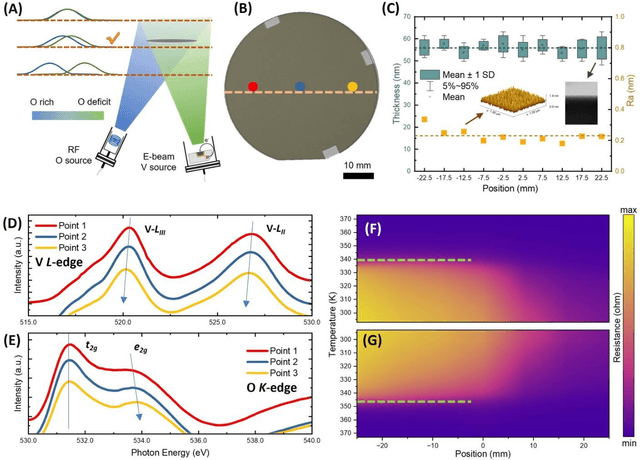
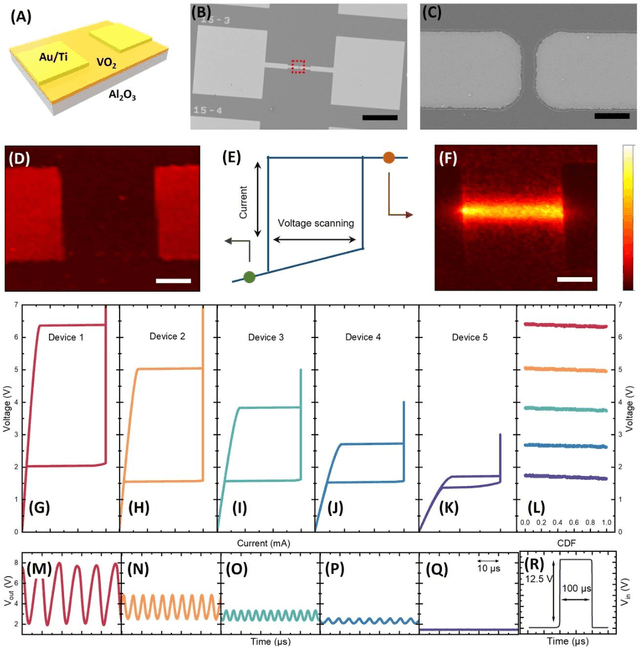
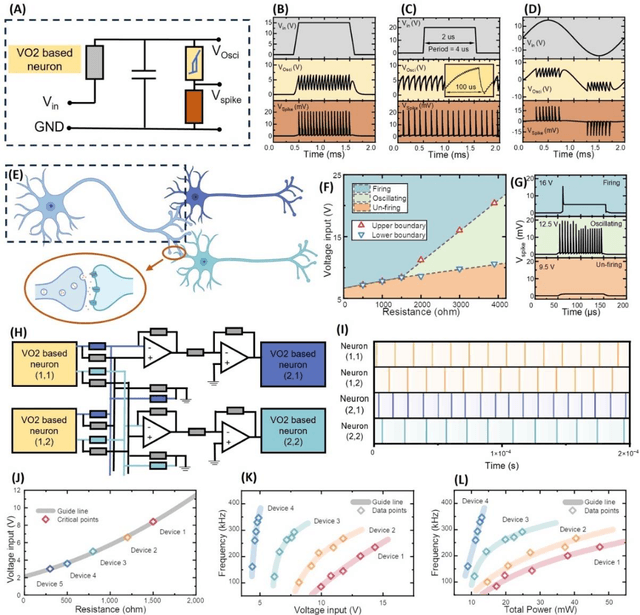
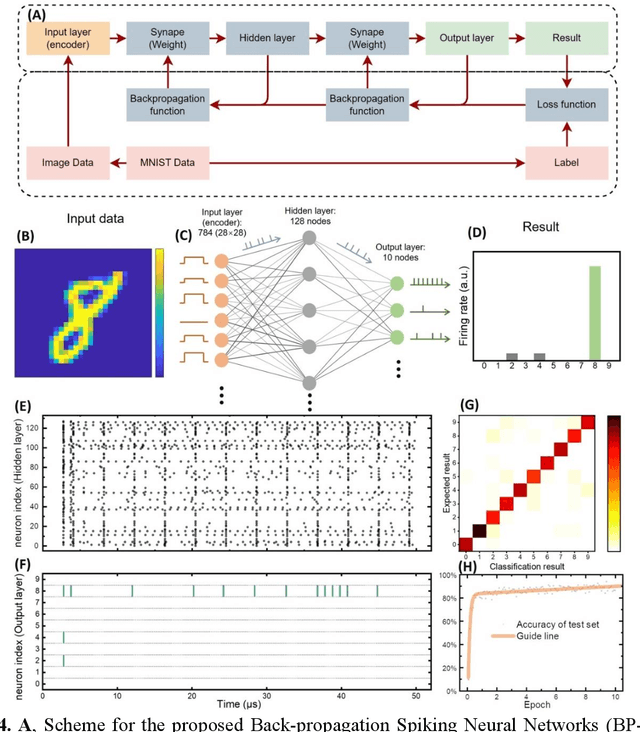
Artificial neuronal devices are the basic building blocks for neuromorphic computing systems, which have been motivated by realistic brain emulation. Aiming for these applications, various device concepts have been proposed to mimic the neuronal dynamics and functions. While till now, the artificial neuron devices with high efficiency, high stability and low power consumption are still far from practical application. Due to the special insulator-metal phase transition, Vanadium Dioxide (VO2) has been considered as an idea candidate for neuronal device fabrication. However, its intrinsic insulating state requires the VO2 neuronal device to be driven under large bias voltage, resulting in high power consumption and low frequency. Thus in the current study, we have addressed this challenge by preparing oxygen vacancies modulated VO2 film(VO2-x) and fabricating the VO2-x neuronal devices for Spiking Neural Networks (SNNs) construction. Results indicate the neuron devices can be operated under lower voltage with improved processing speed. The proposed VO2-x based back-propagation SNNs (BP-SNNs) system, trained with the MNIST dataset, demonstrates excellent accuracy in image recognition. Our study not only demonstrates the VO2-x based neurons and SNN system for practical application, but also offers an effective way to optimize the future neuromorphic computing systems by defect engineering strategy.