 Add to Chrome
 Add to Firefox
 Add to Edge
RESPClinBench: Benchmarking Multimodal Clinical Decision-Making and Longitudinal Disease Management in Respiratory Specialty Care
Aug 06, 2026
Background: Respiratory specialty care requires multimodal interpretation, longitudinal risk assessment, guideline-concordant intervention, and whole-course management, which are poorly represented by examination-oriented medical benchmarks. Objective: To develop RESPClinBench, a real-world scenario-based benchmark for respiratory clinical decision-making, and evaluate seven contemporary large language models across AECOPD-PIM and PNBIM. Methods: RESPClinBench cases were adapted from de-identified respiratory clinical data. Three attending-level respiratory physicians revised cases, reference answers, and atomic clinical-action points, while one senior respiratory specialist performed cross-review and final adjudication. AECOPD-PIM comprised 427 open-ended COPD cases, and PNBIM comprised 196 multimodal pulmonary nodule cases combining chest CT with structured clinical information. Seven models generated 4,361 responses through standardized API inference with temperature 0 and a maximum output length of 8192 tokens. An automated framework calculated the final score as the arithmetic mean of atomic-action recall and rubric-based LLM-as-a-Judge assessment. Results: Across 623 cases, the mean final score was 68.58. Qwen3.6-27B ranked first overall at 71.22, Qwen3.5-397B-A17B led PNBIM at 72.48, and Qwen3.6-27B led AECOPD-PIM at 71.11. Imaging hallucination and serious medical risk occurred in 31.85% and 8.16% of PNBIM responses; medication-safety risk and serious medical risk occurred in 26.93% and 1.44% of AECOPD-PIM responses. Conclusions: RESPClinBench identifies task-specific limitations in multimodal pulmonary nodule assessment and longitudinal COPD management. Combining explicit clinical-action coverage, holistic evaluation, and independent safety flags provides a clinically grounded basis for model selection and prospective validation.

MyoCardBench: A Real-World Data Benchmark for Evaluating Large Language Models in Clinically Authentic Cardiovascular Care Scenarios
Jul 28, 2026Background: Most medical large language model (LLM) benchmarks focus on examination knowledge or isolated tasks and may not reflect the longitudinal, multimodal, and safety-critical workflow of cardiovascular care. Objective: To develop MyoCardBench, a real-world benchmark spanning the cardiovascular care continuum, and assess LLM performance across clinical dimensions and specialist tasks. Methods: MyoCardBench includes 2,263 items from 13 task-specific datasets derived from de-identified cardiovascular records and examination data. Sixteen cardiology physicians conducted annotation and reference construction, followed by cross-review from two senior cardiologists. Seven LLMs generated 15,841 outputs under standardized zero-shot settings. Open-ended tasks were evaluated using key-point coverage and holistic clinical quality, while CardioEthics was scored by accuracy. Results: GPT-5.4 achieved the highest macro-average (62.55) and item-weighted mean (62.19), followed by Gemini 3.1 Pro (59.95) and Qwen 3.6 27B (59.72). GPT-5.4 ranked first in all three dimensions. CardioAuxReport performed best (86.38), whereas CardioECGRead (17.25) and CardioEthics (17.34) were lowest. The largest gaps between holistic clinical quality and key-point coverage occurred in CardioComm (52.71), CardioEmergRescue (52.05), and CardioTreatPlan (48.80). Conclusions: To our knowledge, MyoCardBench is the largest real-world, multi-task benchmark for LLM evaluation across the cardiovascular care continuum and offers the broadest coverage of clinically authentic cardiology scenarios reported to date. It provides a rigorous framework for identifying model strengths, clinically important omissions, and priorities for future development.
MedBench v5: A Dynamic, Process-Oriented, and Hallucination-Aware Benchmark for Clinical Multimodal Models
Jun 25, 2026Existing medical AI benchmarks lack process visibility, atomic skill evaluation, and integrated hallucination detection. We introduce MedBench v5, a redesigned benchmark for clinical multimodal models (language, vision-language, and agent systems) that moves from static QA to dynamic, process-oriented evaluation. MedBench v5 features: (1) a dual-dimensional framework combining Clinical Cognitive Responsiveness (14 sub-dimensions) and Medical Atomic Skills (4 agent environments), covering 63 tasks; (2) three switchable information-flow stressors (omission, contradiction, evidence delay) for factorized degradation analysis; (3) a dynamic process audit protocol with five reasoning nodes that produces model-specific failure fingerprints; (4) hallucination propagation monitoring across initiation, propagation, anchoring, and contradiction interaction-capturing silent hallucination. Experiments on frontier models show that strong overall task performance does not guarantee process stability: stressors mainly disrupt contradiction detection, diagnosis updating, hallucination propagation, and contradiction-based self-correction, while final evidence grounding can remain superficially stable. MedBench v5 provides a unified infrastructure for capability profiling, controllable stress testing, process auditing, and hallucination trajectory analysis in clinical AI evaluation.
Multi-Agent Intelligence for Multidisciplinary Decision-Making in Gastrointestinal Oncology
Dec 23, 2025Multimodal clinical reasoning in the field of gastrointestinal (GI) oncology necessitates the integrated interpretation of endoscopic imagery, radiological data, and biochemical markers. Despite the evident potential exhibited by Multimodal Large Language Models (MLLMs), they frequently encounter challenges such as context dilution and hallucination when confronted with intricate, heterogeneous medical histories. In order to address these limitations, a hierarchical Multi-Agent Framework is proposed, which emulates the collaborative workflow of a human Multidisciplinary Team (MDT). The system attained a composite expert evaluation score of 4.60/5.00, thereby demonstrating a substantial improvement over the monolithic baseline. It is noteworthy that the agent-based architecture yielded the most substantial enhancements in reasoning logic and medical accuracy. The findings indicate that mimetic, agent-based collaboration provides a scalable, interpretable, and clinically robust paradigm for automated decision support in oncology.
Graph Contrastive Learning with Multi-Objective for Personalized Product Retrieval in Taobao Search
Jul 10, 2023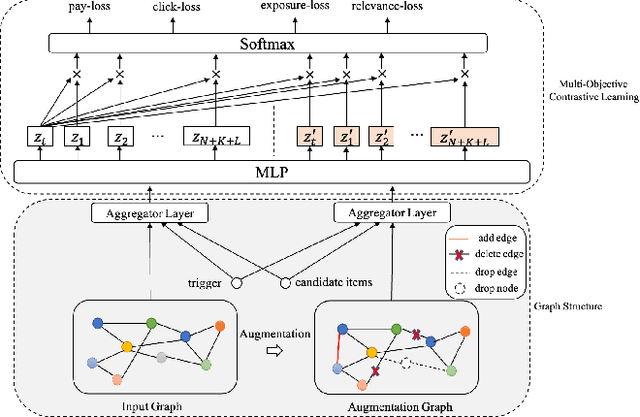
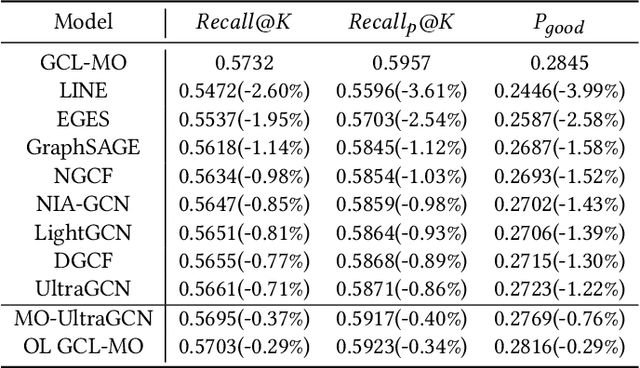
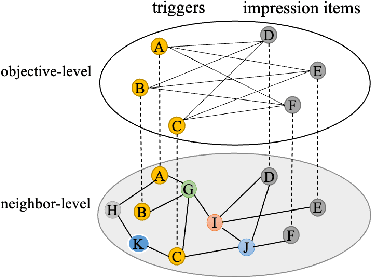
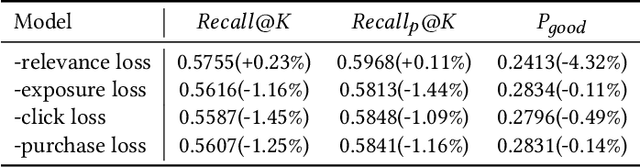
In e-commerce search, personalized retrieval is a crucial technique for improving user shopping experience. Recent works in this domain have achieved significant improvements by the representation learning paradigm, e.g., embedding-based retrieval (EBR) and collaborative filtering (CF). EBR methods do not sufficiently exploit the useful collaborative signal and are difficult to learn the representations of long-tail item well. Graph-based CF methods improve personalization by modeling collaborative signal within the user click graph. However, existing Graph-based methods ignore user's multiple behaviours, such as click/purchase and the relevance constraint between user behaviours and items.In this paper, we propose a Graph Contrastive Learning with Multi-Objective (GCL-MO) collaborative filtering model, which solves the problems of weak relevance and incomplete personalization in e-commerce search. Specifically, GCL-MO builds a homogeneous graph of items and then optimizes a multi-objective function of personalization and relevance. Moreover, we propose a modified contrastive loss for multi-objectives graph learning, which avoids the mutual suppression among positive samples and thus improves the generalization and robustness of long-tail item representations. These learned item embeddings are then used for personalized retrieval by constructing an efficient offline-to-online inverted table. GCL-MO outperforms the online collaborative filtering baseline in both offline/online experimental metrics and shows a significant improvement in the online A/B testing of Taobao search.