 Add to Chrome
 Add to Firefox
 Add to Edge
On the importance of Data Scale in Pretraining Arabic Language Models
Jan 15, 2024
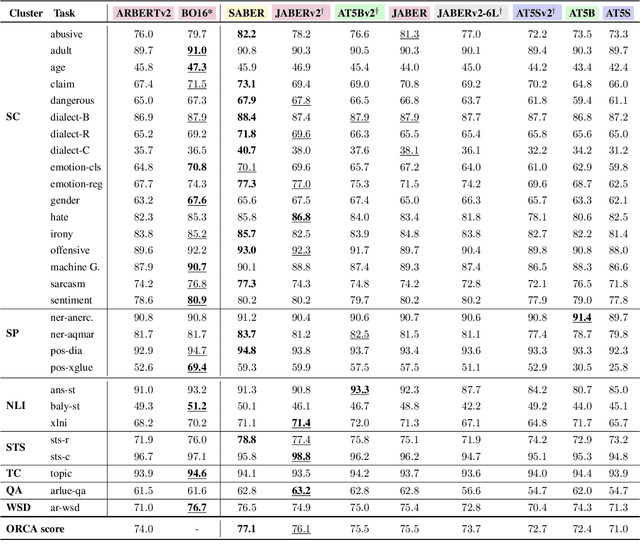

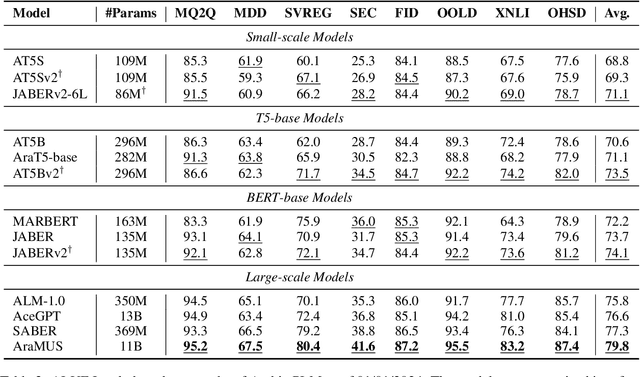

Pretraining monolingual language models have been proven to be vital for performance in Arabic Natural Language Processing (NLP) tasks. In this paper, we conduct a comprehensive study on the role of data in Arabic Pretrained Language Models (PLMs). More precisely, we reassess the performance of a suite of state-of-the-art Arabic PLMs by retraining them on massive-scale, high-quality Arabic corpora. We have significantly improved the performance of the leading Arabic encoder-only BERT-base and encoder-decoder T5-base models on the ALUE and ORCA leaderboards, thereby reporting state-of-the-art results in their respective model categories. In addition, our analysis strongly suggests that pretraining data by far is the primary contributor to performance, surpassing other factors. Our models and source code are publicly available at https://github.com/huawei-noah/Pretrained-Language-Model/tree/master/JABER-PyTorch.

NoMIRACL: Knowing When You Don't Know for Robust Multilingual Retrieval-Augmented Generation
Dec 18, 2023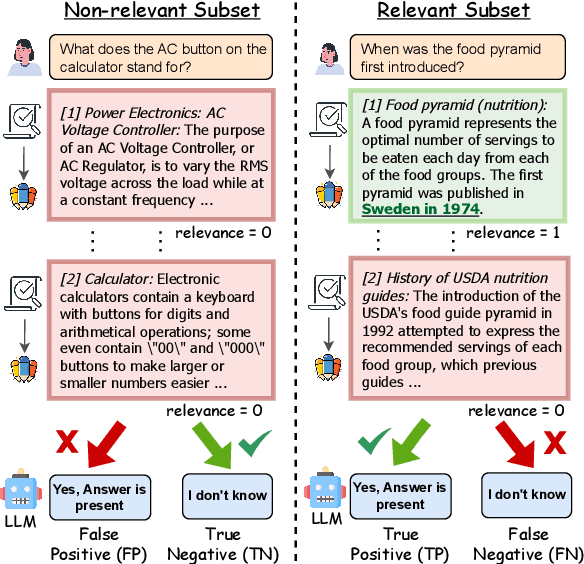

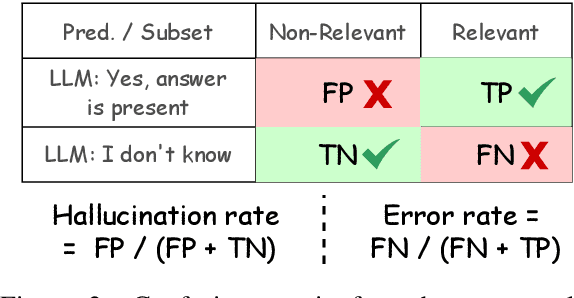
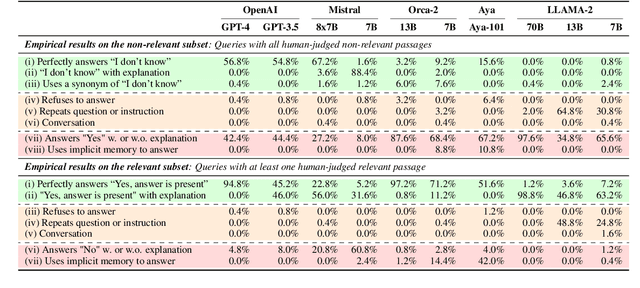
Retrieval-augmented generation (RAG) grounds large language model (LLM) output by leveraging external knowledge sources to reduce factual hallucinations. However, prior works lack a comprehensive evaluation of different language families, making it challenging to evaluate LLM robustness against errors in external retrieved knowledge. To overcome this, we establish NoMIRACL, a human-annotated dataset for evaluating LLM robustness in RAG across 18 typologically diverse languages. NoMIRACL includes both a non-relevant and a relevant subset. Queries in the non-relevant subset contain passages manually judged as non-relevant or noisy, whereas queries in the relevant subset include at least a single judged relevant passage. We measure LLM robustness using two metrics: (i) hallucination rate, measuring model tendency to hallucinate an answer, when the answer is not present in passages in the non-relevant subset, and (ii) error rate, measuring model inaccuracy to recognize relevant passages in the relevant subset. We build a GPT-4 baseline which achieves a 33.2% hallucination rate on the non-relevant and a 14.9% error rate on the relevant subset on average. Our evaluation reveals that GPT-4 hallucinates frequently in high-resource languages, such as French or English. This work highlights an important avenue for future research to improve LLM robustness to learn how to better reject non-relevant information in RAG.
On the Impact of Quantization and Pruning of Self-Supervised Speech Models for Downstream Speech Recognition Tasks "In-the-Wild''
Sep 25, 2023Recent advances with self-supervised learning have allowed speech recognition systems to achieve state-of-the-art (SOTA) word error rates (WER) while requiring only a fraction of the labeled training data needed by its predecessors. Notwithstanding, while such models achieve SOTA performance in matched train/test conditions, their performance degrades substantially when tested in unseen conditions. To overcome this problem, strategies such as data augmentation and/or domain shift training have been explored. Available models, however, are still too large to be considered for edge speech applications on resource-constrained devices, thus model compression tools are needed. In this paper, we explore the effects that train/test mismatch conditions have on speech recognition accuracy based on compressed self-supervised speech models. In particular, we report on the effects that parameter quantization and model pruning have on speech recognition accuracy based on the so-called robust wav2vec 2.0 model under noisy, reverberant, and noise-plus-reverberation conditions.
Sorted LLaMA: Unlocking the Potential of Intermediate Layers of Large Language Models for Dynamic Inference Using Sorted Fine-Tuning (SoFT)
Sep 16, 2023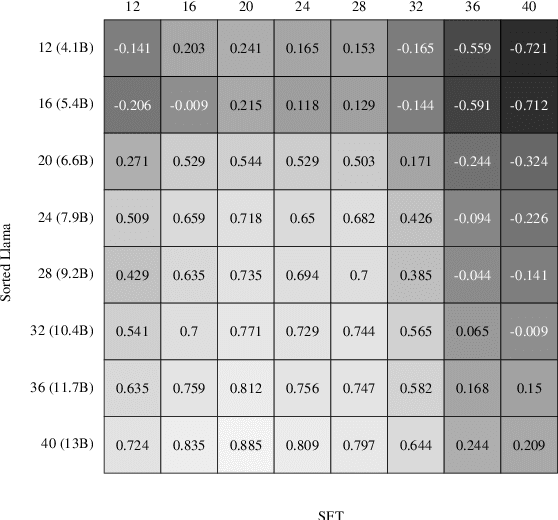
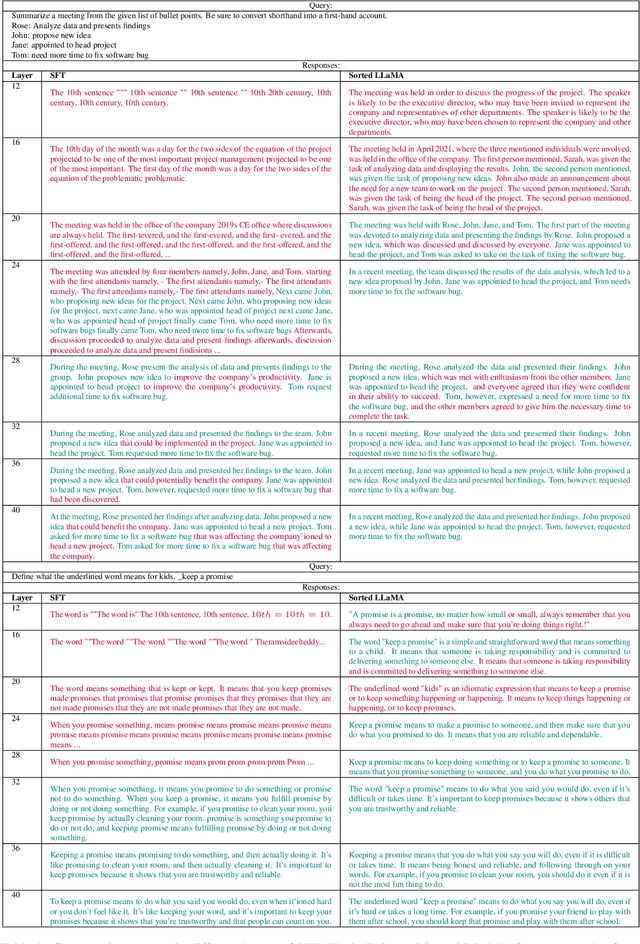
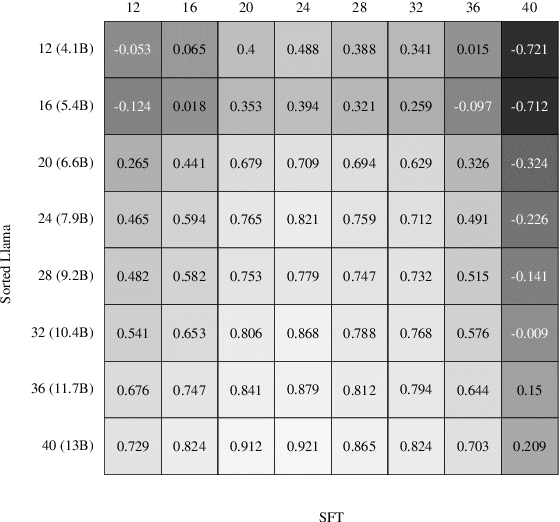

The rapid advancement of large language models (LLMs) has revolutionized natural language processing (NLP). While these models excel at understanding and generating human-like text, their widespread deployment can be prohibitively expensive. SortedNet is a recent training technique for enabling dynamic inference for deep neural networks. It leverages network modularity to create sub-models with varying computational loads, sorting them based on computation/accuracy characteristics in a nested manner. We extend SortedNet to generative NLP tasks, making large language models dynamic without any pretraining and by only replacing standard Supervised Fine-Tuning (SFT) with Sorted Fine-Tuning (SoFT) at the same costs. Our approach boosts model efficiency, eliminating the need for multiple models for various scenarios during inference. We show that using this approach, we are able to unlock the potential of intermediate layers of transformers in generating the target output. Our sub-models remain integral components of the original model, minimizing storage requirements and transition costs between different computational/latency budgets. By applying this approach on LLaMa 2 13B for tuning on the Stanford Alpaca dataset and comparing it to normal tuning and early exit via PandaLM benchmark, we show that Sorted Fine-Tuning can deliver models twice as fast as the original model while maintaining or exceeding performance.
SortedNet, a Place for Every Network and Every Network in its Place: Towards a Generalized Solution for Training Many-in-One Neural Networks
Sep 01, 2023As the size of deep learning models continues to grow, finding optimal models under memory and computation constraints becomes increasingly more important. Although usually the architecture and constituent building blocks of neural networks allow them to be used in a modular way, their training process is not aware of this modularity. Consequently, conventional neural network training lacks the flexibility to adapt the computational load of the model during inference. This paper proposes SortedNet, a generalized and scalable solution to harness the inherent modularity of deep neural networks across various dimensions for efficient dynamic inference. Our training considers a nested architecture for the sub-models with shared parameters and trains them together with the main model in a sorted and probabilistic manner. This sorted training of sub-networks enables us to scale the number of sub-networks to hundreds using a single round of training. We utilize a novel updating scheme during training that combines random sampling of sub-networks with gradient accumulation to improve training efficiency. Furthermore, the sorted nature of our training leads to a search-free sub-network selection at inference time; and the nested architecture of the resulting sub-networks leads to minimal storage requirement and efficient switching between sub-networks at inference. Our general dynamic training approach is demonstrated across various architectures and tasks, including large language models and pre-trained vision models. Experimental results show the efficacy of the proposed approach in achieving efficient sub-networks while outperforming state-of-the-art dynamic training approaches. Our findings demonstrate the feasibility of training up to 160 different sub-models simultaneously, showcasing the extensive scalability of our proposed method while maintaining 96% of the model performance.
Attribute Controlled Dialogue Prompting
Jul 11, 2023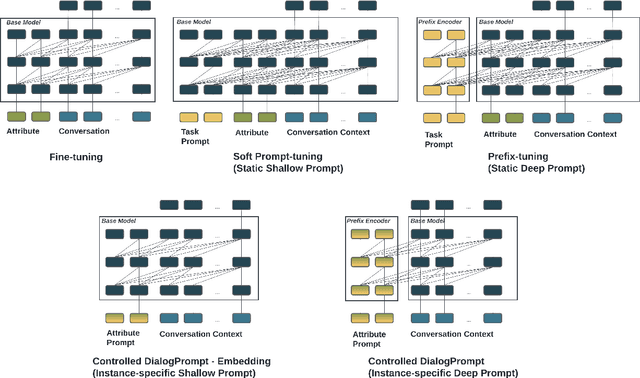


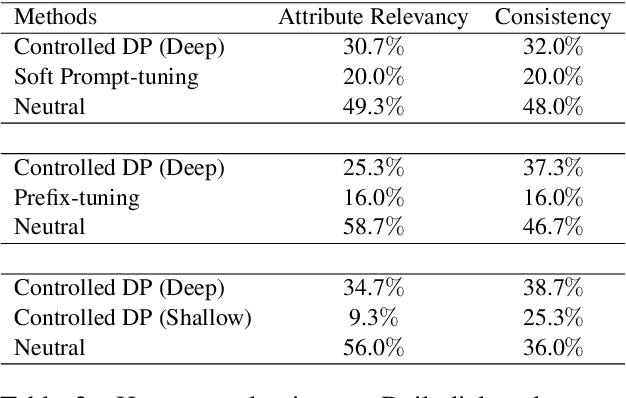
Prompt-tuning has become an increasingly popular parameter-efficient method for adapting large pretrained language models to downstream tasks. However, both discrete prompting and continuous prompting assume fixed prompts for all data samples within a task, neglecting the fact that inputs vary greatly in some tasks such as open-domain dialogue generation. In this paper, we present a novel, instance-specific prompt-tuning algorithm for dialogue generation. Specifically, we generate prompts based on instance-level control code, rather than the conversation history, to explore their impact on controlled dialogue generation. Experiments on popular open-domain dialogue datasets, evaluated on both automated metrics and human evaluation, demonstrate that our method is superior to prompting baselines and comparable to fine-tuning with only 5%-6% of total parameters.
Multimodal Audio-textual Architecture for Robust Spoken Language Understanding
Jun 13, 2023Recent voice assistants are usually based on the cascade spoken language understanding (SLU) solution, which consists of an automatic speech recognition (ASR) engine and a natural language understanding (NLU) system. Because such approach relies on the ASR output, it often suffers from the so-called ASR error propagation. In this work, we investigate impacts of this ASR error propagation on state-of-the-art NLU systems based on pre-trained language models (PLM), such as BERT and RoBERTa. Moreover, a multimodal language understanding (MLU) module is proposed to mitigate SLU performance degradation caused by errors present in the ASR transcript. The MLU benefits from self-supervised features learned from both audio and text modalities, specifically Wav2Vec for speech and Bert/RoBERTa for language. Our MLU combines an encoder network to embed the audio signal and a text encoder to process text transcripts followed by a late fusion layer to fuse audio and text logits. We found that the proposed MLU showed to be robust towards poor quality ASR transcripts, while the performance of BERT and RoBERTa are severely compromised. Our model is evaluated on five tasks from three SLU datasets and robustness is tested using ASR transcripts from three ASR engines. Results show that the proposed approach effectively mitigates the ASR error propagation problem, surpassing the PLM models' performance across all datasets for the academic ASR engine.
AraMUS: Pushing the Limits of Data and Model Scale for Arabic Natural Language Processing
Jun 11, 2023Developing monolingual large Pre-trained Language Models (PLMs) is shown to be very successful in handling different tasks in Natural Language Processing (NLP). In this work, we present AraMUS, the largest Arabic PLM with 11B parameters trained on 529GB of high-quality Arabic textual data. AraMUS achieves state-of-the-art performances on a diverse set of Arabic classification and generative tasks. Moreover, AraMUS shows impressive few-shot learning abilities compared with the best existing Arabic PLMs.
Measuring the Knowledge Acquisition-Utilization Gap in Pretrained Language Models
May 24, 2023While pre-trained language models (PLMs) have shown evidence of acquiring vast amounts of knowledge, it remains unclear how much of this parametric knowledge is actually usable in performing downstream tasks. We propose a systematic framework to measure parametric knowledge utilization in PLMs. Our framework first extracts knowledge from a PLM's parameters and subsequently constructs a downstream task around this extracted knowledge. Performance on this task thus depends exclusively on utilizing the model's possessed knowledge, avoiding confounding factors like insufficient signal. As an instantiation, we study factual knowledge of PLMs and measure utilization across 125M to 13B parameter PLMs. We observe that: (1) PLMs exhibit two gaps - in acquired vs. utilized knowledge, (2) they show limited robustness in utilizing knowledge under distribution shifts, and (3) larger models close the acquired knowledge gap but the utilized knowledge gap remains. Overall, our study provides insights into PLMs' capabilities beyond their acquired knowledge.
On the Transferability of Whisper-based Representations for "In-the-Wild" Cross-Task Downstream Speech Applications
May 23, 2023Large self-supervised pre-trained speech models have achieved remarkable success across various speech-processing tasks. The self-supervised training of these models leads to universal speech representations that can be used for different downstream tasks, ranging from automatic speech recognition (ASR) to speaker identification. Recently, Whisper, a transformer-based model was proposed and trained on large amount of weakly supervised data for ASR; it outperformed several state-of-the-art self-supervised models. Given the superiority of Whisper for ASR, in this paper we explore the transferability of the representation for four other speech tasks in SUPERB benchmark. Moreover, we explore the robustness of Whisper representation for ``in the wild'' tasks where speech is corrupted by environment noise and room reverberation. Experimental results show Whisper achieves promising results across tasks and environmental conditions, thus showing potential for cross-task real-world deployment.