 Add to Chrome
 Add to Firefox
 Add to Edge
Phoneme-Level Deepfake Detection Across Emotional Conditions Using Self-Supervised Embeddings
May 04, 2026
Recent advances in emotional voice conversion (EVC) have enabled the generation of expressive synthetic speech, raising new concerns in audio deepfake detection. Existing approaches treat speech as a homogeneous signal and largely overlook its internal phonetic structure, limiting their interpretability in emotionally conditioned settings. In this work, we propose a phoneme-level framework to analyze emotionally manipulated synthetic speech using real and EVC-generated speech under matched emotional conditions with shared transcripts, phoneme-aligned TextGrids, and WavLM-based embeddings. Our results show that phoneme behavior varies across categories, with complex vowels and fricatives exhibiting higher divergence while simpler phonemes remain more stable. Phonemes with larger distributional differences are also found to be more easily detected, consistently across multiple emotions and synthesis systems. These findings demonstrate that phoneme-level analysis is an effective and interpretable approach for detecting emotionally manipulated synthetic speech.

Investigating the Impact of Speech Enhancement on Audio Deepfake Detection in Noisy Environments
Mar 16, 2026Logical Access (LA) attacks, also known as audio deepfake attacks, use Text-to-Speech (TTS) or Voice Conversion (VC) methods to generate spoofed speech data. This can represent a serious threat to Automatic Speaker Verification (ASV) systems, as intruders can use such attacks to bypass voice biometric security. In this study, we investigate the correlation between speech quality and the performance of audio spoofing detection systems (i.e., LA task). For that, the performance of two enhancement algorithms is evaluated based on two perceptual speech quality measures, namely Perceptual Evaluation of Speech Quality (PESQ) and Speech-to-Reverberation Modulation Ratio (SRMR), and in respect to their impact on the audio spoofing detection system. We adopted the LA dataset, provided in the ASVspoof 2019 Challenge, and corrupted its test set with different Signal-to-Noise Ratio (SNR) levels, while leaving the training data untouched. Enhancement was applied to attenuate the detrimental effects of noisy speech, and the performances of two models, Speech Enhancement Generative Adversarial Network (SEGAN) and Metric-Optimized Generative Adversarial Network Plus (MetricGAN+), were compared. Although we expect that speech quality will correlate well with speech applications' performance, it can also have as a side effect on downstream tasks if unwanted artifacts are introduced or relevant information is removed from the speech signal. Our results corroborate with this hypothesis, as we found that the enhancement algorithm leading to the highest speech quality scores, MetricGAN+, provided the lowest Equal Error Rate (EER) on the audio spoofing detection task, whereas the enhancement method with the lowest speech quality scores, SEGAN, led to the lowest EER, thus leading to better performance on the LA task.
Enhancing Network Intrusion Detection Systems: A Multi-Layer Ensemble Approach to Mitigate Adversarial Attacks
Mar 11, 2026Adversarial examples can represent a serious threat to machine learning (ML) algorithms. If used to manipulate the behaviour of ML-based Network Intrusion Detection Systems (NIDS), they can jeopardize network security. In this work, we aim to mitigate such risks by increasing the robustness of NIDS towards adversarial attacks. To that end, we explore two adversarial methods for generating malicious network traffic. The first method is based on Generative Adversarial Networks (GAN) and the second one is the Fast Gradient Sign Method (FGSM). The adversarial examples generated by these methods are then used to evaluate a novel multilayer defense mechanism, specifically designed to mitigate the vulnerability of ML-based NIDS. Our solution consists of one layer of stacking classifiers and a second layer based on an autoencoder. If the incoming network data are classified as benign by the first layer, the second layer is activated to ensure that the decision made by the stacking classifier is correct. We also incorporated adversarial training to further improve the robustness of our solution. Experiments on two datasets, namely UNSW-NB15 and NSL-KDD, demonstrate that the proposed approach increases resilience to adversarial attacks.
Gender Fairness in Audio Deepfake Detection: Performance and Disparity Analysis
Mar 09, 2026Audio deepfake detection aims to detect real human voices from those generated by Artificial Intelligence (AI) and has emerged as a significant problem in the field of voice biometrics systems. With the ever-improving quality of synthetic voice, the probability of such a voice being exploited for illicit practices like identity thest and impersonation increases. Although significant progress has been made in the field of Audio Deepfake Detection in recent times, the issue of gender bias remains underexplored and in its nascent stage In this paper, we have attempted a thorough analysis of gender dependent performance and fairness in audio deepfake detection models. We have used the ASVspoof 5 dataset and train a ResNet-18 classifier and evaluate detection performance across four different audio features, and compared the performance with baseline AASIST model. Beyond conventional metrics such as Equal Error Rate (EER %), we incorporated five established fairness metrics to quantify gender disparities in the model. Our results show that even when the overall EER difference between genders appears low, fairness-aware evaluation reveals disparities in error distribution that are obscured by aggregate performance measures. These findings demonstrate that reliance on standard metrics is unreliable, whereas fairness metrics provide critical insights into demographic-specific failure modes. This work highlights the importance of fairness-aware evaluation for developing a more equitable, robust, and trustworthy audio deepfake detection system.
BioME: A Resource-Efficient Bioacoustic Foundational Model for IoT Applications
Feb 10, 2026Passive acoustic monitoring has become a key strategy in biodiversity assessment, conservation, and behavioral ecology, especially as Internet-of-Things (IoT) devices enable continuous in situ audio collection at scale. While recent self-supervised learning (SSL)-based audio encoders, such as BEATs and AVES, have shown strong performance in bioacoustic tasks, their computational cost and limited robustness to unseen environments hinder deployment on resource-constrained platforms. In this work, we introduce BioME, a resource-efficient audio encoder designed for bioacoustic applications. BioME is trained via layer-to-layer distillation from a high-capacity teacher model, enabling strong representational transfer while reducing the parameter count by 75%. To further improve ecological generalization, the model is pretrained on multi-domain data spanning speech, environmental sounds, and animal vocalizations. A key contribution is the integration of modulation-aware acoustic features via FiLM conditioning, injecting a DSP-inspired inductive bias that enhances feature disentanglement in low-capacity regimes. Across multiple bioacoustic tasks, BioME matches or surpasses the performance of larger models, including its teacher, while being suitable for resource-constrained IoT deployments. For reproducibility, code and pretrained checkpoints are publicly available.
An Efficient End-to-End Approach to Noise Invariant Speech Features via Multi-Task Learning
Mar 13, 2024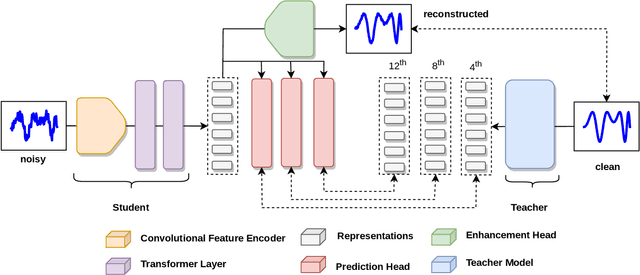
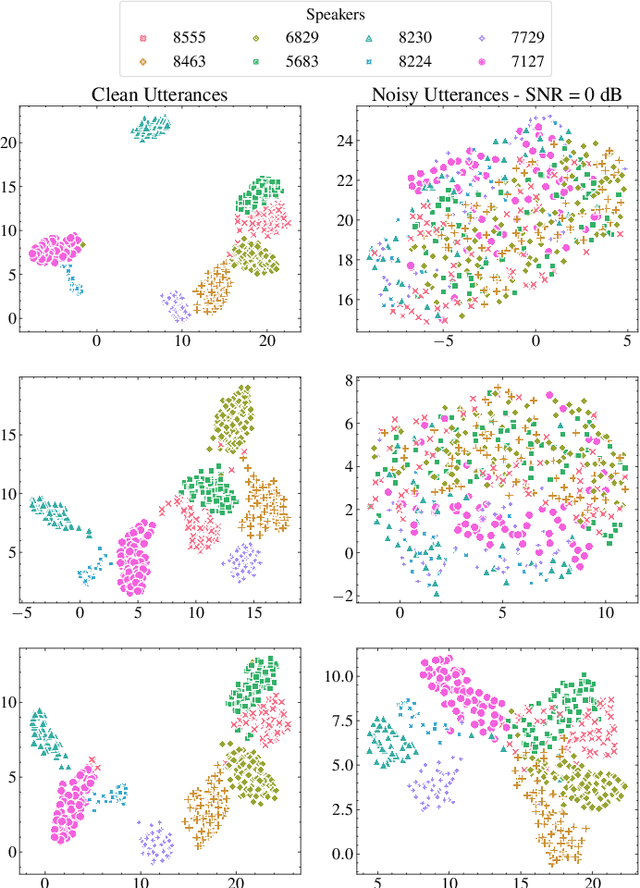
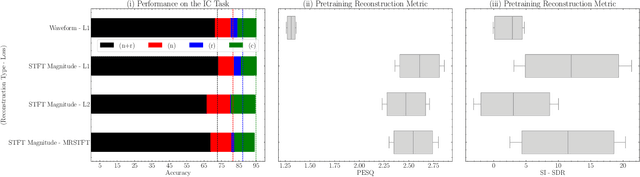
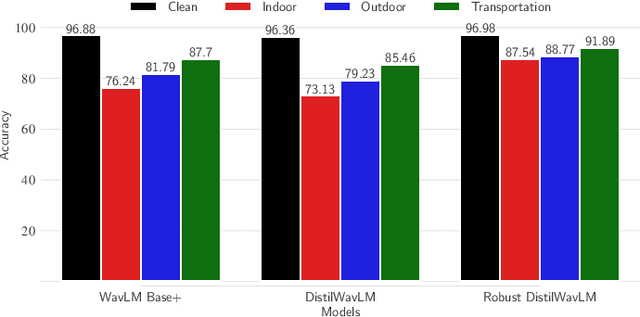
Self-supervised speech representation learning enables the extraction of meaningful features from raw waveforms. These features can then be efficiently used across multiple downstream tasks. However, two significant issues arise when considering the deployment of such methods ``in-the-wild": (i) Their large size, which can be prohibitive for edge applications; and (ii) their robustness to detrimental factors, such as noise and/or reverberation, that can heavily degrade the performance of such systems. In this work, we propose RobustDistiller, a novel knowledge distillation mechanism that tackles both problems jointly. Simultaneously to the distillation recipe, we apply a multi-task learning objective to encourage the network to learn noise-invariant representations by denoising the input. The proposed mechanism is evaluated on twelve different downstream tasks. It outperforms several benchmarks regardless of noise type, or noise and reverberation levels. Experimental results show that the new Student model with 23M parameters can achieve results comparable to the Teacher model with 95M parameters. Lastly, we show that the proposed recipe can be applied to other distillation methodologies, such as the recent DPWavLM. For reproducibility, code and model checkpoints will be made available at \mbox{\url{https://github.com/Hguimaraes/robustdistiller}}.
On the Impact of Quantization and Pruning of Self-Supervised Speech Models for Downstream Speech Recognition Tasks "In-the-Wild''
Sep 25, 2023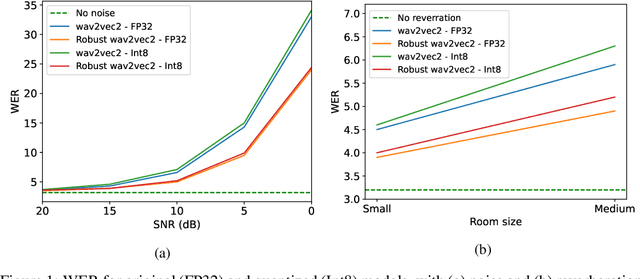
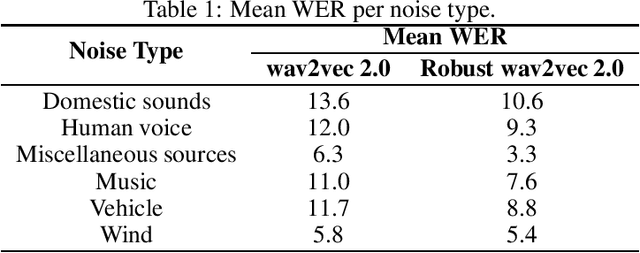
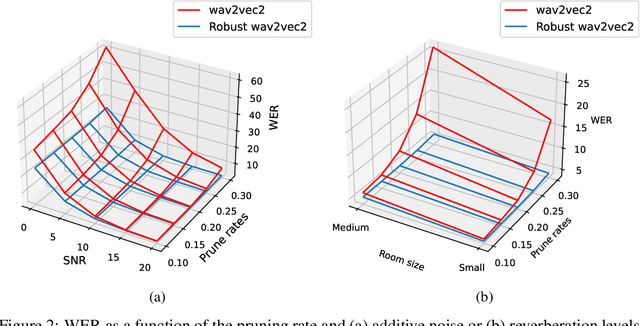
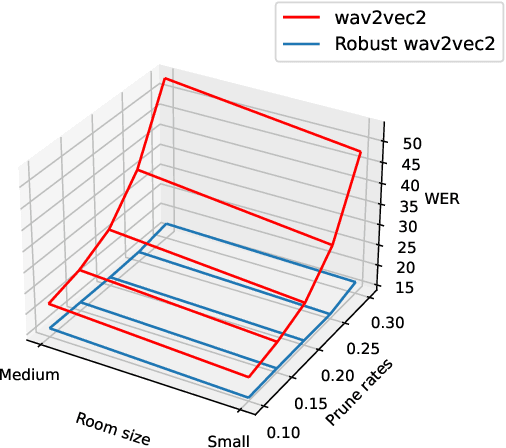
Recent advances with self-supervised learning have allowed speech recognition systems to achieve state-of-the-art (SOTA) word error rates (WER) while requiring only a fraction of the labeled training data needed by its predecessors. Notwithstanding, while such models achieve SOTA performance in matched train/test conditions, their performance degrades substantially when tested in unseen conditions. To overcome this problem, strategies such as data augmentation and/or domain shift training have been explored. Available models, however, are still too large to be considered for edge speech applications on resource-constrained devices, thus model compression tools are needed. In this paper, we explore the effects that train/test mismatch conditions have on speech recognition accuracy based on compressed self-supervised speech models. In particular, we report on the effects that parameter quantization and model pruning have on speech recognition accuracy based on the so-called robust wav2vec 2.0 model under noisy, reverberant, and noise-plus-reverberation conditions.
Multimodal Audio-textual Architecture for Robust Spoken Language Understanding
Jun 13, 2023Recent voice assistants are usually based on the cascade spoken language understanding (SLU) solution, which consists of an automatic speech recognition (ASR) engine and a natural language understanding (NLU) system. Because such approach relies on the ASR output, it often suffers from the so-called ASR error propagation. In this work, we investigate impacts of this ASR error propagation on state-of-the-art NLU systems based on pre-trained language models (PLM), such as BERT and RoBERTa. Moreover, a multimodal language understanding (MLU) module is proposed to mitigate SLU performance degradation caused by errors present in the ASR transcript. The MLU benefits from self-supervised features learned from both audio and text modalities, specifically Wav2Vec for speech and Bert/RoBERTa for language. Our MLU combines an encoder network to embed the audio signal and a text encoder to process text transcripts followed by a late fusion layer to fuse audio and text logits. We found that the proposed MLU showed to be robust towards poor quality ASR transcripts, while the performance of BERT and RoBERTa are severely compromised. Our model is evaluated on five tasks from three SLU datasets and robustness is tested using ASR transcripts from three ASR engines. Results show that the proposed approach effectively mitigates the ASR error propagation problem, surpassing the PLM models' performance across all datasets for the academic ASR engine.
RobustDistiller: Compressing Universal Speech Representations for Enhanced Environment Robustness
Feb 23, 2023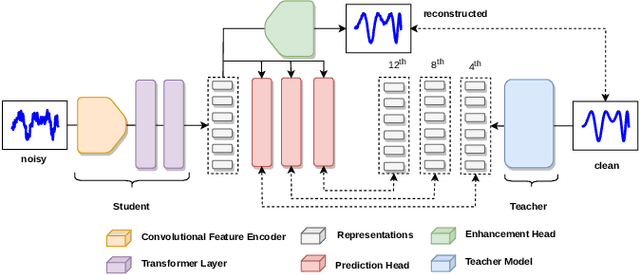
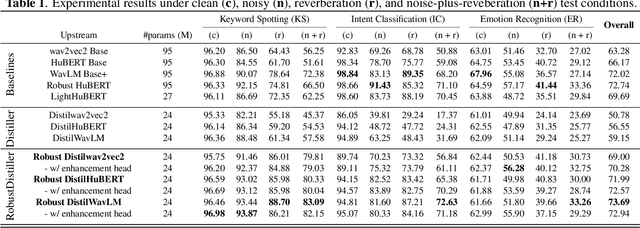
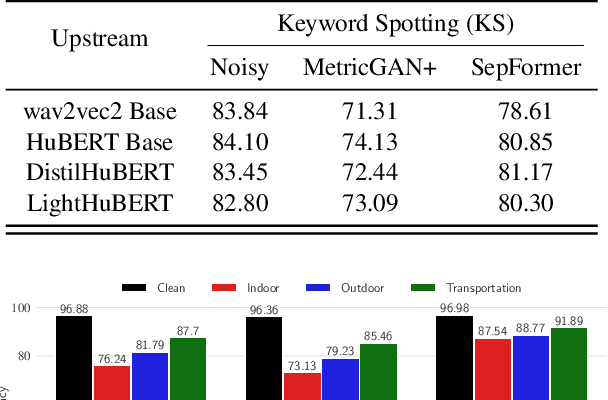
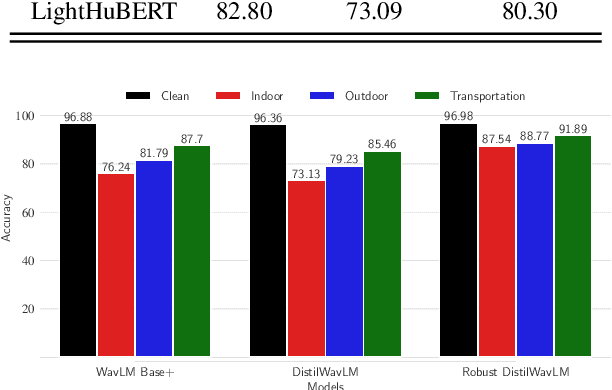
Self-supervised speech pre-training enables deep neural network models to capture meaningful and disentangled factors from raw waveform signals. The learned universal speech representations can then be used across numerous downstream tasks. These representations, however, are sensitive to distribution shifts caused by environmental factors, such as noise and/or room reverberation. Their large sizes, in turn, make them unfeasible for edge applications. In this work, we propose a knowledge distillation methodology termed RobustDistiller which compresses universal representations while making them more robust against environmental artifacts via a multi-task learning objective. The proposed layer-wise distillation recipe is evaluated on top of three well-established universal representations, as well as with three downstream tasks. Experimental results show the proposed methodology applied on top of the WavLM Base+ teacher model outperforming all other benchmarks across noise types and levels, as well as reverberation times. Oftentimes, the obtained results with the student model (24M parameters) achieved results inline with those of the teacher model (95M).
Improving the Robustness of DistilHuBERT to Unseen Noisy Conditions via Data Augmentation, Curriculum Learning, and Multi-Task Enhancement
Nov 12, 2022Self-supervised speech representation learning aims to extract meaningful factors from the speech signal that can later be used across different downstream tasks, such as speech and/or emotion recognition. Existing models, such as HuBERT, however, can be fairly large thus may not be suitable for edge speech applications. Moreover, realistic applications typically involve speech corrupted by noise and room reverberation, hence models need to provide representations that are robust to such environmental factors. In this study, we build on the so-called DistilHuBERT model, which distils HuBERT to a fraction of its original size, with three modifications, namely: (i) augment the training data with noise and reverberation, while the student model needs to distill the clean representations from the teacher model; (ii) introduce a curriculum learning approach where increasing levels of noise are introduced as the model trains, thus helping with convergence and with the creation of more robust representations; and (iii) introduce a multi-task learning approach where the model also reconstructs the clean waveform jointly with the distillation task, thus also acting as an enhancement step to ensure additional environment robustness to the representation. Experiments on three SUPERB tasks show the advantages of the proposed method not only relative to the original DistilHuBERT, but also to the original HuBERT, thus showing the advantages of the proposed method for ``in the wild'' edge speech applications.