 Add to Chrome
 Add to Firefox
 Add to Edge
Cooperative Multi-Agent Learning for Navigation via Structured State Abstraction
Jun 20, 2023
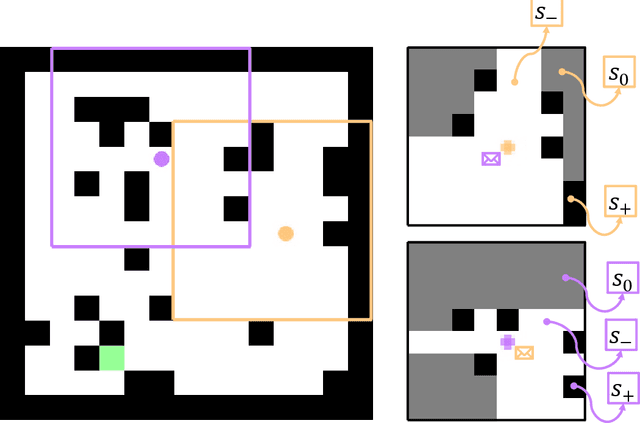
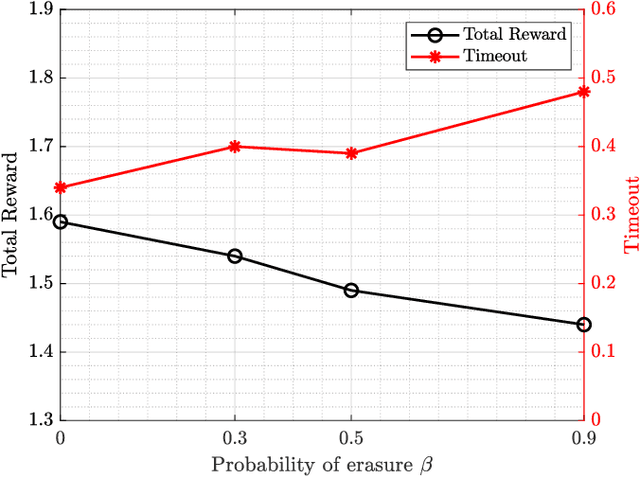
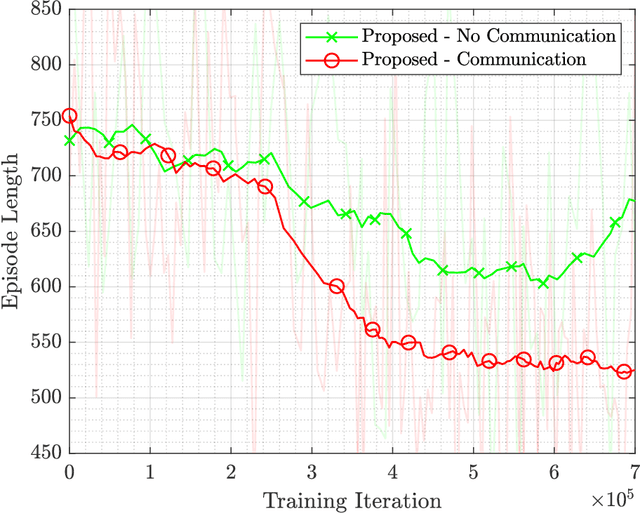
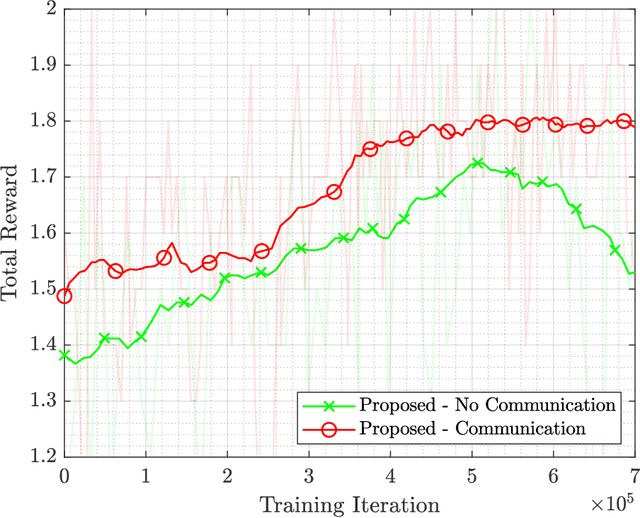
Cooperative multi-agent reinforcement learning (MARL) for navigation enables agents to cooperate to achieve their navigation goals. Using emergent communication, agents learn a communication protocol to coordinate and share information that is needed to achieve their navigation tasks. In emergent communication, symbols with no pre-specified usage rules are exchanged, in which the meaning and syntax emerge through training. Learning a navigation policy along with a communication protocol in a MARL environment is highly complex due to the huge state space to be explored. To cope with this complexity, this work proposes a novel neural network architecture, for jointly learning an adaptive state space abstraction and a communication protocol among agents participating in navigation tasks. The goal is to come up with an adaptive abstractor that significantly reduces the size of the state space to be explored, without degradation in the policy performance. Simulation results show that the proposed method reaches a better policy, in terms of achievable rewards, resulting in fewer training iterations compared to the case where raw states or fixed state abstraction are used. Moreover, it is shown that a communication protocol emerges during training which enables the agents to learn better policies within fewer training iterations.

Reasoning over the Air: A Reasoning-based Implicit Semantic-Aware Communication Framework
Jun 20, 2023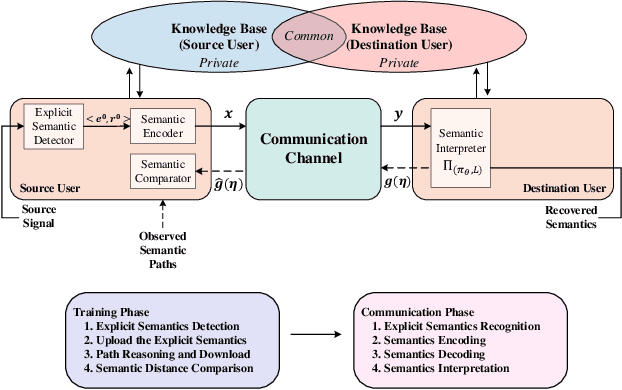
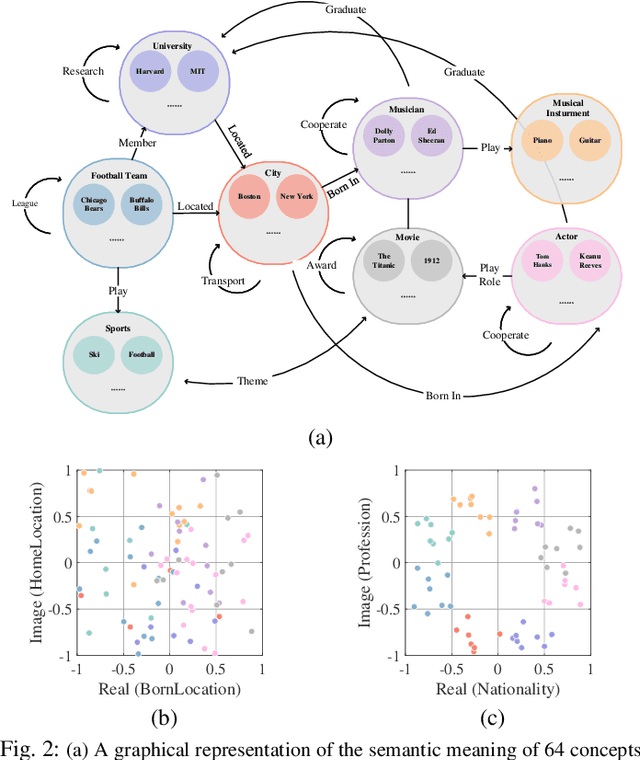
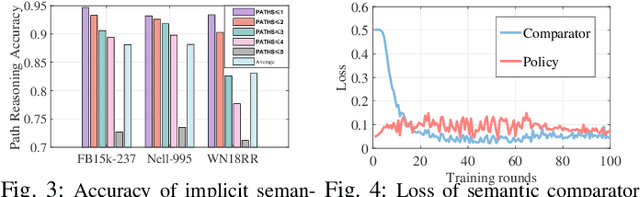
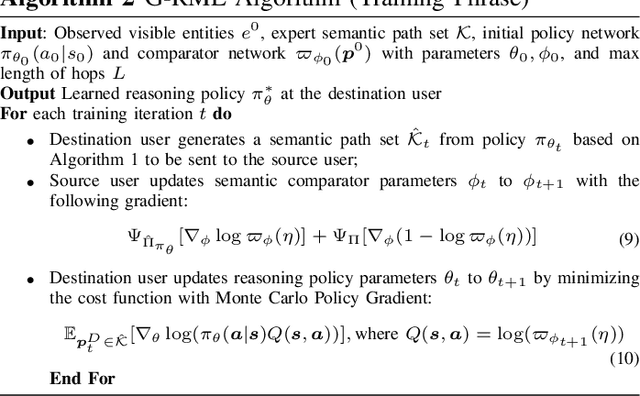
Semantic-aware communication is a novel paradigm that draws inspiration from human communication focusing on the delivery of the meaning of messages. It has attracted significant interest recently due to its potential to improve the efficiency and reliability of communication and enhance users' QoE. Most existing works focus on transmitting and delivering the explicit semantic meaning that can be directly identified from the source signal. This paper investigates the implicit semantic-aware communication in which the hidden information that cannot be directly observed from the source signal must be recognized and interpreted by the intended users. To this end, a novel implicit semantic-aware communication (iSAC) architecture is proposed for representing, communicating, and interpreting the implicit semantic meaning between source and destination users. A projection-based semantic encoder is proposed to convert the high-dimensional graphical representation of explicit semantics into a low-dimensional semantic constellation space for efficient physical channel transmission. To enable the destination user to learn and imitate the implicit semantic reasoning process of source user, a generative adversarial imitation learning-based solution, called G-RML, is proposed. Different from existing communication solutions, the source user in G-RML does not focus only on sending as much of the useful messages as possible; but, instead, it tries to guide the destination user to learn a reasoning mechanism to map any observed explicit semantics to the corresponding implicit semantics that are most relevant to the semantic meaning. Compared to the existing solutions, our proposed G-RML requires much less communication and computational resources and scales well to the scenarios involving the communication of rich semantic meanings consisting of a large number of concepts and relations.
Bayesian Inverse Contextual Reasoning for Heterogeneous Semantics-Native Communication
Jun 10, 2023This work deals with the heterogeneous semantic-native communication (SNC) problem. When agents do not share the same communication context, the effectiveness of contextual reasoning (CR) is compromised calling for agents to infer other agents' context. This article proposes a novel framework for solving the inverse problem of CR in SNC using two Bayesian inference methods, namely: Bayesian inverse CR (iCR) and Bayesian inverse linearized CR (iLCR). The first proposed Bayesian iCR method utilizes Markov Chain Monte Carlo (MCMC) sampling to infer the agent's context while being computationally expensive. To address this issue, a Bayesian iLCR method is leveraged which obtains a linearized CR (LCR) model by training a linear neural network. Experimental results show that the Bayesian iLCR method requires less computation and achieves higher inference accuracy compared to Bayesian iCR. Additionally, heterogeneous SNC based on the context obtained through the Bayesian iLCR method shows better communication effectiveness than that of Bayesian iCR. Overall, this work provides valuable insights and methods to improve the effectiveness of SNC in situations where agents have different contexts.
Federated Learning Games for Reconfigurable Intelligent Surfaces via Causal Representations
Jun 02, 2023In this paper, we investigate the problem of robust Reconfigurable Intelligent Surface (RIS) phase-shifts configuration over heterogeneous communication environments. The problem is formulated as a distributed learning problem over different environments in a Federated Learning (FL) setting. Equivalently, this corresponds to a game played between multiple RISs, as learning agents, in heterogeneous environments. Using Invariant Risk Minimization (IRM) and its FL equivalent, dubbed FL Games, we solve the RIS configuration problem by learning invariant causal representations across multiple environments and then predicting the phases. The solution corresponds to playing according to Best Response Dynamics (BRD) which yields the Nash Equilibrium of the FL game. The representation learner and the phase predictor are modeled by two neural networks, and their performance is validated via simulations against other benchmarks from the literature. Our results show that causality-based learning yields a predictor that is 15% more accurate in unseen Out-of-Distribution (OoD) environments.
Spatiotemporal Attention-based Semantic Compression for Real-time Video Recognition
May 22, 2023This paper studies the computational offloading of video action recognition in edge computing. To achieve effective semantic information extraction and compression, following semantic communication we propose a novel spatiotemporal attention-based autoencoder (STAE) architecture, including a frame attention module and a spatial attention module, to evaluate the importance of frames and pixels in each frame. Additionally, we use entropy encoding to remove statistical redundancy in the compressed data to further reduce communication overhead. At the receiver, we develop a lightweight decoder that leverages a 3D-2D CNN combined architecture to reconstruct missing information by simultaneously learning temporal and spatial information from the received data to improve accuracy. To fasten convergence, we use a step-by-step approach to train the resulting STAE-based vision transformer (ViT_STAE) models. Experimental results show that ViT_STAE can compress the video dataset HMDB51 by 104x with only 5% accuracy loss, outperforming the state-of-the-art baseline DeepISC. The proposed ViT_STAE achieves faster inference and higher accuracy than the DeepISC-based ViT model under time-varying wireless channel, which highlights the effectiveness of STAE in guaranteeing higher accuracy under time constraints.
Trans-Inpainter: A Transformer Model for High Accuracy Image Inpainting from Channel State Information
May 09, 2023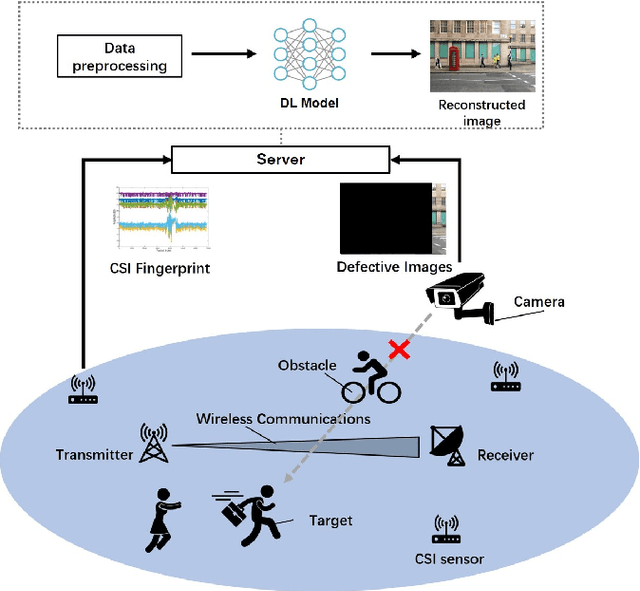
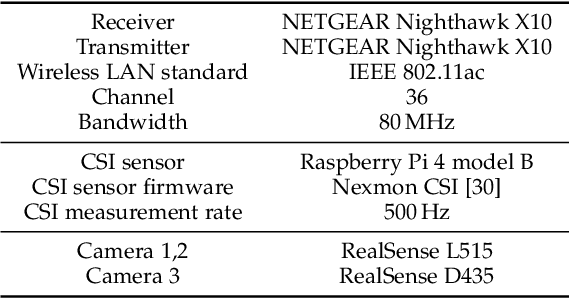
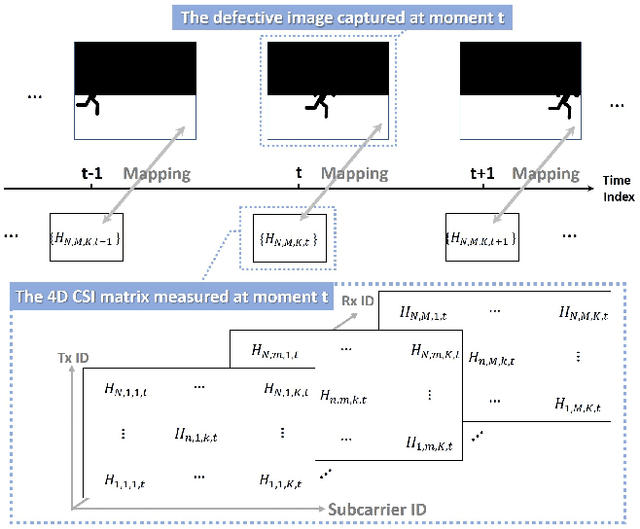
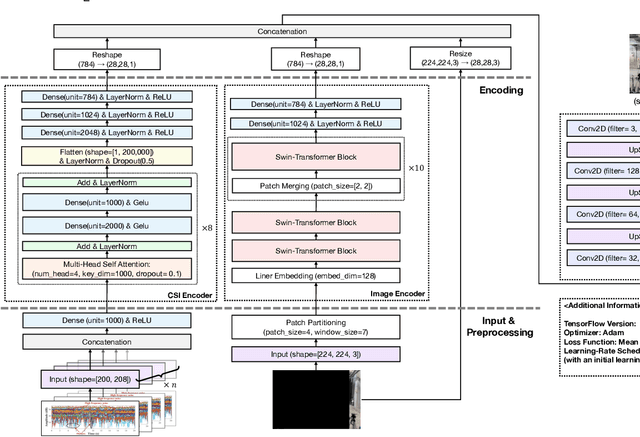
Radio Frequency (RF) signal-based multimodal image inpainting has recently emerged as a promising paradigm to enhance the capability of distortion-free image restoration by integrating wireless and visual information from the identical physical environment and has potential applications in fields like security and surveillance systems. In this paper, we aim to implement an RF-based image inpainting system that enables image restoration in a complex environment while maintaining high robustness and accuracy. This requires accurately converting RF signals into meaningful visual information and overcoming the challenges of RF signals in complex environments, such as multipath interference, signal attenuation, and noise. To tackle this problem, we propose Trans-Inpainter, a novel image inpainting method that utilizes the Channel State Information (CSI) of WiFi signals in combination with transformer networks to generate high-quality reconstructed images. This approach is the first to use CSI for image inpainting, which allows for extracting visual information from WiFi signals to fill in missing regions in images. To further improve Trans-Inpainter's performance, we investigate the impact of variations in CSI data on RF-based imaging ability, i.e., analyzing how the location of the CSI sensors, the combination of CSI from different sensors, and changes in temporal or frequency dimensions of CSI matrix affect the imaging quality. We compare the performance of Trans-Inpainter with RF-Inpainter, the state-of-the-art technology for RF-based multimodal image inpainting, under more realistic experimental scenarios, and with single-modality image inpainting models when only RF or image data is available, respectively. The results show that Trans-Inpainter outperforms other baseline methods in all cases.
Performance Analysis of ML-based MTC Traffic Pattern Predictors
Apr 04, 2023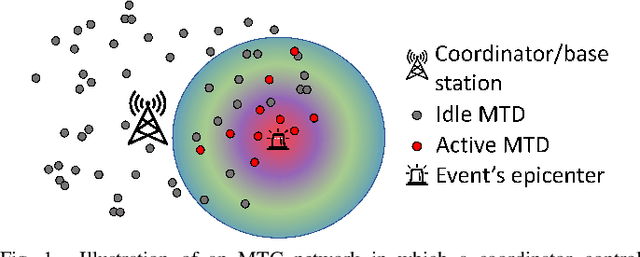
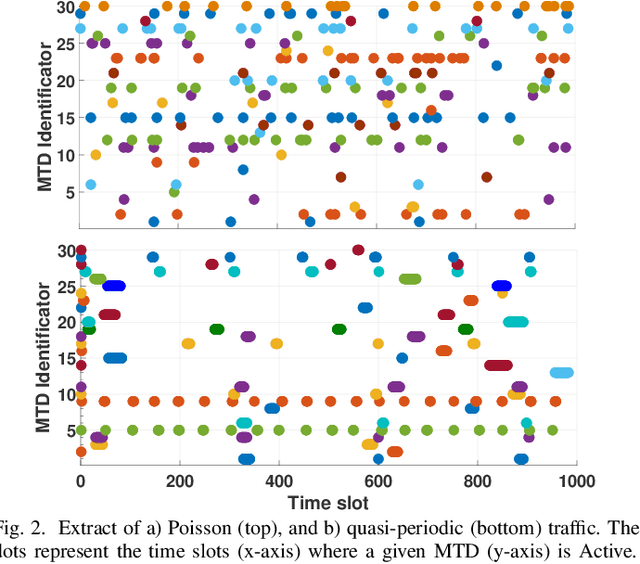
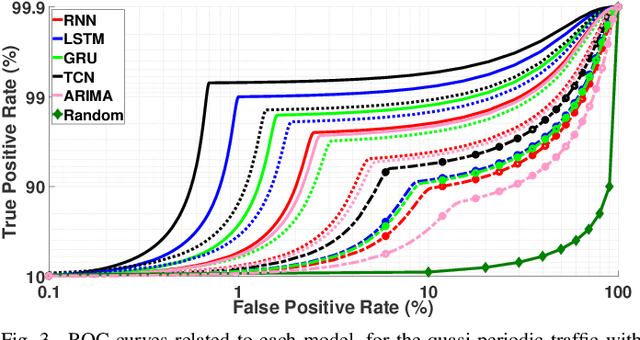
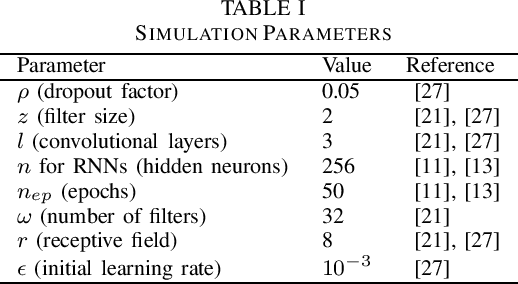
Prolonging the lifetime of massive machine-type communication (MTC) networks is key to realizing a sustainable digitized society. Great energy savings can be achieved by accurately predicting MTC traffic followed by properly designed resource allocation mechanisms. However, selecting the proper MTC traffic predictor is not straightforward and depends on accuracy/complexity trade-offs and the specific MTC applications and network characteristics. Remarkably, the related state-of-the-art literature still lacks such debates. Herein, we assess the performance of several machine learning (ML) methods to predict Poisson and quasi-periodic MTC traffic in terms of accuracy and computational cost. Results show that the temporal convolutional network (TCN) outperforms the long-short term memory (LSTM), the gated recurrent units (GRU), and the recurrent neural network (RNN), in that order. For Poisson traffic, the accuracy gap between the predictors is larger than under quasi-periodic traffic. Finally, we show that running a TCN predictor is around three times more costly than other methods, while the training/inference time is the greatest/least.
Making Sense of Meaning: A Survey on Metrics for Semantic and Goal-Oriented Communication
Mar 20, 2023Semantic communication (SemCom) aims to convey the meaning behind a transmitted message by transmitting only semantically-relevant information. This semantic-centric design helps to minimize power usage, bandwidth consumption, and transmission delay. SemCom and goal-oriented SemCom (or effectiveness-level SemCom) are therefore promising enablers of 6G and developing rapidly. Despite the surge in their swift development, the design, analysis, optimization, and realization of robust and intelligent SemCom as well as goal-oriented SemCom are fraught with many fundamental challenges. One of the challenges is that the lack of unified/universal metrics of SemCom and goal-oriented SemCom can stifle research progress on their respective algorithmic, theoretical, and implementation frontiers. Consequently, this survey paper documents the existing metrics -- scattered in many references -- of wireless SemCom, optical SemCom, quantum SemCom, and goal-oriented wireless SemCom. By doing so, this paper aims to inspire the design, analysis, and optimization of a wide variety of SemCom and goal-oriented SemCom systems. This article also stimulates the development of unified/universal performance assessment metrics of SemCom and goal-oriented SemCom, as the existing metrics are purely statistical and hardly applicable to reasoning-type tasks that constitute the heart of 6G and beyond.
Computation and Privacy Protection for Satellite-Ground Digital Twin Networks
Feb 16, 2023Satellite-ground integrated digital twin networks (SGIDTNs) are regarded as innovative network architectures for reducing network congestion, enabling nearly-instant data mapping from the physical world to digital systems, and offering ubiquitous intelligence services to terrestrial users. However, the challenges, such as the pricing policy, the stochastic task arrivals, the time-varying satellite locations, mutual channel interference, and resource scheduling mechanisms between the users and cloud servers, are critical for improving quality of service in SGIDTNs. Hence, we establish a blockchain-aided Stackelberg game model for maximizing the pricing profits and network throughput in terms of minimizing overhead of privacy protection, thus performing computation offloading, decreasing channel interference, and improving privacy protection. Next, we propose a Lyapunov stability theory-based model-agnostic metalearning aided multi-agent deep federated reinforcement learning (MAML-MADFRL) framework for optimizing the CPU cycle frequency, channel selection, task-offloading decision, block size, and cloud server price, which facilitate the integration of communication, computation, and block resources. Subsequently, the extensive performance analyses show that the proposed MAMLMADFRL algorithm can strengthen the privacy protection via the transaction verification mechanism, approach the optimal time average penalty, and fulfill the long-term average queue size via lower computational complexity. Finally, our simulation results indicate that the proposed MAML-MADFRL learning framework is superior to the existing baseline methods in terms of network throughput, channel interference, cloud server profits, and privacy overhead.
Performance Limits of a Deep Learning-Enabled Text Semantic Communication under Interference
Feb 15, 2023Semantic communication (SemCom) has emerged as a 6G enabler while promising to minimize power usage, bandwidth consumption, and transmission delay by minimizing irrelevant information transmission. However, the benefits of such a semantic-centric design can be limited by radio frequency interference (RFI) that causes substantial semantic noise. The impact of semantic noise due to interference can be alleviated using an interference-resistant and robust (IR$^2$) SemCom design. Nevertheless, no such design exists yet. To shed light on this knowledge gap and stimulate fundamental research on IR$^2$ SemCom, the performance limits of a text SemCom system named DeepSC is studied in the presence of single- and multi-interferer RFI. By introducing a principled probabilistic framework for SemCom, we show that DeepSC produces semantically irrelevant sentences as the power of single- and multi-interferer RFI gets very large. Corroborated by Monte Carlo simulations, these performance limits offer design insights -- regarding IR$^2$ SemCom -- contrary to the theoretically unsubstantiated sentiment that SemCom techniques (such as DeepSC) work well in very low signal-to-noise ratio regimes. The performance limits also reveal the vulnerability of DeepSC and SemCom to a wireless attack using RFI. Furthermore, our introduced probabilistic framework inspires the performance analysis of many text SemCom techniques, as they are chiefly inspired by DeepSC.